

Gesamtpreis (1 Artikel Artikel):
Versandziel:

9780801484629 - Beyond the Household: Women's Place in the Early South, 1700-1835 (Comstock Classic Handbooks) von Kierner, Cynthia A. (6 Ergebnisse)
Direkt zu den wichtigsten Suchergebnissen
Suchfilter
Produktart
- Alle Product Types
- Bücher (6)
- Magazine & Zeitschriften (Keine weiteren Ergebnisse entsprechen dieser Verfeinerung)
- Comics (Keine weiteren Ergebnisse entsprechen dieser Verfeinerung)
- Noten (Keine weiteren Ergebnisse entsprechen dieser Verfeinerung)
- Kunst, Grafik & Poster (Keine weiteren Ergebnisse entsprechen dieser Verfeinerung)
- Fotografien (Keine weiteren Ergebnisse entsprechen dieser Verfeinerung)
- Karten (Keine weiteren Ergebnisse entsprechen dieser Verfeinerung)
- Manuskripte & Papierantiquitäten (Keine weiteren Ergebnisse entsprechen dieser Verfeinerung)
Zustand Mehr dazu
- Neu (3)
- Wie Neu, Sehr Gut oder Gut Bis Sehr Gut (Keine weiteren Ergebnisse entsprechen dieser Verfeinerung)
- Gut oder Befriedigend (3)
- Ausreichend oder Schlecht (Keine weiteren Ergebnisse entsprechen dieser Verfeinerung)
- Wie beschrieben (Keine weiteren Ergebnisse entsprechen dieser Verfeinerung)
Einband
- alle Einbände
- Hardcover (Keine weiteren Ergebnisse entsprechen dieser Verfeinerung)
- Softcover (6)
Weitere Eigenschaften
- Erstausgabe (Keine weiteren Ergebnisse entsprechen dieser Verfeinerung)
- Signiert (Keine weiteren Ergebnisse entsprechen dieser Verfeinerung)
- Schutzumschlag (Keine weiteren Ergebnisse entsprechen dieser Verfeinerung)
- Angebotsfoto (2)
Sprache (1)
Gratisversand
Land des Verkäufers
Verkäuferbewertung
-
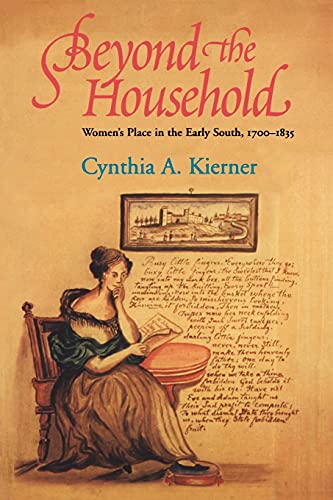
Beyond the Household: Women's Place in the Early South, 1700 1835
Anbieter: ThriftBooks-Dallas, Dallas, TX, USA
Verkäuferbewertung 5 von 5 Sternen

Paperback. Zustand: Very Good. No Jacket. May have limited writing in cover pages. Pages are unmarked. ~ ThriftBooks: Read More, Spend Less.
-
Beyond the Household: Women's Place in the Early South, 1700-1835 (Comstock Classic Handbooks)
Anbieter: Phatpocket Limited, Waltham Abbey, HERTS, Vereinigtes Königreich
Verkäuferbewertung 5 von 5 Sternen
EUR 20,43
EUR 12,28 Versand
Versand von Vereinigtes Königreich nach USAAnzahl: 1 verfügbar
In den WarenkorbZustand: Good. Your purchase helps support Sri Lankan Children's Charity 'The Rainbow Centre'. Ex-library, so some stamps and wear, but in good overall condition. Our donations to The Rainbow Centre have helped provide an education and a safe haven to hundreds of children who live in appalling conditions.
-
Beyond the Household: Women's Place in the Early South, 17001835
Anbieter: Anybook.com, Lincoln, Vereinigtes Königreich
Verkäuferbewertung 5 von 5 Sternen
EUR 18,84
EUR 15,69 Versand
Versand von Vereinigtes Königreich nach USAAnzahl: 1 verfügbar
In den WarenkorbZustand: Good. This is an ex-library book and may have the usual library/used-book markings inside.This book has soft covers. In good all round condition. Please note the Image in this listing is a stock photo and may not match the covers of the actual item,550grams, ISBN:9780801484629.
-
Beyond the Household Women`s Place in the Early South, 17001835
Anbieter: Revaluation Books, Exeter, Vereinigtes Königreich
Verkäuferbewertung 5 von 5 Sternen
EUR 71,91
EUR 11,54 Versand
Versand von Vereinigtes Königreich nach USAAnzahl: 2 verfügbar
In den WarenkorbPaperback. Zustand: Brand New. 801 edition. 304 pages. 9.00x6.50x0.75 inches. In Stock.
-

EUR 57,10
EUR 48,99 Versand
Versand von Deutschland nach USAAnzahl: Mehr als 20 verfügbar
In den WarenkorbZustand: New. Much has been written about the southern lady, that pervasive and enduring icon of antebellum regional identity. But how did the lady get on her pedestal-and were the lives of white southern women always so different from those of their northern.
-

Beyond the Household : Women's Place in the Early South, 17001835
Sprache: Englisch
Verlag: Cornell University Press Sep 1998, 1998
ISBN 10: 0801484626 ISBN 13: 9780801484629
Anbieter: AHA-BUCH GmbH, Einbeck, Deutschland
Verkäuferbewertung 5 von 5 Sternen
Taschenbuch. Zustand: Neu. Neuware - Much has been written about the 'southern lady', that pervasive and enduring icon of antebellum regional identity. But how did the lady get on her pedestal -- and were the lives of white southern women always so different from those of their northern contemporaries In her ambitious new book, Cynthia A. Kierner charts the evolution of the lives of white southern women through the colonial, revolutionary, and early republican eras. Using the lady on her pedestal as the end -- rather than the beginning -- of her story, she shows how gentility, republican political ideals, and evangelical religion successively altered southern gender ideals and thereby forced women to reshape their public roles. Kierner concludes that southern women continually renegotiated their access to the public sphere -- and that even the emergence of the frail and submissive lady as icon did not obliterate women's public role.
