

Gesamtpreis (1 Artikel Artikel):
Versandziel:

9780792382904 - Predictive Modular Neural Networks: Applications to Time Series (The Springer International Series in Engineering and Computer Science, Band 466) von Petridis, Vass... (4 Ergebnisse)
Direkt zu den wichtigsten Suchergebnissen
Suchfilter
Produktart
- Alle Product Types
- Bücher (4)
- Magazine & Zeitschriften (Keine weiteren Ergebnisse entsprechen dieser Verfeinerung)
- Comics (Keine weiteren Ergebnisse entsprechen dieser Verfeinerung)
- Noten (Keine weiteren Ergebnisse entsprechen dieser Verfeinerung)
- Kunst, Grafik & Poster (Keine weiteren Ergebnisse entsprechen dieser Verfeinerung)
- Fotografien (Keine weiteren Ergebnisse entsprechen dieser Verfeinerung)
- Karten (Keine weiteren Ergebnisse entsprechen dieser Verfeinerung)
- Manuskripte & Papierantiquitäten (Keine weiteren Ergebnisse entsprechen dieser Verfeinerung)
Zustand Mehr dazu
- Neu (4)
- Wie Neu, Sehr Gut oder Gut Bis Sehr Gut (Keine weiteren Ergebnisse entsprechen dieser Verfeinerung)
- Gut oder Befriedigend (Keine weiteren Ergebnisse entsprechen dieser Verfeinerung)
- Ausreichend oder Schlecht (Keine weiteren Ergebnisse entsprechen dieser Verfeinerung)
- Wie beschrieben (Keine weiteren Ergebnisse entsprechen dieser Verfeinerung)
Einband
- alle Einbände
- Hardcover (4)
- Softcover (Keine weiteren Ergebnisse entsprechen dieser Verfeinerung)
Weitere Eigenschaften
- Erstausgabe (Keine weiteren Ergebnisse entsprechen dieser Verfeinerung)
- Signiert (Keine weiteren Ergebnisse entsprechen dieser Verfeinerung)
- Schutzumschlag (Keine weiteren Ergebnisse entsprechen dieser Verfeinerung)
- Angebotsfoto (2)
Sprache (1)
Preis
- Beliebiger Preis
- Weniger als EUR 20 (Keine weiteren Ergebnisse entsprechen dieser Verfeinerung)
- EUR 20 bis EUR 45 (Keine weiteren Ergebnisse entsprechen dieser Verfeinerung)
- Mehr als EUR 45
Gratisversand
- Kostenloser Versand nach USA (Keine weiteren Ergebnisse entsprechen dieser Verfeinerung)
Land des Verkäufers
Verkäuferbewertung
-
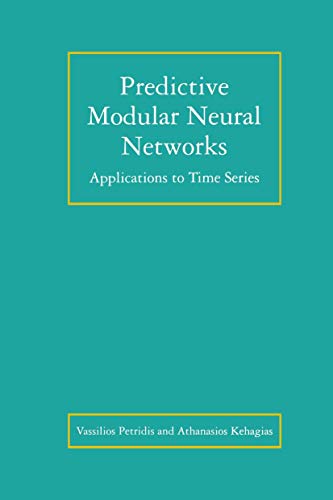
Predictive Modular Neural Networks: Applications to Time Series (The Springer International Series in Engineering and Computer Science, 466)
Buch 95 von 260: The Springer International Series in Engineering and Computer ScienceAnbieter: Ria Christie Collections, Uxbridge, Vereinigtes Königreich
Verkäuferbewertung 5 von 5 Sternen

EUR 115,06
EUR 13,81 Versand
Versand von Vereinigtes Königreich nach USAAnzahl: Mehr als 20 verfügbar
In den WarenkorbZustand: New. In.
-
Predictive Modular Neural Networks
Buch 95 von 260: The Springer International Series in Engineering and Computer ScienceSprache: Englisch
Verlag: Kluwer Academic Publishers, 1998
ISBN 10: 0792382900 ISBN 13: 9780792382904
Anbieter: Kennys Bookstore, Olney, MD, USA
Verkäuferbewertung 5 von 5 Sternen
Zustand: New. This text presents a unified methodology for designing modular neural networks. A family of online algorithms for time series classification, prediction and identification are developed; and a rigorous mathematical analysis of their properties is provided. Series: The Springer International Series in Engineering and Computer Science. Num Pages: 325 pages, biography. BIC Classification: UYQN. Category: (P) Professional & Vocational; (UP) Postgraduate, Research & Scholarly. Dimension: 234 x 156 x 19. Weight in Grams: 642. . 1998. Hardback. . . . . Books ship from the US and Ireland.
-

Predictive Modular Neural Networks
Buch 95 von 260: The Springer International Series in Engineering and Computer ScienceEUR 127,84
EUR 48,99 Versand
Versand von Deutschland nach USAAnzahl: Mehr als 20 verfügbar
In den WarenkorbGebunden. Zustand: New.
-

Predictive Modular Neural Networks : Applications to Time Series
Buch 95 von 260: The Springer International Series in Engineering and Computer ScienceAnbieter: AHA-BUCH GmbH, Einbeck, Deutschland
Verkäuferbewertung 5 von 5 Sternen
Buch. Zustand: Neu. Neuware - The subject of this book is predictive modular neural networks and their ap plication to time series problems: classification, prediction and identification. The intended audience is researchers and graduate students in the fields of neural networks, computer science, statistical pattern recognition, statistics, control theory and econometrics. Biologists, neurophysiologists and medical engineers may also find this book interesting. In the last decade the neural networks community has shown intense interest in both modular methods and time series problems. Similar interest has been expressed for many years in other fields as well, most notably in statistics, control theory, econometrics etc. There is a considerable overlap (not always recognized) of ideas and methods between these fields. Modular neural networks come by many other names, for instance multiple models, local models and mixtures of experts. The basic idea is to independently develop several 'subnetworks' (modules), which may perform the same or re lated tasks, and then use an 'appropriate' method for combining the outputs of the subnetworks. Some of the expected advantages of this approach (when compared with the use of 'lumped' or 'monolithic' networks) are: superior performance, reduced development time and greater flexibility. For instance, if a module is removed from the network and replaced by a new module (which may perform the same task more efficiently), it should not be necessary to retrain the aggregate network.
