

Gesamtpreis (1 Artikel Artikel):
Versandziel:

9780792374411 - Biological Role of Inorganic Pyrophosphate von Heinonen, Jukka K. (4 Ergebnisse)
Direkt zu den wichtigsten Suchergebnissen
Suchfilter
Produktart
- Alle Product Types
- Bücher (4)
- Magazine & Zeitschriften (Keine weiteren Ergebnisse entsprechen dieser Verfeinerung)
- Comics (Keine weiteren Ergebnisse entsprechen dieser Verfeinerung)
- Noten (Keine weiteren Ergebnisse entsprechen dieser Verfeinerung)
- Kunst, Grafik & Poster (Keine weiteren Ergebnisse entsprechen dieser Verfeinerung)
- Fotografien (Keine weiteren Ergebnisse entsprechen dieser Verfeinerung)
- Karten (Keine weiteren Ergebnisse entsprechen dieser Verfeinerung)
- Manuskripte & Papierantiquitäten (Keine weiteren Ergebnisse entsprechen dieser Verfeinerung)
Zustand Mehr dazu
- Neu (4)
- Wie Neu, Sehr Gut oder Gut Bis Sehr Gut (Keine weiteren Ergebnisse entsprechen dieser Verfeinerung)
- Gut oder Befriedigend (Keine weiteren Ergebnisse entsprechen dieser Verfeinerung)
- Ausreichend oder Schlecht (Keine weiteren Ergebnisse entsprechen dieser Verfeinerung)
- Wie beschrieben (Keine weiteren Ergebnisse entsprechen dieser Verfeinerung)
Einband
- alle Einbände
- Hardcover (4)
- Softcover (Keine weiteren Ergebnisse entsprechen dieser Verfeinerung)
Weitere Eigenschaften
- Erstausgabe (Keine weiteren Ergebnisse entsprechen dieser Verfeinerung)
- Signiert (Keine weiteren Ergebnisse entsprechen dieser Verfeinerung)
- Schutzumschlag (Keine weiteren Ergebnisse entsprechen dieser Verfeinerung)
- Angebotsfoto (2)
Sprache (1)
Preis
- Beliebiger Preis
- Weniger als EUR 20 (Keine weiteren Ergebnisse entsprechen dieser Verfeinerung)
- EUR 20 bis EUR 40 (Keine weiteren Ergebnisse entsprechen dieser Verfeinerung)
- Mehr als EUR 40
Gratisversand
Land des Verkäufers
Verkäuferbewertung
-

Biological Role of Inorganic Pyrophosphate
Anbieter: Majestic Books, Hounslow, Vereinigtes Königreich
Verkäuferbewertung 4 von 5 Sternen

EUR 70,68
EUR 7,43 Versand
Versand von Vereinigtes Königreich nach USAAnzahl: 1 verfügbar
In den WarenkorbZustand: New. pp. 264 52:B&W 6.14 x 9.21in or 234 x 156mm (Royal 8vo) Case Laminate on White w/Gloss Lam.
-
Biological Role Of Inorganic Pyrophosphate
Anbieter: Romtrade Corp., STERLING HEIGHTS, MI, USA
Verkäuferbewertung 5 von 5 Sternen

Zustand: New. This is a Brand-new US Edition. This Item may be shipped from US or any other country as we have multiple locations worldwide.
-

Biological Role of Inorganic Pyrophosphate
Sprache: Englisch
Verlag: Springer US, Springer US Aug 2001, 2001
ISBN 10: 079237441X ISBN 13: 9780792374411
Anbieter: buchversandmimpf2000, Emtmannsberg, BAYE, Deutschland
Verkäuferbewertung 5 von 5 Sternen
Buch. Zustand: Neu. Neuware -Dr. Heinonen reviews and critically evaluates the scientific literature on the biological role of inorganic pyrophosphate (PPi ) published from 1940 to the end of 1999. He describes and classifies all known biochemical reactions that produce Ppi; describes and evaluates all published methods used in biological Ppi; and compiles and critically evaluates information on the concentration of PPi (with the conclusion that, contrary to common belief, PPi exists throughout the living world in rather high concentrations). Many reactions in which PPi is used as a biochemical energy source instead of ATP have been described in recent decades, especially in bacteria, protists, and plants. These reactions are evaluated from the bioenergetic and regulatory points of view. Also considered is the possible role of PPi as a source of biochemical energy in the primitive phases of life, before ATP. Data is presented on the regulatory role of PPi in living systems, such as activities of enzymes, fidelity of syntheses of macromolecules, and proliferation of cells. PPi may also regulate the formation and dissolution of bone as well as pathologic calcification of soft tissues and the formation of urinary stones. The formation of calcium pyrophosphate dihydrate crystals in the extracellular fluids of joints cause the disease called pseudogout.Biological Role of Inorganic Pyrophosphate book is a unique and invaluable source of references (about 1120) and summarized data for professionals who study or plan to study the role of PPi in living systems. Many different branches of science (biochemistry, microbiology, bioenergetics, plant physiology, parasitology, evolution, orthopedics, rheumatology) have involvement with PPi. This book sums up available knowledge in one place and will help scientists cross disciplinary boundaries.Springer Verlag GmbH, Tiergartenstr. 17, 69121 Heidelberg 268 pp. Englisch.
-
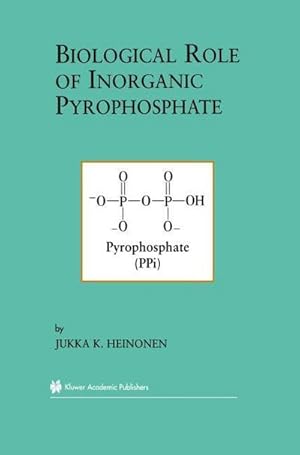
Biological Role of Inorganic Pyrophosphate
Anbieter: AHA-BUCH GmbH, Einbeck, Deutschland
Verkäuferbewertung 5 von 5 Sternen
Buch. Zustand: Neu. Druck auf Anfrage Neuware - Printed after ordering - Dr. Heinonen reviews and critically evaluates the scientific literature on the biological role of inorganic pyrophosphate (PPi ) published from 1940 to the end of 1999. He describes and classifies all known biochemical reactions that produce Ppi; describes and evaluates all published methods used in biological Ppi; and compiles and critically evaluates information on the concentration of PPi (with the conclusion that, contrary to common belief, PPi exists throughout the living world in rather high concentrations). Many reactions in which PPi is used as a biochemical energy source instead of ATP have been described in recent decades, especially in bacteria, protists, and plants. These reactions are evaluated from the bioenergetic and regulatory points of view. Also considered is the possible role of PPi as a source of biochemical energy in the primitive phases of life, before ATP. Data is presented on the regulatory role of PPi in living systems, such as activities of enzymes, fidelity of syntheses of macromolecules, and proliferation of cells. PPi may also regulate the formation and dissolution of bone as well as pathologic calcification of soft tissues and the formation of urinary stones. The formation of calcium pyrophosphate dihydrate crystals in the extracellular fluids of joints cause the disease called pseudogout. Biological Role of Inorganic Pyrophosphate book is a unique and invaluable source of references (about 1120) and summarized data for professionals who study or plan to study the role of PPi in living systems. Many different branches of science (biochemistry, microbiology, bioenergetics, plant physiology, parasitology, evolution, orthopedics, rheumatology) have involvement with PPi. This book sums up available knowledge in one place and will help scientists cross disciplinary boundaries.

