

Gesamtpreis (1 Artikel Artikel):
Versandziel:

9780792307143 - Calixarenes: A Versatile Class of Macrocyclic Compounds (Topics in Inclusion Science, Band 3) (4 Ergebnisse)
Direkt zu den wichtigsten Suchergebnissen
Suchfilter
Produktart
- Alle Product Types
- Bücher (4)
- Magazine & Zeitschriften (Keine weiteren Ergebnisse entsprechen dieser Verfeinerung)
- Comics (Keine weiteren Ergebnisse entsprechen dieser Verfeinerung)
- Noten (Keine weiteren Ergebnisse entsprechen dieser Verfeinerung)
- Kunst, Grafik & Poster (Keine weiteren Ergebnisse entsprechen dieser Verfeinerung)
- Fotografien (Keine weiteren Ergebnisse entsprechen dieser Verfeinerung)
- Karten (Keine weiteren Ergebnisse entsprechen dieser Verfeinerung)
- Manuskripte & Papierantiquitäten (Keine weiteren Ergebnisse entsprechen dieser Verfeinerung)
Zustand Mehr dazu
- Neu (3)
- Wie Neu, Sehr Gut oder Gut Bis Sehr Gut (1)
- Gut oder Befriedigend (Keine weiteren Ergebnisse entsprechen dieser Verfeinerung)
- Ausreichend oder Schlecht (Keine weiteren Ergebnisse entsprechen dieser Verfeinerung)
- Wie beschrieben (Keine weiteren Ergebnisse entsprechen dieser Verfeinerung)
Einband
- alle Einbände
- Hardcover (4)
- Softcover (Keine weiteren Ergebnisse entsprechen dieser Verfeinerung)
Weitere Eigenschaften
- Erstausgabe (Keine weiteren Ergebnisse entsprechen dieser Verfeinerung)
- Signiert (Keine weiteren Ergebnisse entsprechen dieser Verfeinerung)
- Schutzumschlag (Keine weiteren Ergebnisse entsprechen dieser Verfeinerung)
- Angebotsfoto (2)
Sprache (1)
Preis
- Beliebiger Preis
- Weniger als EUR 20 (Keine weiteren Ergebnisse entsprechen dieser Verfeinerung)
- EUR 20 bis EUR 40 (Keine weiteren Ergebnisse entsprechen dieser Verfeinerung)
- Mehr als EUR 40
Gratisversand
- Kostenloser Versand nach USA (Keine weiteren Ergebnisse entsprechen dieser Verfeinerung)
Land des Verkäufers
Verkäuferbewertung
-
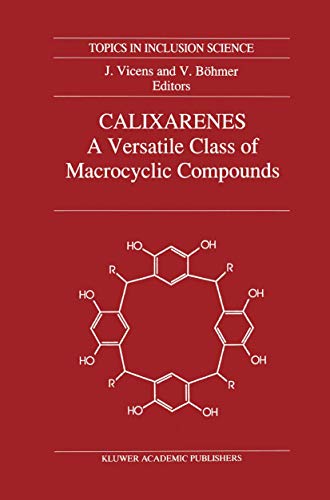
Calixarenes: A Versatile Class of Macrocyclic Compounds (Topics in Inclusion Science, 3)
Anbieter: Ria Christie Collections, Uxbridge, Vereinigtes Königreich
Verkäuferbewertung 5 von 5 Sternen

EUR 162,73
EUR 13,84 Versand
Versand von Vereinigtes Königreich nach USAAnzahl: Mehr als 20 verfügbar
In den WarenkorbZustand: New. In.
-
Hardcover. Zustand: As New. Leichte Kratzer / Abnutzungen / Druckstellen. The term "calixarenes," introduced in 1978 by D. Gutsche, refers to cyclic oligomers formed by the condensation of p-substituted phenols with formaldehyde. This reaction was initially studied by A. von Baeyer, while L. Baekeland produced the first synthetic polymers from these condensates in the early 20th century. A. Zinke noted the potential for cyclic products from t-butylphenol and formaldehyde as early as the 1940s. Despite their historical background, the significant applications of calixarenes in supramolecular chemistry have only recently been recognized. Although calixarene chemistry began slowly in the 1970s, it gained rapid momentum in the 1980s, particularly after C. Pedersen's discovery of crown ethers and the groundbreaking work of J.-M. Lehn and D. Cram with cryptands and spherands, all of whom received the 1987 Nobel Prize in Chemistry. This surge in interest led to a focus on host-guest chemistry, receptor chemistry, and supramolecular chemistry, drawing important parallels with biological processes and the creation of advanced materials. Consequently, calixarene molecules, once viewed as mere by-products of phenoplast manufacturing, began to be recognized as valuable macrocyclic receptor molecules.
-
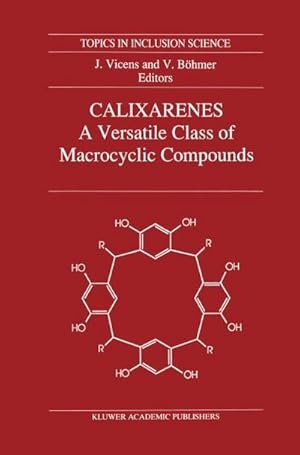
Calixarenes: A Versatile Class of Macrocyclic Compounds
Sprache: Englisch
Verlag: Springer Netherlands, Springer Netherlands, 1990
ISBN 10: 0792307143 ISBN 13: 9780792307143
Anbieter: AHA-BUCH GmbH, Einbeck, Deutschland
Verkäuferbewertung 5 von 5 Sternen
Buch. Zustand: Neu. Druck auf Anfrage Neuware - Printed after ordering - The tenn 'calixarenes', introduced in 1978 by D. Gutsche to describe the cyclic oligomers produced by condensation of p-substituted phenols with fonnaldehyde, is now universally accepted in the chemical community. The condensation of phenol with fonnaldehyde was studied in the last century by A. von Baeyer. Early in this century, L. Baekeland produced the first entirely synthetic polymers from phenol-fonnaldehyde condensates and the possibility that cyclic condensation products could be obtained from t-butylphenol, and fonnaldehyde was mentioned as early as in the beginning of the 1940's by A. Zinke. Despite their long history, the realisation that calixarenes may have very significant applications and uses in supramolecular chemistry is a relatively recent phenomenon. Calixarene chemistry, in contrast to their discovery, started slowly in the 1970's but rapidly gained momentum throughout the 1980's. Following C. Pedersens discovery of the crown ethers and the seminal developments of J. -M. Lehn and D. Cram with cryptands and spherands - all three honoured with the 1987 Nobel Chemistry Prize - the time was right for a surge of interest in research areas, frequently referred to as host-guest chemistry, receptor or supramolecular chemistry, and including important comparisons with biological processes and the development of new advanced materials. Now, the cyclic, bowl or basket-shaped calixarene molecules were looked on in a different light. Rather than 'having developed from harmful by-products of phenoplasts manufacture' they were now seen as potentially valuable macrocyclic receptor molecules.
-
Calixarenes
Sprache: Englisch
Verlag: Kluwer Academic Publishers, 1990
ISBN 10: 0792307143 ISBN 13: 9780792307143
Anbieter: Kennys Bookstore, Olney, MD, USA
Verkäuferbewertung 5 von 5 Sternen
Zustand: New. Editor(s): Vicens, J.; Bohmer, V. Series: Topics in Inclusion Science (Closed). Num Pages: 264 pages, biography. BIC Classification: PNN. Category: (P) Professional & Vocational; (UP) Postgraduate, Research & Scholarly. Dimension: 234 x 156 x 17. Weight in Grams: 571. . 1990. Hardback. . . . . Books ship from the US and Ireland.

