
9780691102320 - the creation of the roman frontier (princeton legacy library) von dyson, stephen l. (2 Ergebnisse)
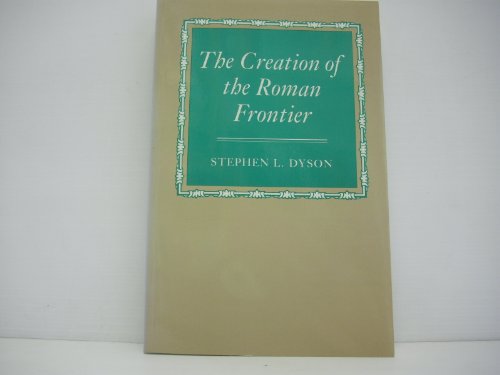
- Softcover
Anbieter: Ancient World Books, Toronto, ON, KanadaAncient World Books
Verkäufer/-in kontaktierenVerkäufer/-in mit 5 SternenZustand: Gebraucht - Gut
EUR 14,43
EUR 6,57 VersandVersand von Kanada nach USAAnzahl: 1 verfügbar
Softcover. Zustand: Very Good+. Scholar's bookplate to inner cover (G. P. Goold). Else fine.; Gathers the scattered and often ambiguous classical references into a coherent description of Roman strategic thinking. Finds the Roman frontier policy to have been much more disciplined than previously supposed.; 1 x 9.5 x 6 Inches; 33…7 pages.
- Softcover
Anbieter: Scrinium Classical Antiquity, Aalten, NiederlandeScrinium Classical Antiquity
Verkäufer/-in kontaktierenVerkäufer/-in mit 5 SternenZustand: Gebraucht
EUR 27,50
EUR 27,50 VersandVersand von Niederlande nach USAAnzahl: 1 verfügbar
Princeton University Press, Princeton, 1985. XII,324p. Paperback. Spine discoloured. Name and date on free endpaper. Initials stamp, date and personal library mark on free endpaper. 'The unwary reader might expect, from the title of this book, that its subject matter would be the development of Roman frontier defences under the…Empire, and so constitute a further contribution to the burgeoning genre of 'Limesstudien'. (.) the term 'frontier' is employed here in the sense familiar from the American 'west', of a sizeable zone of newly won, partially pacified territory, where the indigennous population and incoming settlers live in a wary proximity. In essence this book is a detailed survey of Roman expansion in the middle and later Republic, with a strong archaeological component. There is an emphasis, where the evidence will allow it, on trade patterns and acculturation. (.) The breadth of the author's reading is reflected in the very substantial bibliography, which includes not only important secondary literature in Italian, French and Spanish journals, but also modern studies in imperialism and the frontier phenomenon. Yet some nagging doubts remain. The author is perhaps too ready to accept earlier interpretations of often precarious archaeological evidence.' (LAWRENCE KEPPIE in The Classical Review (New Series), 1986, p.273).
