Gesamtpreis (1 Artikel Artikel):
Versandziel:

9780674868083 - The Taming of the Samurai: Honorific Individualism and the Making of Modern Japan von Ikegami, Eiko (2 Ergebnisse)
Direkt zu den wichtigsten Suchergebnissen
Suchfilter
Produktart
- Alle Product Types
- Bücher (2)
- Magazine & Zeitschriften (Keine weiteren Ergebnisse entsprechen dieser Verfeinerung)
- Comics (Keine weiteren Ergebnisse entsprechen dieser Verfeinerung)
- Noten (Keine weiteren Ergebnisse entsprechen dieser Verfeinerung)
- Kunst, Grafik & Poster (Keine weiteren Ergebnisse entsprechen dieser Verfeinerung)
- Fotografien (Keine weiteren Ergebnisse entsprechen dieser Verfeinerung)
- Karten (Keine weiteren Ergebnisse entsprechen dieser Verfeinerung)
- Manuskripte & Papierantiquitäten (Keine weiteren Ergebnisse entsprechen dieser Verfeinerung)
Zustand Mehr dazu
- Neu (Keine weiteren Ergebnisse entsprechen dieser Verfeinerung)
- Wie Neu, Sehr Gut oder Gut Bis Sehr Gut (1)
- Gut oder Befriedigend (1)
- Ausreichend oder Schlecht (Keine weiteren Ergebnisse entsprechen dieser Verfeinerung)
- Wie beschrieben (Keine weiteren Ergebnisse entsprechen dieser Verfeinerung)
Einband
- alle Einbände
- Hardcover (2)
- Softcover (Keine weiteren Ergebnisse entsprechen dieser Verfeinerung)
Weitere Eigenschaften
- Erstausgabe (1)
- Signiert (Keine weiteren Ergebnisse entsprechen dieser Verfeinerung)
- Schutzumschlag (2)
- Angebotsfoto (1)
Sprache (1)
Preis
- Beliebiger Preis
- Weniger als EUR 20 (Keine weiteren Ergebnisse entsprechen dieser Verfeinerung)
- EUR 20 bis EUR 40 (Keine weiteren Ergebnisse entsprechen dieser Verfeinerung)
- Mehr als EUR 40
Gratisversand
- Kostenloser Versand nach USA (Keine weiteren Ergebnisse entsprechen dieser Verfeinerung)
Land des Verkäufers
Verkäuferbewertung
-

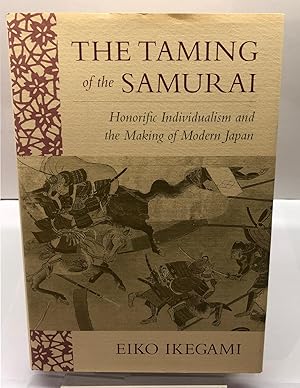
The Taming of the Samurai : Honorific Individualism & the Making of Modern Japan
Anbieter: Joseph Burridge Books, Dagenham, Vereinigtes Königreich
Verkäuferbewertung 5 von 5 Sternen

Erstausgabe
EUR 59,10
EUR 26,39 Versand
Versand von Vereinigtes Königreich nach USAAnzahl: 1 verfügbar
In den WarenkorbHardcover. Zustand: Fine. Zustand des Schutzumschlags: Fine. 1st Edition. x, 428 pages : illustrations ; 24 cm. Contents: I.A Sociological Approach. 1. Honor, State Formation, and Social Theories II. Origins in Violence. 2. The Coming of the Samurai: Violence and Culture in the Ancient World. 3. Vassalage and Honor. 4. The Rite of Honorable Death: Warfare and the Samurai Sensibility III. Disintegration and Reorganization. 5. Social Reorganization in the Late Medieval Period. 6. A Society Organized for War IV. The Paradoxical Nature of Tokugawa State Formation. 7. Tokugawa State Formation. 8. An Integrated Yet Decentralized State Structure. 9. The Tokugawa Neo-Feudal State: A Comparative Evaluation V. Honor and Violence in Transformation. 10. Honor or Order: The State and Samurai Self-Determinism. 11. The Vendetta of the Forty-seven Samurai. 12. Proceduralization of Honor VI. Honor Polarization in Vassalic Bureaucracy. 13. State-Centered Honor and Vassalic Bureaucracy. 14. Hagakure: The Cult of Death and Honorific Individuality. 15. Confucian and Post-Confucian Samurai VII. Honorific individualism and honorific collectivism. 16. Themes of Control and Change Epilogue: Honor and Identity.
-
The Taming of The Samurai: Honorific Individualism and the Making of Modern Japan
Sprache: Englisch
Verlag: Harvard University Press, Cambridge, Massachusetts and London, England, 1995
ISBN 10: 0674868080 ISBN 13: 9780674868083
Anbieter: Jorge Welsh Books, Lisboa, Portugal
Verkäuferbewertung 5 von 5 Sternen
Hardcover. Zustand: Very Good. Dust Jacket Included. English text.; Hardcover (with dust jacket); 17 x 24.5 cm.; 0.78 Kg.; 428 pages.; Used with signs of wear, namely on the outside text block. Interior as new. Signs of wear on the dust jacket that is now protected with a clearcover.; Modern Japan offers us a view of a highly developed society with its own internal logic. Eiko Ikegami makes this logic accessible to us through a sweeping investigation into the roots of Japanese organizational structures. She accomplishes this by focusing on the diverse roles that the samurai have played in Japanese history. From their rise in ancient Japan, through their dominance as warrior lords in the medieval period, and their subsequent transformation to quasi-bureaucrats at the beginning of the Tokugawa era, the samurai held center stage in Japan until their abolishment after the opening up of Japan in the mid-nineteenth century. This book demonstrates how Japan's so-called harmonious collective culture is paradoxically connected with a history of conflict. Ikegami contends that contemporary Japanese culture is based upon two remarkably complementary ingredients, honorable competition and honorable collaboration. The historical roots of this situation can be found in the process of state formation, along very different lines from that seen in Europe at around the same time. The solution that emerged out of the turbulent beginnings of the Tokugawa state was a transformation of the samurai into a hereditary class of vassal-bureaucrats, a solution that would have many unexpected ramifications for subsequent centuries. Ikegami's approach, while sociological, draws on anthropological and historical methods to provide an answer to the question of how the Japanese managed to achieve modernity without traveling the route taken by Western countries. The result is a work of enormous depth and sensitivity that will facilitate a better understanding of, and appreciation for, Japanese society.