

Gesamtpreis (1 Artikel Artikel):
Versandziel:

9780668043182 - German Army Uniforms and Insignia, 1933-1945 von Davis, Brian L. (2 Ergebnisse)
Direkt zu den wichtigsten Suchergebnissen
Suchfilter
Produktart
- Alle Product Types
- Bücher (2)
- Magazine & Zeitschriften (Keine weiteren Ergebnisse entsprechen dieser Verfeinerung)
- Comics (Keine weiteren Ergebnisse entsprechen dieser Verfeinerung)
- Noten (Keine weiteren Ergebnisse entsprechen dieser Verfeinerung)
- Kunst, Grafik & Poster (Keine weiteren Ergebnisse entsprechen dieser Verfeinerung)
- Fotografien (Keine weiteren Ergebnisse entsprechen dieser Verfeinerung)
- Karten (Keine weiteren Ergebnisse entsprechen dieser Verfeinerung)
- Manuskripte & Papierantiquitäten (Keine weiteren Ergebnisse entsprechen dieser Verfeinerung)
Zustand Mehr dazu
- Neu (Keine weiteren Ergebnisse entsprechen dieser Verfeinerung)
- Wie Neu, Sehr Gut oder Gut Bis Sehr Gut (Keine weiteren Ergebnisse entsprechen dieser Verfeinerung)
- Gut oder Befriedigend (2)
- Ausreichend oder Schlecht (Keine weiteren Ergebnisse entsprechen dieser Verfeinerung)
- Wie beschrieben (Keine weiteren Ergebnisse entsprechen dieser Verfeinerung)
Einband
- alle Einbände
- Hardcover (2)
- Softcover (Keine weiteren Ergebnisse entsprechen dieser Verfeinerung)
Weitere Eigenschaften
- Erstausgabe (Keine weiteren Ergebnisse entsprechen dieser Verfeinerung)
- Signiert (Keine weiteren Ergebnisse entsprechen dieser Verfeinerung)
- Schutzumschlag (1)
- Angebotsfoto (Keine weiteren Ergebnisse entsprechen dieser Verfeinerung)
Sprache (1)
Gratisversand
Land des Verkäufers
Verkäuferbewertung
-
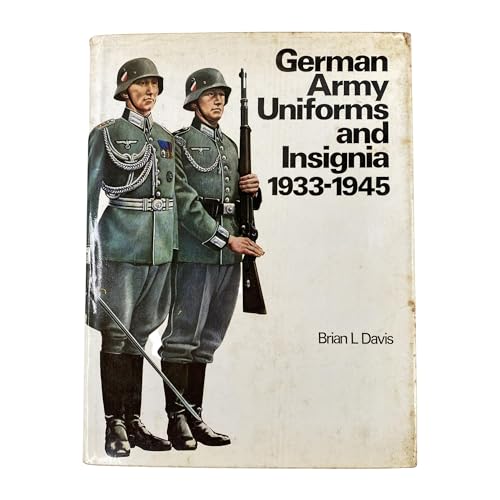
German Army Uniforms and Insignia, 1933-1945
Anbieter: Better World Books, Mishawaka, IN, USA
Verkäuferbewertung 5 von 5 Sternen

Zustand: Very Good. Former library copy. Pages intact with possible writing/highlighting. Binding strong with minor wear. Dust jackets/supplements may not be included. Includes library markings. Stock photo provided. Product includes identifying sticker. Better World Books: Buy Books. Do Good.
-
German Army Uniforms and Insignia 1933-1945
Sprache: Englisch
Verlag: Arco Publishing Company, Inc, New York, 1977
ISBN 10: 0668043180 ISBN 13: 9780668043182
Anbieter: Ground Zero Books, Ltd., Silver Spring, MD, USA
Verkäuferbewertung 5 von 5 Sternen
Hardcover. Zustand: Good. Zustand des Schutzumschlags: Good. 224 pages. Illustrations (some in color, photographs, drawings, and diagrams). Select Chronology. Glossary, Bibliography. The dust jacket is price clipped. The dust jacket has some wear and soiling. War-time photographs support a complete survey of all military uniforms worn during the Third Reich. Brian Leigh Davis is one of the world's leading experts on the insignia and regalia of Nazi Germany. He has previously written three Men-at-Arms books about flags of the Third Reich. The following is a general overview of the Heer main uniforms, used by the German Army prior to and during World War II. Terms such as M40 and M43 were never designated by the Wehrmacht, but are names given to the different versions of the Model 1936 field tunic by modern collectors, to discern between variations, as the M36 was steadily simplified and tweaked due to production time problems and combat experience. Uniforms of the Heer as the ground forces of the Wehrmacht were distinguished from other branches by two devices: the army form of the Wehrmachtsadler or Hoheitszeichen (national emblem) worn above the right breast pocket, and with certain exceptions collar tabs bearing a pair of Litzen (Doppellitze "double braid"), a device inherited from the old Prussian Guard which resembled a Roman numeral II on its side. Both eagle and Litzen were machine-embroidered or woven in white or grey (hand-embroidered in silk, silver or aluminium for officers and in gold bullion for generals). Rank was worn on shoulder-straps except for junior enlisted (Mannschaften), who wore plain shoulder-straps and their rank insignia, if any, on the left upper sleeve. NCO's wore a 9mm silver or grey braid around the collar edge. Shoulder-straps and, in many cases, collar patches were piped or underlaid in Waffenfarbe, a color code which often identified the branch of service to which the unit belonged: white for infantry, red for artillery, rose-pink for Panzer troops and so on. Most belt buckles had the Heeresadler with the inscription "Gott mit uns" ("God with us"). When the Nazis came to power in early 1933 the Reichswehr, the armed forces of the Weimar Republic, were near the end of a two-year project to redesign the Army Feldbluse (field blouse). Beginning in that year the new tunic was issued to the Reichsheer and then the rapidly growing Wehrmacht Heer, although minor design changes continued to be made until the appearance of the standardized Heeres Dienstanzug Modell 1936. The M36 tunic still retained the traditional Imperial and Reichswehr uniform color of grey-green "field gray" (feldgrau)[a] wool, but incorporated four front patch pockets with scalloped flaps and pleats (on Reichswehr tunics the lower pockets were internal and angled). The front was closed with five buttons rather than the previous eight, and the collar and shoulder straps were of a dark bottle-green instead of the Reichswehr grey.[1] Compared to the Weimar-era uniforms the skirt of the feldbluse was shorter and the tailoring was more form-fitting due to Germany's adoption of mechanized warfare: soldiers now spent much time in the confined space of a vehicle and a shorter jacket was less likely to pick up dirt from the seats.[2] It also included an internal suspension system, whereby a soldier could hang an equipment belt on a series of hooks outside of the tunic. These hooks were connected to two straps inside the lining, which spread the weight of the equipment without having to use external equipment suspenders. The M36 was produced and issued until the very end of the war, though successive patterns became predominant. SS field uniforms were of similar appearance externally but to fit their larger patches had a wider, feldgrau collar, and the lower pockets were of an angled slash type similar to the black or grey SS service-dress. The second button of an SS Feldbluse was positioned somewhat lower, so that it could be worn open-collar with a necktie. Due to supply problems, the SS were oft.
