

Gesamtpreis (1 Artikel Artikel):
Versandziel:

9780521845724 - Insurance and Behavioral Economics: Improving Decisions in the Most Misunderstood Industry von Kunreuther, Howard C.; Pauly, Mark V.; McMorrow, Stacey (4 Ergebnisse)
Direkt zu den wichtigsten Suchergebnissen
Suchfilter
Produktart
- Alle Product Types
- Bücher (4)
- Magazine & Zeitschriften (Keine weiteren Ergebnisse entsprechen dieser Verfeinerung)
- Comics (Keine weiteren Ergebnisse entsprechen dieser Verfeinerung)
- Noten (Keine weiteren Ergebnisse entsprechen dieser Verfeinerung)
- Kunst, Grafik & Poster (Keine weiteren Ergebnisse entsprechen dieser Verfeinerung)
- Fotografien (Keine weiteren Ergebnisse entsprechen dieser Verfeinerung)
- Karten (Keine weiteren Ergebnisse entsprechen dieser Verfeinerung)
- Manuskripte & Papierantiquitäten (Keine weiteren Ergebnisse entsprechen dieser Verfeinerung)
Zustand Mehr dazu
- Neu (4)
- Wie Neu, Sehr Gut oder Gut Bis Sehr Gut (Keine weiteren Ergebnisse entsprechen dieser Verfeinerung)
- Gut oder Befriedigend (Keine weiteren Ergebnisse entsprechen dieser Verfeinerung)
- Ausreichend oder Schlecht (Keine weiteren Ergebnisse entsprechen dieser Verfeinerung)
- Wie beschrieben (Keine weiteren Ergebnisse entsprechen dieser Verfeinerung)
Einband
- alle Einbände
- Hardcover (4)
- Softcover (Keine weiteren Ergebnisse entsprechen dieser Verfeinerung)
Weitere Eigenschaften
- Erstausgabe (Keine weiteren Ergebnisse entsprechen dieser Verfeinerung)
- Signiert (Keine weiteren Ergebnisse entsprechen dieser Verfeinerung)
- Schutzumschlag (Keine weiteren Ergebnisse entsprechen dieser Verfeinerung)
- Angebotsfoto (1)
Sprache (1)
Preis
- Beliebiger Preis
- Weniger als EUR 20 (Keine weiteren Ergebnisse entsprechen dieser Verfeinerung)
- EUR 20 bis EUR 45 (Keine weiteren Ergebnisse entsprechen dieser Verfeinerung)
- Mehr als EUR 45
Gratisversand
- Kostenloser Versand nach USA (Keine weiteren Ergebnisse entsprechen dieser Verfeinerung)
Land des Verkäufers
Verkäuferbewertung
-
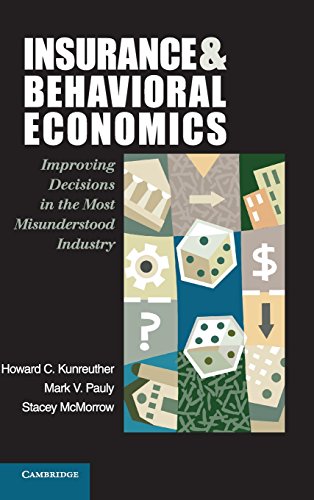
Insurance and Behavioral Economics: Improving Decisions in the Most Misunderstood Industry
Sprache: Englisch
Verlag: Cambridge University Press, 2013
ISBN 10: 0521845726 ISBN 13: 9780521845724
Anbieter: Ria Christie Collections, Uxbridge, Vereinigtes Königreich
Verkäuferbewertung 5 von 5 Sternen

EUR 125,18
EUR 13,83 Versand
Versand von Vereinigtes Königreich nach USAAnzahl: Mehr als 20 verfügbar
In den WarenkorbZustand: New. In.
-
Insurance and Behavioral Economics: Improving Decisions in the Most Misunderstood Industry
Sprache: Englisch
Verlag: Cambridge University Press, 2013
ISBN 10: 0521845726 ISBN 13: 9780521845724
Anbieter: Kennys Bookstore, Olney, MD, USA
Verkäuferbewertung 5 von 5 Sternen
EUR 178,23
EUR 8,96 Versand
Versand innerhalb von USAAnzahl: Mehr als 20 verfügbar
In den WarenkorbZustand: New. This book examines the behavior of individuals at risk and insurance industry policy makers involved in selling, buying and regulation. Num Pages: 342 pages, 13 b/w illus. 10 tables. BIC Classification: KC; KCK; KFFN. Category: (U) Tertiary Education (US: College). Dimension: 162 x 237 x 31. Weight in Grams: 666. . 2013. Illustrated. hardcover. . . . . Books ship from the US and Ireland.
-
Insurance and Behavioral Economics: Improving Decisions in the Most Misunderstood Industry
Anbieter: Revaluation Books, Exeter, Vereinigtes Königreich
Verkäuferbewertung 5 von 5 Sternen
EUR 174,35
EUR 14,43 Versand
Versand von Vereinigtes Königreich nach USAAnzahl: 2 verfügbar
In den WarenkorbHardcover. Zustand: Brand New. 1st edition. 244 pages. 9.00x6.00x1.00 inches. In Stock.
-
Insurance and Behavioral Economics
Sprache: Englisch
Verlag: Cambridge University Press, 2013
ISBN 10: 0521845726 ISBN 13: 9780521845724
Anbieter: AHA-BUCH GmbH, Einbeck, Deutschland
Verkäuferbewertung 5 von 5 Sternen
Buch. Zustand: Neu. Druck auf Anfrage Neuware - Printed after ordering - This book examines the behavior of individuals at risk and insurance industry decision makers involved in selling, buying and regulation. It compares their actions to those predicted by benchmark models of choice derived from classical economic theory. Where actual choices stray from predictions, the behavior is considered to be anomalous. Howard C. Kunreuther, Mark Pauly and Stacey McMorrow attempt to understand why these anomalies occur, in many cases using insights from behavioral economics. The authors then consider if and how such behavioral anomalies could be modified to improve individual and social welfare. This book describes situations in which both public policy and the insurance industry's collective posture need to change. This may require incentives, rules and institutions to help reduce both inefficient and anomalous behavior, thereby encouraging behavior that will improve individual and social welfare.
