

Gesamtpreis (1 Artikel Artikel):
Versandziel:

9780521465496 - The Textuality of Old English Poetry (Cambridge Studies in Anglo-saxon England) von Pasternack, Carol Braun (5 Ergebnisse)
Direkt zu den wichtigsten Suchergebnissen
Suchfilter
Produktart
- Alle Product Types
- Bücher (5)
- Magazine & Zeitschriften (Keine weiteren Ergebnisse entsprechen dieser Verfeinerung)
- Comics (Keine weiteren Ergebnisse entsprechen dieser Verfeinerung)
- Noten (Keine weiteren Ergebnisse entsprechen dieser Verfeinerung)
- Kunst, Grafik & Poster (Keine weiteren Ergebnisse entsprechen dieser Verfeinerung)
- Fotografien (Keine weiteren Ergebnisse entsprechen dieser Verfeinerung)
- Karten (Keine weiteren Ergebnisse entsprechen dieser Verfeinerung)
- Manuskripte & Papierantiquitäten (Keine weiteren Ergebnisse entsprechen dieser Verfeinerung)
Zustand Mehr dazu
- Neu (3)
- Wie Neu, Sehr Gut oder Gut Bis Sehr Gut (Keine weiteren Ergebnisse entsprechen dieser Verfeinerung)
- Gut oder Befriedigend (1)
- Ausreichend oder Schlecht (1)
- Wie beschrieben (Keine weiteren Ergebnisse entsprechen dieser Verfeinerung)
Einband
- alle Einbände
- Hardcover (5)
- Softcover (Keine weiteren Ergebnisse entsprechen dieser Verfeinerung)
Weitere Eigenschaften
- Erstausgabe (Keine weiteren Ergebnisse entsprechen dieser Verfeinerung)
- Signiert (Keine weiteren Ergebnisse entsprechen dieser Verfeinerung)
- Schutzumschlag (Keine weiteren Ergebnisse entsprechen dieser Verfeinerung)
- Angebotsfoto (1)
Sprache (1)
Gratisversand
- Kostenloser Versand nach USA (Keine weiteren Ergebnisse entsprechen dieser Verfeinerung)
Land des Verkäufers
Verkäuferbewertung
-
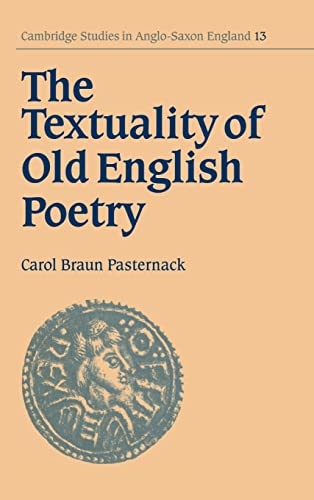
The Textuality of Old English Poetry (Cambridge Studies in Anglo-Saxon England) (Volume 13)
Sprache: Englisch
Verlag: Cambridge University Press, 1995
ISBN 10: 0521465494 ISBN 13: 9780521465496
Anbieter: Anybook.com, Lincoln, Vereinigtes Königreich
Verkäuferbewertung 5 von 5 Sternen

EUR 11,13
EUR 15,76 Versand
Versand von Vereinigtes Königreich nach USAAnzahl: 1 verfügbar
In den WarenkorbZustand: Fair. Volume 13. This is an ex-library book and may have the usual library/used-book markings inside.This book has hardback covers. In fair condition, suitable as a study copy. No dust jacket. Library sticker on front cover. Please note the Image in this listing is a stock photo and may not match the covers of the actual item,550grams, ISBN:0521465494.
-
The Textuality of Old English Poetry (Cambridge Studies in Anglo-Saxon England)
Sprache: Englisch
Verlag: Cambridge University Press, 1995
ISBN 10: 0521465494 ISBN 13: 9780521465496
Anbieter: Labyrinth Books, Princeton, NJ, USA
Verkäuferbewertung 5 von 5 Sternen
Zustand: Good.
-
The Textuality of Old English Poetry (Cambridge Studies in Anglo-Saxon England, Series Number 13)
Sprache: Englisch
Verlag: Cambridge University Press, 1995
ISBN 10: 0521465494 ISBN 13: 9780521465496
Anbieter: Ria Christie Collections, Uxbridge, Vereinigtes Königreich
Verkäuferbewertung 5 von 5 Sternen
EUR 115,66
EUR 13,88 Versand
Versand von Vereinigtes Königreich nach USAAnzahl: Mehr als 20 verfügbar
In den WarenkorbZustand: New. In.
-
The Textuality of Old English Poetry: 13 (Cambridge Studies in Anglo-Saxon England, Series Number 13)
Sprache: Englisch
Verlag: Cambridge University Press, 1995
ISBN 10: 0521465494 ISBN 13: 9780521465496
Anbieter: Kennys Bookstore, Olney, MD, USA
Verkäuferbewertung 5 von 5 Sternen
EUR 163,75
EUR 9,07 Versand
Versand innerhalb von USAAnzahl: Mehr als 20 verfügbar
In den WarenkorbZustand: New. A theoretical reading of the textuality of Old English poetry. Series: Cambridge Studies in Anglo-Saxon England. Num Pages: 238 pages, 5 b/w illus. BIC Classification: 2AB; DSBB; DSC. Category: (P) Professional & Vocational. Dimension: 228 x 152 x 17. Weight in Grams: 481. . 1995. First Edition. hardcover. . . . . Books ship from the US and Ireland.
-

The Textuality of Old English Poetry
Sprache: Englisch
Verlag: Cambridge University Press, 1995
ISBN 10: 0521465494 ISBN 13: 9780521465496
Anbieter: AHA-BUCH GmbH, Einbeck, Deutschland
Verkäuferbewertung 5 von 5 Sternen
Buch. Zustand: Neu. Druck auf Anfrage Neuware - Printed after ordering - This study theorizes how Old English poetry functioned for readers of tenth-century manuscripts. Coupling the rigour of formalist analysis with the innovations of post-structuralist concepts, Professor Pasternack maps the codes and conventions that guided readers in their construction of poems. She defines the verse as 'inscribed', situated between oral and written discourse. Altering our vision of individual poems, which to date has been based on modern printed editions, she coins the terms 'movement' and 'verse sequence' to reconceptualize the poetry according to its presentation in manuscripts, which does not separate poems decisively. Using the concept of intertextuality, she establishes the idea of an 'implied tradition' which, rather than the 'implied author', functioned as the source of a text's authority. Pasternack thus revises the entire basis for long-standing debates concerning the unity and authority of Old English poems.
