

Gesamtpreis (1 Artikel Artikel):
Versandziel:

9780470876183 - Formal Methods for Industrial Critical Systems: A Survey of Applications von Gnesi (6 Ergebnisse)
Direkt zu den wichtigsten Suchergebnissen
Suchfilter
Produktart
- Alle Product Types
- Bücher (6)
- Magazine & Zeitschriften (Keine weiteren Ergebnisse entsprechen dieser Verfeinerung)
- Comics (Keine weiteren Ergebnisse entsprechen dieser Verfeinerung)
- Noten (Keine weiteren Ergebnisse entsprechen dieser Verfeinerung)
- Kunst, Grafik & Poster (Keine weiteren Ergebnisse entsprechen dieser Verfeinerung)
- Fotografien (Keine weiteren Ergebnisse entsprechen dieser Verfeinerung)
- Karten (Keine weiteren Ergebnisse entsprechen dieser Verfeinerung)
- Manuskripte & Papierantiquitäten (Keine weiteren Ergebnisse entsprechen dieser Verfeinerung)
Zustand Mehr dazu
- Neu (6)
- Wie Neu, Sehr Gut oder Gut Bis Sehr Gut (Keine weiteren Ergebnisse entsprechen dieser Verfeinerung)
- Gut oder Befriedigend (Keine weiteren Ergebnisse entsprechen dieser Verfeinerung)
- Ausreichend oder Schlecht (Keine weiteren Ergebnisse entsprechen dieser Verfeinerung)
- Wie beschrieben (Keine weiteren Ergebnisse entsprechen dieser Verfeinerung)
Einband
- alle Einbände
- Hardcover (Keine weiteren Ergebnisse entsprechen dieser Verfeinerung)
- Softcover (6)
Weitere Eigenschaften
- Erstausgabe (Keine weiteren Ergebnisse entsprechen dieser Verfeinerung)
- Signiert (Keine weiteren Ergebnisse entsprechen dieser Verfeinerung)
- Schutzumschlag (Keine weiteren Ergebnisse entsprechen dieser Verfeinerung)
- Angebotsfoto (2)
Sprache (1)
Preis
- Beliebiger Preis
- Weniger als EUR 20 (Keine weiteren Ergebnisse entsprechen dieser Verfeinerung)
- EUR 20 bis EUR 40 (Keine weiteren Ergebnisse entsprechen dieser Verfeinerung)
- Mehr als EUR 40
Gratisversand
- Kostenloser Versand nach USA (Keine weiteren Ergebnisse entsprechen dieser Verfeinerung)
Land des Verkäufers
Verkäuferbewertung
-

Formal Methods for Industrial Critical Systems
Anbieter: PBShop.store UK, Fairford, GLOS, Vereinigtes Königreich
Verkäuferbewertung 4 von 5 Sternen

EUR 98,27
EUR 4,75 Versand
Versand von Vereinigtes Königreich nach USAAnzahl: 15 verfügbar
In den WarenkorbPAP. Zustand: New. New Book. Shipped from UK. Established seller since 2000.
-
Formal Methods for Industrial Critical Systems
Anbieter: Majestic Books, Hounslow, Vereinigtes Königreich
Verkäuferbewertung 4 von 5 Sternen
EUR 112,09
EUR 7,43 Versand
Versand von Vereinigtes Königreich nach USAAnzahl: 3 verfügbar
In den WarenkorbZustand: New. pp. 292.
-
Formal Methods for Industrial Critical Systems A Survey of Applications
Anbieter: Revaluation Books, Exeter, Vereinigtes Königreich
Verkäuferbewertung 5 von 5 Sternen

EUR 129,72
EUR 11,43 Versand
Versand von Vereinigtes Königreich nach USAAnzahl: 2 verfügbar
In den WarenkorbPaperback. Zustand: Brand New. 1st edition. 292 pages. 9.00x6.25x0.75 inches. In Stock.
-
Formal Methods for Industrial Critical Systems: A Survey of Applications
Anbieter: Kennys Bookstore, Olney, MD, USA
Verkäuferbewertung 4 von 5 Sternen
EUR 142,83
EUR 8,90 Versand
Versand innerhalb von USAAnzahl: Mehr als 20 verfügbar
In den WarenkorbZustand: New. Today, formal methods are widely recognized as an essential step in the design process of industrial safety-critical systems. Num Pages: 292 pages, Illustrations. BIC Classification: TBC; TJ. Category: (P) Professional & Vocational. Dimension: 234 x 155 x 17. Weight in Grams: 500. . 2012. 1st Edition. Paperback. . . . . Books ship from the US and Ireland.
-
EUR 100,15
EUR 48,99 Versand
Versand von Deutschland nach USAAnzahl: Mehr als 20 verfügbar
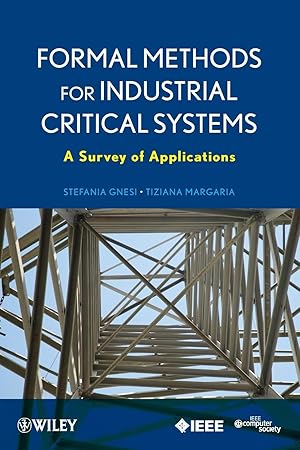
In den WarenkorbZustand: New. STEFANIA GNESI is Director of Research and head of the Formal Methods and Tools Laboratory at ISTI-CNR (Istituto di Scienza e Tecnologie dell Informazione-Consiglio Nazionale delle Ricerche) in Pisa, Italy. She was previously a lecturer in methods and tools.
-

Formal Methods for Industrial Critical Systems : A Survey of Applications
Anbieter: AHA-BUCH GmbH, Einbeck, Deutschland
Verkäuferbewertung 5 von 5 Sternen
Taschenbuch. Zustand: Neu. Neuware - Today, formal methods are widely recognized as an essential step in the design process of industrial safety-critical systems. In its more general definition, the term formal methods encompasses all notations having a precise mathematical semantics, together with their associated analysis methods, that allow description and reasoning about the behavior of a system in a formal manner.Growing out of more than a decade of award-winning collaborative work within the European Research Consortium for Informatics and Mathematics, Formal Methods for Industrial Critical Systems: A Survey of Applications presents a number of mainstream formal methods currently used for designing industrial critical systems, with a focus on model checking. The purpose of the book is threefold: to reduce the effort required to learn formal methods, which has been a major drawback for their industrial dissemination; to help designers to adopt the formal methods which are most appropriate for their systems; and to offer a panel of state-of-the-art techniques and tools for analyzing critical systems.

