

Gesamtpreis (1 Artikel Artikel):
Versandziel:

9780465031337 - It's Even Worse Than It Looks: How the American Constitutional System Collided With the New Politics of Extremism von Mann, Thomas E.; Ornstein, Norman J. (23 Ergebnisse)
Direkt zu den wichtigsten Suchergebnissen
Suchfilter
Produktart
- Alle Product Types
- Bücher (23)
- Magazine & Zeitschriften (Keine weiteren Ergebnisse entsprechen dieser Verfeinerung)
- Comics (Keine weiteren Ergebnisse entsprechen dieser Verfeinerung)
- Noten (Keine weiteren Ergebnisse entsprechen dieser Verfeinerung)
- Kunst, Grafik & Poster (Keine weiteren Ergebnisse entsprechen dieser Verfeinerung)
- Fotografien (Keine weiteren Ergebnisse entsprechen dieser Verfeinerung)
- Karten (Keine weiteren Ergebnisse entsprechen dieser Verfeinerung)
- Manuskripte & Papierantiquitäten (Keine weiteren Ergebnisse entsprechen dieser Verfeinerung)
Zustand Mehr dazu
- Neu (1)
- Wie Neu, Sehr Gut oder Gut Bis Sehr Gut (2)
- Gut oder Befriedigend (19)
- Ausreichend oder Schlecht (1)
- Wie beschrieben (Keine weiteren Ergebnisse entsprechen dieser Verfeinerung)
Einband
Weitere Eigenschaften
Sprache (1)
Gratisversand
Land des Verkäufers
Verkäuferbewertung
-
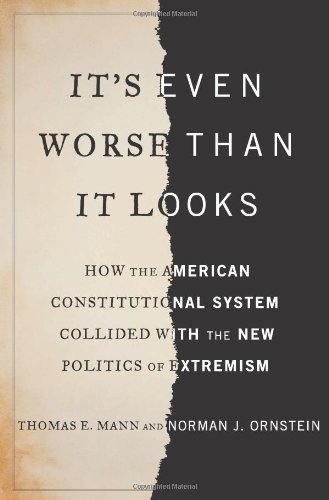
Hardcover. Zustand: Good. 1. It's a preowned item in good condition and includes all the pages. It may have some general signs of wear and tear, such as markings, highlighting, slight damage to the cover, minimal wear to the binding, etc., but they will not affect the overall reading experience.
-
It's Even Worse Than It Looks: How the American Constitutional System Collided With the New Politics of Extremism
Anbieter: Wonder Book, Frederick, MD, USA
Verkäuferbewertung 5 von 5 Sternen

Zustand: Very Good. Very Good condition. Very Good dust jacket. A copy that may have a few cosmetic defects. May also contain light spine creasing or a few markings such as an owner's name, short gifter's inscription or light stamp.
-
It's Even Worse Than It Looks: How the American Constitutional System Collided With the New Politics of Extremism
Anbieter: ThriftBooks-Phoenix, Phoenix, AZ, USA
Verkäuferbewertung 5 von 5 Sternen
Hardcover. Zustand: Good. No Jacket. Former library book; Pages can have notes/highlighting. Spine may show signs of wear. ~ ThriftBooks: Read More, Spend Less.
-
It's Even Worse Than It Looks: How the American Constitutional System Collided With the New Politics of Extremism
Anbieter: ThriftBooks-Atlanta, AUSTELL, GA, USA
Verkäuferbewertung 5 von 5 Sternen
Hardcover. Zustand: Good. No Jacket. Former library book; Pages can have notes/highlighting. Spine may show signs of wear. ~ ThriftBooks: Read More, Spend Less.
-
It's Even Worse Than It Looks: How the American Constitutional System Collided With the New Politics of Extremism
Anbieter: ThriftBooks-Atlanta, AUSTELL, GA, USA
Verkäuferbewertung 5 von 5 Sternen
Hardcover. Zustand: Good. No Jacket. Pages can have notes/highlighting. Spine may show signs of wear. ~ ThriftBooks: Read More, Spend Less.
-
It's Even Worse Than It Looks: How the American Constitutional System Collided With the New Politics of Extremism
Anbieter: ThriftBooks-Atlanta, AUSTELL, GA, USA
Verkäuferbewertung 5 von 5 Sternen
Hardcover. Zustand: Very Good. No Jacket. Former library book; May have limited writing in cover pages. Pages are unmarked. ~ ThriftBooks: Read More, Spend Less.
-
It's Even Worse Than It Looks: How the American Constitutional System Collided With the New Politics of Extremism
Anbieter: ThriftBooks-Dallas, Dallas, TX, USA
Verkäuferbewertung 5 von 5 Sternen
Hardcover. Zustand: Very Good. No Jacket. Missing dust jacket; May have limited writing in cover pages. Pages are unmarked. ~ ThriftBooks: Read More, Spend Less.
-
Hardcover. Zustand: Very Good. No Jacket. May have limited writing in cover pages. Pages are unmarked. ~ ThriftBooks: Read More, Spend Less.
-
It's Even Worse Than It Looks: How the American Constitutional System Collided With the New Politics of Extremism
Anbieter: ThriftBooks-Dallas, Dallas, TX, USA
Verkäuferbewertung 5 von 5 Sternen
Hardcover. Zustand: Very Good. No Jacket. May have limited writing in cover pages. Pages are unmarked. ~ ThriftBooks: Read More, Spend Less.
-
It's Even Worse Than It Looks : How the American Constitutional System Collided with the New Politics of Extremism
Anbieter: Better World Books, Mishawaka, IN, USA
Verkäuferbewertung 5 von 5 Sternen
Erstausgabe
Zustand: Good. First Edition. Former library copy. Pages intact with minimal writing/highlighting. The binding may be loose and creased. Dust jackets/supplements are not included. Includes library markings. Stock photo provided. Product includes identifying sticker. Better World Books: Buy Books. Do Good.
-
It's Even Worse Than It Looks : How the American Constitutional System Collided with the New Politics of Extremism
Anbieter: Better World Books, Mishawaka, IN, USA
Verkäuferbewertung 5 von 5 Sternen
Erstausgabe
Zustand: Good. First Edition. Pages intact with minimal writing/highlighting. The binding may be loose and creased. Dust jackets/supplements are not included. Stock photo provided. Product includes identifying sticker. Better World Books: Buy Books. Do Good.
-

It's Even Worse Than It Looks: How the American Constitutional System Collided with the New Politics of Extremism
Anbieter: WeBuyBooks, Rossendale, LANCS, Vereinigtes Königreich
Verkäuferbewertung 5 von 5 Sternen
EUR 1,65
EUR 6,50 Versand
Versand von Vereinigtes Königreich nach USAAnzahl: 1 verfügbar
In den WarenkorbZustand: Like New. Most items will be dispatched the same or the next working day. An apparently unread copy in perfect condition. Dust cover is intact with no nicks or tears. Spine has no signs of creasing. Pages are clean and not marred by notes or folds of any kind.
-
It's Even Worse Than It Looks: How the American Constitutional System Collided With the New Politics of Extremism
Anbieter: Books End Bookshop, Syracuse, NY, USA
Verkäuferbewertung 4 von 5 Sternen

Hardcover. Zustand: Very Good+. Zustand des Schutzumschlags: Very Good. Later Printing. 8.30 X 5.50 X 1 inches.
-
It's Even Worse Than It Looks: How the American Constitutional System Collided with the New Politics of Extremism
Anbieter: WorldofBooks, Goring-By-Sea, WS, Vereinigtes Königreich
Verkäuferbewertung 5 von 5 Sternen
EUR 3,39
EUR 6,39 Versand
Versand von Vereinigtes Königreich nach USAAnzahl: 2 verfügbar
In den WarenkorbPaperback. Zustand: Very Good. The book has been read, but is in excellent condition. Pages are intact and not marred by notes or highlighting. The spine remains undamaged.
-
Zustand: very good. Gut/Very good: Buch bzw. Schutzumschlag mit wenigen Gebrauchsspuren an Einband, Schutzumschlag oder Seiten. / Describes a book or dust jacket that does show some signs of wear on either the binding, dust jacket or pages.
-
It's Even Worse Than It Looks: How the American Constitutional System Collided with the New Politics of Extremism
Sprache: Englisch
Verlag: Basic Civitas Books 14/06/2012, 2012
ISBN 10: 0465031331 ISBN 13: 9780465031337
Anbieter: AwesomeBooks, Wallingford, Vereinigtes Königreich
Verkäuferbewertung 5 von 5 Sternen
EUR 11,73
EUR 5,69 Versand
Versand von Vereinigtes Königreich nach USAAnzahl: 1 verfügbar
In den WarenkorbZustand: Very Good. This book is in very good condition and will be shipped within 24 hours of ordering. The cover may have some limited signs of wear but the pages are clean, intact and the spine remains undamaged. This book has clearly been well maintained and looked after thus far. Money back guarantee if you are not satisfied. See all our books here, order more than 1 book and get discounted shipping. .
-
It's Even Worse Than It Looks: How the American Constitutional System Collided With the New Politics of Extremism
Anbieter: Wonder Book, Frederick, MD, USA
Verkäuferbewertung 5 von 5 Sternen
Signiert
Zustand: Fair. Signed Copy . Good dust jacket. Writing inside. Inscribed by author on title page. (politics and government, United States, 21st century ).
-
It's Even Worse Than It Looks: How the American Constitutional System Collided with the New Politics of Extremism
Sprache: Englisch
Verlag: Basic Civitas Books 14/06/2012, 2012
ISBN 10: 0465031331 ISBN 13: 9780465031337
Anbieter: Bahamut Media, Reading, Vereinigtes Königreich
Verkäuferbewertung 4 von 5 Sternen
EUR 11,73
EUR 7,96 Versand
Versand von Vereinigtes Königreich nach USAAnzahl: 1 verfügbar
In den WarenkorbZustand: Very Good. Shipped within 24 hours from our UK warehouse. Clean, undamaged book with no damage to pages and minimal wear to the cover. Spine still tight, in very good condition. Remember if you are not happy, you are covered by our 100% money back guarantee.
-
It's Even Worse Than It Looks: How the American Constitutional System Collided With the New Politics of Extremism
Anbieter: Southampton Books, Sag Harbor, NY, USA
Verkäuferbewertung 5 von 5 Sternen
Erstausgabe
Hardcover. Zustand: Like New. First Edition. First Edition, 2nd Printing. Not price-clipped. Published by Basic Books, 2012. Octavo. Hardcover. Book is like new. Dust jacket is like new.100% positive feedback. 30 day money back guarantee. NEXT DAY SHIPPING! Excellent customer service. Please email with any questions. All books packed carefully and ship with free delivery confirmation/tracking. All books come with free bookmarks. Ships from Sag Harbor, New York.
-
It's Even Worse Than It Looks: How the American Constitutional System Collided With the New Politics of Extremism
Anbieter: Wonder Book, Frederick, MD, USA
Verkäuferbewertung 5 von 5 Sternen
Signiert
Zustand: Good. Signed Copy . Good dust jacket. Inscribed by co-author Norman J. Ornstein on half title page. Slightly dampstained.
-
It's Even Worse Than It Looks: How the American Constitutional System Collided With the New Politics of Extremism
Anbieter: Revaluation Books, Exeter, Vereinigtes Königreich
Verkäuferbewertung 5 von 5 Sternen
EUR 25,78
EUR 11,41 Versand
Versand von Vereinigtes Königreich nach USAAnzahl: 1 verfügbar
In den WarenkorbHardcover. Zustand: Brand New. 240 pages. 8.35x5.51x0.94 inches. In Stock.
-
It's Even Worse Than It Looks: How the American Constitutional System Collided with the New Politics of Extremism
Sprache: Englisch
Verlag: Basic Books, New York, NY, 2012
ISBN 10: 0465031331 ISBN 13: 9780465031337
Anbieter: Ground Zero Books, Ltd., Silver Spring, MD, USA
Verkäuferbewertung 4 von 5 Sternen
Erstausgabe Signiert
Hardcover. Zustand: Good. Zustand des Schutzumschlags: Good. Ralph Alswang (Mann photograph) and Peter Holden ( (illustrator). First edition. First printing [stated]. Sewn binding. Cloth over boards. xiv, 226 p. Illustrations. Notes. Index. Signed by author. DJ flap creased. Inscription signed by Mann. Some page warping noted. Thomas E. Mann (born September 10, 1944) is the W. Averell Harriman Chair and a senior fellow in Governance Studies at the Brookings Institution, a non-partisan think tank based in Washington, D.C. He primarily studies and speaks on elections in the United States, campaign finance reform, Senate and filibuster reform, Congress, redistricting, and political polarization. Norman Jay Ornstein (born October 14, 1948) is an American political scientist and an emeritus scholar at the American Enterprise Institute (AEI), a Washington, D.C., conservative think tank. He is the co-author (along with Thomas E. Mann) of It's Even Worse Than It Looks: How the American Constitutional System Collided With the New Politics of Extremism. Foreign Policy named Ornstein, along with Thomas E. Mann, one of its 2012 Top 100 Global Thinkers "for diagnosing America's political dysfunction". Acrimony and hyperpartisanship have seeped into every part of the political process. Congress is deadlocked and its approval ratings are at record lows. America's two main political parties have given up their traditions of compromise, endangering our very system of constitutional democracy. And one of these parties has taken on the role of insurgent outlier; the Republicans have become ideologically extreme, scornful of compromise, and ardently opposed to the established social and economic policy regime. In It's Even Worse Than It Looks, congressional scholars Thomas Mann and Norman Ornstein identify two overriding problems that have led Congressand the United Statesto the brink of institutional collapse. The first is the serious mismatch between our political parties, which have become as vehemently adversarial as parliamentary parties, and a governing system that, unlike a parliamentary democracy, makes it extremely difficult for majorities to act. Second, while both parties participate in tribal warfare, both sides are not equally culpable. The political system faces what the authors call "asymmetric polarization," with the Republican Party implacably refusing to allow anything that might help the Democrats politically, no matter the cost. With dysfunction rooted in long-term political trends, a coarsened political culture and a new partisan media, the authors conclude that there is no "silver bullet" reform that can solve everything. But they offer a panoply of useful ideas and reforms, endorsing some solutions, like greater public participation and institutional restructuring of the House and Senate, while debunking others, like independent or third-party candidates. Above all, they call on the media as well as the public at large to focus on the true causes of dysfunction rather than just throwing the bums out every election cycle. Until voters learn to act strategically to reward problem solving and punish obstruction, American democracy will remain in serious danger. Derived from a Kirkus review: Two scholars examine how today's hyperpartisanship has crippled our government. In a country famous for its rough-and-tumble politics, are things really worse than they've ever been? Yes, wrote Brookings Institution senior fellow Mann and American Enterprise Institute resident scholar Ornstein. To explain the dynamics of the institutional dysfunction plaguing Congress, they begin with a chronicle of the 2011 fight over the debt limit. They trace the governmental breakdown to two sources: 1) the mismatch between our separation-of-powers government and an increasingly parliamentary-style of party politics that features rigid ideologies, a prioritizing of political strategies over national welfare, and an unwillingness to compromise; and 2) the asymmetric nature of the polarizationi.e., a wildly out-of-the-mainstream Republican Party. The authors offer their own proposals for fixing the parties and reforming our governmental institutions, most very loftyfew likely to be adopted. They reject the notion that we're merely passing through an unfortunate phase and insist that we're at an unprecedented impasse. They go on to criticize the mainstream media for its false sense of equivalence. The authors, who've collaborated before, style themselves as straight shooters, nonpartisan analysts who've worked for decades in Washington with members of both parties.
-
It's Even Worse Than It Looks; How the American Constitutional System Collided with the New Politics of Extremism
Anbieter: Ground Zero Books, Ltd., Silver Spring, MD, USA
Verkäuferbewertung 4 von 5 Sternen
Signiert
Hardcover. Zustand: Very good. Zustand des Schutzumschlags: Very good. Ralph Alswang (Mann photograph) and Peter Holden ( (illustrator). Fifth printing [stated]. xiv, 226 pages. Notes. Index. Signed by Norm Ornstein on the title page. Thomas E. Mann (born September 10, 1944) is the W. Averell Harriman Chair and a senior fellow in Governance Studies at the Brookings Institution, a non-partisan think tank based in Washington, D.C. He primarily studies and speaks on elections in the United States, campaign finance reform, Senate and filibuster reform, Congress, redistricting, and political polarization. Norman Jay Ornstein (born October 14, 1948) is an American political scientist and an emeritus scholar at the American Enterprise Institute (AEI), a Washington, D.C., conservative think tank. He is the co-author (along with Thomas E. Mann) of It's Even Worse Than It Looks: How the American Constitutional System Collided With the New Politics of Extremism. Foreign Policy named Ornstein, along with Thomas E. Mann, one of its 2012 Top 100 Global Thinkers "for diagnosing America's political dysfunction". Acrimony and hyperpartisanship have seeped into every part of the political process. Congress is deadlocked and its approval ratings are at record lows. America's two main political parties have given up their traditions of compromise, endangering our very system of constitutional democracy. And one of these parties has taken on the role of insurgent outlier; the Republicans have become ideologically extreme, scornful of compromise, and ardently opposed to the established social and economic policy regime. In It's Even Worse Than It Looks, congressional scholars Thomas Mann and Norman Ornstein identify two overriding problems that have led Congressand the United Statesto the brink of institutional collapse. The first is the serious mismatch between our political parties, which have become as vehemently adversarial as parliamentary parties, and a governing system that, unlike a parliamentary democracy, makes it extremely difficult for majorities to act. Second, while both parties participate in tribal warfare, both sides are not equally culpable. The political system faces what the authors call "asymmetric polarization," with the Republican Party implacably refusing to allow anything that might help the Democrats politically, no matter the cost. With dysfunction rooted in long-term political trends, a coarsened political culture and a new partisan media, the authors conclude that there is no "silver bullet" reform that can solve everything. But they offer a panoply of useful ideas and reforms, endorsing some solutions, like greater public participation and institutional restructuring of the House and Senate, while debunking others, like independent or third-party candidates. Above all, they call on the media as well as the public at large to focus on the true causes of dysfunction rather than just throwing the bums out every election cycle. Until voters learn to act strategically to reward problem solving and punish obstruction, American democracy will remain in serious danger. Derived from a Kirkus review: Two scholars examine how today's hyperpartisanship has crippled our government. In a country famous for its rough-and-tumble politics, are things really worse than they've ever been? Yes, wrote Brookings Institution senior fellow Mann and American Enterprise Institute resident scholar Ornstein. To explain the dynamics of the institutional dysfunction plaguing Congress, they begin with a chronicle of the 2011 fight over the debt limit. They trace the governmental breakdown to two sources: 1) the mismatch between our separation-of-powers government and an increasingly parliamentary-style of party politics that features rigid ideologies, a prioritizing of political strategies over national welfare, and an unwillingness to compromise; and 2) the asymmetric nature of the polarizationi.e., a wildly out-of-the-mainstream Republican Party. The authors offer their own proposals for fixing the parties and reforming our governmental institutions, most very loftyfew likely to be adopted. They reject the notion that we're merely passing through an unfortunate phase and insist that we're at an unprecedented impasse. They go on to criticize the mainstream media for its false sense of equivalence. The authors, who've collaborated before, style themselves as straight shooters, nonpartisan analysts who've worked for decades in Washington with members of both parties.


