

Gesamtpreis (1 Artikel Artikel):
Versandziel:

9780387965413 - Kepler?s Physical Astronomy (Studies in the History of Mathematics and Physical Sciences, 13, Band 13) von Stephenson, Bruce (6 Ergebnisse)
Direkt zu den wichtigsten Suchergebnissen
Suchfilter
Produktart
- Alle Product Types
- Bücher (6)
- Magazine & Zeitschriften (Keine weiteren Ergebnisse entsprechen dieser Verfeinerung)
- Comics (Keine weiteren Ergebnisse entsprechen dieser Verfeinerung)
- Noten (Keine weiteren Ergebnisse entsprechen dieser Verfeinerung)
- Kunst, Grafik & Poster (Keine weiteren Ergebnisse entsprechen dieser Verfeinerung)
- Fotografien (Keine weiteren Ergebnisse entsprechen dieser Verfeinerung)
- Karten (Keine weiteren Ergebnisse entsprechen dieser Verfeinerung)
- Manuskripte & Papierantiquitäten (Keine weiteren Ergebnisse entsprechen dieser Verfeinerung)
Zustand Mehr dazu
- Neu (3)
- Wie Neu, Sehr Gut oder Gut Bis Sehr Gut (1)
- Gut oder Befriedigend (2)
- Ausreichend oder Schlecht (Keine weiteren Ergebnisse entsprechen dieser Verfeinerung)
- Wie beschrieben (Keine weiteren Ergebnisse entsprechen dieser Verfeinerung)
Einband
- alle Einbände
- Hardcover (6)
- Softcover (Keine weiteren Ergebnisse entsprechen dieser Verfeinerung)
Weitere Eigenschaften
- Erstausgabe (Keine weiteren Ergebnisse entsprechen dieser Verfeinerung)
- Signiert (Keine weiteren Ergebnisse entsprechen dieser Verfeinerung)
- Schutzumschlag (Keine weiteren Ergebnisse entsprechen dieser Verfeinerung)
- Angebotsfoto (1)
Sprache (1)
Preis
- Beliebiger Preis
- Weniger als EUR 20 (Keine weiteren Ergebnisse entsprechen dieser Verfeinerung)
- EUR 20 bis EUR 45 (Keine weiteren Ergebnisse entsprechen dieser Verfeinerung)
- Mehr als EUR 45
Gratisversand
Land des Verkäufers
Verkäuferbewertung
-

Kepler's Physical Astronomy (Volume 13)
Anbieter: Anybook.com, Lincoln, Vereinigtes Königreich
Verkäuferbewertung 5 von 5 Sternen

EUR 80,23
EUR 15,99 Versand
Versand von Vereinigtes Königreich nach USAAnzahl: 1 verfügbar
In den WarenkorbZustand: Good. Volume 13. This is an ex-library book and may have the usual library/used-book markings inside.This book has hardback covers. In good all round condition. No dust jacket. Please note the Image in this listing is a stock photo and may not match the covers of the actual item,550grams, ISBN:0387965416.
-
Kepler's Physical Astronomy
Anbieter: Better World Books: West, Reno, NV, USA
Verkäuferbewertung 5 von 5 Sternen
Zustand: Very Good. Pages intact with possible writing/highlighting. Binding strong with minor wear. Dust jackets/supplements may not be included. Stock photo provided. Product includes identifying sticker. Better World Books: Buy Books. Do Good.
-
Kepler's Physical Astronomy (Studies in the History of Mathematics and Physical Sciences, 13)
Anbieter: Ria Christie Collections, Uxbridge, Vereinigtes Königreich
Verkäuferbewertung 5 von 5 Sternen
EUR 129,74
EUR 14,09 Versand
Versand von Vereinigtes Königreich nach USAAnzahl: Mehr als 20 verfügbar
In den WarenkorbZustand: New. In.
-
Kepler's Physical Astronomy: Vol 013
Anbieter: Revaluation Books, Exeter, Vereinigtes Königreich
Verkäuferbewertung 5 von 5 Sternen
EUR 155,18
EUR 11,76 Versand
Versand von Vereinigtes Königreich nach USAAnzahl: 2 verfügbar
In den WarenkorbHardcover. Zustand: Brand New. 1987 edition. 218 pages. 9.50x6.50x0.75 inches. In Stock.
-
Kepler's Physical Astronomy
Anbieter: AHA-BUCH GmbH, Einbeck, Deutschland
Verkäuferbewertung 5 von 5 Sternen
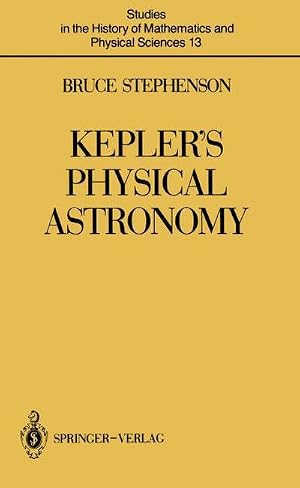
Buch. Zustand: Neu. Druck auf Anfrage Neuware - Printed after ordering - Kepler's Physical Astronomy is an account of Kepler's reformulation of astronomy as a physical science, and of his successful use of (incorrect) physics as a guide in his astronomical discoveries. It presents the only reliable account of the internal logic of Kepler's so-called first and second laws, showing how and to what extent Kepler thought he had derived them from his physical principles. It explains for the first time Kepler's attempt to use an obscure discovery of Tycho Brahe to unify and confirm all of his own physical theories. It also describes the intricate (and neglected) theory which Kepler developed to account for the additional anomalies needed for the theory of the moon.
-
Zustand: Sehr gut. Zustand: Sehr gut | Sprache: Englisch | Produktart: Bücher | Kepler's Physical Astronomy is an account of Kepler's reformulation of astronomy as a physical science, and of his successful use of (incorrect) physics as a guide in his astronomical discoveries. It presents the only reliable account of the internal logic of Kepler's so-called first and second laws, showing how and to what extent Kepler thought he had derived them from his physical principles. It explains for the first time Kepler's attempt to use an obscure discovery of Tycho Brahe to unify and confirm all of his own physical theories. It also describes the intricate (and neglected) theory which Kepler developed to account for the additional anomalies needed for the theory of the moon.
