

Gesamtpreis (1 Artikel Artikel):
Versandziel:

9780312294052 - Postcolonial Theory and Organizational Analysis: A Critical Engagement von Prasad, A. (5 Ergebnisse)
Direkt zu den wichtigsten Suchergebnissen
Suchfilter
Produktart
- Alle Product Types
- Bücher (5)
- Magazine & Zeitschriften (Keine weiteren Ergebnisse entsprechen dieser Verfeinerung)
- Comics (Keine weiteren Ergebnisse entsprechen dieser Verfeinerung)
- Noten (Keine weiteren Ergebnisse entsprechen dieser Verfeinerung)
- Kunst, Grafik & Poster (Keine weiteren Ergebnisse entsprechen dieser Verfeinerung)
- Fotografien (Keine weiteren Ergebnisse entsprechen dieser Verfeinerung)
- Karten (Keine weiteren Ergebnisse entsprechen dieser Verfeinerung)
- Manuskripte & Papierantiquitäten (Keine weiteren Ergebnisse entsprechen dieser Verfeinerung)
Zustand Mehr dazu
- Neu (5)
- Wie Neu, Sehr Gut oder Gut Bis Sehr Gut (Keine weiteren Ergebnisse entsprechen dieser Verfeinerung)
- Gut oder Befriedigend (Keine weiteren Ergebnisse entsprechen dieser Verfeinerung)
- Ausreichend oder Schlecht (Keine weiteren Ergebnisse entsprechen dieser Verfeinerung)
- Wie beschrieben (Keine weiteren Ergebnisse entsprechen dieser Verfeinerung)
Einband
- alle Einbände
- Hardcover (5)
- Softcover (Keine weiteren Ergebnisse entsprechen dieser Verfeinerung)
Weitere Eigenschaften
- Erstausgabe (Keine weiteren Ergebnisse entsprechen dieser Verfeinerung)
- Signiert (Keine weiteren Ergebnisse entsprechen dieser Verfeinerung)
- Schutzumschlag (Keine weiteren Ergebnisse entsprechen dieser Verfeinerung)
- Angebotsfoto (2)
Sprache (1)
Preis
- Beliebiger Preis
- Weniger als EUR 20 (Keine weiteren Ergebnisse entsprechen dieser Verfeinerung)
- EUR 20 bis EUR 45 (Keine weiteren Ergebnisse entsprechen dieser Verfeinerung)
- Mehr als EUR 45
Gratisversand
- Kostenloser Versand nach USA (Keine weiteren Ergebnisse entsprechen dieser Verfeinerung)
Land des Verkäufers
Verkäuferbewertung
-
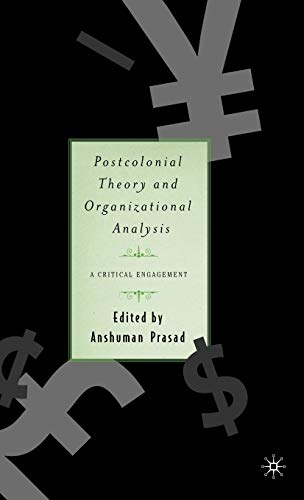
Postcolonial Theory and Organizational Analysis: A Critical Engagement
Anbieter: Ria Christie Collections, Uxbridge, Vereinigtes Königreich
Verkäuferbewertung 5 von 5 Sternen

EUR 139,48
EUR 13,82 Versand
Versand von Vereinigtes Königreich nach USAAnzahl: Mehr als 20 verfügbar
In den WarenkorbZustand: New. In.
-
Postcolonial Theory and Organizational Analysis: a Critical Engagement: A Critical Engagement
Anbieter: Revaluation Books, Exeter, Vereinigtes Königreich
Verkäuferbewertung 5 von 5 Sternen
EUR 191,51
EUR 11,54 Versand
Versand von Vereinigtes Königreich nach USAAnzahl: 2 verfügbar
In den WarenkorbHardcover. Zustand: Brand New. 1st edition. 309 pages. 8.25x5.50x1.00 inches. In Stock.
-
EUR 154,15
EUR 48,99 Versand
Versand von Deutschland nach USAAnzahl: Mehr als 20 verfügbar
In den WarenkorbGebunden. Zustand: New. ANSHUMAN PRASAD is Associate Professor of Management and Director, Doctoral Program, at the School of Business, University of New Haven, Connecticut. He has taught at the University of Calgary, and in the International MBA Program of the Helsinki School of .
-
Postcolonial Theory and Organizational Analysis
Anbieter: Kennys Bookstore, Olney, MD, USA
Verkäuferbewertung 5 von 5 Sternen
Zustand: New. This text takes up a question that has rarely been raised in the field of management: could modern Western colonialism have important implications for the practices and theories that inform management and organizations? Num Pages: 309 pages, 3 black & white illustrations, biography. BIC Classification: HBTQ; HBTR; KJU. Category: (P) Professional & Vocational; (UP) Postgraduate, Research & Scholarly; (UU) Undergraduate. Dimension: 216 x 140 x 22. Weight in Grams: 566. . 2003. Hardback. . . . . Books ship from the US and Ireland.
-

Postcolonial Theory and Organizational Analysis: A Critical Engagement
Sprache: Englisch
Verlag: Palgrave Macmillan Us Mai 2003, 2003
ISBN 10: 0312294050 ISBN 13: 9780312294052
Anbieter: AHA-BUCH GmbH, Einbeck, Deutschland
Verkäuferbewertung 5 von 5 Sternen
Buch. Zustand: Neu. Neuware - This book takes up a question that has rarely been raised in the field of management: 'Could modern Western colonialism have important implications for the practices and theories that inform management and organizations ' Employing the frameworks of postcolonial theory, an international group of scholars addresse this question, and offer remarkable insights about the implications of the colonial encounter for management. Wide-ranging in scope, the book covers major topics like cross-cultural management, control and resistance, corporate culture, the discourse of exoticization in museums and tourism, and stakeholder issues, and sheds new light on the troubling legacy of colonialism. Scholars and practitioners searching for a new idiom of management will find this book's critique of contemporary management invaluable.
