

Gesamtpreis (1 Artikel Artikel):
Versandziel:

9780306452611 - Chaos In The Cosmos: The Stunning Complexity of the Universe von Parker, Barry (8 Ergebnisse)
Direkt zu den wichtigsten Suchergebnissen
Suchfilter
Produktart
- Alle Product Types
- Bücher (8)
- Magazine & Zeitschriften (Keine weiteren Ergebnisse entsprechen dieser Verfeinerung)
- Comics (Keine weiteren Ergebnisse entsprechen dieser Verfeinerung)
- Noten (Keine weiteren Ergebnisse entsprechen dieser Verfeinerung)
- Kunst, Grafik & Poster (Keine weiteren Ergebnisse entsprechen dieser Verfeinerung)
- Fotografien (Keine weiteren Ergebnisse entsprechen dieser Verfeinerung)
- Karten (Keine weiteren Ergebnisse entsprechen dieser Verfeinerung)
- Manuskripte & Papierantiquitäten (Keine weiteren Ergebnisse entsprechen dieser Verfeinerung)
Zustand Mehr dazu
- Neu (5)
- Wie Neu, Sehr Gut oder Gut Bis Sehr Gut (Keine weiteren Ergebnisse entsprechen dieser Verfeinerung)
- Gut oder Befriedigend (3)
- Ausreichend oder Schlecht (Keine weiteren Ergebnisse entsprechen dieser Verfeinerung)
- Wie beschrieben (Keine weiteren Ergebnisse entsprechen dieser Verfeinerung)
Einband
Weitere Eigenschaften
- Erstausgabe (Keine weiteren Ergebnisse entsprechen dieser Verfeinerung)
- Signiert (Keine weiteren Ergebnisse entsprechen dieser Verfeinerung)
- Schutzumschlag (Keine weiteren Ergebnisse entsprechen dieser Verfeinerung)
- Angebotsfoto (2)
Sprache (1)
Gratisversand
Land des Verkäufers
Verkäuferbewertung
-
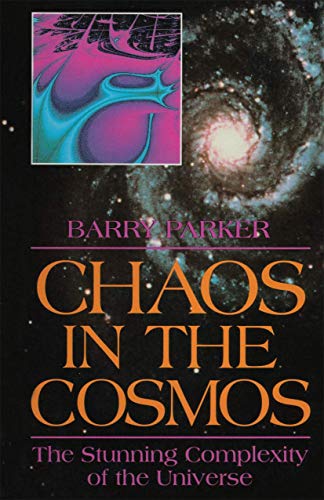
Chaos in the Cosmos : The Stunning Complexity of the Universe
Anbieter: Better World Books, Mishawaka, IN, USA
Verkäuferbewertung 5 von 5 Sternen

Zustand: Good. Pages intact with minimal writing/highlighting. The binding may be loose and creased. Dust jackets/supplements are not included. Stock photo provided. Product includes identifying sticker. Better World Books: Buy Books. Do Good.
-
Chaos in the Cosmos : The Stunning Complexity of the Universe
Anbieter: Better World Books, Mishawaka, IN, USA
Verkäuferbewertung 5 von 5 Sternen
Zustand: Good. Former library copy. Pages intact with minimal writing/highlighting. The binding may be loose and creased. Dust jackets/supplements are not included. Includes library markings. Stock photo provided. Product includes identifying sticker. Better World Books: Buy Books. Do Good.
-
Chaos in the Cosmos: The Stunning Complexity of the Universe
Anbieter: World of Books (was SecondSale), Montgomery, IL, USA
Verkäuferbewertung 5 von 5 Sternen
Zustand: Good. Good condition ex-library book with usual library markings and stickers.
-
Chaos in the Cosmos: The Stunning Complexity of the Universe
Anbieter: Ria Christie Collections, Uxbridge, Vereinigtes Königreich
Verkäuferbewertung 5 von 5 Sternen
EUR 60,60
EUR 13,88 Versand
Versand von Vereinigtes Königreich nach USAAnzahl: Mehr als 20 verfügbar
In den WarenkorbZustand: New. In.
-
Chaos in the Cosmos: The Stunning Complexity of the Universe
Sprache: Englisch
Verlag: Kluwer Boston Incorporated, 1996
ISBN 10: 0306452618 ISBN 13: 9780306452611
Anbieter: Kennys Bookstore, Olney, MD, USA
Verkäuferbewertung 5 von 5 Sternen
Zustand: New. "As this remarkable book shows, we live in a universe beset with chaos. Highly acclaimed popular science writer Barry Parker shows - for the first time in a popular work - the amazing impact chaos theo" . . 1996. Softcover reprint of the original 1st ed. 1996. hardcover. . . . . Books ship from the US and Ireland.
-
Chaos in the Cosmos: The Stunning Complexity of the Universe
Anbieter: Revaluation Books, Exeter, Vereinigtes Königreich
Verkäuferbewertung 5 von 5 Sternen
EUR 80,31
EUR 14,48 Versand
Versand von Vereinigtes Königreich nach USAAnzahl: 2 verfügbar
In den WarenkorbHardcover. Zustand: Brand New. 307 pages. 8.75x5.75x1.00 inches. In Stock.
-

EUR 48,37
EUR 48,99 Versand
Versand von Deutschland nach USAAnzahl: Mehr als 20 verfügbar
In den WarenkorbKartoniert / Broschiert. Zustand: New.
-

Chaos in the Cosmos : The Stunning Complexity of the Universe
Anbieter: AHA-BUCH GmbH, Einbeck, Deutschland
Verkäuferbewertung 5 von 5 Sternen
Taschenbuch. Zustand: Neu. Druck auf Anfrage Neuware - Printed after ordering - 'he year was 1889. The French physicist-mathematician Henry T Poincare could not believe his eyes. He had worked for months on one of the most famous problems in science-the problem of three bodies moving around one another under mutual gravita tional attraction-and what he was seeing dismayed and trou bled him. Since Newton's time it had been assumed that the problem was solvable. All that was needed was a little ingenuity and considerable perseverance, but Poincare saw that this was not the case. Strange, unexplainable things happened when he delved into the problem; it was not solvable after all. Poincare was shocked and dismayed by the result-so disheartened he left the problem and went on to other things. What Poincare was seeing was the first glimpse of a phe nomenon we now call chaos. With his discovery the area lay dormant for almost 90 years. Not a single book was written about the phenomenon, and only a trickle of papers appeared. Then, about 1980 a resurgence of interest began, and thousands of papers appeared along with dozens of books. The new science of chaos was born and has attracted as much attention in recent years as breakthroughs in superconductivity and superstring theory.
