

Gesamtpreis (1 Artikel Artikel):
Versandziel:

9780295974583 - Language and Human Behavior (Jessie and John Danz Lecture Series) von Bickerton, Derek (6 Ergebnisse)
Direkt zu den wichtigsten Suchergebnissen
Suchfilter
Produktart
- Alle Product Types
- Bücher (6)
- Magazine & Zeitschriften (Keine weiteren Ergebnisse entsprechen dieser Verfeinerung)
- Comics (Keine weiteren Ergebnisse entsprechen dieser Verfeinerung)
- Noten (Keine weiteren Ergebnisse entsprechen dieser Verfeinerung)
- Kunst, Grafik & Poster (Keine weiteren Ergebnisse entsprechen dieser Verfeinerung)
- Fotografien (Keine weiteren Ergebnisse entsprechen dieser Verfeinerung)
- Karten (Keine weiteren Ergebnisse entsprechen dieser Verfeinerung)
- Manuskripte & Papierantiquitäten (Keine weiteren Ergebnisse entsprechen dieser Verfeinerung)
Zustand Mehr dazu
- Neu (3)
- Wie Neu, Sehr Gut oder Gut Bis Sehr Gut (Keine weiteren Ergebnisse entsprechen dieser Verfeinerung)
- Gut oder Befriedigend (3)
- Ausreichend oder Schlecht (Keine weiteren Ergebnisse entsprechen dieser Verfeinerung)
- Wie beschrieben (Keine weiteren Ergebnisse entsprechen dieser Verfeinerung)
Einband
- alle Einbände
- Hardcover (Keine weiteren Ergebnisse entsprechen dieser Verfeinerung)
- Softcover (6)
Weitere Eigenschaften
- Erstausgabe (Keine weiteren Ergebnisse entsprechen dieser Verfeinerung)
- Signiert (Keine weiteren Ergebnisse entsprechen dieser Verfeinerung)
- Schutzumschlag (Keine weiteren Ergebnisse entsprechen dieser Verfeinerung)
- Angebotsfoto (2)
Sprache (1)
Gratisversand
Land des Verkäufers
Verkäuferbewertung
-
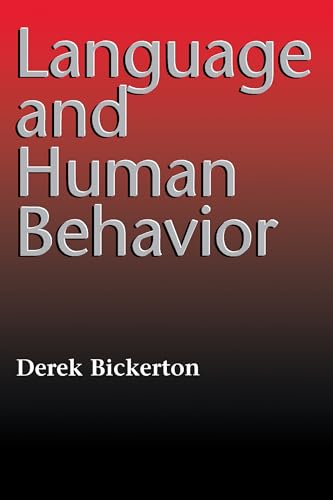
Language and Human Behavior
Sprache: Englisch
Verlag: University of Washington Press, 1996
ISBN 10: 0295974583 ISBN 13: 9780295974583
Anbieter: ThriftBooks-Atlanta, AUSTELL, GA, USA
Verkäuferbewertung 5 von 5 Sternen

Paperback. Zustand: Good. No Jacket. Pages can have notes/highlighting. Spine may show signs of wear. ~ ThriftBooks: Read More, Spend Less.
-
Language and Human Behavior
Sprache: Englisch
Verlag: University of Washington Press, 1996
ISBN 10: 0295974583 ISBN 13: 9780295974583
Anbieter: Better World Books, Mishawaka, IN, USA
Verkäuferbewertung 5 von 5 Sternen
Zustand: Good. Pages intact with minimal writing/highlighting. The binding may be loose and creased. Dust jackets/supplements are not included. Stock photo provided. Product includes identifying sticker. Better World Books: Buy Books. Do Good.
-
Language and Human Behavior (Jessie and John Danz Lectures)
Sprache: Englisch
Verlag: University of Washington Press, 1996
ISBN 10: 0295974583 ISBN 13: 9780295974583
Paperback. Zustand: Good. Paperback in good condition. All inside pages are in great shape. Some damage along the edge of the spine in two spots (1.5 inches x 2). Spine is tight. Front and back cover are in good shape.
-
Language and Human Behavior
Anbieter: Revaluation Books, Exeter, Vereinigtes Königreich
Verkäuferbewertung 5 von 5 Sternen
EUR 45,92
EUR 11,56 Versand
Versand von Vereinigtes Königreich nach USAAnzahl: 2 verfügbar
In den WarenkorbPaperback. Zustand: Brand New. reprint edition. 190 pages. 9.50x6.25x0.50 inches. In Stock.
-

EUR 37,46
EUR 48,99 Versand
Versand von Deutschland nach USAAnzahl: Mehr als 20 verfügbar
In den WarenkorbZustand: New. Über den AutorDerek BickertonInhaltsverzeichnisAcknowledgmentsIntroductionWhat language isLanguage and evolutionLanguage and intelligenceLanguage and consciousnessCo.
-

Language and Human Behavior
Sprache: Englisch
Verlag: University Of Washington Press Mär 1996, 1996
ISBN 10: 0295974583 ISBN 13: 9780295974583
Anbieter: AHA-BUCH GmbH, Einbeck, Deutschland
Verkäuferbewertung 5 von 5 Sternen
Taschenbuch. Zustand: Neu. Neuware - According to Bickerton, the behavioral sciences have failed to give an adequate account of human nature at least partly because of the conjunction and mutual reinforcement of two widespread beliefs: that language is simply a means of communication and that human intelligence is the result of the rapid growth and unusual size of human brains. Bickerton argues that each of the properties distinguishing human intelligence and consciousness from that of other animals can be shown to derive straightforwardly from properties of language. In essence, language arose as a representational system, not a means of communication or a skill, and not a product of culture but an evolutionary adaptation. The author stresses the necessity of viewing intelligence in evolutionary terms, seeing it not as problem solving but as a way of maintaining homeostasis - the preservation of those conditions most favorable to an organism, the optimal achievable conditions for survival and well-being. The term protolanguage is used to describe the stringing together of symbols that prehuman hominids employed. 'It did not allow them to turn today's imagination into tomorrow's fact. But it is just this power to transform imagination into fact that distinguishes human behavior from that of our ancestral species, and indeed from that of all other species. It is exactly what enables us to change our behavior, or invent vast ranges of new behavior, practically overnight, with no concomitant genetic changes'. Language and Human Behavior should be of interest to anyone in the behavioral and evolutionary sciences and to all those concerned with the role of language in human behavior.
