
Gesamtpreis (1 Artikel Artikel):
Versandziel:

9780262525503 - Interface (Mit Press) von Hookway, Branden (8 Ergebnisse)
Direkt zu den wichtigsten Suchergebnissen
Suchfilter
Produktart
- Alle Product Types
- Bücher (8)
- Magazine & Zeitschriften (Keine weiteren Ergebnisse entsprechen dieser Verfeinerung)
- Comics (Keine weiteren Ergebnisse entsprechen dieser Verfeinerung)
- Noten (Keine weiteren Ergebnisse entsprechen dieser Verfeinerung)
- Kunst, Grafik & Poster (Keine weiteren Ergebnisse entsprechen dieser Verfeinerung)
- Fotografien (Keine weiteren Ergebnisse entsprechen dieser Verfeinerung)
- Karten (Keine weiteren Ergebnisse entsprechen dieser Verfeinerung)
- Manuskripte & Papierantiquitäten (Keine weiteren Ergebnisse entsprechen dieser Verfeinerung)
Zustand Mehr dazu
- Neu (4)
- Wie Neu, Sehr Gut oder Gut Bis Sehr Gut (2)
- Gut oder Befriedigend (2)
- Ausreichend oder Schlecht (Keine weiteren Ergebnisse entsprechen dieser Verfeinerung)
- Wie beschrieben (Keine weiteren Ergebnisse entsprechen dieser Verfeinerung)
Einband
- alle Einbände
- Hardcover (Keine weiteren Ergebnisse entsprechen dieser Verfeinerung)
- Softcover (8)
Weitere Eigenschaften
- Erstausgabe (Keine weiteren Ergebnisse entsprechen dieser Verfeinerung)
- Signiert (Keine weiteren Ergebnisse entsprechen dieser Verfeinerung)
- Schutzumschlag (Keine weiteren Ergebnisse entsprechen dieser Verfeinerung)
- Angebotsfoto (3)
Sprache (1)
Preis
- Beliebiger Preis
- Weniger als EUR 20
- EUR 20 bis EUR 40
- Mehr als EUR 40 (Keine weiteren Ergebnisse entsprechen dieser Verfeinerung)
Gratisversand
Land des Verkäufers
Verkäuferbewertung
-

Zustand: very_good. Pages are clean with no markings. May show minor signs of wear or cosmetic defects marks, cuts, bends, or scuffs on the cover, spine, pages, or dust jacket. May have remainder marks on edges.
-
Zustand: Very Good. Former library copy. Pages intact with possible writing/highlighting. Binding strong with minor wear. Dust jackets/supplements may not be included. Includes library markings. Stock photo provided. Product includes identifying sticker. Better World Books: Buy Books. Do Good.
-
Paperback. Zustand: As New. No Jacket. Pages are clean and are not marred by notes or folds of any kind. ~ ThriftBooks: Read More, Spend Less.
-
Zustand: as new. Wie neu/Like new.
-
Interface
Anbieter: Revaluation Books, Exeter, Vereinigtes Königreich
Verkäuferbewertung 5 von 5 Sternen

EUR 30,24
EUR 11,51 Versand
Versand von Vereinigtes Königreich nach USAAnzahl: 1 verfügbar
In den WarenkorbPaperback. Zustand: Brand New. 184 pages. 8.00x5.25x0.75 inches. In Stock.
-
Zustand: New. Num Pages: 184 pages, 12 b&w illus. BIC Classification: PDR; UYZF. Category: (P) Professional & Vocational. Dimension: 203 x 139 x 17. Weight in Grams: 346. . 2014. Paperback. . . . . Books ship from the US and Ireland.
-

Kartoniert / Broschiert. Zustand: New. Branden Hookway teaches in the Department of Architecture and the Department of Design and Environmental Analysis at Cornell University. He is author of Pandemonium: The Rise of Predatory Locales in the Postwar World.A cultural theory of the i.
-

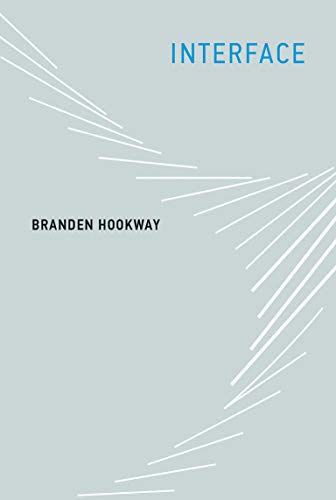
Taschenbuch. Zustand: Neu. Neuware - A cultural theory of the interface as a relation that is both ubiquitous and elusive, drawing on disciplines from cultural theory to architecture.In this book, Branden Hookway considers the interface not as technology but as a form of relationship with technology. The interface, Hookway proposes, is at once ubiquitous and hidden from view. It is both the bottleneck through which our relationship to technology must pass and a productive encounter embedded within the use of technology. It is a site of contestation between human and machine, between the material and the social, between the political and the technological that both defines and elides differences.A virtuoso in multiple disciplines, Hookway offers a theory of the interface that draws on cultural theory, political theory, philosophy, art, architecture, new media, and the history of science and technology. He argues that the theoretical mechanism of the interface offers a powerful approach to questions of the human relationship to technology. Hookway finds the origin of the term interface in nineteenth-century fluid dynamics and traces its migration to thermodynamics, information theory, and cybernetics. He discusses issues of subject formation, agency, power, and control, within contexts that include technology, politics, and the social role of games. He considers the technological augmentation of humans and the human-machine system, discussing notions of embodied intelligence.Hookway views the figure of the subject as both receiver and active producer in processes of subjectification. The interface, he argues, stands in a relation both alien and intimate, vertiginous and orienting to those who cross its threshold.

