

Gesamtpreis (1 Artikel Artikel):
Versandziel:

9780195037784 - Power in the Highest Degree: Professionals and the Rise of a New Mandarin Orderndarin Order von Derber, Charles; Schwartz, William A.; Magrass, Yale R. (6 Ergebnisse)
Direkt zu den wichtigsten Suchergebnissen
Suchfilter
Produktart
- Alle Product Types
- Bücher (6)
- Magazine & Zeitschriften (Keine weiteren Ergebnisse entsprechen dieser Verfeinerung)
- Comics (Keine weiteren Ergebnisse entsprechen dieser Verfeinerung)
- Noten (Keine weiteren Ergebnisse entsprechen dieser Verfeinerung)
- Kunst, Grafik & Poster (Keine weiteren Ergebnisse entsprechen dieser Verfeinerung)
- Fotografien (Keine weiteren Ergebnisse entsprechen dieser Verfeinerung)
- Karten (Keine weiteren Ergebnisse entsprechen dieser Verfeinerung)
- Manuskripte & Papierantiquitäten (Keine weiteren Ergebnisse entsprechen dieser Verfeinerung)
Zustand Mehr dazu
- Neu (3)
- Wie Neu, Sehr Gut oder Gut Bis Sehr Gut (1)
- Gut oder Befriedigend (2)
- Ausreichend oder Schlecht (Keine weiteren Ergebnisse entsprechen dieser Verfeinerung)
- Wie beschrieben (Keine weiteren Ergebnisse entsprechen dieser Verfeinerung)
Einband
- alle Einbände
- Hardcover (6)
- Softcover (Keine weiteren Ergebnisse entsprechen dieser Verfeinerung)
Weitere Eigenschaften
- Erstausgabe (1)
- Signiert (Keine weiteren Ergebnisse entsprechen dieser Verfeinerung)
- Schutzumschlag (1)
- Angebotsfoto (3)
Sprache (1)
Gratisversand
Land des Verkäufers
Verkäuferbewertung
-

Power in the Highest Degree (First Printing) Professionals and the Rise of a New Mandarin Order
Sprache: Englisch
Verlag: Oxford University Press, New York, NY, 1990
ISBN 10: 0195037782 ISBN 13: 9780195037784
Anbieter: True Oak Books, Highland, NY, USA
Verbandsmitglied: IOBA
Verkäuferbewertung 5 von 5 Sternen

Erstausgabe
Hardcover. Zustand: Good. Zustand des Schutzumschlags: No Dust Jacket. First Edition; First Printing. 9 X 6 X 0.81 inches; 275 pages; light foxing on the exterior edges of textblock. Good condition otherwise. No other noteworthy defects. No markings. ; - Your satisfaction is our priority. We offer free returns and respond promptly to all inquiries. Your item will be carefully cushioned in bubble wrap and securely boxed. All orders ship on the same or next business day. Buy with confidence.
-
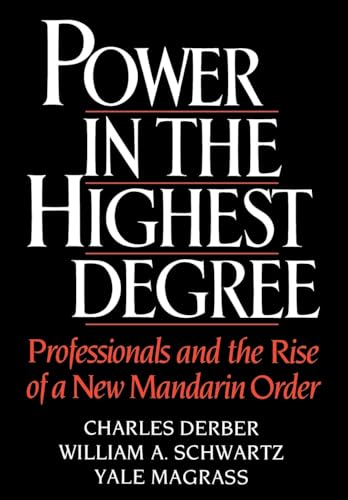
Hardcover. Zustand: New. In shrink wrap.
-
Power in the Highest Degree: Professionals and the Rise of a New Mandarin Order
Anbieter: Anybook.com, Lincoln, Vereinigtes Königreich
Verkäuferbewertung 5 von 5 Sternen
EUR 7,34
EUR 15,40 Versand
Versand von Vereinigtes Königreich nach USAAnzahl: 1 verfügbar
In den WarenkorbZustand: Good. This is an ex-library book and may have the usual library/used-book markings inside.This book has hardback covers. Clean from markings. In good all round condition. Please note the Image in this listing is a stock photo and may not match the covers of the actual item,700grams, ISBN:0195037782.
-
Power in the highest degree : professionals and the rise of a new Mandarin order.
Anbieter: Kloof Booksellers & Scientia Verlag, Amsterdam, Niederlande
Verkäuferbewertung 4 von 5 Sternen

Zustand: as new. New York : Oxford University Press, 1990. Hardcover. Dustjacket. 275 pp. Includes bibliographical references (p. 229-259) and index. - Lawyer, doctor, scientist--these are the jobs Americans commonly cite when asked to list the most prestigious occupations. The word ''professional'' today implies expertise, authority, and excellence. To do a job professionally is to do it well. Yet in a society in which knowledge has become a prized asset and an advanced degree the ticket to wealth and power, the rise of professionalism has a darker, more ominous side. Power in the Highest Degree, one of the most comprehensive studies of professionals ever undertaken, exposes professionalism as a double-edged sword; it illustrates how experts have come to ''own'' and control knowledge, much like the wealthy control capital, thereby transforming capitalist and socialist society, both for better and for worse. Knowledge long predates money as a source of power and wealth in human society, and professionals are only the most recent in a long succession of powerful knowledge classes that have included shaman, witchdoctors, and the Confucian mandarins who ruled China for over a thousand years.Drawing on interviews with over 1,000 practicing professionals, the authors show how, by dispensing self-interested and morally colored judgements as scientific truth, modern professionals are consolidating a monopoly over what passes for objective knowledge. Experts discredit the ordinary knowledge of the general public to generate a vast market of dependent clients. The result is a powerful professional class that creates vital new knowledge and life-saving services, but also wields growing influence over a population deeply insecure about its ability to manage private and public affairs without ''expert'' guidance. English text. Condition : as new. Condition : as new copy. ISBN 9780195037784. Keywords : ,
-
EUR 40,54
EUR 48,99 Versand
Versand von Deutschland nach USAAnzahl: Mehr als 20 verfügbar
In den WarenkorbGebunden. Zustand: New. KlappentextrnrnPower in the Highest Degree, one of the most comprehensive studies of professionals ever undertaken, exposes professionalism as a double-edged sword that is transforming capitalist and socialist societies alike. Drawing on intervi.
-

Power in the Highest Degree : Professionals and the Rise of a New Mandarin Order
Sprache: Englisch
Verlag: Oxford University Press Inc Sep 1990, 1990
ISBN 10: 0195037782 ISBN 13: 9780195037784
Anbieter: AHA-BUCH GmbH, Einbeck, Deutschland
Verkäuferbewertung 5 von 5 Sternen
Buch. Zustand: Neu. Neuware - One of the most sweeping works of social criticism to appear in years, this work offers a bold theory of modern classes and a comprehensive portrait of the modern professional. Drawing on one of the largest studies ever undertaken, including interviews with over 1,000 professionals, the authors show how experts, claiming a monopoly on many types of knowledge, are radically transforming the economic and social order.This book demonstrates how this has resulted in many citizens becoming deeply insecure about their competence to manage private and public affairs without professional guidance. The authors make a case for a society that radically democratizes knowledge while retaining many non-exclusive aspects of professionalism.

