
Gesamtpreis (1 Artikel Artikel):
Versandziel:

9780151997268 - The X-craft raid (5 Ergebnisse)
Direkt zu den wichtigsten Suchergebnissen
Suchfilter
Produktart
- Alle Product Types
- Bücher (5)
- Magazine & Zeitschriften (Keine weiteren Ergebnisse entsprechen dieser Verfeinerung)
- Comics (Keine weiteren Ergebnisse entsprechen dieser Verfeinerung)
- Noten (Keine weiteren Ergebnisse entsprechen dieser Verfeinerung)
- Kunst, Grafik & Poster (Keine weiteren Ergebnisse entsprechen dieser Verfeinerung)
- Fotografien (Keine weiteren Ergebnisse entsprechen dieser Verfeinerung)
- Karten (Keine weiteren Ergebnisse entsprechen dieser Verfeinerung)
- Manuskripte & Papierantiquitäten (Keine weiteren Ergebnisse entsprechen dieser Verfeinerung)
Zustand Mehr dazu
- Neu (Keine weiteren Ergebnisse entsprechen dieser Verfeinerung)
- Wie Neu, Sehr Gut oder Gut Bis Sehr Gut (Keine weiteren Ergebnisse entsprechen dieser Verfeinerung)
- Gut oder Befriedigend (4)
- Ausreichend oder Schlecht (1)
- Wie beschrieben (Keine weiteren Ergebnisse entsprechen dieser Verfeinerung)
Einband
Weitere Eigenschaften
- Erstausgabe (Keine weiteren Ergebnisse entsprechen dieser Verfeinerung)
- Signiert (Keine weiteren Ergebnisse entsprechen dieser Verfeinerung)
- Schutzumschlag (1)
- Angebotsfoto (Keine weiteren Ergebnisse entsprechen dieser Verfeinerung)
Sprache (1)
Gratisversand
Land des Verkäufers
Verkäuferbewertung
-
Hardcover. Zustand: Very Good. No Jacket. May have limited writing in cover pages. Pages are unmarked. ~ ThriftBooks: Read More, Spend Less.
-
Hardcover. Zustand: Fair. No Jacket. Former library book; Readable copy. Pages may have considerable notes/highlighting. ~ ThriftBooks: Read More, Spend Less.
-
Paperback. Zustand: Good. VG, Hardcover with dust jacket. Jacket may appear stressed, some soiling. Silversides submarine library copy with usual markings: Covers wrapped with protective mylar, card catalog numbers taped to spine or written on front end-paper, library bookplates inside front cover; the text and images are clean and unmarked. Pages are clean and unmarked. Binding is tight, hinges are strong.; 100% Satisfaction Guaranteed! Ships same or next business day!
-
The X-Craft Raid
Anbieter: Roundabout Books, Greenfield, MA, USA
Verbandsmitglied: SNEAB
Verkäuferbewertung 4 von 5 Sternen

paperback. Zustand: Very Good. Clean, unmarked copy with some edge wear. Good binding. Dust jacket included if issued with one. We ship in recyclable American-made mailers. 100% money-back guarantee on all orders.
-
The X-Craft Raid
Sprache: Englisch
Verlag: Harcourt Brace Jovanovich, Inc, New York, 1971
ISBN 10: 0151997268 ISBN 13: 9780151997268
Anbieter: Ground Zero Books, Ltd., Silver Spring, MD, USA
Verkäuferbewertung 4 von 5 Sternen
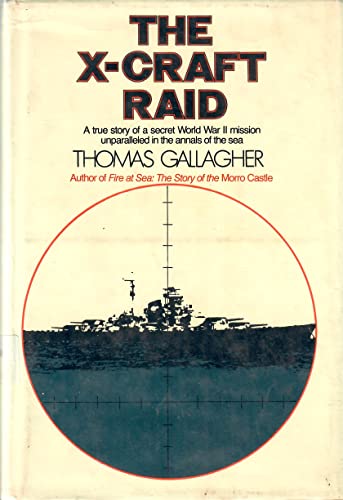
Hardcover. Zustand: Very Good. Zustand des Schutzumschlags: Good. presumed second printing. Format is approximately 5.75 inches by 8 inches. x, [6], 170, [4] pages. Maps. Illustrations. DJ worn, stained and soiled. Includes Preface; The Challenge; The Challenge Met; The Passage; The Attack; Aftermath; and Index. Includes 11 illustrations between pages 142 and 143, as well as two Black and White maps (Attack on the Tirpitz, and Tirpitz Berth). An account of a secret World War II mission unparalleled in the annals of the sea. Thomas Gallagher's account of the gallant and almost unbelievable expedition of British midget submarines to attack and disable the German battleship Tirpitz is one of the great stories to come out of World War II. The Tirpitz was the mightiest naval vessel in all of Europe. When the Germans slipped her into the fjords of occupied Norway in January 1942, she became an overwhelming menace to Allied shipping. Her presence made it impossible for British battleships and aircraft carriers needed in the Pacific to get there. All attempts to destroy her had failed. Churchill and many others felt that she was one of the two or three most crucial problems of the war. Churchill demanded a new weapon. The result was the British X-craft, or midget submarine, and a secret mission against the battleship that was a thousand times the X-craft's size. Gallagher gives the story an unremitting tension, and his material remains fascinating down to the postscripts. This book is at once a mystery and a social document. Readers will be impressed with this coldly surgical dissection of human frailty and the breakdown of human values when leadership fails in a crisis. Thomas Gallagher (1918-1992) was a widely published journalist and the author of eight books, including The Gathering Darkness (1952), which was nominated for a National Book Award; and Fire at Sea: The Story of the Morro Castle (1959), which won the Edgar Allan Poe Award for nonfiction. Thomas Gallagher was a writer whose painstaking research informed nonfiction on great disasters and military heroism and novels that probed the lost lives of bumbling, self-destructive people. Mr. Gallagher was born in Manhattan in 1918. After graduating from Columbia College in 1941, he served in Iran during World War II as a civilian attached to the Army Corps of Engineers. He then shipped out as a seaman on freighters with the merchant marine, where he began to write. His well-received first novel, "The Gathering Darkness" (Bobbs-Merrill, 1952), traced the disintegration of a New York family after it lost its fortune in the stock market crash of 1929. Although he continued to write novels, Mr. Gallagher also turned to nonfiction, producing "The X-Craft Raid" and "Fire at Sea" (Rhinehart & Company, 1959), an investigation of the 1934 fire that destroyed the luxury liner Morro Castle off the New Jersey coast. Mr. Gallagher concluded that rather than being an accident, the fire was set by the ship's sociopathic radio officer. The book won the Edgar Allen Poe Award for nonfiction. Mr. Gallagher's last novel, "Paddy's Lament" (Harcourt Brace Jovanovich, 1982), dealt with the Irish potato famine. Derived from a Kirkus review: Churchill glumly called it "the beast" and declared that "the entire naval situation throughout the world would be altered" if it were sunk or crippled; the 43,000-ton battleship Tirpitz, kept at anchor in a Norwegian fjord, paralyzed the Royal Navy in the North Atlantic. Gallagher has reconstructed the improbable story of how a small band of highly selected British naval officers in "ugly ducklings" -- specially designed midget submarines -- carried out the unenviable job of destroying the monster. He has poured through logs, diaries and intelligence reports and interviewed British, German and Norwegian survivors of the nautical David and Goliath encounter and he conveys the perils of the actual raid with mounting excitement. The X-craft (six were eventually launched) was a marvel of British ingenuity; above water it was propelled by the motor of the venerable London bus and its crew of four engineer-acrobat-divers reported that logistically "climbing inside a midget was like climbing inside a clock." Dangers included drowning, suffocation, detection and self-detonation. Several volunteers perished, some of the craft had to be scuttled, a few men survived minefields, antisubmarine nets, flooded periscopes, broken gyros and failing oxygen supplies to become post-war heroes. This holds the attention of even those normally immune to sea-fever and indifferent to sink-the-Bismarck heroics.

