

Gesamtpreis (1 Artikel Artikel):
Versandziel:

weisinger mortimer (5 Ergebnisse)
Direkt zu den wichtigsten Suchergebnissen
Suchfilter
Produktart
- Alle Product Types
- Bücher (4)
- Magazine & Zeitschriften (1)
- Comics (Keine weiteren Ergebnisse entsprechen dieser Verfeinerung)
- Noten (Keine weiteren Ergebnisse entsprechen dieser Verfeinerung)
- Kunst, Grafik & Poster (Keine weiteren Ergebnisse entsprechen dieser Verfeinerung)
- Fotografien (Keine weiteren Ergebnisse entsprechen dieser Verfeinerung)
- Karten (Keine weiteren Ergebnisse entsprechen dieser Verfeinerung)
- Manuskripte & Papierantiquitäten (Keine weiteren Ergebnisse entsprechen dieser Verfeinerung)
Zustand Mehr dazu
- Neu (Keine weiteren Ergebnisse entsprechen dieser Verfeinerung)
- Wie Neu, Sehr Gut oder Gut Bis Sehr Gut (3)
- Gut oder Befriedigend (2)
- Ausreichend oder Schlecht (Keine weiteren Ergebnisse entsprechen dieser Verfeinerung)
- Wie beschrieben (Keine weiteren Ergebnisse entsprechen dieser Verfeinerung)
Einband
- alle Einbände
- Hardcover (Keine weiteren Ergebnisse entsprechen dieser Verfeinerung)
- Softcover (1)
Weitere Eigenschaften
- Erstausgabe (4)
- Signiert (1)
- Schutzumschlag (Keine weiteren Ergebnisse entsprechen dieser Verfeinerung)
- Angebotsfoto (5)
Sprache (2)
Preis
- Beliebiger Preis
- Weniger als EUR 20 (Keine weiteren Ergebnisse entsprechen dieser Verfeinerung)
- EUR 20 bis EUR 45 (Keine weiteren Ergebnisse entsprechen dieser Verfeinerung)
- Mehr als EUR 45
Gratisversand
Land des Verkäufers
Verkäuferbewertung
-

Startling Stories, March 1939, Vol. 1 No. 2
Verlag: Better Publications, 1939
Anbieter: HALCYON BOOKS, LONDON, Vereinigtes Königreich
Verkäuferbewertung 5 von 5 Sternen

EUR 55,49
EUR 20,85 Versand
Versand von Vereinigtes Königreich nach USAAnzahl: 1 verfügbar
In den WarenkorbSoftcover. Zustand: Very Good. Pages clean with light age toning. Light wear to edges. Rubbing to covers. Featuring "The Impossible World," by Eando Binder, with interior illustrations by Virgil Finlay. Also stories by P. Schuyler Miller, Edmond Hamilton and Will Garth. ALL ITEMS ARE DISPATCHED FROM THE UK WITHIN 48 HOURS ( BOOKS ORDERED OVER THE WEEKEND DISPATCHED ON MONDAY) ALL OVERSEAS ORDERS SENT BY TRACKABLE AIR MAIL. IF YOU ARE LOCATED OUTSIDE THE UK PLEASE ASK US FOR A POSTAGE QUOTE FOR MULTI VOLUME SETS BEFORE ORDERING.
-
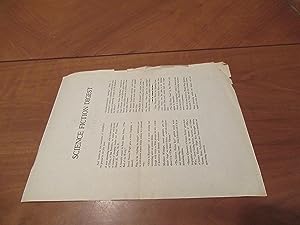
Science Fiction Digest, Full Page Flyer For "Cosmos" To Be Printed In The July 1933 Issue
Sprache: Englisch
Verlag: Science Fiction Digest Company, Jamaica, New York, 1933
Anbieter: Arroyo Seco Books, Pasadena, Member IOBA, Pasadena, CA, USA
Verbandsmitglied: IOBA
Verkäuferbewertung 5 von 5 Sternen
Magazin / Zeitschrift Erstausgabe Signiert
No Binding. Zustand: Good. First Edition. Single Sheet 11" X 8 1/2", Printed On Both Sides, Advertising The "Cosmos" Serial Beginning In The Forthcoming July (1933) Issue. Rare. Signed by Forrest Ackerman.
-

Science Fiction Digest Vol.1 No. 1, September 1932 And No. 2 October 1932
Sprache: Englisch
Verlag: Science Fiction Digest, Brooklyn / South Ozone Park, 1932
Anbieter: Arroyo Seco Books, Pasadena, Member IOBA, Pasadena, CA, USA
Verbandsmitglied: IOBA
Verkäuferbewertung 5 von 5 Sternen
Erstausgabe
Stapled Sheets. Zustand: Near Fine. First Edition. Two Volumes, Near New, Unread, Very Lightly Aged Paper. The Start Of The Genre, "Science Fiction" Treated As A Class Of Literature, The First Sf Fanzine. Rare In Fine Condition. With, The Separate Preliminary Publicity Sheet For Science Fiction Digest, 8 1/2" X 11"; On The Reverse Is An Extensive Ad For Cosmos, The Collaborative Novel To Be Published In A Later Issue Of Science Fiction Digest.
-
Science Fiction Digest [Complete Run]
Verlag: Science Fiction Digest Company, Brooklyn, NY; South Ozone Park, NY; Jamaica, NY, 1933
Anbieter: Burnside Rare Books, ABAA, Portland, OR, USA
Verbandsmitglied: ABAA CBA ILAB
Verkäuferbewertung 5 von 5 Sternen
Erstausgabe
Zustand: Near Fine. First Edition. September 1932 (volume 1, number 1) through December 1933 (volume 2, number 4, whole number 16). A complete run of the amateur magazine published as Science Fiction Digest, prior to its name change to Fantasy Magazine with issue number 17. The Cosmos supplement is not present. Sixteen issues, bound in side-stapled wraps and side-stapled self-wraps. Ranging from Very Good to Near Fine, with general wear, light pencil notations, soiling, some wear to spines and staples. Several small mends and chips, several rear covers detached. A very early science fiction fanzine which absorbed The Time Traveller, which is considered by many to be the first true science fiction fanzine. The two publications shared several overlapping founders and editors. Complete runs are scarce.
-
The Time Traveller: Science Fiction's Only Fan Magazine [later] The Time Traveller: Science Fiction's First Fan Magazine
Verlag: Allen Glasser, New York, 1933
Anbieter: Burnside Rare Books, ABAA, Portland, OR, USA
Verbandsmitglied: ABAA CBA ILAB
Verkäuferbewertung 5 von 5 Sternen
Erstausgabe
Zustand: Near Fine. First Edition. Six of the nine issues of the first "true" science fiction fanzine. Volume I, Numbers 4 - 9, running from April-May 1932 to Winter 1933. Each of the first five issues consists of four to nine mimeographed sheets of typing paper printed both sides and bound with two staples. The sixth issue, printed on a single folded sheet, is subtitled "Science Fiction's First Fan Magazine" rather than "Only Fan Magazine" and announces the fanzine's imminent absorption by Science Fiction Digest. Near Fine with light wear, soiling, and toning; original staples have been replaced, leaving rust traces behind. Two soft subscription creases to each magazine, minimal waterstaining to upper edges, and paper reinforcement to final leaf of No. 4. Rare. The Time Traveller, named after the protagonist of H.G. Wells' famous novel The Time Machine, was a short-lived labor of love by twenty-three-year-old Allen Glasser with help from several teenaged members of the science fiction fan club "The Scienceers," which he had cofounded three years previously. The club produced six issues of a periodical called The Planet, which could justifiably be called the first science fiction fan magazine, but the crown is generally awarded to its successor The Time Traveller on the basis that the latter is entirely and not partly devoted to science fiction. The youthful contributing editors went on to careers in science fiction: Mortimer Weisinger and Julius Schwartz both became well-known editors at DC Comics, while Forrest J. Ackerman wrote and acted and served as a literary agent for authors like Ray Bradbury and Isaac Asimov. Whatever career Glasser might have had was cut short by plagiarism allegations, but he remained a science fiction fan and confounded the Lunarian fan club in the 1950s.

![Bild des Verkäufers für Science Fiction Digest [Complete Run] zum Verkauf von Burnside Rare Books, ABAA](https://pictures.abebooks.com/inventory/md/md32249730057.jpg)
![Bild des Verkäufers für The Time Traveller: Science Fiction's Only Fan Magazine [later] The Time Traveller: Science Fiction's First Fan Magazine zum Verkauf von Burnside Rare Books, ABAA](https://pictures.abebooks.com/inventory/md/md32228016356.jpg)