
Gesamtpreis (1 Artikel Artikel):
Versandziel:

violeta chamorro (10 Ergebnisse)
Direkt zu den wichtigsten Suchergebnissen
Suchfilter
Produktart
- Alle Product Types
- Bücher (10)
- Magazine & Zeitschriften (Keine weiteren Ergebnisse entsprechen dieser Verfeinerung)
- Comics (Keine weiteren Ergebnisse entsprechen dieser Verfeinerung)
- Noten (Keine weiteren Ergebnisse entsprechen dieser Verfeinerung)
- Kunst, Grafik & Poster (Keine weiteren Ergebnisse entsprechen dieser Verfeinerung)
- Fotografien (Keine weiteren Ergebnisse entsprechen dieser Verfeinerung)
- Karten (Keine weiteren Ergebnisse entsprechen dieser Verfeinerung)
- Manuskripte & Papierantiquitäten (Keine weiteren Ergebnisse entsprechen dieser Verfeinerung)
Zustand Mehr dazu
- Neu (Keine weiteren Ergebnisse entsprechen dieser Verfeinerung)
- Wie Neu, Sehr Gut oder Gut Bis Sehr Gut (Keine weiteren Ergebnisse entsprechen dieser Verfeinerung)
- Gut oder Befriedigend (4)
- Ausreichend oder Schlecht (Keine weiteren Ergebnisse entsprechen dieser Verfeinerung)
- Wie beschrieben (6)
Einband
Weitere Eigenschaften
- Erstausgabe (4)
- Signiert (Keine weiteren Ergebnisse entsprechen dieser Verfeinerung)
- Schutzumschlag (1)
- Angebotsfoto (1)
Sprache (3)
Gratisversand
Land des Verkäufers
Verkäuferbewertung
-
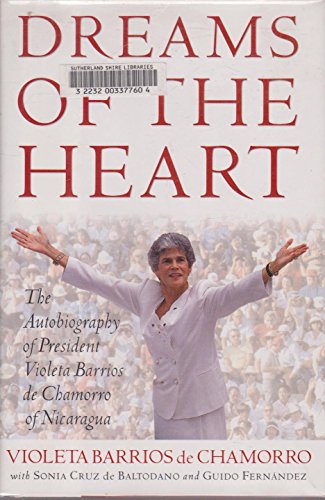
DREAMS OF THE HEART: The Autobiography of President Violeta Barrios de Chamorro of Nicaragua
Anbieter: ThriftBooks-Atlanta, AUSTELL, GA, USA
Verkäuferbewertung 5 von 5 Sternen

Hardcover. Zustand: Very Good. No Jacket. Former library book; May have limited writing in cover pages. Pages are unmarked. ~ ThriftBooks: Read More, Spend Less.
-
DREAMS OF THE HEART: The Autobiography of President Violeta Barrios de Chamorro of Nicaragua
Anbieter: ThriftBooks-Atlanta, AUSTELL, GA, USA
Verkäuferbewertung 5 von 5 Sternen
Hardcover. Zustand: Very Good. No Jacket. May have limited writing in cover pages. Pages are unmarked. ~ ThriftBooks: Read More, Spend Less.
-
DREAMS OF THE HEART: The Autobiography of President Violeta Barrios de Chamorro of Nicaragua
Anbieter: ThriftBooks-Dallas, Dallas, TX, USA
Verkäuferbewertung 5 von 5 Sternen
Hardcover. Zustand: Good. No Jacket. Pages can have notes/highlighting. Spine may show signs of wear. ~ ThriftBooks: Read More, Spend Less.
-
Dreams of the Heart: The Autobiography of President Violeta Barrios de Chamorro of Nicaragua
Sprache: Englisch
Verlag: Simon & Schuster, New York, 1996
ISBN 10: 0684810557 ISBN 13: 9780684810553
Anbieter: Ground Zero Books, Ltd., Silver Spring, MD, USA
Verkäuferbewertung 4 von 5 Sternen

Erstausgabe
Zustand: good, ex-lib., good. First Printing. 24 cm, 352, illus., map, usual library markings.
-
Dreams of the Heart: The Autobiography of President Violeta Barrios de Chamorro of Nicaragua
Sprache: Englisch
Verlag: Simon & Schuster, New York, 1996
ISBN 10: 0684810557 ISBN 13: 9780684810553
Anbieter: Ground Zero Books, Ltd., Silver Spring, MD, USA
Verkäuferbewertung 4 von 5 Sternen
Erstausgabe
Zustand: very good, very good. First Printing. 24 cm, 352, illus., map, index, publisher's ephemera laid in.
-

Dreams of the Heart: The Autobiography of President Violeta Barrios de Chamorro of Nicaragua
Verlag: Simon & Schuster, New York, 1996
Anbieter: Ground Zero Books, Ltd., Silver Spring, MD, USA
Verkäuferbewertung 4 von 5 Sternen
Erstausgabe
Zustand: very good, very good. First Printing. 24 cm, 352, illus., map, index.
-

Sueños del corazón memorias
Anbieter: Librería Alonso Quijano, Alcobendas, M, Spanien
Verkäuferbewertung 5 von 5 Sternen
Biografías Siglo I() Acento. Encuadernación en tapa Blanda. Chamorro, Violeta. 22 cm. Sueños del corazón memoriasTapa deslucida.Tapa ilustrada. Pags.399.Volúmenes. Libro usado.
-

Sueños del corazón
Sprache: Spanisch
Verlag: Acento Editorial, Boadilla del Monte., 1997
ISBN 10: 8448302427 ISBN 13: 9788448302429
Anbieter: Librería Pérez Galdós, Madrid, M, Spanien
Verkäuferbewertung 5 von 5 Sternen
1ª ed. edición. rústica con solapas. 400 páginas.
-
Dreams of the Heart; The Autobiography of President Violeta Barrios de Chamorro of Nicaragua
Sprache: Englisch
Verlag: Simon & Schuster, New York, N.Y., 1996
ISBN 10: 0684810557 ISBN 13: 9780684810553
Anbieter: Ground Zero Books, Ltd., Silver Spring, MD, USA
Verkäuferbewertung 4 von 5 Sternen
Erstausgabe
Hardcover. Zustand: Very good. Zustand des Schutzumschlags: Very good. First Printing, Stated. 352 pages. Map. Includes Acknowledgments, 19 black and white illustrations of Violeta Chamorro and her family between pages 192 and 193. Also contains an Epilogue and an Index. Contains an Inscription by the author (Chamorro) in Spanish on the fep. After the death of her late husband, Pedro, the author ran for the office of president of Nicaragua in order to fulfill the dreams of her husband, that Nicaragua would become a truly democratic republic. Her metamorphosis--from mother and wife to widow of a slain opposition leader and, finally, in February 1990, to democratically elected president of a country--was the ultimate result of a series of unyielding acts of defiance against a military dictatorship. This defiance led to Pedro's assassination and propelled her, as the custodian of Pedro's dream, into the center of Nicaragua's political arena. When Violeta Chamorro defeated Daniel Ortega in 1990 to become president of Nicaragua most observers were shocked. Ortega's Party, the Sandinistas, controlled the country, except for the Catholic Church and Mrs. Chamorro's newspaper, La Prensa, which, virtually alone, predicted the outcome accurately. After the election, many doubted that the Sandinistas would permit Mrs. Chamorro to take office, but she did, thanks to her own canny political instincts in reaching out to the Sandinistas rather than retaliating against them for causing a decade of oppression and poverty. After six years in office, she has brought her country back from ruin, ending a civil war and revitalizing an economy that had become the second worst in the Western Hemisphere. Derived from a Kirkus review: An anecdotal memoir by the democratically elected leader of Nicaragua. Chamorro came to politics accidentally. Although born, like her husband, into the ``top echelons of Nicaragua's social structure,'' the descendant of European landowners, she came to sympathize with the plight of the Indian majority after marrying Pedro Joaquin Chamorro, editor of the liberal newspaper La Prensa. Pedro's murder in 1978 at the hands of the government of Anastasio Somoza, whom he had regularly criticized in print, thrust her into the tumult of revolutionary politics. After the Sandinista rebellion overthrew Somoza, Chamorro became a leader of the loyal opposition, watching as Sandinista leader Daniel Ortega ``turned into a black-shirted party boss with a red bandana around his neck.'' Many of her fellow citizens evidently shared her dismay, and she became president of the country, having won by a large margin in a 1990 race thought certain to go to the Sandinistas. (``Theirs,'' she points out, ``was a $20 million campaign handled by a top American public relations team, ours a campaign run on a shoestring budget.'') Among the high points of the book are Chamorro's firsthand reports of infighting among the Sandinista leadership, torn by complex rivalries that led one hero of the war against Somoza, Comandante Zero, to be excluded from postwar rule. She also provides ample-and remarkable-details on the labyrinthine ways in which American aid dollars filtered down to the coffers of democratic organizations, certainly less generously than they did to the contra fighters. Chamorro is sometimes too fond of unmeaty apothegms, and her book is marred by a translation that is at times jarringly unidiomatic. Yet it provides a close look at the inner workings of a government and a nation in transition, led by a woman of obvious bravery and good will.
-
Memorias de mi gobierno
Anbieter: Librería Pérez Galdós, Madrid, M, Spanien
Verkäuferbewertung 5 von 5 Sternen
TOMO 1: GESTION PRESIDENCIAL (1990-1996) Managua, Nicaragua, 1996. .


