

Gesamtpreis (1 Artikel Artikel):
Versandziel:

timmons bascom (13 Ergebnisse)
Direkt zu den wichtigsten Suchergebnissen
Suchfilter
Produktart
- Alle Product Types
- Bücher (11)
- Magazine & Zeitschriften (2)
- Comics (Keine weiteren Ergebnisse entsprechen dieser Verfeinerung)
- Noten (Keine weiteren Ergebnisse entsprechen dieser Verfeinerung)
- Kunst, Grafik & Poster (Keine weiteren Ergebnisse entsprechen dieser Verfeinerung)
- Fotografien (Keine weiteren Ergebnisse entsprechen dieser Verfeinerung)
- Karten (Keine weiteren Ergebnisse entsprechen dieser Verfeinerung)
- Manuskripte & Papierantiquitäten (Keine weiteren Ergebnisse entsprechen dieser Verfeinerung)
Zustand Mehr dazu
- Neu (1)
- Wie Neu, Sehr Gut oder Gut Bis Sehr Gut (Keine weiteren Ergebnisse entsprechen dieser Verfeinerung)
- Gut oder Befriedigend (11)
- Ausreichend oder Schlecht (Keine weiteren Ergebnisse entsprechen dieser Verfeinerung)
- Wie beschrieben (1)
Einband
Weitere Eigenschaften
Sprache (2)
Gratisversand
Land des Verkäufers
Verkäuferbewertung
-

Portrait of an American: Charles G. Dawes
Verlag: H. Holt
Anbieter: ThriftBooks-Dallas, Dallas, TX, USA
Verkäuferbewertung 5 von 5 Sternen

Hardcover. Zustand: Good. No Jacket. Pages can have notes/highlighting. Spine may show signs of wear. ~ ThriftBooks: Read More, Spend Less.
-

Jesse H. Jones: The Man and the Statesman
Verlag: Henry Holt, 1956
Anbieter: Easy Chair Books, Lexington, MO, USA
Verkäuferbewertung 5 von 5 Sternen
Erstausgabe
Hardcover. Zustand: Good. Zustand des Schutzumschlags: No Dust Jacket. First Edition. 414 pages. Ex-university library marks, shelf wear and fading to the blue spine and covers; pages toned; a solid reading copy. The frontispiece is loose. Quantity Available: 1. Category: Biography & Autobiography; Inventory No: 214586.
-

A Journal of the McKinley Years
Verlag: The Lakeside Press, 1950
Anbieter: Easy Chair Books, Lexington, MO, USA
Verkäuferbewertung 5 von 5 Sternen
Hardcover. Zustand: Good. Zustand des Schutzumschlags: No Dust Jacket. 458 pages. Ex-university library marks; light wear to the green boards. Cracked front hinge; pages yellowed; a good book still. No jacket. Quantity Available: 1. Category: American History; Inventory No: 215347.
-
Jesse H. Jones, The Man and the Statesman
Verlag: Henry Holt and Company
Anbieter: ThriftBooks-Atlanta, AUSTELL, GA, USA
Verkäuferbewertung 5 von 5 Sternen
Hardcover. Zustand: Good. No Jacket. Pages can have notes/highlighting. Spine may show signs of wear. ~ ThriftBooks: Read More, Spend Less.
-
Portrait of an American: Charles G. Dawes
Verlag: H. Holt
Anbieter: Wonder Book, Frederick, MD, USA
Verkäuferbewertung 5 von 5 Sternen
Zustand: Good. Good condition. Good dust jacket. (vice-presidents, united states, history ) A copy that has been read but remains intact. May contain markings such as bookplates, stamps, limited notes and highlighting, or a few light stains.
-
Garner of texas, a Personal History
Verlag: Harper & Brothers
Anbieter: Wonder Book, Frederick, MD, USA
Verkäuferbewertung 5 von 5 Sternen
Zustand: Good. Good condition. Very Good dust jacket. (United States, Legislators, Biography) A copy that has been read but remains intact. May contain markings such as bookplates, stamps, limited notes and highlighting, or a few light stains.
-

Portrait of an American: Charles G. Dawes
Verlag: Henry Holt & Company, NY, 1953
Anbieter: Round Table Books, LLC, Gurnee, IL, USA
Verbandsmitglied: MWABA
Verkäuferbewertung 5 von 5 Sternen
Erstausgabe
Hard Cover. Zustand: Very Good. Zustand des Schutzumschlags: No Dust Jacket. Stated First Edition. First Printing. Publisher's full brick cloth, gilt lettering on brown panels on spine and cover. Illustrated with photographs. The story of General Charles G. Dawes, Vice President of the United States, Nobel Peace Prize Winner, first Director of the Budget, and Author of the post-World War I "Dawes Plan.". Former owner's small label on fep, otherwise unmarked, tight, square, and clean. VERY GOOD. . Photographs. 8vo 8" - 9" tall. 344 pp.
-
GARNER Of TEXAS.
Verlag: Harper & Brothers Publishers, Ne, 1948
Anbieter: Books From California, Simi Valley, CA, USA
Verkäuferbewertung 4 von 5 Sternen

hardcover. Zustand: Good.
-
Jesse H. Jones, the man and the statesman
Verlag: Henry Holt amd Cp, [amu, New York, 1956
Anbieter: Ground Zero Books, Ltd., Silver Spring, MD, USA
Verkäuferbewertung 4 von 5 Sternen
Erstausgabe
Hardcover. 414 p. 25 cm. Illustrations. Index. From Wikipedia: "Holman Jones (April 5, 1874 June 1, 1956) was a Democratic politician and entrepreneur from Houston, Texas. He served as United States Secretary of Commerce from 1940 to 1945. His most important role was to head the Reconstruction Finance Corporation (RFC), (1932 1945), a federal agency originally created in the Herbert Hoover administration that played a major role in combating the Great Depression and financing industrial expansion during World War II. Jones was in charge of spending US$50 billion, especially in financing railways and building munitions factories. Born in Robertson County, Tennessee, Jones was the son of tobacco farmer and merchant William Hasque Jones and Laura Anna Holman. His mother died when he was six years old. His father sent him to manage a tobacco factory at age 14, and at 19 he was put in charge of his uncle's lumberyards. Five years later, after his uncle, M. T. Jones, died, Jones moved to Houston to manage his uncle's estate and opened a lumberyard company, which grew quickly. During this period, Jesse opened his own business, the South Texas Lumber Company. He also began to expand into real estate, In 1908, Jones constructed a new office and plant for the rapidly growing Houston Chronicle in exchange for a half-interest in the company, which had been solely owned by Marcellus Foster." The relationship between Jones and the "Chronicle would last the rest of his life." In 1926, Jones became the sole owner of the paper and named himself as publisher. In 1937, he transferred ownership of the paper to the newly established Houston Endowment Inc. Jones retained the title of publisher until his death in 1956. Sometime after 1908, Jones organized the Texas Trust Company. By 1912, he had become president of Houston's National Bank of Commerce. This bank later merged with Texas National Bank to become the Texas National Bank of Commerce, and grew into a major regional financial institution. It became part of JP Morgan Chase & Co. in 2008. In 1911, Jones purchased the original five-story Rice Hotel from Rice University. He then razed the original buildings and constructed the present 17-story building, now formally named as the Post Rice Lofts. The new Rice Hotel building opened on May 17, 1913. Jones soon made his mark as a builder across Houston, and helped to secure federal funding for the Houston Ship Channel, which opened in 1914 and made the city a viable port. President Woodrow Wilson offered him the position of Secretary of Commerce, but Jones decided instead to focus on his businesses though he could not refuse when Wilson asked him to become director general of military relief for the American Red Cross during World War I. When the Reconstruction Finance Corporation was established in 1932, President Hoover appointed Jones to the RFC's board, even though Hoover was a Republican and Jones a Democrat. In 1933, President Franklin Delano Roosevelt made him the Chairman of the RFC, while also expanding the RFC's powers to make loans and bail out banks. This led some to refer to Jones as "the fourth branch of government." Roosevelt reportedly called Jones "Jesus H. Jones." According to Joseph P. Lash, the President considered Jones too conservative and shot down a strong movement to make Jones the Democratic vice presidential nominee in 1940. Jones retired from the RFC on 17 July 1939, to become Federal Loan Administrator (head of the Federal Loan Agency, which supervised the RFC and some other bodies). Jones later served under Roosevelt as Secretary of Commerce in 1940 the same position he had turned down a quarter-century before and served until 1945, when he was forced out in favor of Roosevelt's outgoing Vice President, Henry A. Wallace. Fair. No dust jacket. Spine faded and parts of cover discolored. Slightly shaken. First edition. First Edition [stated]. Presumed first printing.
-

EUR 34,21
EUR 48,99 Versand
Versand von Deutschland nach USAAnzahl: Mehr als 20 verfügbar
In den WarenkorbZustand: New. KlappentextMany of the earliest books, particularly those dating back to the 1900s and before, are now extremely scarce and increasingly expensive. We are republishing these classic works in affordable, high quality, modern editions, usi.
-
Garner of Texas; A Personal History
Verlag: Harper & Brothers, New York, 1948
Anbieter: Ground Zero Books, Ltd., Silver Spring, MD, USA
Verkäuferbewertung 4 von 5 Sternen
Erstausgabe Signiert
Hardcover. Zustand: Good. [12], 294, [8] pages. Frontispiece. Facsimile. Cover has some wear and soiling. Inscription on the fep. The inscription reads To Mary Tuebler with the affection of Bascom N. Timmons and the compliments of Wright Morrow. This appears to have been signed by Bascom and not Morrow. No dust jacket present. Bascom Nolley Timmons (March 31, 1890 - June 8, 1987) was an American newspaperman based in Washington, D.C., in a career that spanned all or parts of six decades. He was an advisor to U.S. Presidents Calvin Coolidge and Franklin D. Roosevelt, who had been competing opposite party candidates for Vice President of the United States in 1920. A native of Amarillo, Texas, Timmons began his career in journalism at the age of sixteen with the former Fort Worth Record in Fort Worth, Texas. He later worked for the defunct Dallas Times-Herald, the Amarillo News, and the Milwaukee Sentinel. In 1912, he joined The Washington Post''. In 1920, Timmons created a bureau in the nation's capital, to serve newspapers in Texas, Oklahoma, Louisiana, Alabama, and Ohio. In 1932, Timmons became president of the National Press Club. Timmons was widely respected and liked in Washington, D.C., but his reporting long infuriated Lyndon B. Johnson. Timmons' press bureau served a number of newspapers. His biggest customer, the Fort Worth Star-Telegram, listed him as its chief correspondent. Shortly after Johnson became President, he surreptitiously pressured the Amon G. Carter Jr., the Star-Telegram's owner, to drop Timmons. The paper phased him out; Timmons seemed unaware of Johnson's role. John Nance Garner III (November 22, 1868 - November 7, 1967), known among his contemporaries as "Cactus Jack", was an American Democratic politician and lawyer from Texas. He served as the 39th speaker of the United States House of Representatives from 1931 to 1933 and as the 32nd vice president of the United States under Franklin D. Roosevelt from 1933 to 1941. Garner and Schuyler Colfax (from 1863 to 1873) are the only politicians to have served as presiding officers of both chambers of the United States Congress as speaker of the House and vice president of the United States. Garner sought the Democratic presidential nomination in the 1932 presidential election, but agreed to serve as Franklin D. Roosevelt's running mate at the 1932 Democratic National Convention. He and Roosevelt won the 1932 election and were re-elected in 1936. He famously described the vice presidency as being "not worth a bucket of warm piss" (for many years, this quote was bowdlerized as "warm spit"). Wright Chalfant Morrow (1858-1942) attended law school at the University of Virginia. Upon his graduation, Morrow returned to Hillsboro and began practicing law with his brothers-in-law at their firm Tarlton, Tarlton, and Morrow. His brother-in-law Benjamin Dudley Tarlton would go on to have a distinguished legal career, with the University of Texas Law School named in his honor. At this time, most of Morrow's cases related to land disputes. One such case, concerning a dispute over the ownership of a homestead, reached the Texas Court of Criminal Appeals in 1900. Morrow was first elected as District Judge of Hill County in 1897 on the Democratic ticket. He was re-elected in 1889. Morrow was elected and served as a state senator for Hill, Ellis, and Johnson Counties from 1912 until 1916. While in office, he served on several committees, including the labor, public roads, towns and city corporation, and judiciary committees. He also served as the senate president pro tempore during his first term. While in office, Morrrow helped to draft and pass Senate Bill 166, which revised the Texas Court of Criminal Appeals' reversal policy. It held that" the case shall not be reversed unless an error was committed calculated to injure the rights of the defendant, and not then unless the error was pointed out in objections made as the charge was given, or in the refusal of special charges requested, made at the time of trial. " In 1916, Morrow ran successfully for the office of judge of the Court of Criminal Appeals. He served in this position until 1921, at which time he was appointed presiding judge of the court. Morrow supported the Robertson Law, which required out of state life insurance companies operating in Texas to invest 75% of their Texas revenues in Texas securities. At the time of his first re-election, he received the largest number of votes for a state office in Texas to that date, demonstrating his favor among his constituents. Morrow is best known for his role in establishing the rule that all motions for rehearing should be considered by a judge other than the judge who heard the original case. He also established the right to present oral arguments for rehearing motions. As a lawyer and judge, Morrow was noted for his dedication to the letter of the law. Morrow continued to serve as presiding judge at the Texas Court of Criminal Appeals in Austin, until his retirement in 1939. First Edition [stated], presumed first printing.
-
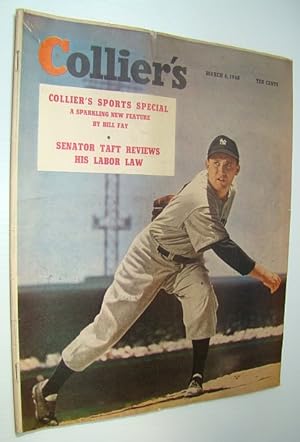
Collier's Magazine, March 6 1948 - Chiang Kai-shek's Power Fading in China
Verlag: The Crowell-Collier Publishing Company, Springfield, IL, U.S.A., 1948
Anbieter: RareNonFiction, IOBA, Ladysmith, BC, Kanada
Verbandsmitglied: IOBA
Verkäuferbewertung 5 von 5 Sternen
Magazin / Zeitschrift Erstausgabe
Single Issue Magazine. Zustand: Good. Illustrated by Peskin, David; Brockhurst, Gerald; Hamlin, Paul; Wiggins;Pike, John; Shook Euclid; Burns, Paul C.; (illustrator). First Edition. 78 pages. Articles: Between the bear and the dragon - Chiang Kai-shek's power in China has faded - article with great photos; Collier's Sports - the low-down on baseball salaries; Hollywood Goes to Rome - shooting the Cagliostro movie in Rome; Toward Peace in Labor - how the Labor-Management relations Act has worked so far; John N. Garner's Story (part 3) - reveals the former Vice-Presidents's attitude toward the Roosevelt lend-spend policy and the third term; Whether Man - New York's Blizzard of '47 put the forecasters on a spot; Hard Times Come To Wall Street - why the nation's money center is in the red in this boom era. Fiction: Jeff Coongate and the Stolen Crony; The Day Before Sunday; The Mysterious Way (part 5 of 6); Blessed are the Merciful; Dark Red for Love; Meet My Family. Nice ads include: The 1948 Studebaker (inside front cover); RKO movies of the month; nice diamond ad featuring portrait of Mrs. Lewis McCracken, the former Miss Francine Whitten, of Washington, D.C.; Philco radio-phonographs; Ford Cars (nice color photo one-page ad in Europe; Lucky Strike cigarettes; Rummy soft drink; Ballantine Ale - nice color one-page ad with cowboy theme; Great two-page color-phot ad for Heinz soups (they offered turtle soup back then!); Hamm's Beer; Stewart-Warner radio-phonographs; Brewer's Best beer; Bicycle playing cards; Emerson radios; National Guard recruiting ad; Miller High Life beer; Trav-ler radios; Clark's Tendermint chewing gun; Chesterfield cigarette ad on back cover features Charles Coburn, Ann Todd, Ethel Barrymore, Louis Jourdan, VAlli and Gregory Peck. Average wear. Unmarked. A sound vintage copy.; Folio - over 12" - 15" tall; Collier's Magazine, March 6 1948 Chiang Kai-shek's power in China has faded - article with great photos; Collier's Sports - the low-down on baseball salaries; Hollywood Goes to Rome - shooting the Cagliostro movie in Rome; Toward Peace in Labor - how the.
-
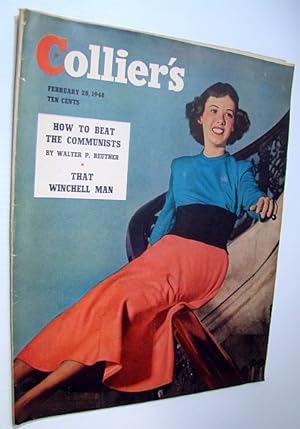
Collier's Magazine, February 28 1948 - Walter Winchell / Communists in the UAW
Verlag: The Crowell-Collier Publishing Company, Springfield, IL, U.S.A., 1948
Anbieter: RareNonFiction, IOBA, Ladysmith, BC, Kanada
Verbandsmitglied: IOBA
Verkäuferbewertung 5 von 5 Sternen
Magazin / Zeitschrift Erstausgabe
Single Issue Magazine. Zustand: Good. Illustrated by McLeod, Ronald; Hurst, Oliver; Prince, William Meade;Pennington Jr., Harry; Miller, Richard; Morgan, Wallace; Kraft, Arthur;Humbert Studios; (illustrator). First Edition. 90 pages. Articles: How to Beat the Communists - by UAW (United Auto Workers') chief Walter Reuther; Walter Winchell - Aan American Phenomenon - a study of the fastest talker on the airwaves; Our Lights are Going Out - electrical power shortage; John N. Garner's Story (part 2) - the former Vice-President tells of his most serious disagreement with Mr. Roosevelt; Hot-Sun Hockey - The Pacific Coast goes for hockey in a big way - article with color photos including the Fresno Falcons playing the Los Angeles Monarchs; Boys at Work - this school reforms tough kids. Fiction: Jason Hazard's Swim; The Female Circumstance; Cupid Up the Bayou!; The Farmer's Face; The Mysterious Way; Interruptions, Interruptions. Nostalgic ads include: Old Thompson Whiskey; Packard cars; GMC trucks (nice!); Nash cars; Oldsmobile two-page color ad; Dodge Trucks; Lord Calver liquor ad featuring one-page color photo portrait of Richard C. Kettles, Jr. and his boxer Worlord; Chrysler color centerfold features cowboy scene; Chevrolet trucks; Botany 500; Samson card tables; Kleenex (featuring Little Lulu); Wow! - two-page color ad for Roma Wines features large image of Jane Russell; Camel cigarette ad on back cover features rodeo star Jerry Ambler, fisher Dorothy Allan Newstead, polo star Cecil Smith and table-tennis star Mary Reilly. Average wear. Unmarked. A sound vintage copy.; Folio - over 12" - 15" tall; Collier's Magazine, February 28 1948 How to Beat the Communists - by UAW (United Auto Workers') chief Walter Reuther; Walter Winchell - Aan American Phenomenon - a study of the fastest talker on the airwaves; Our Lights are Going Out - electrical power sh.


