

Gesamtpreis (1 Artikel Artikel):
Versandziel:

stirner m (16 Ergebnisse)
Direkt zu den wichtigsten Suchergebnissen
Suchfilter
Produktart
- Alle Product Types
- Bücher (16)
- Magazine & Zeitschriften (Keine weiteren Ergebnisse entsprechen dieser Verfeinerung)
- Comics (Keine weiteren Ergebnisse entsprechen dieser Verfeinerung)
- Noten (Keine weiteren Ergebnisse entsprechen dieser Verfeinerung)
- Kunst, Grafik & Poster (Keine weiteren Ergebnisse entsprechen dieser Verfeinerung)
- Fotografien (Keine weiteren Ergebnisse entsprechen dieser Verfeinerung)
- Karten (Keine weiteren Ergebnisse entsprechen dieser Verfeinerung)
- Manuskripte & Papierantiquitäten (Keine weiteren Ergebnisse entsprechen dieser Verfeinerung)
Zustand Mehr dazu
- Neu (2)
- Wie Neu, Sehr Gut oder Gut Bis Sehr Gut (4)
- Gut oder Befriedigend (4)
- Ausreichend oder Schlecht (Keine weiteren Ergebnisse entsprechen dieser Verfeinerung)
- Wie beschrieben (6)
Einband
Weitere Eigenschaften
Sprache (5)
Gratisversand
- Kostenloser Versand nach USA (Keine weiteren Ergebnisse entsprechen dieser Verfeinerung)
Land des Verkäufers
Verkäuferbewertung
-

L'unique et sa propriété
Sprache: Französisch
Verlag: Editions de La Table Ronde, 2000
ISBN 10: 2710309963 ISBN 13: 9782710309963
Zustand: good. Befriedigend/Good: Durchschnittlich erhaltenes Buch bzw. Schutzumschlag mit Gebrauchsspuren, aber vollständigen Seiten. / Describes the average WORN book or dust jacket that has all the pages present.
-

UNICO Y SU PROPIEDAD, EL
Anbieter: SoferBooks, Barcelona, B, Spanien
Verkäuferbewertung 5 von 5 Sternen

Zustand: New. Zustand des Schutzumschlags: NUEVO.
-

LA SOCIETA' DEGLI STRACCIONI (Italian)
Anbieter: Brook Bookstore, Milano, MI, Italien
Verkäuferbewertung 5 von 5 Sternen
Zustand: new.
-
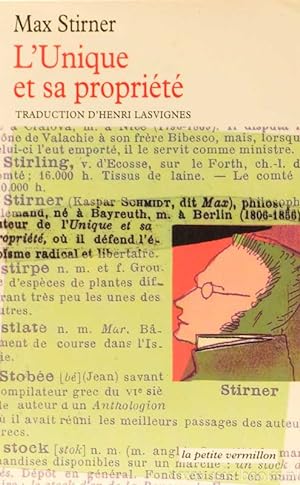
L'unique et sa propriété. Traduction et postface de Henri Lasvignes. Présentation de Cécile Guérard.
Anbieter: Antiquariaat Isis, Groningen, Niederlande
Verkäuferbewertung 5 von 5 Sternen
Paris, La Table Ronde, 2000. 411 pp. Paperback. (le petite vermillon) *good condition*.
-
Der Einzige und sein Eigentum. Mit e. Nachw. hrsg. von Ahlrich Meyer / Universal-Bibliothek ; Nr. 3057/3062
Anbieter: Antiquariat im Schloss, Schwaigern, D, Deutschland
Verkäuferbewertung 5 von 5 Sternen
Erstausgabe
kart. ERSTAUSGABE. 461 S.; ; 16 cm Sehr guter Zustand. Sprache: Deutsch Gewicht in Gramm: 900.
-

Zustand: Used: Like New. LIVRE A L?ETAT DE NEUF. EXPEDIE SOUS 3 JOURS OUVRES. NUMERO DE SUIVI COMMUNIQUE AVANT ENVOI, EMBALLAGE RENFORCE. EAN:9782380280319.
-
L'unico.Con uno studio di Vittorio Roudine sulla vita e l'opera di Max Stirner.
Verlag: Ed. Sociale,, Milano,, 1922
Anbieter: Studio Bibliografico Benacense, Riva del garda, TN, Italien
Verkäuferbewertung 5 von 5 Sternen
paperback. Zustand: Buono (Good). Cm. 19, pp. 445 (3). Bross. orig. Buona conservazione. Book.
-

L'unico. Versione dal tedesco con una introduzione di Ettore Zuccoli.
Verlag: Bocca s.a. (anni '20), Torino
Anbieter: Studio Bibliografico Benacense, Riva del garda, TN, Italien
Verkäuferbewertung 5 von 5 Sternen
hardcover. Zustand: Good. Cm. 25,5, pp. xxiv, 270 (2). Bross. orig. ill. Ben conservato. Book.
-

L'UNIQUE ET SA PROPRIETE.
Verlag: STOCK+PLUS, 1978
ISBN 10: 2234008123 ISBN 13: 9782234008120
Couverture souple. Zustand: bon. R240129512: 1978. In-12. Broché. Bon état, Couv. convenable, Dos satisfaisant, Intérieur frais. 455 pages. . . . Classification Dewey : 100-PHILOSOPHIE ET DISCIPLINES CONNEXES.
-

L'unico. Versione dal tedesco con una introduzione di Ettore Zuccoli.
Verlag: Bocca,, Torino,, 1909
Anbieter: Studio Bibliografico Benacense, Riva del garda, TN, Italien
Verkäuferbewertung 5 von 5 Sternen
Cm. 23,5, pp. xxxii, 331 (1). Solida leg. coeva in mezza pergamena con punte, dorso liscio con titoli in oro su tassello. Ben conservato.
-
Die Lösung der sozialen Frage oder Individualismus.
Verlag: Dresden u. Leipzig, Pierson, 1911., 1911
Anbieter: Antiquariat Thomas Rezek, München, Deutschland
Verkäuferbewertung 5 von 5 Sternen
8°. 4 Bll., 146 SS. Original-Broschur mit Deckeltitel und Bordüre "Seltene wohl einzige Ausgabe dieser Schrift über den philosophischen Anarchismus bzw hier "Individualismus". Das Werk ist Krause und Stirner gewidmet, auf den Hauptteil (Über natürliche staatenose Ökonomie) folgen noch zwei Aufsätze: Schiller und der Anarchismus - Über Stirners Der Einzige und sein Eigentum. - Der Verfasser ist vemutlich der 1852 in Stuttgart geborene Alfred Martin Cless. " - Titel mit alter Überklebung im weissen Rand oben, wenige kleine alte Notizen in Bleistift, Umschlag leicht fleckig, innen sonst sauber, unbeschnitten.
-
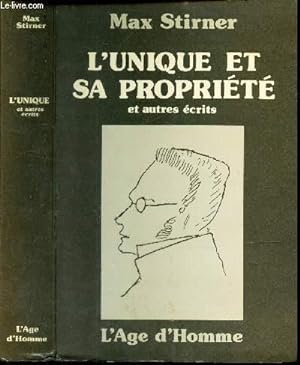
L'UNIQUE ET SA PROPRIETE ET AUTRES RECITS.
Verlag: L'AGE D'HOMME, 1977
Couverture souple. Zustand: bon. R320111348: 1977. In-8. Broché. Bon état, Couv. convenable, Dos satisfaisant, Intérieur frais. 437 pages. - Couverture contrepliée - . . . . Classification Dewey : 100-PHILOSOPHIE ET DISCIPLINES CONNEXES.
-
LE FAUX PRINCIPE DE NOTRE EDUCATION- L ANTICRITIQUE - BIBLIOTHEQUE SOCIALE BILINGUE - francais allemand
Verlag: AUBIER MONTAIGNE, 1974
Couverture souple. Zustand: bon. R200045625: 1974. In-8. Broché. Bon état, Couv. convenable, Dos satisfaisant, Intérieur frais. 182 pages. . . . Classification Dewey : 370-Education.
-

Hauswirtschaftsunterricht in der Sonderschule für Lernbehinderte (Unterrichtsplanung Hauswirtschaft)
Verlag: Schneider Hohengehren
ISBN 10: 3871162094 ISBN 13: 9783871162091
Anbieter: Buchmarie, Darmstadt, Deutschland
Verkäuferbewertung 4 von 5 Sternen

Zustand: Very Good.
-

Der Einzige und sein Eigentum
Sprache: Deutsch
Verlag: Weltgeist-Bücher Verlags-Gesellschaft
Anbieter: Leipziger Antiquariat, Leipzig, Deutschland
Verkäuferbewertung 5 von 5 Sternen
18,0 x 12,0 cm, Leinenband. Zustand: Gut. 358 Seiten Zustand: Einband etwas berieben, Papier etwas gebräunt // Ohne Angabe zum Erscheinungsjahr. /// Versand gratis Innerhalb Deutschlands - Portofrei in Deutschland- ab 20 Euro mit Post ID - Gratisversand deutschlandweit innerhalb Deutschlands gratis Versand -Versandkostenfrei innerhalb Deutschlands /// Sprache: Deutsch Gewicht in Gramm: 330.
-
Der Einzige und sein Eigenthum. (Privat-Ausgabe. Veranstaltet von John Henry Mackay). (Leipzig, Offizin von W. Drugulin, 1911). - (Bound with:) STIRNER, M. (PSEUD. OF J.C. SCHMIDT). Das unwahre Prinzip unserer Erziehung oder der Humanismus and Realismus.
Anbieter: A. Gerits & Son b.v., Diemen, Niederlande
Verkäuferbewertung 5 von 5 Sternen
Signiert
(Leipzig, Spamersche Buchdruckerei, 1911). (2), 354, (6) pp.; (2), 25 pp. 4to. Grey and blue-brown marbled paper over boards, raised bands with label and gilt lettering, the compartments with a floral decoration, the original covers preserved, gilt lettered scroll to front cover reading 'Plus est en Moi.' The first work is number 116 of 980 copies printed, the second work is number 61 of 980 copies printed. Both are printed on especially prepared Van Gelder-Zonen paper with the name of John Henry Mackay as watermark. The first work is signed by John Henry Mackay on the annotated leaf bound in at the end. The orginal covers are Japanese 'Pergamentpapier'; the idea to have the books bound was abandoned 'da es unmöglich ist, hier den Geschmack des einzelnen auch nur annähernd zu treffen.' The last 6 pages of the first work contain the 'Inhalt', a leaf with the title and at the bottom the text: Beilage zu Exemplar Nr. 116, followed by the annotated leaf which is dated Charlottenburg bei Berlin, 1. Juli 1911 and signed by John Henry Mackay. In the first work Stirner proceeds from Hegelianism to its almost complete inversion in a doctrine that denied all absolutes and all institutions, and based itself solely on the 'ownness' of the human individual. His is the ideal of the man who realizes himself in conflict with the collectivity and other individuals. Striner holds the individual to be the focal point and center of the world and asserted that the feelings and thinking of the individual determine the whole scale of social values and that there is nothing objective outside the individual, or the ego. Since the individual who creates the world through his imagination and will is the only reality, the world belongs to the individual: the world becomes his possession.The ressemblance between Nietzsche and Stirner is striking and indeed Nietzsche regarded Stirner as one of the unrecognized seminal minds of the nineteenth century. With the growing vogue for Nietzsche at the end of the century Stirner's work witnessed a popular revival. But Stirners greatest influence was exerted upon anarchism, many years after his death. It is still a classic of libertarian thought in which the uniqueness of the individual is stressed.Max Stirner, born as Johann Caspar Schmidt, was born in 1806 in Bayreuth and died in 1856 in Berlin. He was one of the most prominent left-wing Hegelians in Berlin and he contributed, together with Karl Marx and other young bourgeois radicals, to the Rheinische Zeitung, the journal of the advanced wing of the industrial and banking circles in the Rhineland. The present work is his major and most celebrated work which made a strong impression on the German intelligentsia and which was widely read and reviewed. The work was published in 1844 (although the title-page on all first editions reads 1845) and it forced Marx and Engles to write extensive refutations of Stirner's ideas in their Die deutsche Ideologie.John Henry Mackay, the Scots born German poet, was the chief instrument in the revival of Stirnerism. He met Stirner's name very early in his career while reading Lange's History of Materialism, and was moved to read Stirner's book. Mackay was so impressed that he devoted part of his life to the rediscovery and rehabilitation of the lost and forgotten genius. His biography of Stirner appeared in Berlin in 1898 and it is a tribute to his thoroughness that since its publication not one important fact about Stirner has been discovered by anybody.


