Gesamtpreis (1 Artikel Artikel):
Versandziel:

samuelson paul edited joseph stiglitz (5 Ergebnisse)
Direkt zu den wichtigsten Suchergebnissen
Suchfilter
Produktart
- Alle Product Types
- Bücher (5)
- Magazine & Zeitschriften (Keine weiteren Ergebnisse entsprechen dieser Verfeinerung)
- Comics (Keine weiteren Ergebnisse entsprechen dieser Verfeinerung)
- Noten (Keine weiteren Ergebnisse entsprechen dieser Verfeinerung)
- Kunst, Grafik & Poster (Keine weiteren Ergebnisse entsprechen dieser Verfeinerung)
- Fotografien (Keine weiteren Ergebnisse entsprechen dieser Verfeinerung)
- Karten (Keine weiteren Ergebnisse entsprechen dieser Verfeinerung)
- Manuskripte & Papierantiquitäten (Keine weiteren Ergebnisse entsprechen dieser Verfeinerung)
Zustand Mehr dazu
- Neu (Keine weiteren Ergebnisse entsprechen dieser Verfeinerung)
- Wie Neu, Sehr Gut oder Gut Bis Sehr Gut (Keine weiteren Ergebnisse entsprechen dieser Verfeinerung)
- Gut oder Befriedigend (1)
- Ausreichend oder Schlecht (Keine weiteren Ergebnisse entsprechen dieser Verfeinerung)
- Wie beschrieben (4)
Einband
- alle Einbände
- Hardcover (5)
- Softcover (Keine weiteren Ergebnisse entsprechen dieser Verfeinerung)
Weitere Eigenschaften
Sprache (1)
Gratisversand
Land des Verkäufers
Verkäuferbewertung
-

The Collected Scientific Papers of Paul A. Samuelson. Volume II.
Verlag: Cambridge: The M.I.T. Press, 1966., 1966
Anbieter: Motte & Bailey, Booksellers, Ann Arbor, MI, USA
Verbandsmitglied: IOBA
Verkäuferbewertung 4 von 5 Sternen

Erstausgabe
Hardcover in full cloth. First edition. Thick quarto (oversized). Former owner's name n flyleaf. Slight wear to edges and corners of boards. Slight soiling to edges of the textblock. Dj has wear along the edges with a few small tears and chipping especially on the head and heel of spine. Dj is also scuffed on the covers. Covers pages 775-1813 of the collected papers with notes and index. The second volume in this massive collection of the economic writings and theories of Paul A. Samuelson. Very Good in Fair price-clipped dust jacket.
-

The Collected Scientific Papers of Paul A. Samuelson, Volume 1 / I.
Verlag: The MIT Press, 1966,, 1966
Anbieter: BRIMSTONES, Lewes, Vereinigtes Königreich
Verkäuferbewertung 5 von 5 Sternen

EUR 11,77
EUR 22,86 Versand
Versand von Vereinigtes Königreich nach USAAnzahl: 1 verfügbar
In den Warenkorbhardback, large 8vo, xii,771pp, slight browning, otherwise clean and sound, no inscriptions, Very Good condition in rubbed and frayed dustwrapper.
-

The Collected Scientific Papers of Paul A. Samuelson. Volumes I-IV.
Verlag: MIT Press, Cambridge, MA, 1966
Anbieter: Sekkes Consultants, North Dighton, MA, USA
Verkäuferbewertung 5 von 5 Sternen
Erstausgabe
Hardcover. Zustand: very good. Zustand des Schutzumschlags: very good. First edition. The Nobel Laureate's writings included in the first four volumes. They document the long and distinguished career of one of America's most important economists and encompass more than 280 articles. The first two contain virtually all of Samuelson's contributions to economic theory through mid-1964; Volume 3 contains all the scientific papers written from mid-1964 through 1970; Volume 4 consists of 86 articles, all the scientific contributions of Samuelson from mid-1971 through 1976. These four volumes belonged to professor Mark Schupack (each volume bares his bookplate on the pastedown). Schupack was a student of Samuelson at MIT who went on to teach economics at Brown University. During his career at Brown, Schupack was chair of the economics department, associate provost, dean of the graduate school, and vice provost. A few pages with marginalia by the professor. Volume one has a chip to the top spine of the dust-jacket and a closed tear along the front flap fold. Volume 3 with sunning to the spine. All volumes have minor edge-wear. 6½" - 9½". book.
-
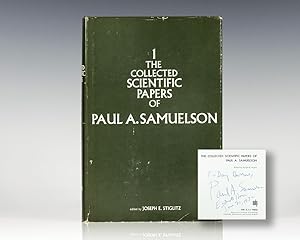
The Collected Scientific Papers of Paul A. Samuelson. Volumes I.
Verlag: MIT Press, Cambridge, MA, 1966
Anbieter: Raptis Rare Books, Palm Beach, FL, USA
Verkäuferbewertung 5 von 5 Sternen
Erstausgabe Signiert
First edition, early printing of Volume I of the Nobel Prize-winning economists papers. Octavo, original cloth. Inscribed by the author on the title page,ÂÂ"For Doug Burrows, Paul A. Samuelson, Endicott House, June 21, 1972." Fine in a near fine dust jacket. "It is a measure of Professor Samuelson's preeminence that the sheer scale of his work should be so much taken for granted," observes a reviewer in the "Economist" who goes on to note that "a cynic might add that it would have been better for Professor Samuelson to write less merely to give others a chance to write at all." In fact, Samuelson's output, his "extraordinary mastery of methods, both mathematical and linguistic" (review of Volume 4 of "The Collected Scientific Papers"), have not diminished. Volumes 1 through 4 encompass more than 280 articles. The first two contain virtually all of Samuelson's contributions to economic theory through mid-1964; Volume 3 contains all the scientific papers written from mid-1964 through 1970, and the last volume brings his work up to through 1976.
-
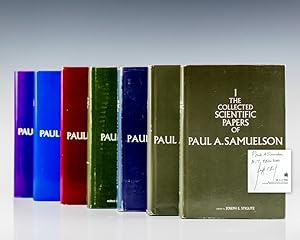
The Collected Scientific Papers of Paul A. Samuelson. Volumes I-VII.
Verlag: MIT Press 1966-2011, Cambridge, MA, 1966
Anbieter: Raptis Rare Books, Palm Beach, FL, USA
Verkäuferbewertung 5 von 5 Sternen
Erstausgabe Signiert
First editions of each volume of the collected papers of Nobel Prize-winning economists papers. Octavo, 7 volumes, original cloth. Volumes 1-5 are near fine in very good to near fine dust jackets. Volumes 1-5 are signed by Paul A. Samuelson; volumes I & II are signed by fellow Nobel Prize-winning economist Joseph E. Stiglitz, who served as editor of these volumes. Volumes 6 and 7 are fine in a fine jackets, and were published posthumously. A very attractive set, rare and desirable signed. "It is a measure of Professor Samuelson's preeminence that the sheer scale of his work should be so much taken for granted," observes a reviewer in the "Economist" who goes on to note that "a cynic might add that it would have been better for Professor Samuelson to write less merely to give others a chance to write at all." In fact, Samuelson's output, his "extraordinary mastery of methods, both mathematical and linguistic" (review of Volume 4 of "The Collected Scientific Papers"), have not diminished. Volumes 1 through 4 encompass more than 280 articles. The first two contain virtually all of Samuelson's contributions to economic theory through mid-1964; Volume 3 contains all the scientific papers written from mid-1964 through 1970, and the last volume brings his work up to through 1976.