

Gesamtpreis (1 Artikel Artikel):
Versandziel:

root darrell (4 Ergebnisse)
Direkt zu den wichtigsten Suchergebnissen
Suchfilter
Produktart
- Alle Product Types
- Bücher (4)
- Magazine & Zeitschriften (Keine weiteren Ergebnisse entsprechen dieser Verfeinerung)
- Comics (Keine weiteren Ergebnisse entsprechen dieser Verfeinerung)
- Noten (Keine weiteren Ergebnisse entsprechen dieser Verfeinerung)
- Kunst, Grafik & Poster (Keine weiteren Ergebnisse entsprechen dieser Verfeinerung)
- Fotografien (Keine weiteren Ergebnisse entsprechen dieser Verfeinerung)
- Karten (Keine weiteren Ergebnisse entsprechen dieser Verfeinerung)
- Manuskripte & Papierantiquitäten (Keine weiteren Ergebnisse entsprechen dieser Verfeinerung)
Zustand Mehr dazu
- Neu (4)
- Wie Neu, Sehr Gut oder Gut Bis Sehr Gut (Keine weiteren Ergebnisse entsprechen dieser Verfeinerung)
- Gut oder Befriedigend (Keine weiteren Ergebnisse entsprechen dieser Verfeinerung)
- Ausreichend oder Schlecht (Keine weiteren Ergebnisse entsprechen dieser Verfeinerung)
- Wie beschrieben (Keine weiteren Ergebnisse entsprechen dieser Verfeinerung)
Einband
Weitere Eigenschaften
- Erstausgabe (Keine weiteren Ergebnisse entsprechen dieser Verfeinerung)
- Signiert (Keine weiteren Ergebnisse entsprechen dieser Verfeinerung)
- Schutzumschlag (Keine weiteren Ergebnisse entsprechen dieser Verfeinerung)
- Angebotsfoto (3)
Sprache (1)
Preis
- Beliebiger Preis
- Weniger als EUR 20 (Keine weiteren Ergebnisse entsprechen dieser Verfeinerung)
- EUR 20 bis EUR 45 (Keine weiteren Ergebnisse entsprechen dieser Verfeinerung)
- Mehr als EUR 45
Gratisversand
- Kostenloser Versand nach USA (Keine weiteren Ergebnisse entsprechen dieser Verfeinerung)
Land des Verkäufers
Verkäuferbewertung
-

The Training Evaluation Process. A Practical Approach to Evaluating Corporate Training Programs.
Buch 3 von 24: Evaluation in Education and Human ServicesSprache: Englisch
Verlag: Kluwer Academic Publishers, 1992
ISBN 10: 0792392663 ISBN 13: 9780792392668
Anbieter: Kennys Bookstore, Olney, MD, USA
Verkäuferbewertung 4 von 5 Sternen

Zustand: New. Offers the commercial training industry with an approach to use when evaluating training programs. This book is helpful to evaluate training programs across the various corporate environments. Series: Evaluation in Education and Human Services. Num Pages: 277 pages, biography. BIC Classification: JNU; KJMV2; PB. Category: (P) Professional & Vocational; (UP) Postgraduate, Research & Scholarly. Dimension: 241 x 166 x 21. Weight in Grams: 562. . 1992. Hardback. . . . . Books ship from the US and Ireland.
-
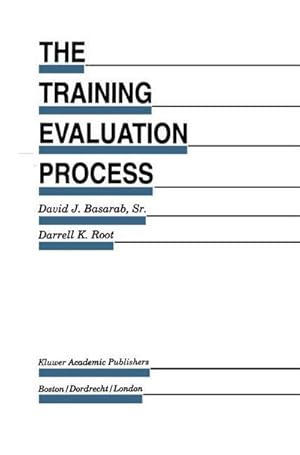
The Training Evaluation Process : A Practical Approach to Evaluating Corporate Training Programs
Buch 3 von 24: Evaluation in Education and Human ServicesAnbieter: AHA-BUCH GmbH, Einbeck, Deutschland
Verkäuferbewertung 5 von 5 Sternen

Buch. Zustand: Neu. Druck auf Anfrage Neuware - Printed after ordering - This book details a unique training evaluation approach developed by David J. Basarab, Sr. currently the Manager of Evaluation at Motorola University. This approach was developed in part based on information from his graduate coursework with Dr. Darrell K. Root, professor of program evaluation and educational administration at the University of Dayton. It enabled Motorola to evaluate their corporate training programs to determine whether money spent on training was an investment or an expense. This evaluation approach is also significant in determining either the effectiveness of or the opportunities to improve corporate training programs. In this text, The Training Evaluation Process, David Basarab and Darrell Root provide commercial industry training with a step-by-step approach to use when evaluating training progrruns, thus allowing training to be viewed as an investment rather than an expense. This text focuses on assessing training programs, so that they may be improved. This approach provides a successful procedure to use when evaluating training programs. Included in the text is a comprehensive explanation of the evaluation model developed by D. L. Kirkpatrick (Kirkpatrick, D. L., November 1959) in which he described four levels of evaluating training progrruns: Level 1 -Reaction: Evaluate to learn participants' perception to the training program. Level 2 -Learning: Evaluate to determine whether participants have learned the course subject matter. Level 3 -Behavior: Evaluate participants' use of newly acquired job skills on the job. Level 4 -Results: Evaluate the organizational impact of training on company's workforce.
-

The Training Evaluation Process
Buch 3 von 24: Evaluation in Education and Human ServicesSprache: Englisch
Verlag: Springer Netherlands, Springer Netherlands Okt 2012, 2012
ISBN 10: 9401053065 ISBN 13: 9789401053068
Anbieter: buchversandmimpf2000, Emtmannsberg, BAYE, Deutschland
Verkäuferbewertung 5 von 5 Sternen
Taschenbuch. Zustand: Neu. Neuware -This book details a unique training evaluation approach developed by David J. Basarab, Sr. currently the Manager of Evaluation at Motorola University. This approach was developed in part based on information from his graduate coursework with Dr. Darrell K. Root, professor of program evaluation and educational administration at the University of Dayton. It enabled Motorola to evaluate their corporate training programs to determine whether money spent on training was an investment or an expense. This evaluation approach is also significant in determining either the effectiveness of or the opportunities to improve corporate training programs. In this text, The Training Evaluation Process, David Basarab and Darrell Root provide commercial industry training with a step-by-step approach to use when evaluating training progrruns, thus allowing training to be viewed as an investment rather than an expense. This text focuses on assessing training programs, so that they may be improved. This approach provides a successful procedure to use when evaluating training programs. Included in the text is a comprehensive explanation of the evaluation model developed by D. L. Kirkpatrick (Kirkpatrick, D. L., November 1959) in which he described four levels of evaluating training progrruns: Level 1 -Reaction: Evaluate to learn participants' perception to the training program. Level 2 -Learning: Evaluate to determine whether participants have learned the course subject matter. Level 3 -Behavior: Evaluate participants' use of newly acquired job skills on the job. Level 4 -Results: Evaluate the organizational impact of training on company's workforce.Springer Verlag GmbH, Tiergartenstr. 17, 69121 Heidelberg 288 pp. Englisch.
-

The Training Evaluation Process : A Practical Approach to Evaluating Corporate Training Programs
Buch 3 von 24: Evaluation in Education and Human ServicesSprache: Englisch
Verlag: Springer Netherlands, Springer Netherlands, 2012
ISBN 10: 9401053065 ISBN 13: 9789401053068
Anbieter: AHA-BUCH GmbH, Einbeck, Deutschland
Verkäuferbewertung 5 von 5 Sternen
Taschenbuch. Zustand: Neu. Druck auf Anfrage Neuware - Printed after ordering - This book details a unique training evaluation approach developed by David J. Basarab, Sr. currently the Manager of Evaluation at Motorola University. This approach was developed in part based on information from his graduate coursework with Dr. Darrell K. Root, professor of program evaluation and educational administration at the University of Dayton. It enabled Motorola to evaluate their corporate training programs to determine whether money spent on training was an investment or an expense. This evaluation approach is also significant in determining either the effectiveness of or the opportunities to improve corporate training programs. In this text, The Training Evaluation Process, David Basarab and Darrell Root provide commercial industry training with a step-by-step approach to use when evaluating training progrruns, thus allowing training to be viewed as an investment rather than an expense. This text focuses on assessing training programs, so that they may be improved. This approach provides a successful procedure to use when evaluating training programs. Included in the text is a comprehensive explanation of the evaluation model developed by D. L. Kirkpatrick (Kirkpatrick, D. L., November 1959) in which he described four levels of evaluating training progrruns: Level 1 -Reaction: Evaluate to learn participants' perception to the training program. Level 2 -Learning: Evaluate to determine whether participants have learned the course subject matter. Level 3 -Behavior: Evaluate participants' use of newly acquired job skills on the job. Level 4 -Results: Evaluate the organizational impact of training on company's workforce.

