Gesamtpreis (1 Artikel Artikel):
Versandziel:

printer j d (5 Ergebnisse)
Direkt zu den wichtigsten Suchergebnissen
Suchfilter
Produktart
- Alle Product Types
- Bücher (4)
- Magazine & Zeitschriften (Keine weiteren Ergebnisse entsprechen dieser Verfeinerung)
- Comics (Keine weiteren Ergebnisse entsprechen dieser Verfeinerung)
- Noten (Keine weiteren Ergebnisse entsprechen dieser Verfeinerung)
- Kunst, Grafik & Poster (1)
- Fotografien (Keine weiteren Ergebnisse entsprechen dieser Verfeinerung)
- Karten (Keine weiteren Ergebnisse entsprechen dieser Verfeinerung)
- Manuskripte & Papierantiquitäten (Keine weiteren Ergebnisse entsprechen dieser Verfeinerung)
Zustand Mehr dazu
- Neu (Keine weiteren Ergebnisse entsprechen dieser Verfeinerung)
- Wie Neu, Sehr Gut oder Gut Bis Sehr Gut (1)
- Gut oder Befriedigend (2)
- Ausreichend oder Schlecht (Keine weiteren Ergebnisse entsprechen dieser Verfeinerung)
- Wie beschrieben (2)
Einband
Weitere Eigenschaften
- Erstausgabe (1)
- Signiert (Keine weiteren Ergebnisse entsprechen dieser Verfeinerung)
- Schutzumschlag (1)
- Angebotsfoto (5)
Sprache (1)
Preis
- Beliebiger Preis
- Weniger als EUR 20 (Keine weiteren Ergebnisse entsprechen dieser Verfeinerung)
- EUR 20 bis EUR 45 (Keine weiteren Ergebnisse entsprechen dieser Verfeinerung)
- Mehr als EUR 45
Gratisversand
- Kostenloser Versand nach USA (Keine weiteren Ergebnisse entsprechen dieser Verfeinerung)
Land des Verkäufers
Verkäuferbewertung
-
Howson Taylor : Master Potter: A memoir with an appreciation of Ruskin pottery
Verlag: City of Birmingham School of Printing, Central School of Arts, [Birmingham], 1936
Anbieter: Quair Books PBFA, Leeds, Vereinigtes Königreich
Verbandsmitglied: PBFA
Verkäuferbewertung 5 von 5 Sternen

Erstausgabe
EUR 143,11
EUR 24,89 Versand
Versand von Vereinigtes Königreich nach USAAnzahl: 1 verfügbar
In den WarenkorbPaper wrappers. Zustand: Fine. FIRST EDITION. Tall side-sewn booklet (25.3 x 16cm), pp. [2 blank], 27, [3, incl. 'Marks used on Ruskin Pottery, 1898-1935)'] + 2 plates, incl. 1 colour. Cream paper wrappers, front wrapper lettered in orange, cord-sewn. Gentle edgewear. Faint, fine spotting to verso of rear wrapper, else, clean, bright and tight. Birmingham Post clipping (10.02.1978) 'The family fired with enthusiasm,' about the Ruskin Pottery, laid in. Fine. A gorgeous first edition copy of L. B. Powell's illustrated memoir (and memorial) of Ruskin Pottery's master potter, Howson Taylor, printed under the direction of master printer Leonard Jay at the City of Birmingham School of Printing, Central School of Arts and Crafts, with student and staff collaboration, including "Compositors' work by boys in the pre-apprentice classes"; from the library of Jay's friends, the Birmingham-based artists Ernest and Catherine Hill, with their supplied cream paper dust jacket (nicked). The Ruskin Pottery was founded in 1898 by William Howson Taylor's father, Edward R. Taylor, who was headmaster of Birmingham School of Art. Howson Taylor (1876-1935), and the pottery, were renowned for their "remarkable glazes". The pottery closed in July 1935, when Taylor retired (and died in the September); the formulae for the glazes and all the pottery documentation were destroyed to prevent reproductions. Master printer-craftsman and pioneer of printing education, Leonard Jay (1888-1963) came from a family "steeped in printing". An Artisan Art Scholarship allowed Jay to attend the London County Council Central School of Arts and Crafts, Holborn from 1909, where "he enrolled on the newly established typography evening classes run by the printer-scholar John Henry Mason" and in 1912 was appointed Mason's first assistant instructor. Diverging from his mentor's focus on traditional hand-processes, Jay "understood if technical education was to succeed it had to work with existing trade practices," and introduced students to commercial printing, demonstrating "that quality bookwork could be produced using modern machinery" (ODNB). In 1925 Jay was appointed the first head of the Birmingham School of Printing, "the largest centre of printing outside London," where he would remain until his retirement in 1953. "Through an innovative publishing programme, Jay provided all students with the opportunity to produce at least one piece of work of great distinction of which they could be justly proud" and under his direction around 150 (the number varies) finely printed books and pamphlets, including this one, were produced by the Department's students and staff. A friend of Jay's, Ernest F. Hill, RBSA (1873-1960) was a British painter, arts educator and Vice President of the Royal Birmingham Society of Artists (RSBA). An early Newlyn group member, he worked primarily in watercolour, favouring British landscape and coastal scenes; he exhibited at the Royal Academy until 1946, Royal Institute of Oil Painters, but his paintings were most often hung in Birmingham (CAI, 2021). Hill was Headmaster of the prestigious Bournville School of Art and Crafts, and was well-connected in regional cultural networks, as well as with the Cadbury family. Less in known of Catherine Hill, who was a watercolour artist, print maker and book binder. Their library reflected these interests, featuring numerous arts and crafts, typographical and fine press books, often in excellent condition, thanks to the addition of hand-marbled, clear or paper wrappers (as here).
-
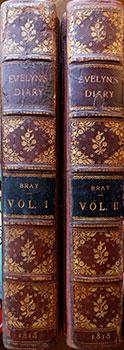
Memoirs, illustrative of the life and writings of John Evelyn, Esq. F.R.S. author of the "Sylva", &c. &c. : comprising his diary, from the year 1641 to 1705-6, and a selection of his familiar letters : to which is subjoined, the private correspondence between King Charles I. and his Secretary of State, Sir Edward Nicholas, whilst his majesty was in Scotland, 1641, and at other times during the Civil War : also between Sir Edward Hyde, afterwards Earl of Clarendon, and Sir Richard Browne, ambassador to the Court of France, in the time of King Charles I. and the usurpation : the whole now first published from the original mss. in two volumes. First edition.
Verlag: London : Printed for Henry Colburn, Conduit Street and sold by John and Arthur Arch, Cornhill
Anbieter: Wittenborn Art Books, San Francisco, CA, USA
Verkäuferbewertung 5 von 5 Sternen
Zustand: Good. 2 vols. 4to. 9 x 11-5/8 inches. Vol. I: xxxii, 620 pp. with 7 plates. Vol II: xii,366,ii, 336pp. with 4 plates, Contemporary sheepskin with 5 raised bands the gilt embossing on spine, expertly repaired. Lowndes, II, p. 767.
-

Eaton Hall - The Library, from Views of Eaton Hall.
Verlag: London: William Clarke., 1826
Anbieter: Wittenborn Art Books, San Francisco, CA, USA
Verkäuferbewertung 5 von 5 Sternen
Kunst / Grafik / Poster
Zustand: Good. Hand-colored lithograph. 29.7 x 40 cm. (image). 39 x 50.7 cm. (sheet). Very Good. Sheet trimmed and mounted to support sheet. Light foxing.
-
![Bild des Verkäufers für [ J. T. Maleville, nineteenth-century printer in Washington, DC. ] Menu printed on pink silk. zum Verkauf von Richard M. Ford Ltd](https://pictures.abebooks.com/inventory/md/md18546004576.jpg)
[ J. T. Maleville, nineteenth-century printer in Washington, DC. ] Menu printed on pink silk.
Verlag: 'J. T. MALEVILLE PRINT 407 10TH ST.' Washington DC Undated s?, 1880
Anbieter: Richard M. Ford Ltd, London, Vereinigtes Königreich
Verkäuferbewertung 5 von 5 Sternen
EUR 95,41
EUR 5,21 Versand
Versand von Vereinigtes Königreich nach USAAnzahl: 1 verfügbar
In den WarenkorbPrinted in black ink on one side of a 23.5 x 17.5 cm piece of pink silk. An interesting piece of American nineteenth-century printing, with only the printer's details giving a clue to the occasion of the dinner. Within a decorative border, and with Maleville's slug in bottom left-hand corner. A sumptuous 'service à la russe', with potages, hors d'oeuvre, poisson, relevé, entrées roti, entremets and dessert. See Image.
-
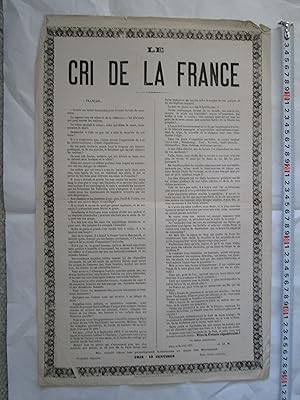
Le Cri de la France
Verlag: imp. Edouard Vert 28 avril 1871, Paris, 1871
Anbieter: Expatriate Bookshop of Denmark, Svendborg, Dänemark
Verkäuferbewertung 5 von 5 Sternen
50x32cm, One sheet, single-side. [ Reference: Firmin Maillard "Les publications de la rue pendant le siége et la Commune. Satires-- canards-- complaintes-- chansons-- placards et pamphlets. Bibliographie pittoresqve et anecdotiqve" nr. 106.: "Un feuillet avec encadrement, le recto seul est imprimé; imp. Edouard Vert. Les initiales J. D. S. dont est [par] ce 'petit factum représentent la France, c'est elle qui parle (J. D. S. n'est qu'un témoin auriculaire c' est lui qui le dit). La France raconte la chute de la seconde République, l'attenat de Bonaparte : 'Il se disait le neveu de quelque grand capitaine ;' la guerre de Prusse, 'cette trombe de presque deux millions d'anges destructeurs; ' la reddition de Paris 'n'ayant plus de vivres, et aussi par la faute de ses fils les plus puis- sants,' et enfin la Commune : 'Ah !mes fils, la nappe de sang qui tombe du front des combattants leur cache la lumière et les empêche de voir qu'ils frappent leur mère depuis vingt- cinq jours'. Elle prêche la conciliation : 'Cessez vos combats à la voix de la France ; reprenez les travaux de la paix, et bientôt tous nos malheurs pourront se réparer. Soyez justes et équitables les uns envers les autres ; que nul ne cherche à opprimer son frère et à lui ravir ses droits. Donnez- vous tous l'accolade de la paix et criez avec moi, devant le monde entier : Vive la France Republicaine' Soyez justes et équitables les uns envers les autres. Le 28 avril Pyat demandait à Vermorel la clef de ses dépêches chiffrées à M . Rouher et Vermorel lui donnait rendez-vous à la dernière barricade ! La Commune ordonnait .,."]. Some wear and tears to edges. Good.