Gesamtpreis (1 Artikel Artikel):
Versandziel:

plumier charles (19 Ergebnisse)
Direkt zu den wichtigsten Suchergebnissen
Suchfilter
Produktart
- Alle Product Types
- Bücher (18)
- Magazine & Zeitschriften (Keine weiteren Ergebnisse entsprechen dieser Verfeinerung)
- Comics (Keine weiteren Ergebnisse entsprechen dieser Verfeinerung)
- Noten (Keine weiteren Ergebnisse entsprechen dieser Verfeinerung)
- Kunst, Grafik & Poster (1)
- Fotografien (Keine weiteren Ergebnisse entsprechen dieser Verfeinerung)
- Karten (Keine weiteren Ergebnisse entsprechen dieser Verfeinerung)
- Manuskripte & Papierantiquitäten (Keine weiteren Ergebnisse entsprechen dieser Verfeinerung)
Zustand Mehr dazu
- Neu (8)
- Wie Neu, Sehr Gut oder Gut Bis Sehr Gut (2)
- Gut oder Befriedigend (5)
- Ausreichend oder Schlecht (Keine weiteren Ergebnisse entsprechen dieser Verfeinerung)
- Wie beschrieben (4)
Einband
Weitere Eigenschaften
- Erstausgabe (4)
- Signiert (Keine weiteren Ergebnisse entsprechen dieser Verfeinerung)
- Schutzumschlag (Keine weiteren Ergebnisse entsprechen dieser Verfeinerung)
- Angebotsfoto (11)
Sprache (3)
Gratisversand
Land des Verkäufers
Verkäuferbewertung
-

*Tombe gallo-romaine à Sombreffe (fouilles de 1959 et 1962)
Sprache: Französisch
Verlag: Société archéologique de Namur, Namur, 1986
Anbieter: Librairie Archaion, Bruxelles, Belgien
Verkäuferbewertung 5 von 5 Sternen

Broché. Zustand: Bon. pp. 169-195, 15 fig. Extrait des Annales de la Société archéologique de Namur Tome 64 (1985-1986). Inv. 27429.
-

LArt de tourner ou de faire en perfection toutes sortes douvrages au tour. 1749
Anbieter: Majestic Books, Hounslow, Vereinigtes Königreich
Verkäuferbewertung 4 von 5 Sternen

EUR 33,77
EUR 7,51 Versand
Versand von Vereinigtes Königreich nach USAAnzahl: 4 verfügbar
In den WarenkorbZustand: New. pp. 435.
-

Description des plantes de l'Amerique ?avec leurs figures /par le R.P. Charles Plumier, religieux minime. Volume {#1070} (French Edition)
Anbieter: Ria Christie Collections, Uxbridge, Vereinigtes Königreich
Verkäuferbewertung 5 von 5 Sternen
EUR 22,50
EUR 13,84 Versand
Versand von Vereinigtes Königreich nach USAAnzahl: Mehr als 20 verfügbar
In den WarenkorbZustand: New. In.
-

Description Des Plantes de l'Amérique, Avec Leurs Figures (Sciences) (French Edition)
Anbieter: Ria Christie Collections, Uxbridge, Vereinigtes Königreich
Verkäuferbewertung 5 von 5 Sternen
EUR 29,79
EUR 13,84 Versand
Versand von Vereinigtes Königreich nach USAAnzahl: Mehr als 20 verfügbar
In den WarenkorbZustand: New. In.
-

Description des plantes de l'Amerique ?avec leurs figures /par le R.P. Charles Plumier, religieux minime. Volume {#1070} (French Edition)
Anbieter: Ria Christie Collections, Uxbridge, Vereinigtes Königreich
Verkäuferbewertung 5 von 5 Sternen
EUR 33,07
EUR 13,84 Versand
Versand von Vereinigtes Königreich nach USAAnzahl: Mehr als 20 verfügbar
In den WarenkorbZustand: New. In.
-

Nova Plantarum Americanarum Genera.
Sprache: Englisch
Verlag: GALE ECCO SABIN AMERICANA, 2012
ISBN 10: 1275739156 ISBN 13: 9781275739154
EUR 19,61
EUR 48,99 Versand
Versand von Deutschland nach USAAnzahl: Mehr als 20 verfügbar
In den WarenkorbZustand: New.
-

EUR 34,06
EUR 48,99 Versand
Versand von Deutschland nach USAAnzahl: Mehr als 20 verfügbar
In den WarenkorbZustand: New.
-

EUR 37,67
EUR 48,99 Versand
Versand von Deutschland nach USAAnzahl: Mehr als 20 verfügbar
In den WarenkorbGebunden. Zustand: New.
-

Taschenbuch. Zustand: Neu. Description Des Plantes de l'Amérique, Avec Leurs Figures | Charles Plumier | Taschenbuch | Kartoniert / Broschiert | Französisch | 2017 | Hachette Livre - BNF | EAN 9782013018173 | Verantwortliche Person für die EU: Libri GmbH, Europaallee 1, 36244 Bad Hersfeld, gpsr[at]libri[dot]de | Anbieter: preigu.
-
L'Art de tourner, ou de faire en perfection toutes sortes d'ouvrages au tour (The Art of Turning, or of Making Perfectly All Sorts of Works on the Lathe)
Verlag: P. Aubouin; P. Ribou; C. Jombert, Paris, 1706
Anbieter: ERIC CHAIM KLINE, BOOKSELLER (ABAA ILAB), Santa Monica, CA, USA
Verkäuferbewertung 4 von 5 Sternen
Contemporary calf. Zustand: Good. Second edition. Folio (37.7 by 24.2 cm). [28], 187 pp. Engraved half-tile; engraved headpieces, initials, head- and tailpieces; 71 full-page engraved plates (1 folding). Contemporary calf (with mild erosion/rubbing), spine lettered and tooled in gilt. Light to moderate dampstain at top margin extending several inches down the gutter. Mild worm-tracing at fore-margin last fifty leaves (only occasionally affecting plates), else a good, amply-margined copy, complete with all plates noted in the printer's list. Second edition of this highly influencial and copiously illustrated work on the craft of ornamental wood turning, first published at Lyons in 1701. The son of a carpenter and woodturner, Charles Plumier (1646-1701) entered the monstery of the Minims at Marseilles, where he excelled in the study of the sciences, particularly mathematics and physics, under the tutelage of father Emmanuel Maignan, who was himself a master turner. Along with documenting the history of lathes from ancient times to the his own era, Plumier provides detailed illustrations of their various types and functions, along with additional tools and paraphernalia. L'Art de Tourner quickly became a standard reference for wood turning. Plumier is perhpas even better known for his botanical explorations (1689-1695) in the West Indies as the royal botanist for king Louis XIV of France; these researches are documented in his massive Nova Plantarum Americanarum Genera (1703-1704). A note on the plates: The placement of the 71 plates is noted on the leaf facing the opening of the main text; with three exceptions, plate content is not described. While the list notes plate numbers in Roman (I-LXIX; LXXIII; and LXXXII), in fact 66 of the plates are numbered in Arabic, three are unnumbered (nos. 66, 68, 69), and two employ other symbols (no. 56 - diamond; no. 67 - star). The placement list indicates that four plates (IX, XLII, LXXIII, and LXXXII) may each be inserted at two locations, though they make only one appearance in this copy. Provenance and annotations: Bookplate of Warren Greene Ogden, Jr., noting this title from the portion of his library comprising the history of tool building. Full title: L'Art de Tourner, ou de Faire en Perfection Toutes Sortes d'Ouvrages au Tour. Dans Lequel outre les principes & élemens du tour qu'on y enseigne méthodiquement pour tourner tant le bois, l'ivoire &c. que le fer & tous les autres métaux, on voit encore plusieurs belles machines à faire des ovales, tant simples que figurées de toutes grandeurs; la maniere de tourner le globe parfait, le rampant, l'excentrique, les pointes de diamant, les facettes, le panier our échquier, la couronne ondoyante, la rose à raiseau, les manches de couteaux façon d'Angleterre, les ovaries, la rose à jour ondée & goderonnée, les globes concentriques, la massuë à pointes, les tabatieres barlongues de toutes figures, le bâton rompu, les cannelures, les écailles &c. & généralement toutes les methodes les plus secrettes de cet art, avec la disposition des tours, &c. Ouvrage Tres Curieux et Tres necessaire à ceux qui s'exercent au tour. Composé en Francois et en Latin en faveur des etrangers, & enrichi de pres de quatre-vingt planches.
-
L'ArtdeTourner, oudeFaire en Perfection toutes Sortes d'Ouvrages au Tour
Verlag: Pierre Aubouin et al., Paris, 1706
Anbieter: Royoung Bookseller, Inc. ABAA, Ardsley, NY, USA
Verkäuferbewertung 3 von 5 Sternen

leather_bound. Second edition. 187 pages. Folio, 37.5 x 24.5 cm. 72 engraved plates including engraved additional title. French and Latin text. The first tome devoted exclusively to the lathe and concerned primarily with ornamental wood turning. Interior contents faultless and fresh. Owner inscription verso of free endpaper dated 1835 and small inscriptions top and bottom of title page. Raised bands, spine panels richly gilt with arabesques, binding very tight, maroon spine label printed in gilt. Some adhesions to covers contemporaneously repaired and not distinguishably. Contemporary full brown calf. Very good.
-
Description des plantes de l'Amerique. Avec leurs figures
Verlag: Jean Anisson, Paris, 1693
Erstausgabe
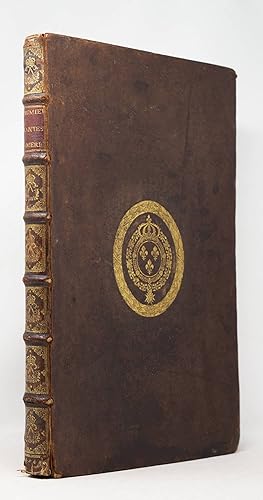
Hardcover. Zustand: Very good. First. THE FIRST ISSUE OF PLUMIER'S FIRST BOTANICAL WORK IN THE ARMORIAL BINDING OF LOUIS XIV. Paris: Jean Anisson, Imprimerie Royale; 1693 (as printed: 1713). First edition, first issue. Folio in 4s (16 1/8" x 10 5/8", 410mm x 271mm). [Full collation available.] With 108 engraved plates, as well as an engraved printer's device on the title-page and an engraved head-piece and initial to A1r. Bound in contemporary speckled calf. Gilt supralibros of Louis XIV (Olivier 2492, fers 7 and 21) to both boards. On the spine, six raised bands. In the panels, gilt cipher of Louis, coronetted and surmounted by the sun. Author and title gilt to chestnut morocco in the second panel. Gilt roll to the edges of the boards. All edges of the text-block speckled brown and red. Head- and tail-pieces perished. Front board split but solid. Some wear to the fore-corners and to the spine. Publication date corrected with abrasion and ink manuscript on the title-page. A mild but persistent damp-stain to the upper spine-corner of the text and plates, and sporadically to the lower margin (heavy in the final two plates). Shelf-label (CO/ I), ownership signature "?Laleunette. Paris. 1771", ink notes in an early hand and the armorial bookplate of Mr. (Benoît) Vaivolet, all to the front paste-down. Concordance notes to much of the text and to every plate, nearly all in the hand of the front paste-down (viz. Vaivolet). Pricing to the rear paste-down. As the New World unfurled its infiniteness to Europe, its Edenic botanical bounty became an object of desire as well as of curiosity. Fr. Charles Plumier O.M. (1646-1704) was botaniste du roi to Louis XIV, and acted as an agent of that nascent covetousness. The Description was Plumier's first publication based on his his voyages to the Antilles (i.e., the West Indies, viz. the islands of the Caribbean). He would make three trips in total, and eventually publish his magnum opus, the Nova plantarum americanarum genera (1703-1704), but the Description fueled France's immense interest in American flora, especially the ferns. Plumier's reputation among botanists is unrivalled; Linnaeus accepted his taxonomy with practically no changes, and wrote glowingly of his work; he named the genus Plumeria in his honor. At his death, he left a substantial trove of material -- text and drawings -- for future work. Indeed, his drawings are of as much value as his botanical descriptions; he has several modes of drafting, but some of the most striking plates show a simplification and directness informed by his botanical expertise. There are two issues of the first edition; this is the first (very rare indeed), distinguished by the transposition of a letter of the date: M. DC. CXIII instead of M. DC. XCIII. An owner has corrected this. The armorial binding -- as well as the inclusion of Louis XIV's cipher on the spine -- points to royal involvement if not ownership (the BnF still holds the copy from the royal library: FRBNF31124663). The king would often commission a certain number of copies of works (especially by authors with a royal connection or patronage) to be bound by the royal binder in order to be distributed at his discretion. The original recipient is unknown; the owner whose signature is difficult to decipher who owned the book in Paris in 1771 is unlikely to have been alive in 1693. Benoît Vaivolet (1734-1828) was himself a botanist of note, and a collector of botanical works not (merely) for their beauty but for their use in his own research and publication. Active in the Linnaean Society of Lyon (he was seneschal-lieutenant for the bailiwick of Villefranche (sur Saône) in Beaujolais, about 16 miles north of Lyon), he went on plant-collecting and -identifying missions throughout the region. His notes at the beginning (and, perhaps, throughout) make connections to the works of Linnaeus and Wildenow i.a., as well as to other works of Plumier's. Alden & Landis 693/137; Hunt 389; Nissen, BBI 1544; Sabin 63455; Stafleu-Cowan 8066.
-

L'art de tourner, ou de faire en perfection toutes sortes d'ouvrages au tour [.] : ouvrage très curieux et très nécessaire à ceux qui s'exercent au tour, composé en français et en latin en faveur des étrangers, et enrichi de près de quatre-vingt planches
Verlag: à Lyon, chez Jean Certe, Marchand Libraire, impr. Imprimé par les soins de Monsieur Labbé Perichon de St Saluadour, à Lyon, 1701
Anbieter: Librairie de l'Avenue - Henri Veyrier, Saint-Ouen, FR, Frankreich
Verkäuferbewertung 4 von 5 Sternen
Couverture rigide. Zustand: Bon état. In-folio 35 x 24 cm. Reliure début XIXe s. demi-veau pastiche XVIIIe s., dos à nerfs ornés encadrés de fers dorés, non folioté [15 ff. titre-frontispice, gravé, titre, épître, préface, table, approbations et privilège, ordre des planches], 187 pp., texte imprimé sur 2 colonnes en latin et français, 71 planches hors-texte dont 1 repliée et le frontispice, les planches sont numérotées de façon continue de 1 à 65, le frontispice, la planche repliée, et les 2 planches représentant l'intérieur s'un atelier de tournage ne sont pas numérotées et 2 planches sont chiffrées 73 et 82 comme prévu à la table. Soit, ouvrage bien complet de ses 71 planches. Le feuillet 2 de la préface a été remonté avec perte du texte latin et une déchirure avec petite perte du texte. Dos légèrement frotté, coins légèrement émoussés et frottés, intérieur très frais.Important ouvrage d'une relative rareté dans cette première édition. Botaniste et voyageur-naturaliste français, le père Charles Plumier (1646-1704), de l'Ordre des Minimes, était un spécialiste de la flore des Antilles et ses découvertes sont considérables. C'est lui qui le premier a donné aux plantes le nom de personnalités diverses, tel le bégonia pour Michel Bégon. Il laissa derrière lui de nombreux travaux tel cet "art de tourner", bel ouvrage alors précurseur.
-

L'art de tourner - Die Kunst zu drechseln, oder alle Arten von Arbeiten auf der Drehbank vollkommen zu verfertigen.
Verlag: Leipzig Breitkopf (), 1776
Anbieter: Antiquariat Gerhard Gruber, Heilbronn, Deutschland
Verkäuferbewertung 5 von 5 Sternen
Erstausgabe
EUR 2.420,00
EUR 40,00 Versand
Versand von Deutschland nach USAAnzahl: 1 verfügbar
In den Warenkorb(40 x 25,5 cm). (3) XX, 234 S. Mit gestochenem Titel, gestochener Titelvignette und 83 Kupfertafeln. Halblederband der Zeit. Erste deutsche Ausgabe mit deutsch-französischem Paralleltext. - Plumier beschreibt hier alle Bereiche des Drechslerhandwerks und zeigt damit, dass zu dieser Zeit gerade in Frankreich die Feindreherei hoch entwickelt war. Das Werk enthält die erste Beschreibung einer Patronendrehbank. Die zahlreichen Abbildungen zeigen Werkzeuge, Drehbänke und hübsche kunsthandwerkliche Gegenstände. - Kleiner Stempel mit Initialen auf Titel. Stellenweise leicht stockfleckig bzw. gebräunt. Deckel neu mit altem Papier überzogen. Rücken sorgsam restauriert. Insgesamt gut erhalten. - Ornamentstichkatalog 1247; Darmstaedter S. 192.
-
Descriptions Des Plantes De L'Amérique.
Verlag: Paris: L'Imprimerie Royale, 1693., 1693
Anbieter: D & E LAKE LTD. (ABAC/ILAB), Toronto, ON, Kanada
Verkäuferbewertung 2 von 5 Sternen

Erstausgabe
Hardcover. Zustand: Very Good. 1st Edition. folio. pp. 4 p.l., 94, [8], [1 leaf]. with half-title. large engraved title vignette. engraved headpiece & initial. 108 engraved plates after drawings by Plumier. new half calf over later 18th century bds., endpapers preserved (edges rubbed, marginal browning to some of the plates & light spotting to first few leaves but overall a nice wide-margined copy). engraved armorial bookplate of John Amory Lowell. First Edition, Second Issue, with the corrected date on the title-page. Plumier made three separate expeditions to the Caribbean, in 1689, 1693, and 1695. On the first of these he accompanied physician Joseph Surian; on the last two he travelled alone as 'botaniste du roi'. He discovered, drew, and described hundreds of new species, and left behind over 6,000 detailed drawings of West Indian plants. Many of Plumier's generic names were adopted by Linnaeus and are still in use today, among them Fuchsia, Caesalpinia, and Magnolia. The present work, based on his second trip, was his first botanical publication. Included are many plates showing ferns and clematis. "Plumier was one of the first naturalists interested in the Antilles. He is known for his excellent descriptions and drawings of a great number of species. Although Plumier's herbarium was lost in a shipwreck, his drawings and Surian's herbarium on which Plumier collaborated are extant. Plumeria, an American tree or shrub of the family Apocynaceae, was named in honour of Plumier." (DSB) European Americana 693/137. Hunt 389. JCB p. 275. Nissen BBI 1544. Pritzel 7213. Sabin 63455.
-

Fourteen engravings from "Description des plantes de l'Amerique. Avec leurs figures." First edition of the engravings.
Verlag: Paris: De l'Imprimerie Royale, M.DC.CXIII [1693], 1693
Anbieter: Wittenborn Art Books, San Francisco, CA, USA
Verkäuferbewertung 5 von 5 Sternen
Kunst / Grafik / Poster
Zustand: Good. Engravings on 17th Century laid paper. 42 x 25cm. Each plate annotated in the lower margin in elegant 18th Century scholarly penmanship.Petite déchirure avec manque en marge haute d'une planche.Alden & Landis 693/137; Hunt 389; Nissen, BBI 1544; Sabin 63455; Stafleu-Cowan 8066. Expertise by : Amaury BONNETAIN.
-
L'Art de Tourner, ou de Faire en Perfection Toutes sortes d'Ouvrages au Tour
Verlag: Lyon: Jean Certe, 1701
Anbieter: Zubal-Books, Since 1961, Cleveland, OH, USA
Verkäuferbewertung 5 von 5 Sternen
Zustand: Very Good. *Price HAS BEEN REDUCED by 10% until Monday, May 11 (SALE item)* first edition, folio, [xxvi], 187 pp., 71 plates, one of which is folding; contemporary full calf, binding worn, text and plates age-toned with an occasional age spot, overall very good. - If you are reading this, this item is actually (physically) in our stock and ready for shipment once ordered. We are not bookjackers. Buyer is responsible for any additional duties, taxes, or fees required by recipient's country. Photos available upon request.
-
Description des plantes de l'Amerique
Verlag: L'Imprimerie Royale, Paris, 1693
Anbieter: Rulon-Miller Books (ABAA / ILAB), St. Paul, MN, USA
Verbandsmitglied: ABAA ILAB RMABA
Verkäuferbewertung 5 von 5 Sternen
Erstausgabe
First Edition. First edition, second issue (with the correct date on the title page); folio, pp. [8], 94, [10]; 108 engraved plates; 19th century roan-backed marbled boards; joints rubbed, library sticker at base of spine, 2 MHS bookplates and an earlier engraved bookplate of P. T. Brown, perforated stamp in the bottom margin of the title page; the last 6 plates show some waterstaining entering from the fore-margin, many plates with small neat identifications in Latin in the margins; in all, a very good copy. "Le Pere Plumier, a monk in the order of St. Francesco di Paula, was an important botantical traveller. Tournefort and he became friends and they herborized together throughout the Midi. After that, Plumier's travels included the Antilles and several long voyages to other islands in the West Indies and to America, where he discovered, drew, and described hundreds of new plants, many of which are shown in his own books, though much of his work had to remain unpublished until Boerhaave and Jean Burmann were able to edit part of his papers, and publish them as the Plantarum Americanarum Fascisculi X in 1755-60" (Hunt). "Plumier was one of the first naturalists interested in the Antilles. He is known for his excellent descriptions and drawings of a great number of species. Although Plumier's herbarium was lost in a shipwreck, his drawings and Surian's herbarium on which Plumier collaborated are extant. Plumeria, an American tree or shrub of the family Apocynaceae, was named in honour of Plumier" (DSB). European Americana 693/137; Hunt 389. JCB p. 275. Nissen BBI 1544. Pritzel 7213. Sabin 63455.
-
L'Art de Tourner ou de Faire en perfection toutes sortes d'Ouvrages au Tour.Ouvrage très curieux composé en François et en Latin.
Anbieter: Librairie Laurencier, Bordeaux, AQUIT, Frankreich
Verkäuferbewertung 4 von 5 Sternen
Aubouin.Ribou.Jombert.1706.In-folio en reliure d'époque.187 p.Frontispice et 70 Planches gravées.BE.Reliure avec qques griffures et marques de mouillures.Coins émoussés.Dos à 6 nerfs avec caissons ornés et pièce de titre.Coiffe supérieure absente,mors droit supérieur légèrement ouvert.