Gesamtpreis (1 Artikel Artikel):
Versandziel:

planck max physicist nobel laureate (3 Ergebnisse)
Direkt zu den wichtigsten Suchergebnissen
Suchfilter
Produktart
- Alle Product Types
- Bücher (Keine weiteren Ergebnisse entsprechen dieser Verfeinerung)
- Magazine & Zeitschriften (Keine weiteren Ergebnisse entsprechen dieser Verfeinerung)
- Comics (Keine weiteren Ergebnisse entsprechen dieser Verfeinerung)
- Noten (Keine weiteren Ergebnisse entsprechen dieser Verfeinerung)
- Kunst, Grafik & Poster (Keine weiteren Ergebnisse entsprechen dieser Verfeinerung)
- Fotografien (Keine weiteren Ergebnisse entsprechen dieser Verfeinerung)
- Karten (Keine weiteren Ergebnisse entsprechen dieser Verfeinerung)
- Manuskripte & Papierantiquitäten (3)
Zustand Mehr dazu
- Neu (Keine weiteren Ergebnisse entsprechen dieser Verfeinerung)
- Wie Neu, Sehr Gut oder Gut Bis Sehr Gut (Keine weiteren Ergebnisse entsprechen dieser Verfeinerung)
- Gut oder Befriedigend (Keine weiteren Ergebnisse entsprechen dieser Verfeinerung)
- Ausreichend oder Schlecht (Keine weiteren Ergebnisse entsprechen dieser Verfeinerung)
- Wie beschrieben (3)
Einband
- alle Einbände
- Hardcover (Keine weiteren Ergebnisse entsprechen dieser Verfeinerung)
- Softcover (Keine weiteren Ergebnisse entsprechen dieser Verfeinerung)
Weitere Eigenschaften
- Erstausgabe (Keine weiteren Ergebnisse entsprechen dieser Verfeinerung)
- Signiert (1)
- Schutzumschlag (Keine weiteren Ergebnisse entsprechen dieser Verfeinerung)
- Angebotsfoto (3)
Sprache (1)
Preis
- Beliebiger Preis
- Weniger als EUR 20 (Keine weiteren Ergebnisse entsprechen dieser Verfeinerung)
- EUR 20 bis EUR 45 (Keine weiteren Ergebnisse entsprechen dieser Verfeinerung)
- Mehr als EUR 45
Gratisversand
- Kostenloser Versand nach USA (Keine weiteren Ergebnisse entsprechen dieser Verfeinerung)
Land des Verkäufers
Verkäuferbewertung
-
Autograph letter signed.
Verlag: Berlin-Grunewald, 30. XI. 1919., 1919
Anbieter: Kotte Autographs GmbH, Roßhaupten, Deutschland
Verkäuferbewertung 5 von 5 Sternen

Manuskript / Papierantiquität
EUR 6.500,00
EUR 20,00 shipping
Versand von Deutschland nach USAAnzahl: 1 verfügbar
In den Warenkorb8vo. 4 pp. Handwritten letter to Dr. Ludwik Silberstein. In full (translated): "You will have been waiting a long time already for my thanks for your detailed letter of the 7th, as well as for the work on vector algebra, very interesting and valuable to me, and yet I am only getting to writing to you today, after having also received your friendly congratulations on the Nobel Prize (of the 15th of this month). But you will understand me when I tell you that deep sadness has taken up residence in my house in the last week. I had two twin daughters, dear blooming girls, who were the joy of my whole heart. One married the history professor Dr. Fehling in Heidelberg 5 years ago and was snatched away in childbed upon the birth of her child. My son-in-law Fehling married my other daughter, his sister-in-law, 2 years later, and now she has been overtaken by exactly the same fate as her sister. Now only the little grandchildren are left, two healthy, strong girls who nonetheless chiefly arouse and keep alive in me grief and melancholy about those lost. I feel certain of your warm sympathy, even without your expressing it to me in a special letter.Now, first and foremost, I am sending you Major MacMahon's letter back. Where the matter of the Pt standard is concerned, it goes without saying that I regret the incident most deeply. I probably scarcely need to emphasize that, if I had had any influence on the handling of the affair, if I had even known about it at all, I would in any event have attempted to bring it about that this object, intended for scientific purposes, was protected and taken good care of. As it is, however, I must first of all find out what can still be established after the fact in this matter. For the time being, I and my colleague, the chemist Prof. Haber, have not yet unearthed what has become of the Pt rod. It is of course possible that this object, like any and all publicly and privately owned platinum, was confiscated and used for military purposes. It is also still possible, however, that it will yet turn up somewhere.In any case, I will report to you later about the results of our inquiries. It matters a great deal to me not to appear in your eyes and those of all objectively thinking people as a defender of unjustified expedients of force. However much every patriot feels the moral duty to take action on behalf of his fatherland's interests, national egoism still finds a limit in respect for such goods as serve supranational goals, namely science or art. I must conclude for today; there are still far too many storms breaking in on me. May God keep your wife and children in health." Silberstein notes the dates of receipt and reply at the top. In fine condition, with slight running to ink at the top of the first page.Planck was awarded the 1918 Nobel Prize in Physics in 1919 (as a 'reserved' prize awarded after no recipient was selected the previous year), in 'recognition of the services he rendered to the advancement of Physics by his discovery of energy quanta.' After thanking Silberstein for a congratulatory note, he details his recent personal tragedythe death in childbirth of his second twin daughter, Emmaand ponders the disappearance of a platinum rod, evidently a length standard defining the meter. In 1889, the International Bureau of Weights and Measures distributed 'National Prototype Metre Bars' to thirty nations to define the international standard; Planck seems to suspect that Germany's bar (no. 18) had been confiscated and used for war materiel.From the collection of physicist Ludwik Siberstein.
-
Autograph letter signed.
Verlag: Berlin-Grunewald, 4. VIII. 1919., 1919
Anbieter: Kotte Autographs GmbH, Roßhaupten, Deutschland
Verkäuferbewertung 5 von 5 Sternen
Manuskript / Papierantiquität Signiert
EUR 6.500,00
EUR 20,00 shipping
Versand von Deutschland nach USAAnzahl: 1 verfügbar
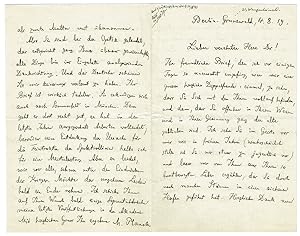
In den Warenkorb8vo. 4 pp. Handwritten letter to Dr. Ludwik Silberstein. In full (translated): "Your friendly letter, which I received so unexpectedly a few days ago, was a great, heartfelt double joy to me: for one thing, to see that you and yours are well, and then that you have evidently remained entirely as of old in your character and disposition. I see you in spirit before me as in earlier years (probably I am imagining you somewhat too youthfully), and I let you tell me about your so varied life, which has yet brought you to a safe harbor after many storms. Sincere thanks now above all for your amiable offer to do me kindness not only in word but also in deed. Fortunately, I do not need to make such demands on your goodness. Even if we had to endure many kinds of sadness during the war (my oldest son fell in France, and one of my twin daughters died in childbed), we have still never directly suffered lack, and now, hopefully, things will gradually start to move forward again with diligent work. I am very happy to hear from you that there are also people in England who are looking toward the future with rational ideas and know how to distinguish between political and personal antagonisms. Only if one considers even a political opponent as an honorable man is one able to judge him correctly. Still, I believe that science will soon do its part to pave the way for a proper understanding. One must only have patience.I do not know whether you are aware that I lost my first wife to death in 1909 and am now married for the second time, since 1911, to a niece of hers, who has given me a little son, now 7 years old. We are all well; my other twin daughter has married her brother-in-law and at the same time taken on the little orphaned grandchild, who is thriving splendidly, as a second mother.So you have ended up in optics; that fully corresponds to your exceedingly conscientious way of thinking, analyzing each thing down to the smallest details. And you do not seem to me to have forgotten your German in the least. Your letter is really beyond reproach. You also ask for news of Sommerfeld in Munich. Things are going quite well for him there; he has completed excellent papers in recent years, and in particular, I consider his discovery of the cause of the fine structure of the spectral lines a masterwork. But like all of us, he is suffering severely under the impressions of the war. May the frightful suffering soon come to an end! If you wish, I will send you some offprints of my most recent publications with the Academy soon." Silberstein notes the dates of receipt and reply at the top. In fine condition.In this significant autobiographical letter, Planck catches Silberstein up on some of the goings-on in his personal life, which was marred by tragedy in the World War I era: after the death of his first wife in 1909, his son Erwin was taken prisoner by the French in 1914, his son Karl was killed in action at Verdun in 1916, and his beloved daughter Grete died in childbirth. Her twin sister, Emma, married her widower, took in the orphaned child, and was "thriving splendidly," but she too would die in childbirth later on in 1919. Although Erwin survived, he would be executed during World War II as a conspirator in the 20 July Plot, Claus von Stauffenberg's attempt to assassinate Hitler.Planck, a staunchly patriotic German, had been a signatory to the infamous 'Manifesto of the Ninety-Three,' a 1914 proclamation in which prominent German scientists, scholars, and artists declared their unequivocal support of German military actions in the early period of World War I. This helped to solidify support for the war amongst the intellectual class. However, Planck's principal focus was physics, not politics. By 1916, he had moderated his views, and went semi-public with his regret about having signed the manifesto. Writing after war's end, he looks forward to renewed cooperation among the international scientific community and hopes that science will "pave the way for a proper understanding" between peoples.From the collection of physicist Ludwik Siberstein.
-
Autograph letter signed ("M. Planck").
Verlag: (Berlin-)Grunewald, 13 Feb. 1908., 1908
Anbieter: Antiquariat INLIBRIS Gilhofer Nfg. GmbH, Vienna, A, Österreich
Verbandsmitglied: ILAB VDA VDAO
Verkäuferbewertung 5 von 5 Sternen
Manuskript / Papierantiquität
EUR 4.500,00
EUR 30,00 shipping
Versand von Österreich nach USAAnzahl: 1 verfügbar
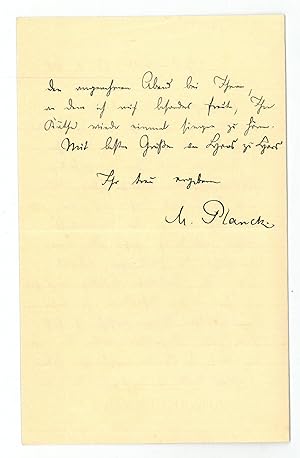
In den Warenkorb8vo. 1½ pp. on bifolium. To Mrs Warburg, a relative of the physicist Emil Warburg, thanking her for a letter of congratulations which has so overjoyed him that he has given his twin daughters permission to skip their appointment with their tailor in favour of accepting an invitation to visit the letter-writer: "Eigentlich weiß ich nicht, was ich stärker empfinde: die Freude oder die Ehre, die Sie mir mit Ihrem eigenhändigen Glückwunschschreiben erwiesen haben. Wie groß der Eindruck auf micht war, läßt sich nur an der Unvernunft messen, mit der ich gegen alle meine Grundsätze den Zwillingen erlaubt habe, Ihre freundliche Einladung anzunehmen und ihre wichtige Schneiderin zu versäumen; denn in solchen Dingen verstehe ich sonst keinen Spaß. Inzwischen werden Sie wohl den Brief der Kinder empfangen haben. Gerne denke ich noch zurück an den angenehmen Abend bei Ihnen, an dem ich mich besonders freute, Ihre Käthe wieder einmal singen zu hören [.]".