Gesamtpreis (1 Artikel Artikel):
Versandziel:

pithou pierre (49 Ergebnisse)
Direkt zu den wichtigsten Suchergebnissen
Suchfilter
Produktart
- Alle Product Types
- Bücher (49)
- Magazine & Zeitschriften (Keine weiteren Ergebnisse entsprechen dieser Verfeinerung)
- Comics (Keine weiteren Ergebnisse entsprechen dieser Verfeinerung)
- Noten (Keine weiteren Ergebnisse entsprechen dieser Verfeinerung)
- Kunst, Grafik & Poster (Keine weiteren Ergebnisse entsprechen dieser Verfeinerung)
- Fotografien (Keine weiteren Ergebnisse entsprechen dieser Verfeinerung)
- Karten (Keine weiteren Ergebnisse entsprechen dieser Verfeinerung)
- Manuskripte & Papierantiquitäten (Keine weiteren Ergebnisse entsprechen dieser Verfeinerung)
Zustand Mehr dazu
Weitere Eigenschaften
- Erstausgabe (7)
- Signiert (Keine weiteren Ergebnisse entsprechen dieser Verfeinerung)
- Schutzumschlag (Keine weiteren Ergebnisse entsprechen dieser Verfeinerung)
- Angebotsfoto (35)
Sprache (4)
Gratisversand
Land des Verkäufers
Verkäuferbewertung
-

Pervigilium Veneris
Anbieter: Majestic Books, Hounslow, Vereinigtes Königreich
Verkäuferbewertung 4 von 5 Sternen

EUR 29,12
EUR 7,50 Versand
Versand von Vereinigtes Königreich nach USAAnzahl: 4 verfügbar
In den WarenkorbZustand: New.
-

Pervigilium Veneris
Anbieter: PBShop.store US, Wood Dale, IL, USA
Verkäuferbewertung 5 von 5 Sternen

PAP. Zustand: New. New Book. Shipped from UK. Established seller since 2000.
-

Traitez Des Droits Et Libertez De L'eglise Gallicane 1
Anbieter: PBShop.store UK, Fairford, GLOS, Vereinigtes Königreich
Verkäuferbewertung 4 von 5 Sternen
EUR 28,71
EUR 6,77 Versand
Versand von Vereinigtes Königreich nach USAAnzahl: 15 verfügbar
In den WarenkorbPAP. Zustand: New. New Book. Shipped from UK. Established seller since 2000.
-

Pervigilium Veneris
Anbieter: Majestic Books, Hounslow, Vereinigtes Königreich
Verkäuferbewertung 4 von 5 Sternen
EUR 40,12
EUR 7,50 Versand
Versand von Vereinigtes Königreich nach USAAnzahl: 4 verfügbar
In den WarenkorbZustand: New.
-
Pervigilium Veneris
Anbieter: PBShop.store UK, Fairford, GLOS, Vereinigtes Königreich
Verkäuferbewertung 4 von 5 Sternen
EUR 24,09
EUR 4,80 Versand
Versand von Vereinigtes Königreich nach USAAnzahl: Mehr als 20 verfügbar
In den WarenkorbPAP. Zustand: New. New Book. Shipped from UK. Established seller since 2000.
-

Pervigilium Veneris
Anbieter: PBShop.store US, Wood Dale, IL, USA
Verkäuferbewertung 5 von 5 Sternen
HRD. Zustand: New. New Book. Shipped from UK. Established seller since 2000.
-
Pervigilium Veneris
Anbieter: PBShop.store UK, Fairford, GLOS, Vereinigtes Königreich
Verkäuferbewertung 4 von 5 Sternen
EUR 33,87
EUR 5,79 Versand
Versand von Vereinigtes Königreich nach USAAnzahl: Mehr als 20 verfügbar
In den WarenkorbHRD. Zustand: New. New Book. Shipped from UK. Established seller since 2000.
-

L'holocausticon - des vertus de l'holocausticon composé - histoire de l'hypothétique à chambre à gaz qui voulait se faire plus grosse qu'un combinat industriel
Couverture souple. Zustand: bon. R160211757: 1986. In-8. Broché. Etat d'usage, Tâchée, Agrafes rouillées, Intérieur acceptable. 29 pages - mouillures sur les plats. . . . Classification Dewey : 200-RELIGION.
-

EUR 32,31
EUR 48,99 Versand
Versand von Deutschland nach USAAnzahl: Mehr als 20 verfügbar
In den WarenkorbZustand: New. KlappentextrnrnThis is a reproduction of the original artefact. Generally these books are created from careful scans of the original. This allows us to preserve the book accurately and present it in the way the author intended. Since the origina.
-

Taschenbuch. Zustand: Neu. Libertés de l'Église Gallicane, Suivies de la Déclaration de 1682, Avec Une Introduction | Et Des Notes | Pierre Pithou (u. a.) | Taschenbuch | Kartoniert / Broschiert | Französisch | 2013 | Hachette Livre - BNF | EAN 9782013376358 | Verantwortliche Person für die EU: Libri GmbH, Europaallee 1, 36244 Bad Hersfeld, gpsr[at]libri[dot]de | Anbieter: preigu.
-

EUR 56,79
EUR 48,99 Versand
Versand von Deutschland nach USAAnzahl: Mehr als 20 verfügbar
In den WarenkorbZustand: New.
-
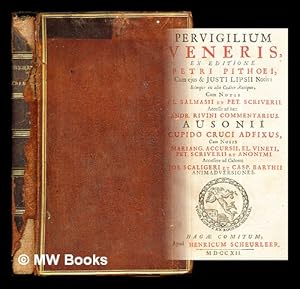
Pervigilium Veneris, ex editione Petri Pithoei, cum ejus & Justi Lipsii notis : itémque ex alio codice antique, cum notis Cl. Salmasii et Pet. Seriverii. Accessit ad haec Andr. Rivini commentarius. Ausonii cupido cruci adfixus / cum notis Mariang. Accursii . Accessere ad calcem Jos. Scaligeri et Casp. Barthii animadversiones
Verlag: Hagae Comitum : apud Henricum Scheurleer, 1712
Erstausgabe
First Edition. Poor copy in the original leather boards; wear and tear as with age. Text remains in fine condition and without blemish. Physical description; xvi, 208, [15] pages. Subjects; Latin poetry History and criticism ; Early works to 1800. 1 Kg.
-

Taschenbuch. Zustand: Neu. Coustumes Du Bailliage de Troyes En Champagne Conférées Aux Coustumes de France | Ensemble l'Estat Des Appartenances d'Icelles Coustumes, Le Droict de Champagne. Nouvelle Édition | Pierre Pithou | Taschenbuch | Kartoniert / Broschiert | Französisch | 2017 | Hachette Livre - BNF | EAN 9782013080712 | Verantwortliche Person für die EU: Libri GmbH, Europaallee 1, 36244 Bad Hersfeld, gpsr[at]libri[dot]de | Anbieter: preigu.
-
Les Coustumes du bailliage de Troyes en Champagne. Conférées aux coustumes de France. Augmentée sur chascun Tiltre d'observations amples & nécessaires.
Sprache: Französisch
Verlag: A PARIS, Chez CARDIN BESONGNE, 1629, 1629
Couverture rigide. Zustand: Assez bon. un fort volume in-4° (160 x 220 mm), [14] ff. (titre, dédicace, vie de Pithou par Josias Mercier, éloges funèbres), XX pp., 806 pp., [26] ff. (tables des auteurs et des remarques, addition, errata). Reliure en veau brun, dos à nerfs, soulignés d'une roulette dorée, orné du titre et de caissons fleuronnés dorés, roulette dorée sur les coupes (reliure de l'époque). (reliure frottée, manque de cuir en queue de dos, charnière ouverte sur 8cm au premier plat, un coin émoussé, présence d'une cerne claire en marge inférieure sur le titre et les cinq feuillets suivants, une autre cerne claire angulaire sur plusieurs feuillets avec atteinte au texte, rousseurs pâles, petits manques en marge du feuillet 403-404, erreurs de pagination : " 125 " au lieu de " 112 ", " 195 " au lieu de " 193 ", " 663 " au lieu de " 763 "). Titre imprimé en rouge et en noir. Marque au titre. Ex-libris volant ( " Louis Mrin Typographe à Troyes " ). Réédition de ces coutumes publiées pour la première fois en 1600. Rare.
-

PETRI PITHOEI OPERA SACRA, JURIDICA, HISTORICA, MISCELLANEA
Sprache: Französisch
Verlag: Sebastien Cramoisy, Paris, 1609
Anbieter: AU POINT DU JOUR, TROYES, Frankreich
Verkäuferbewertung 3 von 5 Sternen

cuir. Zustand: Bon. reliure vélin souple de l'époque, quelques manques, titre manuscrit sur le dos ; 4ffnch+840pp+15ffnch (table) ; Ce livre est dédié par Charles Labbe à Jacques-Auguste de Thou, président au parlement. Parmi le nombre considérable de traités et d'opuscules en vers et en prose qu'il renferme (31), on en trouve de très intéressants pour l'histoire de France et pour l'histoire littéraire, Techener N°1790 en donne le détail, la majorité est en latin, mais on peut trouver en Français "Bref recueil des Evêques de Troyes, mémoires des comtes de Champagne et de Brie, Les libertez de l'église gallicane, Harangue faite à Agen" ; belle impression ornée de vignettes, lettrines et culs de lampes ; intérieur frais malgré des mouillures en tête des 200 dernières pages ; quelques notes marginales anciennes Ex-libris manuscrit "Delafon"? Ce livre est "l'Oeuvre de Pithou", il regroupe ses principales études ; célèbre jurisconsulte et érudit aubois, Pierre Pithou (1539-1596) était un des principaux auteurs de la "Satyre Ménippée", et protéger d'Henri IV.
-
Pervigilium veneris. Ex Editione Petri Pithoei, Cum ejus & Justi Lipsii Notis. Cum Notis C. Salmasii et Pet. Scriverii. Acessit ad haec Andr. Rivini Commentarius.
Verlag: Scheuerleer, Den Haag, 1712
Anbieter: Antiquariat Stefan Krüger, Essen, NRW, Deutschland
Verkäuferbewertung 3 von 5 Sternen
Leder. XVI, 208 S., 8 Bl. Ldr. d. Zt (Rücken lädiert, Bindung defekt, Vorderdeckel lose. Titelblatt braunfl. u. mäßig fingerfl. Buch.
-

EUR 44,77
EUR 48,99 Versand
Versand von Deutschland nach USAAnzahl: Mehr als 20 verfügbar
In den WarenkorbZustand: New. KlappentextrnrnThis scarce antiquarian book is a facsimile reprint of the original. Due to its age, it may contain imperfections such as marks, notations, marginalia and flawed pages. Because we believe this work is culturally important, we have.
-
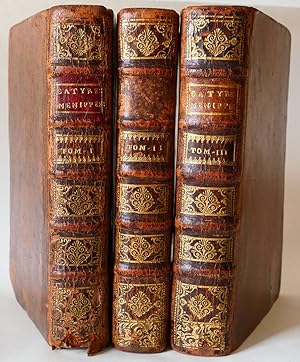
Satyre Ménippée, de la vertue du catholicon d'Espagne, et de la tenue des états de Paris, à laquelle est ajouté un discours sur l'interprétation du mot de Higuiero dei inferno & qui en est l'auteur. Plus le Regret sur la mort de l'Asne ligueur d'une damoiselle, qui mourut pendant le siège de Paris. Dernière édition, divisée en trois tomes, enrichie de figures en taille douce, augmentée de nouvelles remarques & de plusieurs pièces qui servent à prouver & à éclaircir les endroits les plus difficiles, avec des tables très-amples des matières
Verlag: Chez les Héritiers de Mathias Kerner
Anbieter: Librairie Lis Tes Ratures, Nantes, Frankreich
Verbandsmitglied: ILAB
Verkäuferbewertung 5 von 5 Sternen
A Ratisbone [Rouen], 1714, 3 vol. petit in-8 plein veau sombre, dos à cinq nerfs, pièce de titre rouge (manquante au T.II), dos très orné, Levrette doré en pied des volumes (Famille de Germay è). Reliure de l'époque. L'illustration de cette édition comprend : 1 frontispice / 6 planches hors-texte dont 2 dépliantes. T.I "Satyre Ménippée" Frontispice gravé par Cornelus Severus-5ff.(titre-Avertissement-table)-XXIIpp.-428pp.-12ff. de table des matières. // T.II "Remarques sur la Styre Ménippée" par Le Duchat 3ff.-474pp.-17ff. // T.III "Preuves de la Satyre Ménippée"2ff.-536pp.-15ff. Cette édition reprend l'édition de 1709. Les remarques constituant le troisième volume sont de l'érudit Jacob Le Duchat qui en donna la première édition en 1696. On lui doit également la première édition critique de Rabelais en 1711. Deux coins un peu émoussés. Coiffe inférieure du T.I absente avec petits manques de cuir. Petites perforations du cuir en haut du T.II. Une planches dépliante a été anciennement restaurée (déchirure sans manque). Brunet V-145 pour l'édition de 1709. "Le Duchat, à qui l'on doit cette grande édition , en avait donné une (hollande) en 1696, in-12, en un seul volume, mais il a ajouté à celle-ci de nombreuses remarques et plusieurs pièces du temps qui en augmente l'intérêt." // Grand Larousse du XIXème T.XI-p.32 "Célèbre pamphlet politique du XVIème siècle dirigé contre la Ligue (1594). [.] A la mort de Henri Ill, Henri de Navarre, son successeur légitime, avait pris le titre de roi; mais la Ligue, qui avait détrôné Valois, refusa de le reconnaître. Le duc de Mayenne, son chef, maître de Paris et de la majeure partie du royaume, fit la guerre au nouveau monarque, qui le vainquit, mais ne put l'abattre entièrement. Philippe II soutenait de son argent et de ses soldats la cause catholique, dansle but secret de se payer de ses sacrifices en plaçant sa fille Eugénie sur le trône de France. Mayenne, de son côté, aspirait à la couronne, et tous deux s'accordèrent à convoquer les états, qui devaient trancher là-question. [.]Cette satire fraye la route à Henri IV vers le trône; elle met au grand jour les prétentions de la Ligue, ses intentions secrètes, ses folies, ses crimes. Elle ne se contente pas de disserter ou de parodier, elle fait agir et vivre cette grande conspiration. Irrésistible satire, burlesque, populaire, fine et profonde, elle a quatre éditions en un mois; mêlée de vers légers, d'épigrammes piquantes, de pages éloquentes, de comiques parodies; tableau chargé, mais réel, des murs de l'époque dont elle est le plus curieux monument. Les politiques, les historiens, les gens de goût la consultent encore. LES PLUS JOLIS VERS DE LA FIN DU XVIÈME SIECLE S'Y TROUVENT SEMÉS[.]." Ex-libris manuscrit de "Vaillant de Pouilly".
-
Pervigilium Veneris, ex editione Petri Pithoei, Cum ejus Justi Lipsii Notis; Itémque ex alio Codice Antiquo, Cum Notis Cl. Salmasii et Pet. Scriverii. Accessit ad haec Andr. Rivini commentarius. Ausonii Cupido cruci adfixus, Cum Notis Mariang. Accurssii, El. Vineti, Pet. Scriverii et Anonymi. Accessere ad Calcem Jos. Scaligeri et Casp. Barthii animadversiones. [Text Lateinisch]. Titel, Incipit und Ende der Dedikation in rot und schwarz gedruckt. Mit Holzschnittdruckermarke (Hermes/Merkur) auf Titel, Holzschnittinitialen und -zierstücken.
Verlag: Henricus Scheurleer, Den Haag, 1712
Anbieter: Versandantiquariat Bürck (VDA / ILAB), Berlin, Deutschland
Verbandsmitglied: GIAQ ILAB VDA
Verkäuferbewertung 5 von 5 Sternen
Leder. Zustand: Gut. Octavo. 196 x 118 mm XVI, 208, [15], [1 weiße] Seiten, incl. Indices. Handgefertigter hellbrauner Kalbledereinband der Zeit (201 x 125 x 20 mm) mit glattem Rücken, darauf ein goldgeprägtes rotes Titelrückenschild und Filetenvergoldung. Stehkantenvergoldung, rot/weiße handgestochene Kapitale. Sprache: Latein, (Einband etwas fleckig, Ecken leicht bestoßen, Vordergelenk angeplatzt; innen recht gut.). Dies Gedicht zum Lobe des Frühlingserwachens durchzieht als Motto Walter Paters "Marius": "Cras amet, qui numquam amavit; quique amavit, cras amet" (Morgen liebe, wer niemals geliebt hat, wer schon geliebt hat, liebe morgen!). Es handelt sich um ein Gedicht in lateinischer Sprache, bisweilen Catull zugeschrieben, das, wohl im Frühling vor einem dreinächtlichen Fest der Venus geschrieben, in schöner, poetischer Sprache das jährliche Wiedererwecken von Fauna und Flora durch die Göttin beschreibt. "Das Pervigilium Veneris (lateinisch >Nachtfeier der Venus<) ist ein spätantikes lateinisches Gedicht, das ohne Verfassernamen in der Anthologia Latina überliefert wurde. In 93 Versen (metrisch: katalektischen trochäischen Tetrametern) schildert es die Wiederkehr des Frühlings mit der Belebung der Natur am Vorabend eines traditionellen Venusfestes im Hain von Hybla auf Sizilien. Die Schilderung gilt besonders der mythischen Bedeutung des Frühlings, so berichtet das Gedicht von den Tänzen der Nymphen sowie dem Auftreten des Liebesgottes Amor/Eros sowie der Leben und Liebe spendenden Göttin Venus/Aphrodite. (.) Obwohl sich der Text formal als traditionelles Prozessionslied gibt, wie es bei derartigen Festen gesungen wurde, handelt es sich wohl um das Werk eines einzelnen Autors, der nach neuerem Forschungsstand den Poetae novi des 4. Jahrhunderts zuzurechnen ist. Viel diskutiert wurde die schon 1872 vorgetragene Vermutung der Verfasserschaft des Tiberianus. Deren Befürworter verweisen auf stilistische Ähnlichkeiten mit der Kleindichtung des Tiberianus. Die Hypothese stößt aber in der neueren Forschung überwiegend auf Skepsis oder entschiedene Ablehnung. Seit seiner Wiederentdeckung und Erstedition durch den Humanisten Pierre Pithou hat das Pervigilium viele Bewunderer gefunden und zählt zu den berühmtesten anonym überlieferten lateinischen Dichtungen." (Wikipedia). Die vorliegende, nach Pierre Pithou (1539-96, vgl. Sandys II,192) herausgegebene Ausgabe enthält die Noten von Lipsius, Claude Saumaise und Pierre Schrijver zusammen mit dem Kommentar von Andreas Rivinus. Provenienz: Gestochenes Wappenexlibris von Sir John E. Swinburne, Bart., (1762-1861) dem Großvater des Dichters Algernon Charles Swinburne, ein Freund Mirabeaus und Wilkes', Besitzer einer feinen Bibliothek mit reichem Bestand an französischer Literatur des 18. Jh. - Contemporary calf, spine gilt. From the library of Sir John E. Swinburne, Bart (1762-1861), grandfather of Algernon Charles Swinburne. Upper hinge partly cracked, internal condition good. - Ebert 16317 - Graesse V,216 - Schreiber 719 - Gay/L. III,692-3 - Schweiger II,ii,719 - Hayn/Gotendorf VI,148. - RFM. - Weitere Bilder auf Anfrage oder auf unserer Homepage.
-
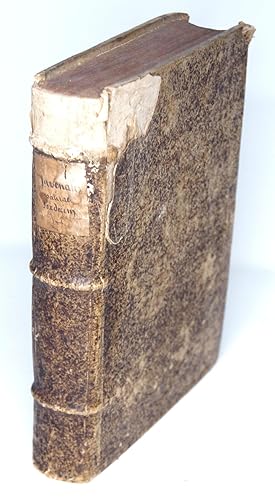
Junii Juvenalis Satyrae sexdecim, cum veteris scholiastae et Joan. Britannici commentariis, quibus accesserunt P. Pithoei, Coelii Secundi Curionis et Theodori Pulmanni notae et variae lectiones. Additus est index geminus rerum et verborum omnium absolutissimus
Verlag: apud Marcum Orry (Lutetiae), 1602
Anbieter: Librairie Douin, LA CELLE SAINT-CLOUD, Frankreich
Verkäuferbewertung 5 von 5 Sternen
Couverture rigide. Zustand: Très bon. Curione, Celio Secondo (1503-1569). Notes éditoriales Britannico, Giovanni. Auteur du commentaire Pithou, Pierre (1539-1596). Notes éditoriales Poelmann, Theodor (1510-1580). Notes éditoriales (illustrator). 2 parties en 1 vol. grand in-8° (15x22 cm) ; 16-716- index p. ; Pleine rel. peau de truie, dos à 3 nerfs, pièce de titre manuscrite. Manque de cuir en haut du dos et du plat sup. Frottis. Annotations à l'encre sur la page de titre. Intérieur très frais. 13C2 1100g.
-
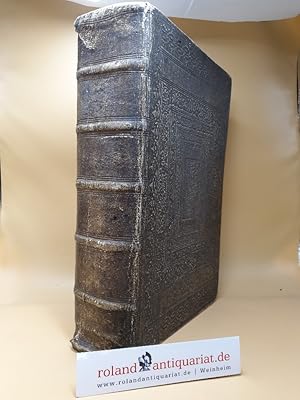
(1) Corpus Juris Canonici Gregorii XIII. Pont. Max. jussu editum. Tomus primus. / (2) Gregorii Papae IX. Decretales. Tomus secundus. Cui accedit Septimus Decretalium Liber, et Jo. Pauli Lancelotti Institutiones Juris Canonici.
Verlag: Bibliopol. (=Leipzig), Johann Friedrich Gleditsch. 1705 ., 1705
Anbieter: Roland Antiquariat UG haftungsbeschränkt, Weinheim, Deutschland
Verkäuferbewertung 5 von 5 Sternen
Schweinsleder-Holzdeckelband auf Bünden mit reicher Ornament-Prägung. Titelblätter in Schwarz-Rot-Druck. Mit 2 Titelkupfern (Portraits der Brüder Pithou, Wappenvignette) und 2 Kupferstichen (Arbor Consanguinitatis und Arbor Affinitatis = Ordnung der Verwandschaftsgrade). A Petro Pithoeo, et Francisco Fratre, Jurisconsultis ad veteres Codices Manuscriptos restitutum, et notis illustratum. Ex Bibliotheca Illustrissimi, D.D. Claudii Le Peletier, Regni Administri, et Regii Franciae Aerarii Praefecti. Kanten berieben, Einband stark gedunkelt. Oberes und unteres Kapital eingerissen. Erste und letzte Seiten an den Rändern leicht ausgefranst. Pierre Pithou (1539-1596), (ursprünglich Calvinist, legte 1573 den protestantischen Glauben ab) war Autor vieler geschichtlicher und juristischer Werke. Er gab auch antike Literatur (Juvenal, Phaedrus, Petronius) neu heraus. Francois Pithou (1543-1621), französischer Jurist und Autor. Paginierung: 32 Blatt, 492 Seiten und 6 Blatt, Seiten 1-282, 3 Blatt, Seiten 283-488, 41 Blatt Index und 4 Blatt, Seiten 1-86, 6 Blatt, Seiten 87-140. Sprache: Deutsch Gewicht in Gramm: 4850 Tomus Primus, Tomus Secundus, Appendix Juris Canonici, continens Librum Septimum Decretalium et Jo. Pauli Lancelotti Institutiones Juris Canonici. 3 Teile in 1 Band. Leipziger Nachdruck der Ausgabe Paris 1687.
-
Corpus juris canonici Gregorii XIII. pont. max. jussu editum
Verlag: apud Dionysium Thierry, viâ Jacobeâ, sub signo Urbis Lutetiae, Paris, 1687
Anbieter: Antiquariaat Meuzelaar, Heusden, NB, Niederlande
Verkäuferbewertung 5 von 5 Sternen
Contemporary Full Leather. Place Printed: Paris Ex Libris: See picture There are 9 extra pictures availabe on request! 7 (1-10) The front and rear joints of the book are split, but the covers are still attached to the book. The top of the text block is slightly damaged, but this does not affect the text. Height (cm): 40 Width (cm): 27 Thickness (cm): 8 Weight (kg): 4,864.
-
Preuves des libertez de l'Église Gallicane
Verlag: Gabriel Cramoisy, Paris, 1651
Anbieter: Librairie Seigneur, VOINGT, Frankreich
Verkäuferbewertung 5 von 5 Sternen
Zustand: Moyen. Seconde édition revue et augmentée d'ungrand nombre d'Actes, & illustrée de plusieurs nouvelles observations. Plein veau fauve. Reliure épidermée et sans pièces de titre.
-
Couverture rigide. Zustand: Assez bon. In-8°; reliure solide avec dos en vélin vert, manques au dos, fissure à la charnière; recueil factice de 5 ouvrages parmi lesquels la rare défense de Mme Vigée Lebrun par son mari en 1793, reliée en 4e position dans le livre; Frédéric Guillaume: édité à Paris en 1811 chez Renard, 388 pages; Mirabeau: édité par Pithou et Desenne à Paris, sans date, 87 pages; Corvisart: 32 pages, sans page de titre; LEBRUN: édité par le citoyen Lebrun à Paris, an 2e de la République, 22 pages; Lair, notices historiques, édité par Poisson à Caen en 1807, 96 pages. Intérieur en très bon état;
-
Germanicarum rerum scriptores aliquot insignes, hactenus incogniti. Qui gesta sub regibus & imperatoribus teutonicis (.) tomus unus, nunc primum editus. Ex bibliotheca Marquardi Freheri, consiliarii Palatini. - and 1 o.
Verlag: Francofurti, Apud heredes Andreae Wecheli, Claudium Marnium & Ioannem Aubrium, 1600. [11] 466 pp. plus index and appendix. Text in Latin., 1600
Anbieter: Antiquariaat Hortus Conclusus, Bergambacht, Niederlande
Verkäuferbewertung 5 von 5 Sternen
Contemporary pig leather binding over wooden boards, but binding rather worn/damaged. Leather on spine heavily damaged, edges of sides rather worn, but still well bound with cords. One original clasp present. Contents in (very) good condition (!). Please see description or ask for photos.
-
![Bild des Verkäufers für CORPUS JURIS CANONICI Tomus I-II. [primus et secundus] VOL: 1) Corpus Iuris Canonici : Gregorii XIII. Pont. Max. Iussu Editum / A Petro Pithoeo, Et Francisco Fratre, Iurisconsultis, Ad Veteres Codices Manuscriptos Restitutum, Et Notis Illustratum. Ex Bibliotheca Illustrissimi D.D. Claudii LePeletier, Regni Administri Et Regii Franciae Aerarii Praefecti VOL II: 2) Gregorii Papae IX. Decretales / A Petro Et Francisco Pithoeo I.C. Ad Veteres Manuscriptos Codices Restitutae Et Notis Illustratae, Ex Bibliotheca Illustrissimi D.D. Claudii Le Peletier, Regni Administri, Regii Franciae Aerarii Praefecti Et Supremi Senatus Praesidis Influati zum Verkauf von ANTIQUARIAT.WIEN Fine Books & Prints](https://pictures.abebooks.com/inventory/md/md31231047395.jpg)
CORPUS JURIS CANONICI Tomus I-II. [primus et secundus] VOL: 1) Corpus Iuris Canonici : Gregorii XIII. Pont. Max. Iussu Editum / A Petro Pithoeo, Et Francisco Fratre, Iurisconsultis, Ad Veteres Codices Manuscriptos Restitutum, Et Notis Illustratum. Ex Bibliotheca Illustrissimi D.D. Claudii LePeletier, Regni Administri Et Regii Franciae Aerarii Praefecti VOL II: 2) Gregorii Papae IX. Decretales / A Petro Et Francisco Pithoeo I.C. Ad Veteres Manuscriptos Codices Restitutae Et Notis Illustratae, Ex Bibliotheca Illustrissimi D.D. Claudii Le Peletier, Regni Administri, Regii Franciae Aerarii Praefecti Et Supremi Senatus Praesidis Influati
Verlag: Gleditschius (Johann Friedrich Gleditsch), Lipsiae / [Lipsiae] Leipzig, 1695
Anbieter: ANTIQUARIAT.WIEN Fine Books & Prints, Wien, Österreich
Verkäuferbewertung 5 von 5 Sternen
2 Bände in einem Blindgeprägtem Schweinslederband der Zeit auf Holzdeckeln mit 2 Schließen, mit rundum Farbschnitt in grün, 2°, 1. Band: Vol 1: 32 Blatt, 492 Seiten, 4 Blatt, 86 Seiten, 6 Blatt ,Seite 87-140 // 2. Band: Vol 2: 6 Blatt, 282 Seiten, 3 Blatt, Seite 283-488 und 41 Blatt; Titelblätter jeweils mit Vignette, mit 2 ganzseitigen Kupferstichen, und einer gestochenen Textvignette, kleinere Mängel, teil etwas stockfleckig, Titelblatt des 2 Bandes mit kleinerer Fehlstelle ohne Textverlust, Zustand: gut komplett; Leipziger Ausgabe der bereits1687 in Paris posthum erschienen Ausgabe der Brüder Pithou; Graesse II, 274; Brunet II, 29; VD17 1:009961S; VD17 1:009963G; Kirchenrecht la 7000 Buch.
-
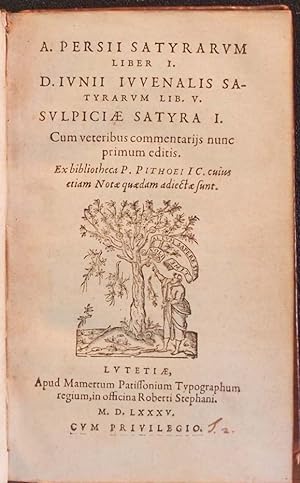
A. Persii Satyrarum liber I.D. Iunii Iuvenalis Satyrarum lib. V. Sulpiciae Satyra I. Cum veteribus commentariis nunc primum editis.
Verlag: Mamert Pattison at the press of Robert Estienne, Paris, 1585
Anbieter: Rodger Friedman Rare Book Studio, ABAA, Tuxedo, NY, USA
Verkäuferbewertung 5 von 5 Sternen
Zustand: Very Good. Octavo (17 cm); [10], 302, [10] pages. Estienne device on title page. Foliated woodcut initial and ornamental headpiece at beginning. In c17 polished calf, double-ruled in gilt on boards; five raised bands on spine, with gilt floral tools in the compartments. All edges gilt. A fine copy with some wear to corners and joins of binding; a few scattered underscorings and marginalia in an early hand. References: Schreiber, 258; Renouard, Estienne, 186:2; see also Gilbert Highet, Juvenal the Satirist, pages 207-208. First appearance of Pierre Pithou's edition of Juvenal and Persius, based on the discovery of a 9th-century manuscript in the Benedictine abbey of Lorsch. The manuscript was turned up in the course of the Humanist program of hunting and recovering early monastic copies of classical texts, and it was awarded to Pithou (1539-1596) in his capacity as one of the ablest classicists of his time. In addition to the text of the poems, it contained the ancient scholia and glosses on the satirists, published in print here for the first time. The manuscript remains our oldest and best textural source for the Persius and Juvenal. It is kept at Montpellier, where it is known as "Codex Pithoeanus" after its first editor.
-
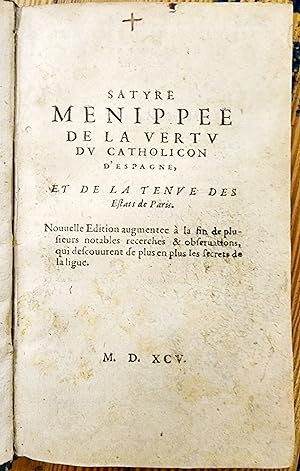
Satyre Ménippée de la Vertu du Catholicon d'Espagne, et de la tenue des Estats de Paris
Verlag: n/p, 1595
Anbieter: Chaco 4ever Books, Montevideo, MO, Uruguay
Verkäuferbewertung 5 von 5 Sternen
Erstausgabe
Encuadernación de tapa blanda. Zustand: Muy bien. 1ª Edición. In-12. 244p. With the rare blanc between p196/197. Bound in early blue vellum. La Satyre Ménippée de la vertu du Catholicon d'Espagne was a political and satirical work in prose and verse that mercilessly parodied the Catholic League and Spanish pretensions during the Wars of Religion in France, and championed the idea of an independent but Catholic France. The work was a collaborative effort of various functionaries, lawyers, clerics and scholars. It appeared at a time that coincided with the ascendance of Henry IV of France and the defeat of the League. The title derives from the classical Greek and Roman literary genre "menippean satire", a form of carnivalesque literature in a free-form mixture of prose, verse and dialogue. Mikhail Bakhtin called the Satyre Ménippée "one of the greatest political satires of world literature". The Satyre Ménippée was written in 1593 and published in Tours in 1594 during the Etats Généraux convened in Paris by the leader of the Catholic League, Charles, Duke of Mayenne. Charles hoped to get himself elected to the French throne in the place of the pretender to the throne, the future Henry IV of France. The work was conceived by Pierre le Roy, canon of Rouen and chaplain to the cardinal of Bourbon, during discussions with friends at the home of Jacques Gillot, canon of the Sainte-Chapelle, in Paris. The work was written by Nicolas Rapin, Jean Passerat and Florent Chrestien, and edited/revised by Pierre Pithou. The philosophy of the group around Pithou and Rapin, which formed the ideological motivation for Satire Ménippée, was that of the "Politiques" moderate Catholics who privileged peace, conceived of a distinction between the State and Religion, and sought political accommodation with the Huguenots. By the end of the civil wars, the "politiques" were the principal target of attack of the Catholic League. The work includes a description of a procession and all the forces of the League, a burlesque description of the opening of the États Généreaux, imaginary speeches by real personages such as the Duke of Mayenne, the legate of the Pope, and the cardinals Pelvé (attributed to Chrestien) and Aubray (attributed to Pithou), and a number of additional satires and epigrams. The writers paint the miseries of the nation and the blindness of their detractors, and they encourage an alliance of the people and the monarchy to save the nation. The comical and openly derisive brilliance of the work made it extremely popular at the time.
-

Traitez (traité) des droits et libertez (libertés)de l'Eglise Gallicane. 2 vols. 1731. And: Preuves des libetez de l'Eglise Gallicane. Troisième édition. 1 vol. 1651, sur l'imprimé 1731.
Verlag: Sébastien & Gabriel Cramoisy, Paris, 1731
Anbieter: Emile Kerssemakers ILAB, Heerlen, Niederlande
Verkäuferbewertung 5 von 5 Sternen
EUR 1.500,00
EUR 44,00 Versand
Versand von Niederlande nach USAAnzahl: 1 verfügbar
In den Warenkorb3 vols. Folio (24x26 cm). Contemporary granite-patterned calf, spines with raised bands, spines gilt, with title-labels (imperfections and tears to hinges, but still holding strong; rubbings to spines, covers and corners). Marbled endpapers. Decorative woodcuts on titles, engraved vignette and large woodcut for "Le Songe du Verger". - Fairly good set of the most complete 18th century edition. This work became the basis for the declaration of the French clergy (1682) concerning the authority of the pope. Collation (inner- and outter margins waterstained in places): Vol. I (Tome 1): (iv),344 pp. with Arrests, Memoires, Discours, i.a. Libellus BERTRANDI Cardinalis adversus magistrum Petrum de Cugneriis, Purgatus a Variis Mendis. 50 pp.; Commentaire sur le Traité. de Maistre Pierre Pithou. 1652. (xii),126 pp.; De l'origine et du progrez des interdicts ecclesiastiques. 78, (ii: Privilège) pp; Traité de ce qui s'est fait et pratiqué par les empereurs et les rois dans tous les tems. par PIERRE DUPUYS. (II),42 PP.; Epistola. (ii) pp.; Apologie pour la publication. par P. DUPUYS. 12 pp. - Vol. II (Tome seconnd): (viii),10(Table des Traictez)pp.; (ii),10 pp: Dissertation sur Le Songe du Verger; 250 pp.: Le Songe du Verger qui parle de la Disputacion du Clerc et du Chevalier. Livre Premier. With full-page woodcut.; 152 pp.: Le Songe du Vergier. Seconde Partie.; (xxiv),248 pp: REMONSTRANTIA HIBERNORUM contra Lovaniensis, ultramontanasque censuras. cum duplici Appendice R. CARON, Juxta Exemplar Londiniense anni 1665: 1731. - Vol.III: (Tome premier, partie 1-2 (et Tome deuxième parties 3-4) Preuves des Libertez de l'Eglise Gallicane. (iv)pp; 14 pp.: Privilège du Roi, Au Lecteur and Anciens Témoignages.; (iv) pp. and p.;15-32: Les Libertez par PITHOU; (XII)pp: Table chronologique. 220, 225 pp.;(i:blank)(iv: Halftitle and title Tome second)pp.;192 and 262 pp.: Preuves des Libertez. ; (vi)pp: Table des Matières. 10g.
-
EPIGRAMMATA ET POEMATIA VETERA. Quorum pleraque nunc primùm ex antiquis codicibus & lapidibus alia sparsim antehac errantia, iam undecunque collecta emendatiora eduntur.
Verlag: Imp. Iacobum Chouët. Lyon, 1596, 1596
Anbieter: FARRÉ Libreria Anticuaria, Barcelona, B, Spanien
Verkäuferbewertung 5 von 5 Sternen
. 15 cm. [8], 616 pág. (sign. *4, a-z8, 2a-p8, 2q4). Escudo tipográfico en portada (escorpión propio del impresor Antoine Blanc con el texto: "Mors et Vita"). Página 375 plegada. Enc. en piel por René Kieffer, nervios, cortes pintados, contracantos con ruedas doradas. Ligera señal de óxido. * Reimpresión de la edición de 1590 a cargo de Pierre Pithou (según Baudrier, Bibliographie lyonnaise: recherches sur les imprimeurs, libraires, relieurs et fondeurs de lettres de Lyon au XVIe siècle / Henri et J. Baudrier, 1999 (XII, p. 487), cuya recopilación alcanzó una gran difusión en su época. Los epigrammata, un género propio de gran popularidad, daban cabida a composiciones de época antigua (Virgilio, Catón, Ovidio entre muchos otros) y a otros textos antiguos y renacentistas. A partir de la década de 1560, Francia vio surgir una nueva generación de intelectuales fascinados por la literatura y el derecho clásicos latinos. Estudiosos de la poesía, la gramática y los textos legales de la Antigüedad tardía, vieron en los autores clásicos un reflejo de su propia sociedad, que combinaba la erudición literaria con el compromiso político. Entre sus máximos exponentes se contaban Pierre Daniel, Claude Dupuy, Florent Chrestien, Alphonse Delbene, Joseph Scaliger y el que nos ocupa, Pierre Pithou. En el colofón consta: "Ex typographia Antonii Candidi". Biblioteca Nacional de Francia 31118287. Literatura clásica. Poesía latina.


![Bild des Verkäufers für Pervigilium Veneris, ex editione Petri Pithoei, Cum ejus Justi Lipsii Notis; Itémque ex alio Codice Antiquo, Cum Notis Cl. Salmasii et Pet. Scriverii. Accessit ad haec Andr. Rivini commentarius. Ausonii Cupido cruci adfixus, Cum Notis Mariang. Accurssii, El. Vineti, Pet. Scriverii et Anonymi. Accessere ad Calcem Jos. Scaligeri et Casp. Barthii animadversiones. [Text Lateinisch]. Titel, Incipit und Ende der Dedikation in rot und schwarz gedruckt. Mit Holzschnittdruckermarke (Hermes/Merkur) auf Titel, Holzschnittinitialen und -zierstücken. zum Verkauf von Versandantiquariat Bürck (VDA / ILAB)](https://pictures.abebooks.com/inventory/md/md21456655018.jpg)