

Gesamtpreis (1 Artikel Artikel):
Versandziel:

nancy selvage (7 Ergebnisse)
Direkt zu den wichtigsten Suchergebnissen
Suchfilter
Produktart
- Alle Product Types
- Bücher (7)
- Magazine & Zeitschriften (Keine weiteren Ergebnisse entsprechen dieser Verfeinerung)
- Comics (Keine weiteren Ergebnisse entsprechen dieser Verfeinerung)
- Noten (Keine weiteren Ergebnisse entsprechen dieser Verfeinerung)
- Kunst, Grafik & Poster (Keine weiteren Ergebnisse entsprechen dieser Verfeinerung)
- Fotografien (Keine weiteren Ergebnisse entsprechen dieser Verfeinerung)
- Karten (Keine weiteren Ergebnisse entsprechen dieser Verfeinerung)
- Manuskripte & Papierantiquitäten (Keine weiteren Ergebnisse entsprechen dieser Verfeinerung)
Zustand Mehr dazu
- Neu (2)
- Wie Neu, Sehr Gut oder Gut Bis Sehr Gut (3)
- Gut oder Befriedigend (2)
- Ausreichend oder Schlecht (Keine weiteren Ergebnisse entsprechen dieser Verfeinerung)
- Wie beschrieben (Keine weiteren Ergebnisse entsprechen dieser Verfeinerung)
Einband
Weitere Eigenschaften
- Erstausgabe (Keine weiteren Ergebnisse entsprechen dieser Verfeinerung)
- Signiert (Keine weiteren Ergebnisse entsprechen dieser Verfeinerung)
- Schutzumschlag (Keine weiteren Ergebnisse entsprechen dieser Verfeinerung)
- Angebotsfoto (3)
Sprache (2)
Gratisversand
Land des Verkäufers
Verkäuferbewertung
-

New China : Porcelain Art from Jingdezhen, 1910-2012
Sprache: Englisch
Verlag: China Institute Gallery, China Institute in America, 2012
ISBN 10: 0977405486 ISBN 13: 9780977405480
Anbieter: Better World Books, Mishawaka, IN, USA
Verkäuferbewertung 5 von 5 Sternen

Zustand: Very Good. Former library copy. Pages intact with possible writing/highlighting. Binding strong with minor wear. Dust jackets/supplements may not be included. Includes library markings. Stock photo provided. Product includes identifying sticker. Better World Books: Buy Books. Do Good.
-
New China Porcelain Art From Jingdezhen 1910-2012
Sprache: Englisch
Verlag: China Institute, New York, 2012
ISBN 10: 0977405486 ISBN 13: 9780977405480
Anbieter: Gebrauchtbücherlogistik H.J. Lauterbach, Gummersbach, NRW, Deutschland
Verkäuferbewertung 5 von 5 Sternen
Broschiert. Zustand: Sehr gut. 28 x 22 cm 108 S. :. Broschiert. Sprache: Englisch, Zustand: Sehr Gut, eher ungelesen; * Die Photos sind original von uns erstellt worden, u.a. erkennbar an einem kleinen weißen Stück Papier im oberen Schnitt. Ab und an verwenden Suchmaschinen Verlagsphotos, bei den Portalen selbst, werden aber nur unsere Originalphotos gezeigt.
-
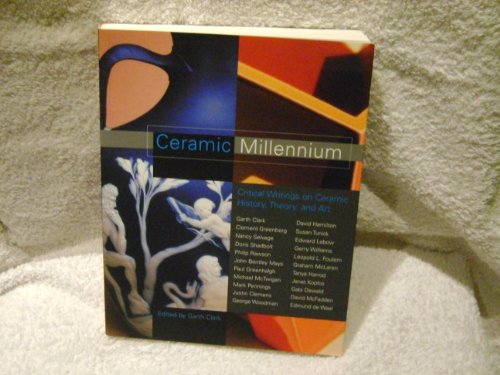
Ceramic Millennium: Critical Writings on Ceramic History, Theory and Art
Sprache: Englisch
Verlag: The Press of the Nova Scotia College of Art and Design, 2006
ISBN 10: 0919616453 ISBN 13: 9780919616455
Anbieter: Mooney's bookstore, Den Helder, Niederlande
Verkäuferbewertung 4 von 5 Sternen

Zustand: Very good.
-
Ceramic Millennium: Critical Writings on Ceramic History, Theory and Art
Sprache: Englisch
Verlag: The Press of the Nova Scotia College of Art and Design, 2006
ISBN 10: 0919616453 ISBN 13: 9780919616455
Anbieter: Ethan Daniel Books, Toronto, ON, Kanada
Verkäuferbewertung 5 von 5 Sternen
Soft cover. Zustand: Fine. Essays on ceramic art illustrated with black-and-white photographs. A fine paperback copy with only faint wear to covers and no marks, inscriptions or fading to inside pages. No crease to spine. Appears unread. 400 pages. s131.
-

Staatssicherheit und KSZE-Prozess
Sprache: Deutsch
Verlag: Vandenhoeck & Ruprecht Gmbh & Co, 2019
ISBN 10: 3525310692 ISBN 13: 9783525310694
Anbieter: SKULIMA Wiss. Versandbuchhandlung, Westhofen, Deutschland
Verkäuferbewertung 5 von 5 Sternen
Zustand: Sehr Gut. Zustandsbeschreibung: leichte Lagerspuren, Archivexemplarstempel auf Vorsatz. MfS zwischen SED und KGB (1972-1989). Aus der Einleitung: "Die Studie untersucht den Einfluss Erich Mielkes und seines Ministeriums auf die Entspannungs- und KSZE-Politik der DDR und der Sowjetunion in den Jahren 1972 bis 1989 sowie die Bemühungen der Staatssicherheit, die damit verbundene »Friedensoffensive« des Ostens gegen den Westen zu unterstützen und gleichzeitig die destabilisierenden Auswirkungen von Zugeständnissen Moskaus an den Westen auf die ostdeutsche Diktatur zu minimieren und einzudämmen." 757 Seiten, gebunden (Analysen und Dokumente der BStU [der Bundesbeauftragten für die Unterlagen des Staatssicherheitsdienstes der Ehemaligen Deutschen Demokratischen Republik]; Band 54/Vandenhoeck & Ruprecht 2019). Statt EUR 55,00. Gewicht: 1268 g - Gebunden/Gebundene Ausgabe - Sprache: Deutsch.
-

Buch. Zustand: Neu. Staatssicherheit und KSZE-Prozess | MfS zwischen SED und KGB (1972-1989), Analysen und Dokumente der BStU 54, Wissenschaftliche Reihe der Bundesbeauftragten für die Unterlagen des Staatssicherheitsdienstes der ehemaligen Deutschen Demokratischen Republik (BStU) | Douglas/Süß, Walter Selvage | Buch | 761 S. | Deutsch | 2019 | Vandenhoeck & Ruprecht | EAN 9783525310694 | Verantwortliche Person für die EU: Vandenhoeck & Ruprecht, Theaterstr. 13, 37073 Göttingen, ute[dot]schnueckel[at]brill[dot]com | Anbieter: preigu.
-

Staatssicherheit und KSZE-Prozess : MfS zwischen SED und KGB (1972-1989)
Sprache: Deutsch
Verlag: Vandenhoeck & Ruprecht Mär 2019, 2019
ISBN 10: 3525310692 ISBN 13: 9783525310694
Anbieter: AHA-BUCH GmbH, Einbeck, Deutschland
Verkäuferbewertung 5 von 5 Sternen
Buch. Zustand: Neu. Neuware - The book analyzes the role, activities and influence of the East German Ministry of State Security (MfS or Stasi) not only in connection with the Conference for Security and Cooperation in Europe (CSCE) and its follow-up conferences (i. e., the 'CSCE Process'), but also in terms of limiting its influence upon East German society in terms of improved human rights and increased human contacts between East and West. On the one hand, the MfS supported the hard line of the East German party and state leadership in the CSCE process - also, when necessary, in opposition to the Soviet Union. On the other hand, the MfS supported Moscow's demands - also communicated by its 'fraternal organ', the KGB - that the East German leadership should conduct a policy of strict 'delimitation' (Abgrenzung) with regard to West Germany in order to seal Germany's division. In general, Minister of State Security Erich Mielke supported the hardest possible line toward West Germany, whether as a representative of the East German Party leadership with regard to Moscow or as a supporter of Moscow's hard line for the GDR towards West Germany within the SED regime. However, the economic weakness of the GDR and the Soviet Union, further exacerbated by the arms race with NATO and especially the U.S. in the 1980's, led to concessions by both regimes to the West both within and outside of the CSCE process that further limited the possibilities of the MfS in terms of repressing East German dissidents. More importantly, this was also the case with regard to the growing movement to emigrate from the GDR to West Germany that had developed in response to the GDR's signing of the CSCE Final Act in Helsinki in August 1975. In the end, the Stasi, which had always been a 'servant of two masters' - i. e. the East German Party and the Soviet Union, represented by the KGB - could no longer keep the domestic effects arising from the CSCE process and détente under control because of the concessions of its two erstwhile 'masters' to the West.

