Gesamtpreis (1 Artikel Artikel):
Versandziel:

mulla sadra (17 Ergebnisse)
Direkt zu den wichtigsten Suchergebnissen
Suchfilter
Produktart
- Alle Product Types
- Bücher (17)
- Magazine & Zeitschriften (Keine weiteren Ergebnisse entsprechen dieser Verfeinerung)
- Comics (Keine weiteren Ergebnisse entsprechen dieser Verfeinerung)
- Noten (Keine weiteren Ergebnisse entsprechen dieser Verfeinerung)
- Kunst, Grafik & Poster (Keine weiteren Ergebnisse entsprechen dieser Verfeinerung)
- Fotografien (Keine weiteren Ergebnisse entsprechen dieser Verfeinerung)
- Karten (Keine weiteren Ergebnisse entsprechen dieser Verfeinerung)
- Manuskripte & Papierantiquitäten (Keine weiteren Ergebnisse entsprechen dieser Verfeinerung)
Zustand Mehr dazu
- Neu (8)
- Wie Neu, Sehr Gut oder Gut Bis Sehr Gut (1)
- Gut oder Befriedigend (5)
- Ausreichend oder Schlecht (Keine weiteren Ergebnisse entsprechen dieser Verfeinerung)
- Wie beschrieben (3)
Einband
Weitere Eigenschaften
- Erstausgabe (3)
- Signiert (Keine weiteren Ergebnisse entsprechen dieser Verfeinerung)
- Schutzumschlag (1)
- Angebotsfoto (5)
Sprache (3)
Gratisversand
Land des Verkäufers
Verkäuferbewertung
-
On the Hermeneutics of the Light Verse of the Qur'an
Sprache: Englisch
Verlag: Islamic College for Advanced Studies Publications, 2021
ISBN 10: 1904063160 ISBN 13: 9781904063162
Anbieter: Better World Books, Mishawaka, IN, USA
Verkäuferbewertung 5 von 5 Sternen

Zustand: Very Good. Pages intact with possible writing/highlighting. Binding strong with minor wear. Dust jackets/supplements may not be included. Stock photo provided. Product includes identifying sticker. Better World Books: Buy Books. Do Good.
-
Divine Manifestations: Concerning the Secrets of the Perfecting Sciences
Sprache: Englisch
Verlag: Islamic College for Advanced Studies Publications, London, 2010
ISBN 10: 1904063357 ISBN 13: 9781904063353
Anbieter: Salsus Books (P.B.F.A.), Kidderminster, Vereinigtes Königreich
Verbandsmitglied: PBFA
Verkäuferbewertung 5 von 5 Sternen
Erstausgabe
EUR 17,74
EUR 17,22 Versand
Versand von Vereinigtes Königreich nach USAAnzahl: 1 verfügbar
In den WarenkorbSoft cover. Zustand: Good. 1st Edition. 195pp paperback, some light pencil annotation and light scattered spotting.
-

The Elixir of the Gnostics
Sprache: Englisch
Verlag: FARMS (imprint of Brigham Young University), 2002
ISBN 10: 0934893705 ISBN 13: 9780934893701
Anbieter: PBShop.store UK, Fairford, GLOS, Vereinigtes Königreich
Verkäuferbewertung 4 von 5 Sternen

EUR 34,67
EUR 5,76 Versand
Versand von Vereinigtes Königreich nach USAAnzahl: 7 verfügbar
In den WarenkorbHRD. Zustand: New. New Book. Shipped from UK. Established seller since 2000.
-

The Elixir of the Gnostics: A parallel English-Arabic text (Brigham Young University - Islamic Translation Series)
Verlag: Brigham Young University, 2002
Anbieter: Books From California, Simi Valley, CA, USA
Verkäuferbewertung 4 von 5 Sternen
hardcover. Zustand: Good. minor wear and creasing underlined and highlighted passages; column notation.
-
The Elixir of the Gnostics: A parallel English-Arabic text (Islamic Translation Series)
Anbieter: Revaluation Books, Exeter, Vereinigtes Königreich
Verkäuferbewertung 5 von 5 Sternen
EUR 36,29
EUR 14,35 Versand
Versand von Vereinigtes Königreich nach USAAnzahl: 2 verfügbar
In den WarenkorbHardcover. Zustand: Brand New. bilingual edition. 145 pages. 9.50x6.25x1.00 inches. In Stock.
-
The Elixir of the Gnostics: A parallel English-Arabic text (Brigham Young University - Islamic Translation Series)
Anbieter: Kennys Bookstore, Olney, MD, USA
Verkäuferbewertung 4 von 5 Sternen
Zustand: New. This work is unique among Sadra's writing in that it reworks and amplifies an earlier Persian work, the "Jawidannama". by Baba Afdal. The underlying theme of the work is the importance of self-knowledge in an individual's journey of origin and return. Translator(s): Chittick, William. Num Pages: 192 pages. BIC Classification: HPDF; HRH. Category: (P) Professional & Vocational. Dimension: 164 x 238 x 27. Weight in Grams: 610. . 2002. 1st Edition. Hardcover. . . . . Books ship from the US and Ireland.
-

Le Verset de la Lumiere: Commentaire (Classiques En Poche) (Arabic and French Edition)
Anbieter: Gallix, Gif sur Yvette, Frankreich
Verkäuferbewertung 4 von 5 Sternen
Zustand: Neuf.
-
Le Verset De La Lumiere: Commentaire
Anbieter: Revaluation Books, Exeter, Vereinigtes Königreich
Verkäuferbewertung 5 von 5 Sternen
EUR 24,41
EUR 11,48 Versand
Versand von Vereinigtes Königreich nach USAAnzahl: 1 verfügbar
In den WarenkorbPaperback. Zustand: Brand New. bilingual edition. 264 pages. Arabic language. 7.01x4.25x0.87 inches. In Stock.
-

EUR 23,19
EUR 48,99 Versand
Versand von Deutschland nach USAAnzahl: Mehr als 20 verfügbar
In den WarenkorbZustand: New.
-
Verset de la lumière (Le)
Anbieter: Librairie La Canopee. Inc., Saint-Armand, QC, Kanada
Verkäuferbewertung 5 von 5 Sternen
État NEUF / NEW condition 630-80003 '9782251800035 Classiques en poche - bil. 02/07/2009 Poche.
-

Trooni tarkuse raamat. metafüüsilisi tõdemusi
Verlag: Unknown, 2023
ISBN 10: 9985778588 ISBN 13: 9789985778586
Zustand: new. Pages: 264 Language: Estonian. Iraani filosoofias tänapäevani ülimalt mõjuka nn. Isfahani koolkonna asutajaks oli Sadr ud-Din Shirazi (1572-1640), keda üldiselt tuntakse Mulla Sadra nime all (lihtsustatult Mulla Sadra). Mulla Sadra teosed on shiia islami filosoofiale põhjapaneva tähtsusega ning neid uuritakse ja kommenteeritakse tänapäevani. Käesolevas ülevaates ei saa muidugi anda kokkuvõtet Mulla Sadra mahukast loomingust ning võib-olla on seda ka vara teha, sest esiteks pole kogu Mulla Sadra looming veel üldkättesaadav ning teiseks oleks sellega tutvumine aastate, kui mitte aastakümnete töö, sest tuleks lugeda ka kogu seda kirjandust, mis on Mulla Sadra loomingu taustaks või millele ta ise viitab. Seepärast vaid mõned tähelepanekud peamiste teemade kohta tema loomingus. 9789985778586.
-

Metaphysical Penetrations
Sprache: Englisch
Verlag: Brigham Young University Press, 2014
ISBN 10: 0842528393 ISBN 13: 9780842528399
Anbieter: Kennys Bookstore, Olney, MD, USA
Verkäuferbewertung 4 von 5 Sternen
Zustand: New. Mulla Sadra is one of the prominent figures of post-Avicennan Islamic philosophy and among the most important philosophers of Safavid Persia. This title represents a paradigm shift from the Aristotelian metaphysics of fixed substances, which had dominated Islamic philosophy, to an analysis of existence as the ground and dynamic source of things. Editor(s): Kalin, Ibrahim. Translator(s): Nasr, Seyyed Hossein. Series: Islamic Translation Series. Num Pages: 320 pages. BIC Classification: HPDC. Category: (G) General (US: Trade). Dimension: 161 x 236 x 22. Weight in Grams: 564. . 2014. Bilingual. Hardcover. . . . . Books ship from the US and Ireland.
-
The Elixir of the Gnostics: A parallel English-Arabic text
Sprache: Englisch
Verlag: Brigham Young University, USA, 2002
ISBN 10: 0934893705 ISBN 13: 9780934893701
Anbieter: Begging Bowl Books, Lincoln, Vereinigtes Königreich
Verbandsmitglied: IOBA
Verkäuferbewertung 5 von 5 Sternen
Erstausgabe
EUR 59,13
EUR 26,41 Versand
Versand von Vereinigtes Königreich nach USAAnzahl: 1 verfügbar
In den WarenkorbHardcover. Zustand: Fine. Zustand des Schutzumschlags: Fine. 1st Edition. Arabic-English parallel text with introduction and notes. This work of Mulla Sadra (1572-1640) elaborates on an earlier Presian work, The Book of the Everlasting by Baba Afdal. Almost as new. Dj in a clear, protective wrapper. 8vo, xxxvii, 145 + 87 (in Arabic) pp. 620g.
-
On the Hermeneutics of the Light Verse of the Quran
Anbieter: Books From California, Simi Valley, CA, USA
Verkäuferbewertung 4 von 5 Sternen
paperback. Zustand: Good.
-
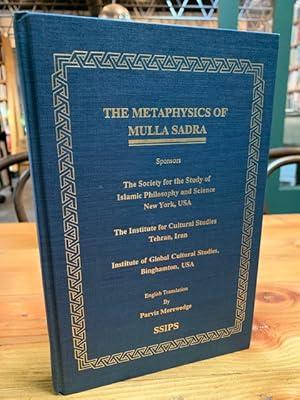
The Metaphysics of Mulla Sadra
Verlag: The Society for the Study of Islamic Philosophy and Science, 1992
Erstausgabe
Hardcover. Zustand: Very Good. 1st Edition. SSIPS: 1992. Octavo. Hardcover without a dust jacket. Blue boards with gilt lettering. price sticker on the rear board. Book is on the upper end of very good condition.
-
Al-Hikma al-Mutaaliya fi al-Asfar al-Aqliyya al-Arba'a (The Transcendent Theosophy in the Four Journeys of the Intellect).
Verlag: Qajar Persia dated 12 Dhu'l-Qa?da AH 1823 CE., 1238
Anbieter: Robert Frew Ltd. ABA ILAB, London, Vereinigtes Königreich
Verbandsmitglied: ABA ILAB PBFA
Verkäuferbewertung 5 von 5 Sternen
EUR 38.432,01
EUR 11,48 Versand
Versand von Vereinigtes Königreich nach USAAnzahl: 1 verfügbar
In den WarenkorbIlluminated manuscript on fine polished paper, copied by Abdullah bin Mohammed al-Mashhadi. Volume I: 232 leaves, single column, 25 lines in an elegant black naskh hand with rubrication (key words and headings in red) and occasional overlining; with a large gilt and polychrome illuminated heading at the opening. Condition: minor scattered spotting and a very small marginal tear to fol. 237, otherwise exceptionally clean and crisp. Volume II: 140 leaves, written in the same fine naskh with rubrication and overlining, also opening with a large illuminated heading. Condition: extremely clean and fresh throughout. Leaf size 300 × 190 mm. Both volumes bound in contemporary roan, expertly rebacked in tan leather; light rubbing at extremities; overall very presentable. An attractive Qajar-period copy of Mulla ?adra's celebrated synthesisal-Hikma al-muta?aliyathe foundational text of the later Iranian seminarian curriculum, prized not only for its doctrinal significance (primacy and gradation of existence, substantial motion) but also for its reception history in nineteenth-century Iran. Finely preserved illuminated sets from this period, in such condition, are uncommon on the market. Biography: Mulla Sadra (Sadr al-Din Muhammad Shirazi, 1571/721640) was the most influential intellectual figure of the late Safavid period, remembered not only as a thinker but as the founder of the school of al-hikma al-muta?aliya, or Transcendent Theosophy. Born in Shiraz, he received his early training under prominent teachers in Isfahan, most notably Mir Damad and Shaykh Baha? al-Din al-?Amili (Shaykh Baha?i). This Isfahan period introduced him to the traditions of Avicennian peripateticism, Suhrawardi's Illuminationism, and the metaphysics of Ibn ?Arabi, all of which he would later weave into his own synthesis. After years of study, Sadra withdrew to the village of Kahak near Qom for a period of seclusion and ascetic practice. There he combined rigourous scholarship with spiritual discipline, producing early drafts of his later works and cultivating the view that intellectual activity must be inseparable from inner purification. Eventually he returned to public life in Shiraz, where he was appointed to teach at the Madrasa-yi Khan, an institution founded under Safavid patronage. During this later phase he composed the works that secured his intellectual legacy. In addition to his vast al-Asfar al-Arba?a, he wrote shorter treatises such as al-Masha?ir (The Book of Metaphysical Prehensions), al-Shawahid al-rububiyya (The Divine Witnesses), and several Qur?anic commentaries and eschatological treatises, including his celebrated discussion of bodily resurrection (al-hashr). These writings reveal not only his metaphysical commitmentsthe primacy and gradation of existence, the doctrine of substantial motion, and the unity of the intellect and intelligiblebut also his conviction that true philosophy culminates in spiritual ascent and visionary knowledge. Mulla Sadra died in Basra in 1640 while on pilgrimage to Mecca, leaving behind an intellectual system that reshaped the philosophical landscape of Iran and the broader Islamic world. His works were copied extensively during the Qajar period, ensuring their survival and embedding them into the curricula of Shi?i seminaries. Even today, the Asfar remains central to advanced study in Qom and elsewhere, while modern scholarship has secured his place not only in Islamic intellectual history but also in global philosophical discourse. Mulla Sadra's biography thus reflects a life devoted to bridging rational inquiry, mystical experience, and theological reflection, a synthesis that continues to inform debates on metaphysics, psychology, and eschatology. The Transcendent Theosophy in the Four Journeys of the Intellect (al-Asfar al-Arba'a) Mulla Sadra's al-Hikma al-Muta?aliya fi al-Asfar al-?Aqliyya al-Arba?acommonly called the Asfar or "Four Journeys"is both his magnum opus and the architectonic expression of his hikma, or transcendent wisdom. Written and revised over several decades, it serves simultaneously as an encyclopaedic synthesis and a spiritual itinerary: the intellect's gradual passage through ontology, cosmology, theology, and anthropology. Structured around four symbolic "journeys," the text explores, in sequence, the nature of being and its modalities, the constitution of the cosmos through substance and accident, the divine names and attributes, and finally the human soul in its genesis, development, death, and return. More than a mere summa of antecedent traditions, the Asfar reframes Avicennian, Illuminationist, and mystical doctrines within an experiential metaphysics in which rational argumentation, spiritual unveiling, and scriptural revelation converge. Among the most influential doctrines articulated in the Asfar is the principle of the primacy of existence (asalat al-wujud), which asserts that existence is ontologically fundamental and essences are only conceptual abstractions. This reorients the metaphysical project away from essentialism and grounds it in wujud as a single but graded reality. Closely related is Sadra's teaching on the modulation or gradation of being (tashkik al-wujud), whereby existence is analogically one yet admits of intensification and diminution across levels of reality. A further cornerstone is the doctrine of substantial motion (al-haraka al-jawhariyya), which extends change from accidents into substances themselves, reimagining nature as an ongoing process and providing the basis for the soul's substantial growth toward higher intensities of being. The epistemological correlate of these doctrines is the unity of the intellect and the intelligible, according to which knower and known coincide in act during genuine intellection, a view that supports the ascent staged throughout the Asfar. The method of the work is both synthetic and dialogical. Avicenna supplies metaphysical scaffolding, Suhrawardi contributes the ontol.
-
Hikmat al-muta?aliya fi-l-asfar al-?aqliyya al-arba?a ????? ????????? ?? ??????? ??????? ???????
Verlag: c.1709., Persia (Iran)., 1709
Anbieter: Alexandre Antique Prints, Maps & Books, Toronto, ON, Kanada
Verkäuferbewertung 5 von 5 Sternen
contemporary full black morocco, flat spine., The Transcendent Philosophy of the Four Journeys of the Intellect, known as Four Journeys, is an extended compendium of Islamic philosophy written by the 17th century Islamic scholar, Mulla Sadra. The book explains his philosophy of transcendent theosophy. It was first published in print in 1865 in Tehran in four volumes, where it was accompanied by a commentary on three of the volumes by Hadi Sabzavari (1797?1893). To date, no notable, critical English translation of the book has been made.Mulla Sadr? (?adr ad-D?n Mu?ammad Sh?r?z?) (c.1571 CE?1640 CE), was an Iranian Shia Islamic philosopher, theologian and ??lim (scholar). He was a prominent figure in the Iranian cultural renaissance of the 17th century. Oliver Leaman of the University of Kentucky calls Mulla Sadra "the most important and influential philosopher of the last four hundred years in the Muslim world". Mulla Sadra's writing style is analytical and critical., Size : 8vo., , Text on creamy gloss paper, 336 leaves, 24 lines to the page, text in black and red ink, in Naskhi script, marginal notes in period handwriting.