

Gesamtpreis (1 Artikel Artikel):
Versandziel:

moser reta (9 Ergebnisse)
Direkt zu den wichtigsten Suchergebnissen
Suchfilter
Produktart
- Alle Product Types
- Bücher (9)
- Magazine & Zeitschriften (Keine weiteren Ergebnisse entsprechen dieser Verfeinerung)
- Comics (Keine weiteren Ergebnisse entsprechen dieser Verfeinerung)
- Noten (Keine weiteren Ergebnisse entsprechen dieser Verfeinerung)
- Kunst, Grafik & Poster (Keine weiteren Ergebnisse entsprechen dieser Verfeinerung)
- Fotografien (Keine weiteren Ergebnisse entsprechen dieser Verfeinerung)
- Karten (Keine weiteren Ergebnisse entsprechen dieser Verfeinerung)
- Manuskripte & Papierantiquitäten (Keine weiteren Ergebnisse entsprechen dieser Verfeinerung)
Zustand Mehr dazu
- Neu (4)
- Wie Neu, Sehr Gut oder Gut Bis Sehr Gut (1)
- Gut oder Befriedigend (2)
- Ausreichend oder Schlecht (Keine weiteren Ergebnisse entsprechen dieser Verfeinerung)
- Wie beschrieben (2)
Einband
Weitere Eigenschaften
- Erstausgabe (1)
- Signiert (Keine weiteren Ergebnisse entsprechen dieser Verfeinerung)
- Schutzumschlag (Keine weiteren Ergebnisse entsprechen dieser Verfeinerung)
- Angebotsfoto (4)
Sprache (2)
Gratisversand
- Kostenloser Versand nach USA (Keine weiteren Ergebnisse entsprechen dieser Verfeinerung)
Land des Verkäufers
Verkäuferbewertung
-

Space-Age Acronyms: Abbreviations and Designations
Anbieter: Visible Voice Books, Cleveland, OH, USA
Verkäuferbewertung 5 von 5 Sternen

Zustand: Good. Plenum Press New York 1964 8vo. 427 pages. ex-library copy. blue cloth boards. binding tight.
-
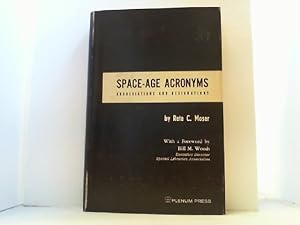
Space-Age Acronyms. Abbreviations and Designations.
Sprache: Englisch
Verlag: Plenum, New York, 1964
Anbieter: Antiquariat Uwe Berg, Toppenstedt, Deutschland
Verkäuferbewertung 5 von 5 Sternen
427 S., OPbd., Gr.-8*. Gut erhaltener Pappband mit Schutzumschlag. 69 Sprache: Englisch Gewicht in Gramm: 1000.
-
Space-Age Acronyms; Abbreviations and Designations
Verlag: Plenum Press, New York, 1964
Anbieter: Ground Zero Books, Ltd., Silver Spring, MD, USA
Verkäuferbewertung 4 von 5 Sternen

Erstausgabe
Hardcover. Zustand: Good. Presumed First Edition, First printing. 26 cm. [10], 427, [1] pages. Ex-library with the usual library markings. Name of previous owner in ink on fep. With a Foreword by Bill M. Woods, Executive Director of the Special Libraries Association. Acronym agglomeration is an affliction of the age, and there are acronym addicts who, in their weakness, find it impossible to resist them. It is then for the reader and listener and for the writer and speaker that Reta C. Moser has compiled this guide. Its effective application to the art of communication is urged. Such use should help avoid many of the misunderstandings involving terminology which occur daily. Although such misunderstandings are certainly crucial in humanistic and social situations, they are often of immediate import and the trigger to disaster in scientific, technical, and political situations. Many acronyms and definitions are provided, with due credit to Miss Moser's diligence in making the compilation and with the acknowledgment that the acronymical phenomenon is very much with us. This first edition is certain to be of value to writers, librarians, editors, and others who must identify and deal with acronyms. Special Libraries Association (SLA) is an international professional association for library and information professionals working in business, government, law, finance, non-profit, and academic organizations and institutions. The Special Libraries Association was founded in 1909 in the United States by a group of librarians working in specialized settings, led by John Cotton Dana, who served as the first president of SLA from 1909 to 1911. In the years prior to SLA's founding Dana and other librarians saw an increasing demand for the types of materials that specialized libraries could provide, and recognized that as information professionals working in such settings responded to the demands of their jobs they were creating a new kind of librarianship. The group sought to address their common problems by banding together. Their goal, as stated in the first issue of Special Libraries, was to "unite in co-operation all small libraries throughout the country; financial, commercial, scientific, industrial; and special departments of state, college and general libraries; and, in fact, all libraries devoted to special purposes and serving a limited clientage.".
-
Space-Age Acronyms; Abbreviations and Designations
Verlag: IFI/Plenum, New York, 1969
Anbieter: Ground Zero Books, Ltd., Silver Spring, MD, USA
Verkäuferbewertung 4 von 5 Sternen
Hardcover. Zustand: good, ex-lib. Second Revised Edition. 26 cm, 534, usual library markings, some of which have been blacked over. Some 15, 000 acronyms and 25, 000 definitions are provided, about a 50% increase over the 1964 edition.
-

EUR 21,63
EUR 48,99 Versand
Versand von Deutschland nach USAAnzahl: Mehr als 20 verfügbar
In den WarenkorbKartoniert / Broschiert. Zustand: New. KlappentextrnrnThere is a monument at Gettysburg that bears his name another has his written words. His Official Report (OR) authenticates that Confederates other than Virginians and Carolinians crossed over the stone wall, and it also establis.
-

EUR 27,87
EUR 48,99 Versand
Versand von Deutschland nach USAAnzahl: Mehr als 20 verfügbar
In den WarenkorbGebunden. Zustand: New. KlappentextrnrnThere is a monument at Gettysburg that bears his name another has his written words. His Official Report (OR) authenticates that Confederates other than Virginians and Carolinians crossed over the stone wall, and it also establis.
-

Space-Age Acronyms: Abbreviations and Designations
Anbieter: Revaluation Books, Exeter, Vereinigtes Königreich
Verkäuferbewertung 5 von 5 Sternen
EUR 81,09
EUR 14,37 Versand
Versand von Vereinigtes Königreich nach USAAnzahl: 2 verfügbar
In den WarenkorbPaperback. Zustand: Brand New. 500 pages. 9.61x6.69x1.01 inches. In Stock.
-

Space-Age Acronyms : Abbreviations and Designations
Anbieter: AHA-BUCH GmbH, Einbeck, Deutschland
Verkäuferbewertung 5 von 5 Sternen
Taschenbuch. Zustand: Neu. Druck auf Anfrage Neuware - Printed after ordering - Acronym agglomeration is an affliction of the age, and there are acronym addicts who, in their weakness, find it impossible to resist them. More than once in recent months my peers have cautioned me about my apparent readiness to use not only acronyms, but abbreviations, foreign isms, codes, and other cryptic symbols rather than common, ordinary American words. Many among us, though, either have not received or have chosen to ignore such advice. As a consequence, what we write and speak is full of mystery and confusion. It is then for the reader and listener and for the writer and speaker that Reta C. Moser has compiled this guide. Its effective application to the art of communication is urged. Such use should help avoid many of the misunderstandings involving terminology which occur daily. Although such misunderstandings are certainly crucial in humanistic and social situations, they are often of immediate import and the trigger to disaster in scientific, technical, and political situations. Some 15,000 acronyms and 25,000 definitions are provided (a 50- and 47 -percent increase over the 1964 edition!), with due credit to Miss Moser's diligence in making the compilation and with the acknowledgment that the acronymical phenomenon is very much with us. This edition, like the first, is certain to be of value to writers, librarians, editors, and others who must identify and deal with acronyms.
-
Zustand: Sehr gut. Zustand: Sehr gut | Seiten: 504 | Sprache: Englisch | Produktart: Bücher | Acronym agglomeration is an affliction of the age, and there are acronym addicts who, in their weakness, find it impossible to resist them. More than once in recent months my peers have cautioned me about my apparent readiness to use not only acronyms, but abbreviations, foreign isms, codes, and other cryptic symbols rather than common, ordinary American words. Many among us, though, either have not received or have chosen to ignore such advice. As a consequence, what we write and speak is full of mystery and confusion. It is then for the reader and listener and for the writer and speaker that Reta C. Moser has compiled this guide. Its effective application to the art of communication is urged. Such use should help avoid many of the misunderstandings involving terminology which occur daily. Although such misunderstandings are certainly crucial in humanistic and social situations, they are often of immediate import and the trigger to disaster in scientific, technical, and political situations. Some 15,000 acronyms and 25,000 definitions are provided (a 50- and 47 -percent increase over the 1964 edition!), with due credit to Miss Moser's diligence in making the compilation and with the acknowledgment that the acronymical phenomenon is very much with us. This edition, like the first, is certain to be of value to writers, librarians, editors, and others who must identify and deal with acronyms.


