
Gesamtpreis (1 Artikel Artikel):
Versandziel:

maker unknown (57 Ergebnisse)
Direkt zu den wichtigsten Suchergebnissen
Suchfilter
Produktart
- Alle Product Types
- Bücher (57)
- Magazine & Zeitschriften (Keine weiteren Ergebnisse entsprechen dieser Verfeinerung)
- Comics (Keine weiteren Ergebnisse entsprechen dieser Verfeinerung)
- Noten (Keine weiteren Ergebnisse entsprechen dieser Verfeinerung)
- Kunst, Grafik & Poster (Keine weiteren Ergebnisse entsprechen dieser Verfeinerung)
- Fotografien (Keine weiteren Ergebnisse entsprechen dieser Verfeinerung)
- Karten (Keine weiteren Ergebnisse entsprechen dieser Verfeinerung)
- Manuskripte & Papierantiquitäten (Keine weiteren Ergebnisse entsprechen dieser Verfeinerung)
Zustand Mehr dazu
- Neu (Keine weiteren Ergebnisse entsprechen dieser Verfeinerung)
- Wie Neu, Sehr Gut oder Gut Bis Sehr Gut (Keine weiteren Ergebnisse entsprechen dieser Verfeinerung)
- Gut oder Befriedigend (Keine weiteren Ergebnisse entsprechen dieser Verfeinerung)
- Ausreichend oder Schlecht (Keine weiteren Ergebnisse entsprechen dieser Verfeinerung)
- Wie beschrieben (57)
Einband
- alle Einbände
- Hardcover (Keine weiteren Ergebnisse entsprechen dieser Verfeinerung)
- Softcover (Keine weiteren Ergebnisse entsprechen dieser Verfeinerung)
Weitere Eigenschaften
- Erstausgabe (1)
- Signiert (Keine weiteren Ergebnisse entsprechen dieser Verfeinerung)
- Schutzumschlag (Keine weiteren Ergebnisse entsprechen dieser Verfeinerung)
- Angebotsfoto (45)
Sprache (1)
Gratisversand
- Kostenloser Versand nach USA (Keine weiteren Ergebnisse entsprechen dieser Verfeinerung)
Land des Verkäufers
Verkäuferbewertung
-
![Bild des Verkäufers für [Later woodengraving, 20th century] Portrait of Michiel de Ruyter (1607-1676) [series title: Zes vaderlandsche rijm], 1 p. zum Verkauf von Antiquariaat Arine van der Steur / ILAB](https://pictures.abebooks.com/inventory/md/md20050777460.jpg)
[Later woodengraving, 20th century] Portrait of Michiel de Ruyter (1607-1676) [series title: Zes vaderlandsche rijm], 1 p.
Anbieter: Antiquariaat Arine van der Steur / ILAB, Den Haag, Niederlande
Verkäuferbewertung 4 von 5 Sternen

Portrait of Michiel de Ruyter. Below the portrait a quotation attributed to him: 'Houdt moed, mijn kinderen, houdt moed! / Zoo moet men doen om de zege te verkrijgen / Michiel Adrianszoon de Ruyter', which means: 'be brave, my fellow, be brave! This is how you should act to gain the triumph'. From a series of six portraits and quotations, wood engraving on laid paper; total: 352 x 217 mm.
-
Re-treatment plant at Kalgoorlie, Western Australian goldfields. Circa 1900.
Anbieter: Douglas Stewart Fine Books, Armadale, VIC, Australien
Verkäuferbewertung 5 von 5 Sternen

[s.l., s.n., circa 1900]. Photographic glass magic lantern slide, 82 x 82 mm, with original manuscript caption label 'Kalgurli (sic) Retreatment Plant'; in very good condition.
-

Profile potrait of Juan I of Austria (1547-1578). Inscribed on the bottom: 'IOANES AUSTRIACUS CAROLI V. / FIL. BELGII GUBERNATOR.'; numbered on the top left: '506' l Etching on paper, small margins; platemark: 114 x 63 mm, total: 133 x 75 mm.PP01JI (Juan I of Austria).
-
Bust portrait in profile towards the right of Juan I of Austria (1547-1578). On the bottom three line text in Dutch: 'DON JOHAN VAN OOSTENRYK, / GOUVERNEUR GENERAEL / DER NEDERLANDEN.' From an unknown publication; on the tio left corner: 'Tom. 1, N. 17' l Engraving on paper with broad margins; platemark: 263 x 180 mm, total: 305 x 220 mm. PP01JI (Juan I of Austria).
-
![Bild des Verkäufers für The Virgin [Canivet] (De Maagd Maria). zum Verkauf von Antiquariaat Arine van der Steur / ILAB](https://pictures.abebooks.com/inventory/md/md22188648104.jpg)
The Virgin [Canivet] (De Maagd Maria).
Anbieter: Antiquariaat Arine van der Steur / ILAB, Den Haag, Niederlande
Verkäuferbewertung 4 von 5 Sternen
Decorated holy card, with punctured borders, with second margin in gold. In an oval the Virgin Mary with crossed hands on her chest. On the verso French text and some scribbles in pen. Titled: 'vierge imma[.]llée' 'Holy cards/immaginette are small, mass-produced, wallet-sized cards that have been, and still are, a significant marker of "growing up Catholic." In many respects they represent, and have been used as, the people's Lives of the Saints, the child's first lesson in orthodoxy and everyday manners, art for the masses, a modern version of the Bible of the illiterate. Despite the adjective "holy" and although they are often treated by the devout as placeholders for the sacred, holy cards are not really sacred objects. They are, instead, aids to worship, reminders of the sacraments and of the model lives of saints and other hallowed figures. More than that [.] they can be understood and often function as rich and cherished repositories of personal and cultural memory both visual and verbal.' This kind of decorated Holy cards are also referred to as 'canivets' ['Santini' or 'Immaginette' in Italian] and were '[.] securely tucked away in a pocket, or pinned to the folds of clothing, they could be retrieved in moments of anguish or need to be looked at, touched, perhaps kissed, and often spoken to. During the 1700s and 1800s, as the middle and merchant classes increased in numbers, the cards reflected that changing economic demographic. For those rising in wealth and status, elaborate lace versions of immaginette, canivets, very similar to Victorian valentines, began to circulate alongside humbler and simpler versions in Europe, particularly in France and subsequently in Italy. Carefully crafted, expensive versions of immaginette were exchanged as gifts and mementos of important religious occasions. When left blank, and in the hands of literate people, the verso (back side) of these artifacts became the site of "epistolary" exchanges between teachers and students, between parents and children, and between friends.' [D. George, M. Rizzi Salvator. Holy Cards/Immaginette: The Extraordinary Literacy of Vernacular Religion, in 'College Composition and Communication', Vol. 60, No. 2 (Dec., 2008), pp. 250-284]. Engraving on paper, elaborate puncturing of the paper along the border; gilded inner border; total: 93 x 64 mm; damp stain on the bottom; upper right decorated margin damaged .
-
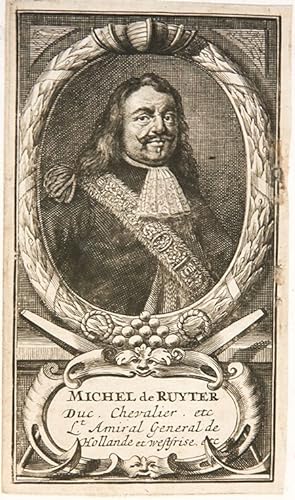
Antique Etching and Engraving - Portrait of Michiel de Ruyter (1607-1676) - Unknown Maker
Anbieter: Antiquariaat Arine van der Steur / ILAB, Den Haag, Niederlande
Verkäuferbewertung 4 von 5 Sternen
Bust portrait of admiral Michiel de Ruyter in a laurel wreath. Inscription on pedestal: 'MICHEL de RUYTER / Duc Chevalier etc / Lt. Admiral General de / Hollande et Westfrise, etc.' Etching and engraving on paper, pasted on cardboard paper, no margins; print size: 110 x 61 mm; Good contrast.
-
![Bild des Verkäufers für [Antique portrait print, etching and engraving] Don Johan de Austria. [Juan I of Austria (1547-1578)/Jan van Oostenrijk], 1 p. zum Verkauf von Antiquariaat Arine van der Steur / ILAB](https://pictures.abebooks.com/inventory/md/md16327479976.jpg)
[Antique portrait print, etching and engraving] Don Johan de Austria. [Juan I of Austria (1547-1578)/Jan van Oostenrijk], 1 p.
Anbieter: Antiquariaat Arine van der Steur / ILAB, Den Haag, Niederlande
Verkäuferbewertung 4 von 5 Sternen
Profile portrait of Juan I of Austria (1547-1578) in oval and external decorative frame. Inscribed on the bottom: 'Don Johan de Austria.' Engraving and etching on paper, some dirt on the bottom; total: 275 x 165 mm PP01JI (Juan I of Austria).
-
Frontispiece to a publication concerning fighting and duels. Second edition. The title is reproduced on a ribbon above; on the bottom address of the publisher and year: 'TE DELFT, Gedrukt Bi ANDRIEZ VOORSTAD. / 1702'. In the picture in the foreground a priest (Jesuit?) reading from a book a sentence to a kneeling man on the right; further towards the background different kind of duels, on horse and on foot. l Etching and engraving on paper, on the right trimmed to plate mark; total: 168 x 99 mm; on the verso scribblings in pencil and black ink.
-
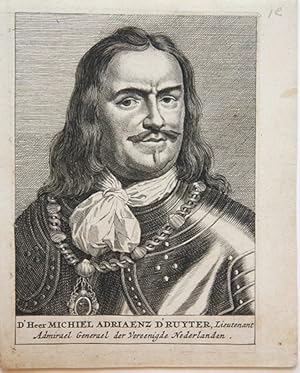
Antique Engraving and Etching - Portrait of Michiel de Ruyter (1607-1676) - Unknown Maker, 1 p.
Anbieter: Antiquariaat Arine van der Steur / ILAB, Den Haag, Niederlande
Verkäuferbewertung 4 von 5 Sternen
Bust portrait of admiral Michiel de Ruyter in armor. On the bottom an inscription: "D Heer MICHIEL ADRIAENZ D RUITER, Lieutent / Admirael Generael der Vereenigde Nederlanden." Engraving and etching on paper with small margins; plate mark: 162 x 120 mm, total: 175 x 143 mm; slightly yellowing paper; Muller 4628g (?).
-
Profile portrait of Juan I of Austria (1547-1578) in a circular frame, inscribed: JOANNES AUSTRIACUS CAROLI V. F. PHILIPPI REGIS CATHOLICI NOMINE APUD BELGAS GUBERNATOR ET CAPITANEUS GENERAL. ANN. MDCIIII. Numbered on the bottom left: '126'. This plate was employed in Emanuel van Meteren 'Historia Oder Eigentliche und War hafte Beschreibung aller Kriegshändel unnd Gedenckwürdigen Geschichten', ca. 1610. l Etching on paper with margins; platemark: 172 x 171, total: 189 x 183 mm; small hole slightly below the center, small tear on the right bottom affecting slightly the plate, otherwise in good conditions. PP01JI (Juan I of Austria).
-
![Bild des Verkäufers für [Antique title page, 1664] Nassouser heldens pronk-toneel / Allegorische voorstelling met mannen in harnas, Faam en Hollandse Maagd, published 1664, 1 p. zum Verkauf von Antiquariaat Arine van der Steur / ILAB](https://pictures.abebooks.com/inventory/md/md31325819240.jpg)
[Antique title page, 1664] Nassouser heldens pronk-toneel / Allegorische voorstelling met mannen in harnas, Faam en Hollandse Maagd, published 1664, 1 p.
Anbieter: Antiquariaat Arine van der Steur / ILAB, Den Haag, Niederlande
Verkäuferbewertung 4 von 5 Sternen
A group of armoured men (possibly princes of Orange and/or stadtholders) stands around a seated man. In front of him, a soldier lies on his back on a Medusa figure. On the left is the Dutch Virgin with the coat of arms. At the top, Fame flies with a trumpet and laurel wreath.The title inscribed on a flag hanging from the trumpet: NASSOUER HELDENS Pronk-toneel.With the date and the address of the publisher below: T'AMSTERDAM By Ian Iansz, op 't water inde Parkstraat A. 1664.[NL] Een groep geharnaste mannen (mogelijk prinsen van Oranje en/of stadhouders) staat rondom een zittende man. Voor hem ligt een soldaat op zijn rug op een Medusa-figuur. Links zit de Hollandse Maagd met wapenschild. Aan de bovenzijde vliegt Faam met bazuin en lauwerkrans.bookillustration - boekillustratie - frontispiece - frontispice Engraving on paper, trimmed within plate mark; total: 147 x 81 mm; evenly yellowing paper; overall in good condition.
-
Bust portrait of admiral Michiel de Ruyter in an oval frame. Inscribed on the bottom: 'M.A. de RUYTER / Lt. Adm. du Pais Bas.' l Etching on paper, trimmed within plate mark; total: 118 x 69 mm.
-
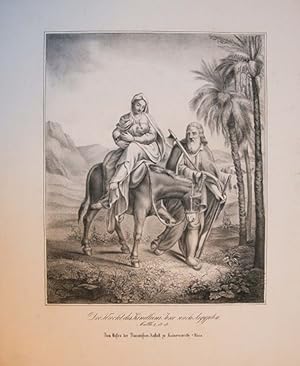
The Flight to Egypt
Anbieter: Antiquariaat Arine van der Steur / ILAB, Den Haag, Niederlande
Verkäuferbewertung 4 von 5 Sternen
The Virgin and Child on a donkey and St. Joseph walking beside in the desert. Possibly from the first half of the nineteenth century. Lettered at the bottom: 'Die Flucht des Kindleins Jesu nach Aegypten. / Matth. 2, 13-15 /Zum Besten der Diaconissen-Anstalt zu Kaiserswerth a/Rhein'. Lithography on paper; total: 468 x 377 mm; soil and stains along the margins, not affecting the image. Some small tears on the most external margins.
-
Bust portrait of Wolfgang Amadeus Mozart (1756-1791), looking to the right. With signature of Mozart at bottom l Engraving and etching on paper with margins; plate mark: 143 x 96 mm, total: 253 x 177 mm; stained paper, some light stains affect the plate, light foxing, paper pin hole on the top.
-
Bust portrait of admiral Michiel de Ruyter in an oval. On the bottom an inscription: "MICHAEL DE REUTER VICE AD: / MIRAL VON HOLLANDT VND / WESTFRIESSLANDT etc." l Engraving and etching on paper with small margins; plate mark: 181 x 122 mm, total: 210 x 151 mm; mounted on cardboard (top margin).
-
Commemorative medal with portrait of admiral Michiel de Ruyter on one side and on the other the Four Day's battle between the English and the Dutch fleet in 1666. Inscription on the portrait side: 'MICHAEL DE RVITER PROVINCIARVM CONFOEDERAT: / BELGIC ARCHITHA. LASSVS DUX ET EQVES.' under the sea battle: 'PVGNANDO' on the bottom right: 'fig.: 103'; bottom portion from larger plate. On the verso collector's mark of Pim van Eekelen. l Engraving on paper with small margins, pasted on thicker paper with margin drawn in brown ink; total: 98 x 164 mm.
-

Antique Etching - Portrait in Oval of Michiel de Ruyter (1607-1676) - Unknown Maker
Anbieter: Antiquariaat Arine van der Steur / ILAB, Den Haag, Niederlande
Verkäuferbewertung 4 von 5 Sternen
Bust portrait of admiral Michiel de Ruyter in oval laurel wreath. Above on the right: 'Par. II Pag. 388' From unknown publication. Etching on paper; plate mark: 130 x 103 mm, total: 151 x 105 mm.
-
Bust portrait of Antonio Albizzi in an oval. Antonio Albizzi (lat : Antonius Albicius) was an Italian jurist and genealogist, born in Florence in 1547. In 1576 he was in the service of Cardinal-Archduke Andreas of Austria. In 1585 he converted to Lutheranism and spent the rest of his life in the Protestant Imperial City of Kempten, where he died in 1626. His most famous work was Principum Christianorum Stemmata (Augsburg 1612), an unusual collection of engravings showing the family trees of the leading royal and noble houses of Europe of that time (and unusually also including the genealogy of the Turkish Emperors). The fine decorative engravings include family trees, portraits and coats of arms and are set against the backdrop of City views and panoramas closely copied from the Civitates Orbis Terrarum by Georg Braun & Franz Hogenberg (1572-1618). Lettered on the oval frame: 'ANTONIVS ALBICIVS NOBILIS FLORENTINVS'; on the bottom: 'Haec est ALBITII, Regum qui Stemmata scripsit. / Atque Ducum, artificis prodita imago manu. / Nobilitatis uti scriptor quoq[ue] Nobilis esset; / Nobilis hic genere est, Scriptore, et ingenio'. l Engraving on laid paper; on the verso text in letterpress; total: 193 x 127 mm.
-
![Bild des Verkäufers für [Antique portrait print, prent, etching and letterpress] Oorsprong en voortgang der Neder-landtscher beroerten ende ellendicheden. Waerin vertoont worden, de voornaemste tyrannijen . [Juan I of Austria (1547-1578)/Jan van Oostenrijk], 1 p. zum Verkauf von Antiquariaat Arine van der Steur / ILAB](https://pictures.abebooks.com/inventory/md/md16327480125.jpg)
[Antique portrait print, prent, etching and letterpress] Oorsprong en voortgang der Neder-landtscher beroerten ende ellendicheden. Waerin vertoont worden, de voornaemste tyrannijen . [Juan I of Austria (1547-1578)/Jan van Oostenrijk], 1 p.
Anbieter: Antiquariaat Arine van der Steur / ILAB, Den Haag, Niederlande
Verkäuferbewertung 4 von 5 Sternen
Profile portrait in an oval of Juan I of Austria (1547-1578), from the publication: Oorsprong en voortgang der Neder-landtscher beroerten ende ellendicheden. Waerin vertoont worden, de voornaemste tyrannijen .(1616) by Johannes Gysius, p. 370. Inscribed on the ovel frame:'IOANNIS AVSTRIACVS PRINC. FRANCAE-VILLAE, GVB. GENERALIS IN BELGIO.' and small dutch poem on the bottom:'Des Keysers Soon ben ick, onechtelijck gheboren. / Voor Namen creech de pest, die my feer wreedt verslan.' Etching and letterpress on paper, pasted on thicker paper; total (original paper):165 x 128 mm PP01JI (Juan I of Austria).
-
![Bild des Verkäufers für [Antique portrait print, etching and engraving] IOANNIS, AVSTRIACVS PRINC FRANCÆ VILLÆ, GVB, GENERALIS IN, BELGIO [Juan I of Austria (1547-1578)/Jan van Oostenrijk], 1 p. zum Verkauf von Antiquariaat Arine van der Steur / ILAB](https://pictures.abebooks.com/inventory/md/md16327479915.jpg)
[Antique portrait print, etching and engraving] IOANNIS, AVSTRIACVS PRINC FRANCÆ VILLÆ, GVB, GENERALIS IN, BELGIO [Juan I of Austria (1547-1578)/Jan van Oostenrijk], 1 p.
Anbieter: Antiquariaat Arine van der Steur / ILAB, Den Haag, Niederlande
Verkäuferbewertung 4 von 5 Sternen
Profile portrait of Juan I of Austria (1547-1578) in oval and external decorative frame. Inscribed on the bottom: 'Don Jan van Oostenryck Prince van / Franca-villa Gouverneur der Nederlanden / H. Jacopzoen. exc'; inscribed on the oval frame: 'IOANNIS, AVSTRIACVS PRINC FRANCÆ VILLÆ, GVB, GENERALIS IN, BELGIO'. Engraving and etching on paper pasted on cardboard; total: 267 x 176 mm PP01JI (Juan I of Austria).
-

Print/Portret/Portrait: Ernst of Austria/Groothertog Ernst van Oostenrijk.
Anbieter: Antiquariaat Arine van der Steur / ILAB, Den Haag, Niederlande
Verkäuferbewertung 4 von 5 Sternen
Portrait of Ernst, Archduke of Austria, bust, turned to the left, glancing at the viewer, wearing armor, chain and ruff, with moustache; in lettered circle: "ERNESTVS D.G. ARCHIDVX AVSTRIAE DUX BURGUNDIAE COMES TIROLIS, ET BELGICARU PROVINCIARU GUBERN." It is not clear from which publication this portrait is taken from. On the verso of both pages is text in Latin referring to the Duke of Alba and Ernst of Austria. The dates and the text at the top of the pages suggest that the portrait was probably taken from an edition of the "Belgian Lion" by Michael von Aitzing. Etching and engraving on paper with broad margins; plate mark: 192 x 189 mm, total: 255 x 358 mm; crease in the middle as two pages are joined together. In good condition.
-
Engraved frontispiece of the first Edition of the political pamphlet 'Comoedia Vetus'. Though anonymously published, it commonly accepted that the author was Willem Meerman (?-1612), a seafaring man. In 1612, the year this pamphlet was published, Meerman embarked on a voyage to America, from which he never returned. In this pamplet, Meerman uses maritime expressions as an allegory on the political situation in Holland. The pamphlet is written in a clear and witty style. It attacks the protestant clergy in Holland as being little better than their Catholic predecessors. Hence the title, which translates as "the old game". The illustrated titlepage print shows prince Maurits, seated at a table with seven other gentlemen. He holds a stick, a man with a head shaped like church pulls at the other end of the stick. At the front of the scene, several sailors are approaching and watch the scene in surprise. At the foot of the title are the words "Eij Maet, siet is 't lant vol gecken? Noom wil mijn Heer de stock onttrecken". In the same year 1612 another edition was issued, slightly smaller, with the extended title "Comoedia Vetus, of anders ghenoemt Het Bootsmanspraetjen". The addition "bootmans praetjen" stuck and came back in later editions, which were issued well into the 18th century, until 1740. On the verso collector's mark: Gemeente Museum of The Hague (L. 1096); here are also pencil scribbles. l Etching and engraving on paper, trimmed within plate mark, margins restored; total: 197 x 146 mm; traces of previous mounting on the verso.
-
Artist's impression of the Harbour Bridge approaches, North Sydney. Late 1920s.
Anbieter: Douglas Stewart Fine Books, Armadale, VIC, Australien
Verkäuferbewertung 5 von 5 Sternen
Silver gelatin print photograph of an artist's drawing, 165 x 390 mm; verso annotated in ink 'Harbour Bridge Approaches, North Sydney', and with a newspaper editor's annotations in pencil '1 / 17' and '6 cols'; old vertical fold with a tiny tear at top edge, pin holes at top corners; unmounted.
-
[Antique print, etching, 1612] JOANNES AUSTRIACUS CAROLI V. IMPERATORIS FILIUS . [Juan I of Austria (1547-1578)/ Juan (Jan) van Oostenrijk], published 1612, 1 p.
Anbieter: Antiquariaat Arine van der Steur / ILAB, Den Haag, Niederlande
Verkäuferbewertung 4 von 5 Sternen
Full length portrait of Juan I of Austria (1547-1578) on a prancing horse: head turned towards his right shoulder. View of Namur in the background. Inscribet at the bottom: 'JOANNES AUSTRIACUS CAROLI V. IMPERATORIS FILIUS / Quartus regius Gubernator ab anno 1577 ad cal: / Octobris anni 1578 imperavit / Cum Privileg. Ord. foed'. employed as illustration in Emanuel van Meteren: 'Historien der Nederlanden tot het jaar 1612', het Vijfde Boek p. 120 recto. Numbered on the bottom right: 5.Juan van Oostenrijk was een Spaans legerleider en landvoogd van de Nederlanden aan het begin van de Tachtigjarige Oorlog. Don Juan was een onwettige en in het geheim geboren zoon van keizer Karel V en Barbara Blomberg. Etching on paper, on the verso letterpress, no margins; total: 257 x 161 mm. PP01JI (Juan I of Austria).
-
![Bild des Verkäufers für [Antique engraving, gravure] Unknown maker, Seal with a Madonna and Child. zum Verkauf von Antiquariaat Arine van der Steur / ILAB](https://pictures.abebooks.com/inventory/md/md30745263027.jpg)
[Antique engraving, gravure] Unknown maker, Seal with a Madonna and Child.
Anbieter: Antiquariaat Arine van der Steur / ILAB, Den Haag, Niederlande
Verkäuferbewertung 4 von 5 Sternen
Print of a seal in almond shape, with inscripted frame: "sigillu dom. bte marie virgm. in galilea in haga ordis cor con".Within frame, a Madonna and child. Printed on a wide sheet of 18th century paper. Engraving on paper with great margins; plate mark: 81 x 58 mm, total: 332 x 418 mm; on eighteenth century paper with Amsterdam watermark and countermark "VI." Some very light dirt on the paper, otherwise in great condition.
-
![Bild des Verkäufers für [Antique title page, 1677/78] Hollandsche, Zeelandsche ende Vriesche Chronyck, published 1677/78, 1 p. zum Verkauf von Antiquariaat Arine van der Steur / ILAB](https://pictures.abebooks.com/inventory/md/md30745254655.jpg)
[Antique title page, 1677/78] Hollandsche, Zeelandsche ende Vriesche Chronyck, published 1677/78, 1 p.
Anbieter: Antiquariaat Arine van der Steur / ILAB, Den Haag, Niederlande
Verkäuferbewertung 4 von 5 Sternen
Frontispiece to the 1677 Scriverius' edition of 'Hollandsche, Zeelandsche ende Vriesche Chronyck.', published in The Hague by Johannes Tongerlo en Levyn van Dyk.On this impression, a small strip of paper was added at the bottom reading 'In 's Gravenhage, by Joan Vely, en Jasper Doll, Boeck-verkopers'.This is, in fact, a frontispiece to the edition from 1678. Rather than reprinting from the plate (which would have been acquired by Vely-Doll) the publishers intervened on the plate by adding the strip of paper below. This strip came loose on the right and it allows us to read the former inscription, at least partially: 'Brugman Advocaet 1667.'On verso handwritten note in pen and black ink: 'P. Scriverius. Holl. Zeel. en de . 1667'. Engraving on paper, trimmed to plate, with an insert of a strip of paper; total: 201 x 153 mm; overall in good condition.
-
![Bild des Verkäufers für [Antique title page, 1677] Virtue fighting against vices (De Deugd vecht tegen de ondeugden), published 1677, 1 p. zum Verkauf von Antiquariaat Arine van der Steur / ILAB](https://pictures.abebooks.com/inventory/md/md22188647928.jpg)
[Antique title page, 1677] Virtue fighting against vices (De Deugd vecht tegen de ondeugden), published 1677, 1 p.
Anbieter: Antiquariaat Arine van der Steur / ILAB, Den Haag, Niederlande
Verkäuferbewertung 4 von 5 Sternen
Above on the right a curtain with inscription: 'VIRTUS contra VITIA Per varias demonstrata selectissimas conciones, in singulos. Controversitis per quam utiles ac necessiarias.' A woman, most likely the personification of Virtue is holding back with a shield the vices, with the help of two small putti holding flaming swords.On the bottom is the address of the publisher and the date: 'COLONIAE AGRIPPINAE APUD IOANNEM WILHELMUM FRIESSEM IUNIOREM A. MDCLXXVII' (Cologne, 1677) It is not known for which publication this frontispiece was intended. Engraving on paper, trimmed within plate mark; total: 284 x 180 mm; small defect on the plate due to printing process, some discolouration on the bottom left, small tear on the margin above, two tiny holes, otherwise in very good condition.
-
![Bild des Verkäufers für [Antique title page, 1749] HORAE DIURNAE BREVIARII ROMANI, published 1749, 2 pp. zum Verkauf von Antiquariaat Arine van der Steur / ILAB](https://pictures.abebooks.com/inventory/md/md22188648064.jpg)
[Antique title page, 1749] HORAE DIURNAE BREVIARII ROMANI, published 1749, 2 pp.
Anbieter: Antiquariaat Arine van der Steur / ILAB, Den Haag, Niederlande
Verkäuferbewertung 4 von 5 Sternen
Frontispiece and title page to a breviary published in Antwerp by Plantin Moretus.In the frontispiece, the personification of Ecclesia is sitting on the clouds on the right holding a ferula. On the other hand on the right is a descending landscape with ruins, leading to the basilica of St. Peter in Rome. Flying in the sky is a small angel with a trumpet from which hung the Papal arms.Inscribed at the bottom: 'ANTVERPIAE / EX ARCHITYPOGRAPHIA PLANTINIANA'; in the title page a small vignette with three putti holding the papal insignia. Engraving and letterpress on paper; total: 208 x 125 mm; frontispiece is soiled, the lettered page is in better condition.
-
![Bild des Verkäufers für [Antique etching and engraving] Portrait of Michiel de Ruyter (1607-1676), Michiel de Ruiter, 1 p. zum Verkauf von Antiquariaat Arine van der Steur / ILAB](https://pictures.abebooks.com/inventory/md/md19816196592.jpg)
[Antique etching and engraving] Portrait of Michiel de Ruyter (1607-1676), Michiel de Ruiter, 1 p.
Anbieter: Antiquariaat Arine van der Steur / ILAB, Den Haag, Niederlande
Verkäuferbewertung 4 von 5 Sternen
Bust portrait of admiral Michiel de Ruyter in front of a seascape with ships. On the bottom an inscription: "MICHIEL ADRIAENSZ. DE RUYTER / Hertog Ridder etc: Luijtenand Admiraal / Generaal can Holland. en West Vriesland"; Engraving and etching on paper with small margins; plate mark: 249 x 168 mm, total: 259 x 179 mm on the verso traces of previous mounting, top right corner damaged, but not affecting the plate, thin paper.
-

Engraving/gravure: ALDVS MANUCIVS (Portrait of Aldo Manuzio) (Portret van Italiaanse humanist en publicist Manuzio).
Anbieter: Antiquariaat Arine van der Steur / ILAB, Den Haag, Niederlande
Verkäuferbewertung 4 von 5 Sternen
Portrait of Aldo I Manuzio, bust, in profile, facing right, wearing a gown over tunic and hat. Manuzio was an editor, grammarian and Italian humanist. He is considered one of the greatest publishers ever existed in a modern sense. He introduced the italic format and the octavo as book format. He used to mark the books he edited with a very recognizable device: an anchor with a dolphin. This engraving was made after renown portaits of him. Inscribed below: "ALDVS ANUCIVS. / Buchdrucker in Venedig. / War Geboren in Rom A. 1445 / und Starb A. 1515." German impression from before 1750. On verso collector's mark L. 4780; from the collection Simon Emmering (1914-1999) Engraving on paper with margins: plate mark: 149 x 100 mm, total: 191 x 132; mounted on mat in passepartout. In very good condition.


![Bild des Verkäufers für [Antique print, etching, 1612] JOANNES AUSTRIACUS CAROLI V. IMPERATORIS FILIUS . [Juan I of Austria (1547-1578)/ Juan (Jan) van Oostenrijk], published 1612, 1 p. zum Verkauf von Antiquariaat Arine van der Steur / ILAB](https://pictures.abebooks.com/inventory/md/md16327479989.jpg)