Gesamtpreis (1 Artikel Artikel):
Versandziel:

libri guglielmo (17 Ergebnisse)
Direkt zu den wichtigsten Suchergebnissen
Suchfilter
Produktart
- Alle Product Types
- Bücher (17)
- Magazine & Zeitschriften (Keine weiteren Ergebnisse entsprechen dieser Verfeinerung)
- Comics (Keine weiteren Ergebnisse entsprechen dieser Verfeinerung)
- Noten (Keine weiteren Ergebnisse entsprechen dieser Verfeinerung)
- Kunst, Grafik & Poster (Keine weiteren Ergebnisse entsprechen dieser Verfeinerung)
- Fotografien (Keine weiteren Ergebnisse entsprechen dieser Verfeinerung)
- Karten (Keine weiteren Ergebnisse entsprechen dieser Verfeinerung)
- Manuskripte & Papierantiquitäten (Keine weiteren Ergebnisse entsprechen dieser Verfeinerung)
Zustand Mehr dazu
- Neu (4)
- Wie Neu, Sehr Gut oder Gut Bis Sehr Gut (5)
- Gut oder Befriedigend (3)
- Ausreichend oder Schlecht (Keine weiteren Ergebnisse entsprechen dieser Verfeinerung)
- Wie beschrieben (5)
Einband
Weitere Eigenschaften
- Erstausgabe (7)
- Signiert (1)
- Schutzumschlag (Keine weiteren Ergebnisse entsprechen dieser Verfeinerung)
- Angebotsfoto (8)
Sprache (5)
Gratisversand
Land des Verkäufers
Verkäuferbewertung
-

Biografie di Galileo
Sprache: Italienisch
Verlag: Createspace Independent Publishing Platform, 2014
ISBN 10: 1502702851 ISBN 13: 9781502702852
Anbieter: ThriftBooks-Dallas, Dallas, TX, USA
Verkäuferbewertung 5 von 5 Sternen

Paperback. Zustand: As New. No Jacket. Pages are clean and are not marred by notes or folds of any kind. ~ ThriftBooks: Read More, Spend Less.
-

Catalogue of the Extraordinary Collection of Splendid Manuscripts Chiefly Upon Vellum, in Various Languages of Europe and the East Classic Reprint
Anbieter: PBShop.store US, Wood Dale, IL, USA
Verkäuferbewertung 5 von 5 Sternen
PAP. Zustand: New. New Book. Shipped from UK. Established seller since 2000.
-
Catalogue of the Extraordinary Collection of Splendid Manuscripts Chiefly Upon Vellum, in Various Languages of Europe and the East Classic Reprint
Anbieter: PBShop.store UK, Fairford, GLOS, Vereinigtes Königreich
Verkäuferbewertung 4 von 5 Sternen

EUR 25,04
EUR 5,77 Versand
Versand von Vereinigtes Königreich nach USAAnzahl: 15 verfügbar
In den WarenkorbPAP. Zustand: New. New Book. Shipped from UK. Established seller since 2000.
-

Catalogue of the Extraordinary Collection of Splendid Manuscripts Chiefly Upon Vellum, in Various Languages of Europe and the East Classic Reprint
Anbieter: PBShop.store US, Wood Dale, IL, USA
Verkäuferbewertung 5 von 5 Sternen
HRD. Zustand: New. New Book. Shipped from UK. Established seller since 2000.
-
Catalogue of the Extraordinary Collection of Splendid Manuscripts Chiefly Upon Vellum, in Various Languages of Europe and the East Classic Reprint
Anbieter: PBShop.store UK, Fairford, GLOS, Vereinigtes Königreich
Verkäuferbewertung 4 von 5 Sternen
EUR 30,85
EUR 5,77 Versand
Versand von Vereinigtes Königreich nach USAAnzahl: 15 verfügbar
In den WarenkorbHRD. Zustand: New. New Book. Shipped from UK. Established seller since 2000.
-

Scientist, Scholar & Scoundrel: A Bibliographical Invetigation of the Life and Exploits of Count Guglielmo Libri
Verlag: The Grolier Club, New York, 2013
Anbieter: Between the Covers-Rare Books, Inc. ABAA, Gloucester City, NJ, USA
Verbandsmitglied: ABAA ESA ILAB IOBA
Verkäuferbewertung 5 von 5 Sternen
Erstausgabe
Softcover. Zustand: Fine. First edition. Octavo. 176pp. Illustrated. Fine in wrappers. Published in conjunction with an exhibition at The Grolier Club.
-
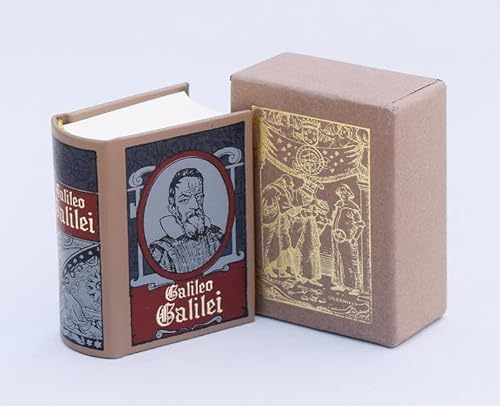
Galileo Galilei - Leben und Werk. (Miniaturbuch)
Sprache: Deutsch
Verlag: Leipzig : Miniaturbuchverlag, 2009
ISBN 10: 3861841428 ISBN 13: 9783861841425
Anbieter: Antiquariat Smock, Freiburg, Deutschland
Verkäuferbewertung 5 von 5 Sternen
Zustand: Sehr gut. Formateinband: Kleinformat, ill. Kunstledereinband im Schuber / gebundene Ausgabe 510 S. (6x4,5 cm) Miniaturbuch im Schuber; 1. Aufl.; In sehr gutem Zustand. Sprache: Deutsch Gewicht in Gramm: 150 [Stichwörter: Miniaturbuch, Miniaturbücher, Miniatur].
-
Zustand: Hervorragend. Zustand: Hervorragend | Seiten: 352 | Sprache: Englisch | Produktart: Bücher | Keine Beschreibung verfügbar.
-
Catalogue of the extraordinary collection of Splendid Manuscripts, Chiefly upon Vellum in various Languages of Europe and the East, formed by M. Guglielmo Libri. Mathematical, Medical and other Scientific Works, Ancient Italians poets and Prose Writers, autograph Mss. of Tasso, Galileo, Kepler, Leibnitz, &c., [ With : ] Catalogue of the Magnificent Collection of Precious Manuscripts and Objects of Art and vertu of M. Guglielmo Libri
Sprache: Englisch
Verlag: Sotheby, 1859
Anbieter: Librairie du Cardinal, GRADIGNAN, Frankreich
Verkäuferbewertung 5 von 5 Sternen
Erstausgabe
rigide. Zustand: Bon. Catalogue of the extraordinary collection of Splendid Manuscripts, Chiefly upon Vellum in various Languages of Europe and the East, formed by M. Guglielmo Libri. Mathematical, Medical and other Scientific Works, Ancient Italians poets and Prose Writers, autograph Mss. of Tasso, Galileo, Kepler, Leibnitz, &c., Wich will be sold by auction bu S. Leigh Sotheby & John Wilkinson, on Monday 28th of March 1859 [ With : ] Catalogue of the Magnificent Collection of Precious Manuscripts and Objects of Art and vertu of M. Guglielmo Libri, Which will be sold by auction by Sotheby, Wilkinson & Hodge, on june 1 1864, 1 vol. in-4 reliure demi-chagrin maroquiné brun, dos à 5 nerfs, xlviii-260 pp. et 37 planches, 1190 numéros ; 2 ff., 44 pp. et 15 planches Très intéressant exemplaire (reliure frottée, bon état intérieur), provenant de la bibliothèque du grand libraire Georges Heilbrun (avec son ex-libris), et bien complet de l'intégralité des prix d'adjudications (pour le premier catalogue) porté en margé à l'encre (prix de départ et prix d'arrivée). Guglielmo Libri fut certainement le plus grand voleur de livres et de manuscrits précieux du XIXe siècle ; il pilla notamment la bibliothèque Inguimbertine de Carpentras, la bibliothèque Royale, la bibliothèque de l'Arsenal, etc. Devant les soupçons qui pesaient sur lui, il réussit à s'enfuir en Angleterre où il réalisa pour une véritable fortune les trésors qu'il avait dérobés. Catalogue Lemouel, 10 octobre 2012 Langue: Anglais.
-
Histoire des sciences mathématiques en Italie, depuis la renaissance des lettres jusqu'à la fin du dix-septième siècle
Verlag: Jules Renouard & Cie, 1838
Anbieter: Librairie Le Feu Follet, Paris, Frankreich
Verbandsmitglied: ILAB
Verkäuferbewertung 5 von 5 Sternen
Erstausgabe
couverture souple. Jules Renouard & Cie | Paris 1838-1841 | 14.3 x 22.5 cm | 4 volumes brochés | Edition originale et unique édition, à la sortie mouvementée : le premier volume avait été imprimé dès 1835, chez Paulin, mais l'édition entière périt dans l'incendie de la rue du Pot-au-Fer ; l'auteur refondit alors son travail, et fit paraître sa nouvelle version en 1838, en même temps que le second volume. Petits manques marginaux sur les dos et les plats, le deuxième volume est recouvert d'une couverture d'attente muette (sans ses couvertures imprimées), rousseurs éparses. * L'ouvrage est important, fondé sur de nombreuses pièces manuscrites, dont des correspondances de Galilée, Fermat, Descartes (on apprendra plus tard qu'elles avaient été dérobées à la Laurentienne lorsque Libri enseignait en Italie), et fut le premier à révéler l'importance de Léonard de Pise (appelé Leonardo Fibonacci par l'auteur). C'était l'époque où le comte Libri (1803-1869) n'était encore que le brillant mathématicien que le monde littéraire français se félicitait d'avoir attiré, et qui enseignait à la Faculté des sciences de Paris ; pas encore l'escroc et le voleur professionnel qui réussit à détourner des milliers de livres et de documents autographes des bibliothèques française (Royale, Arsenal, de l'Observatoire, Inguimbertine, pour ne citer que les fonds les plus touchés), et les emporta en Angleterre quand il se vit contraint de quitter la France à la suite de la découverte de ses malversations. | [ENGLISH DESCRIPTION FOLLOWS] First and only edition, with a tumultuous publishing history: the first volume had been printed as early as 1835 by Paulin, but the entire edition was destroyed in the fire on rue du Pot-au-Fer. The author subsequently revised his work and published a new version in 1838, simultaneously with the second volume. Minor marginal defects to spines and covers; the second volume is bound in a temporary plain wrapper (lacking the printed covers); scattered foxing. * An important work, based on numerous manuscript sources, including correspondence by Galileo, Fermat, and Descartes (which would later be revealed to have been stolen from the Laurentian Library while Libri was teaching in Italy). It was also the first work to highlight the significance of Leonardo of Pisa (referred to by the author as Leonardo Fibonacci). At the time, Count Libri (18031869) was still considered the brilliant mathematician whom the French literary world was proud to have welcomed, and who was teaching at the Faculty of Sciences in Parisnot yet the swindler and professional thief who managed to embezzle thousands of books and autograph documents from French libraries (including the Royal Library, the Arsenal, the Observatory, and the Inguimbertine, among the most affected collections), and who fled to England after the discovery of his misdeeds. 4 vol. in-8, brochés, couv. impr., non coupés. 1) xxviii-[4] et 464 pp. - 2) [8] et 534 pp. - 3) [8] et 461 pp. - 4) [4]-492 et [4] pp.
-
[ Lot de 5 ouvrages et brochures relatifs à l'affaire Guglielmo Libri : ] Réponse de M. Libri au rapport de M. Boucly [ On joint : ] Lettres à M. Hatton, Juge d'Instruction au sujet de l'incroyable accusation intentée contre M. Libri, contenant de curieux détails sur toute cette affaire, par M. Paul Lacroix [ On joint : ] Lettre à M. Paul Lacroix (Bibliophile Jacob) contenant Un curieux épisode de l'histoire des Bibliothèques publiques, avec quelques faits nouveaux relatifs à M. Libri et à l'odieuse persécution dont il est l'objet, par Achille Jubinal, [ On joint : ] Lettre de M. Libri à M. le Président de l'Institut de France [ On joint : ] Mémoire sur les irrégularités de la Procédure criminelle suivi contre L. Libri
Sprache: Französisch
Erscheinungsdatum: 1848
Anbieter: Librairie du Cardinal, GRADIGNAN, Frankreich
Verkäuferbewertung 5 von 5 Sternen
Erstausgabe
souple. Zustand: Assez bon. 5 vol. ou brochures in-8 : Réponse de M. Libri au rapport de M. Boucly, publié dans le Moniteur Universel du 19 mars 1848, Chez tous les Libraires, Paris, 1848, 115 pp. [ On joint : ] Lettres à M. Hatton, Juge d'Instruction au sujet de l'incroyable accusation intentée contre M. Libri, contenant de curieux détail s sur toute cette affaire, par M. Paul Lacroix, Paulin, Paris, 1849, 64 pp. [ On joint : ] Lettre à M. Paul Lacroix (Bibliophile Jacob) contenant Un curieux épisode de l'histoire des Bibliothèques publiques, avec quelques faits nouveaux relatifs à M. Libri et à l'odieuse persécution dont il est l'objet, par Achille Jubinal, Paulin, Paris, 1849, 64 pp. [ On joint : ] Lettre de M. Libri à M. le Président de l'Institut de France, Barthès et Lowell, Londres, 1850, 72 pp. [ On joint : ] Mémoire sur les irrégularités de la Procédure criminelle suivi contre L. Libri, et sur l'application de l'art. 441 du Code d'Instruction criminelle pour la révision de cette procédure, par Me Henry Celliez, Imprimerie de Ad. R. Lainé et J. Havard, Paris, 1861, 92 pp. Intéressante réunion de 5 brochures et ouvrages relatifs à l'extraordinaire affaire Libri. Mathématicien et bibliophile, Guglielmo Libri (1803-1869) parvint à se faire nommer secrétaire de la Commission du Catalogue général des manuscrits des bibliothèques publiques de France. Il profita de sa fonction pour piller les bibliothèques de France, et après sa fuite en Angleterre, en vendit une partie à Lord Ashburnham. Etat très satisfaisant (qq. usures, restauration ou mouill.). Langue: Français.
-
[ Lot de 9 ouvrages et brochures relatifs à l'affaire Guglielmo Libri : ] Réponse de M. Libri au rapport de M. Boucly [ On joint : ] Lettres à M. Hatton, Juge d'Instruction au sujet de l'incroyable accusation intentée contre M. Libri, contenant de curieux détails sur toute cette affaire, par M. Paul Lacroix [ On joint : ] Lettre à M. Paul Lacroix (Bibliophile Jacob) contenant Un curieux épisode de l'histoire des Bibliothèques publiques, avec quelques faits nouveaux relatifs à M. Libri et à l'odieuse persécution dont il est l'objet, par Achille Jubinal, [ On joint : ] Lettre de M. Libri à M. le Président de l'Institut de France [ On joint : ] Mémoire sur la persécution qu'on fait souffrir en France à M. Libri, par M. Ranieri Lamporecchi [ On joint : ] Lettre de M. Libri à M. Barthélémy Saint-Hilaire, Administrateur du Collège de France [ On joint : ] Pétition adressée au Sénat sur l'Affaire de M. Libri [ On joint : ] M. Libri n'est pas Contumax. Consultation de Me Henry Celliez sur la p
Sprache: Französisch
Erscheinungsdatum: 1848
Anbieter: Librairie du Cardinal, GRADIGNAN, Frankreich
Verkäuferbewertung 5 von 5 Sternen
Erstausgabe Signiert
souple. Zustand: Bon. 9 vol. ou brochures in-8 : Réponse de M. Libri au rapport de M. Boucly, publié dans le Moniteur Universel du 19 mars 1848, Chez tous les Libraires, Paris, 1848, 115 pp. [ On joint : ] Lettres à M. Hatton, Juge d'Instruction au sujet de l'incroyable accusation intentée contre M. Libri, contenant de curieux détail s sur toute cette affaire, par M. Paul Lacroix, Paulin, Paris, 1849, 64 pp. [ On joint : ] Lettre à M. Paul Lacroix (Bibliophile Jacob) contenant Un curieux épisode de l'histoire des Bibliothèques publiques, avec quelques faits nouveaux relatifs à M. Libri et à l'odieuse persécution dont il est l'objet, par Achille Jubinal, Paulin, Paris, 1849, 64 pp. [ On joint : ] Lettre de M. Libri à M. le Président de l'Institut de France, Barthès et Lowell, Londres, 1850, 72 pp. [ On joint : ] Mémoire sur la persécution qu'on fait souffrir en France à M. Libri, par M. Ranieri Lamporecchi, accompagné des adhésions des Professeurs de la faculté de Droit de l'Université de Pise, du Président de la Chambre des Députés de Toscane et de plusieurs autres jurisconsultes éminens, et précédé d'une lettre de M. del Rosso, avocat, à M. le Président de la Chambre des mises en accusation de la Cour d'Appel de Paris, Barthès et Lowell, Londres, 1850, 76 pp. et 1 f. [ On joint : ] Lettre de M. Libri à M. Barthélémy Saint-Hilaire, Administrateur du Collège de France, Barthès et Lowell, Londres, 1850, 31 pp. [ On joint : ] Pétition adressée au Sénat sur l'Affaire de M. Libri avec une note à l'appui signée par MM. Guizot, le marquis d'Audiffret, Prosper Mérimée, douard Laboulaye, Victor Leclerc, Paulin Paris, Jules Pelletier, Alfred de Wailly, Romain Merlin, et Henry Celliez, Typographie de Ch. Lahure et Cie, Paris, 1861, 8 pp. [ On joint : ] M. Libri n'est pas Contumax. Consultation de Me Henry Celliez sur la pétition adressée au Sénat, suivi de l'adhésion de Me Edouard Laboulaye, et d'une adresse des Députés au Parlement italien, Imprimerie de Ad. R. Lainé et J. Havard, Paris, 1861, 14 pp. [ On joint : ] Mémoire sur les irrégularités de la Procédure criminelle suivi contre L. Libri, et sur l'application de l'art. 441 du Code d'Instruction criminelle pour la révision de cette procédure, par Me Henry Celliez, Imprimerie de Ad. R. Lainé et J. Havard, Paris, 1861, 92 pp. Très intéressante réunion de 9 brochures et ouvrages relatifs à l'extraordinaire affaire Libri. Mathématicien et bibliophile, Guglielmo Libri (1803-1869) parvint à se faire nommer secrétaire de la Commission du Catalogue général des manuscrits des bibliothèques publiques de France. Il profita de sa fonction pour piller les bibliothèques de France, et après sa fuite en Angleterre, en vendit une partie à Lord Ashburnham. Bon ensemble (qq. usures et manques en couv.). Langue: Français.
-
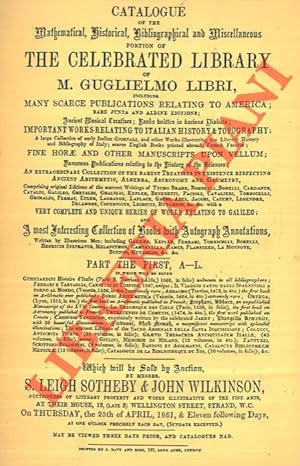
Catalogue of the Mathematical, Historical, Bibliographical and Miscellaneous Portion of the Ceelbrated Library of M. Guglielmo Libri?
Erscheinungsdatum: 1999
Anbieter: Libreria Piani, Monte San Pietro, BO, Italien
Verkäuferbewertung 5 von 5 Sternen
London, Sothebys & Wilkinson, 1861 (ma anastatica, Torino, Tipostampa, 1999,) due parti rilegate in un volume in 8vo (cm. 22 x 27) tutta tela verde con tasselo al dorso, pp. 799. De Ricci faceva notare che tutte le aste di libri organizzate a Londra dal Conte Libri tra il 1850 e il 1864 contenevano "a large number of valuable books and manuscripts, and, if udes with caution, will always be found of use the bibliographer".
-
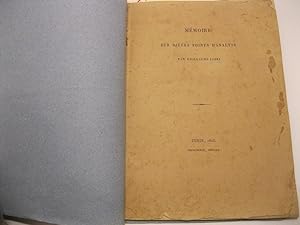
Memoire sur divers points d'analyse par Guillaume Libri
Verlag: Imprimerie Royale, Turin, 1823
Anbieter: Coenobium Libreria antiquaria, Asti, AT, Italien
Verkäuferbewertung 4 von 5 Sternen
In 8, pp. 32. P. post. rifatto. Br. ed. Uniforme brunitura con qualche macchia marg. Estratto da 'Memoires de l'Academie Royale des sciences de Turin'. Edizione originale della prima opera di Guglielmo Libri, pubblicata a soli vent'anni, lo stesso in cui venne nominatoÂProfessore emerito all'Universita' di Pisa. L'anno dopo rinuncera' all'incaricoÂper motivi di salute. ITA.
-

Catalogue of the Choicer Portion of the Magnificent Library formed by M.Guglielmo Libri, so eminent as a collector,. London, Leigh, Sotheby & Wilkinson, 1859. Sale starting on 1st August 1859 to continue for 12 days.
Anbieter: Hünersdorff Rare Books ABA ILAB, London, Vereinigtes Königreich
Verkäuferbewertung 2 von 5 Sternen

Erstausgabe
EUR 532,81
EUR 25,86 Versand
Versand von Vereinigtes Königreich nach USAAnzahl: 1 verfügbar
In den WarenkorbHardcover. Zustand: Very Good. No Jacket. 1st Edition. Libri, Guglielmo (1803-69) Catalogue of the Choicer Portion of the Magnificent Library formed by M.Guglielmo Libri, so eminent as a collector, who is leaving London in consequence of ill health, and solely for that reason disposing of his literary treasures : Unknown block books; Specimens of early typography and art Editions principes of great rarity; Poems and romances of chivalry, Early productions of the English press Manuscripts & books with autograph notes Including a collection of historical bindings in the most perfect state of preservation. London, Leigh, Sotheby & Wilkinson, 1859. Large 8vo. xx + 380p. Brown half shagreen; gilt lettering on spine. Sale catalogue comprising 2824 lots describing the most valuable early printed books and manuscripts from the magnificent collections of Guglielmo Libri selected for the benefit of his private library during decades of unsupervised plundering of public libraries in Italy and France. The books and manuscript had remained largely uncatalogued at the time which made it difficult to judge the extent of losses. The lots are offered for sale on Monday, 1st August 1859 and over the twelve following days. Count Guglielmo Libri, an outstanding Florentine mathematician, who is now best known as a notorious cleptomaniac, stole books and manuscripts from libraries in Italy and France while researching as a scholar aided by social introductions. His first thefts were scientific manuscripts and books of hours from the library of Lorenzo de Medici in Florence. Seeking greater opportunities he emigrated to France and befriended the politician François Guizot. By 1841, he had become chief inspector of French libraries with unsupervised access to collections all over France. Although massive thefts were discovered in 1847 with Libri as a prime suspect, he was shielded by Prosper Merimée and other friends, whom he lost during the 1848 Revolution. Fearing arrest for theft, he fled to London disguised as a political refugee, having beforehand sent some 30,000 books and manuscripts to be sold. After his conviction in absentia in France, Libri defended his reputation in London in a public letter written on his behalf to the Athenaeum in 1851. With the help of Antonio Panizzi, director of the British Library, he was able to retain the trust of his English contacts and presented himself as a maliciously slandered bibliophile forced to sell his collections because of poor health. The real extent of his thefts and deceptions was conclusively exposed after his death when his collections had already been sold. British Museum, List of Catalogues of English Book Sales, pp 295-96.
-
Catalogue of the mathematical, historical, bibliographical, and miscellaneous portion of the celebrated library of M. Guglielmo Libri. London, Leigh, Sotheby & Wilkinson, 1861
Erscheinungsdatum: 1861
Anbieter: Hünersdorff Rare Books ABA ILAB, London, Vereinigtes Königreich
Verkäuferbewertung 2 von 5 Sternen
Erstausgabe
EUR 568,33
EUR 25,86 Versand
Versand von Vereinigtes Königreich nach USAAnzahl: 1 verfügbar
In den WarenkorbHardcover. Zustand: Very Good. No Jacket. 1st Edition. Libri, Guillermo. Catalogue of the mathematical, historical, bibliographical, and miscellaneous portion of the celebrated library including many scarce publications, relating to America; Rare Junta and Aldine editions Important works relating to Italian history & topography Fine Horae and other manuscripts upon vellum Numerous publications relating to the history of the sciences a very complete and unique series of works relating to GalileoPart the First, A L. London: S. Leigh Sotheby & John Wilkinson, 1861. Large 8vo. xxxi + [1]p + [4] plates of facsimiles + 475 + [1 blank]p. Half shagreen with gilt lettering to spine. The first of two large miscellaneous auction catalogues with descriptions of 4335 lots sold over 12 days from 25th April to 8th May 1861; 250 items related to Galileo, described as lots 2985-3235, were sold on the 9th day. (A second auction ended 26th July 1861). Count Guglielmo Libri-Camucci, outstanding Florentine mathematician, is best known as a convicted cleptomaniac, who stole books and manuscripts from libraries in Italy and France while researching as a scholar owing to social introductions. His first thefts were scientific manuscripts and books of hours from the library of Lorenzo de Medici in Florence. Seeking greater opportunities he emigrated to France and befriended the politician François Guizot. By 1841, he was made chief inspector of French libraries with unsupervised access to collections all over France. Although massive thefts were discovered in 1847 with Libri as the prime suspect, he was shielded by Prosper Merimé and other friends, whom he lost during the 1848 Revolution. Fearing arrest for theft, he fled to London disguised as a political refugee, having beforehand sent some 30,000 books and manuscripts to be auctioned. After his conviction in absentia in France, Libri defended his reputation in London in a public letter written on his behalf by Achille Jubinal to the Athenaeum in 1851. With the help of Antonio Panizzi, director of the British Library, he was able to retain the trust of his English contacts, presenting himself as a bibliophile slandered by malicious political enemies who was forced to sell his collections because of his poor health, as explained in his lengthy (bilingual) introduction contained in the preliminaries.The extent of his thefts and deceptions was conclusively exposed after his death in 1869, when his collections were already sold. ' the first auction sale of rare books to describe in detail so many great classics in the mathematical and physical sciences.' (Norman). British Museum, List of Catalogues of English Book Sales, pp 295-96.
-
Monuments inà dits ou peu connus faisant partie du cabinet de Guillaume Libri et qui se rapportent à l�histoire de l�ornementation chez diffà rents peuples. Seconde à dition augmentà e des plusieurs planches
Verlag: London,, London, 1864
Anbieter: Libreria Alberto Govi di F. Govi Sas, Modena, MO, Italien
Verkäuferbewertung 5 von 5 Sternen
Zustand: Molto buono (Very Good). LA COPIA DI GIUSEPPE MARTINI In folio (mm. 400x513). Pp. 14, [2], 5 carte di tavole (numerate A-E), 60 carte di tavole numerate I-LX. Le tavole sono cromolitografie e sono tutte accompagnate da carte protettive. Testo dell'introduzione in francese. Legatura coeva in mezzo marocchino, dorso a sei nervi riccamente decorato in oro, tagli dorati, sguardie marmorizzate. Ottima copia perfettamente conservata. Provenienza: Giuseppe Martini, come da ex libris presente insieme ad alcune note di mano del medesimo, probabilmente riferentesi alla data di acquisizione ?2 febbraio '13? Sul risguardo anteriore timbro ovale (cm. 3x2) del milionario americano William Appleton (70 Beacon Street, Boston), datato 3 febbraio 1873, ripetuto anche al frontespizio, alla tavola XXI ed alla tavola XLIII. RARA SECONDA EDIZIONE aumentata di 5 tavole, numerate da A a E, rispetto alla prima edizione apparsa, sempre a Londra, nel 1862 per i tipi di Dulau. Esistono tuttavia copie della prima edizione recanti un Supplément datato 1864 che contiene dette tavole. Del 1862 è anche il catalogo d'asta bilingue francese ed inglese, con cui Libri vendette la parte più significativa della sua collezione: Catalogue of the reserved and most valuable portion of the Libri Collection, containing [.] ancient manuscripts & printed books [.] several unknown block-books; ancient drawings by the great masters; and including a [.] collection of historical ornamented bindings [.] which will be sold by auction, by Messrs. S. Leigh Sotheby & John Wilkinson [.] on [.] 25th July, 1862. Si tratta senza dubbio del più sontuoso ed importante tra i vari cataloghi (tutti già molto rari) di Guglielmo Libri, sia per il contenuto che presenta che per la qualità con cui fu stampato. Libri non badò certo a spese nella scelta della carta (di due tipi diversi per il testo e per le cromolitografie) e nella legatura di pregevolissima fattura. L'introduzione si trova a volte con testo francese ed inglese su due colonne. Il catalogo contiene la riproduzione ad altissima qualità di 113 preziose legature dall'epoca Carolongia fino al Rinascimento. Libri fu ?a scholarly scoundrel who made wholesale thefts from the French libraries to which he had access [?] In 1862, Libri published a magnificent folio volume of sixty plates in chromolithography [?] It contained 113 reproductions of bindings from Carolingian goldsmith's book covers to Renaissance gold-tooled bindings, all, of course, stolen, with descriptions in English and French, offering for the first time a considerable corpus for study and comparison? (B.H. Breslauer, The Uses of Bookbinding Literature, New York, 1986, pp. 15-16). Non censito in ICCU; OCLC, 1040460688; Schmidt-Kunsemuller, 1339.


![Bild des Verkäufers für Catalogue of the extraordinary collection of Splendid Manuscripts, Chiefly upon Vellum in various Languages of Europe and the East, formed by M. Guglielmo Libri. Mathematical, Medical and other Scientific Works, Ancient Italians poets and Prose Writers, autograph Mss. of Tasso, Galileo, Kepler, Leibnitz, &c., [ With : ] Catalogue of the Magnificent Collection of Precious Manuscripts and Objects of Art and vertu of M. Guglielmo Libri zum Verkauf von Librairie du Cardinal](https://pictures.abebooks.com/inventory/md/md22797904186.jpg)

![Bild des Verkäufers für [ Lot de 5 ouvrages et brochures relatifs à l'affaire Guglielmo Libri : ] Réponse de M. Libri au rapport de M. Boucly [ On joint : ] Lettres à M. Hatton, Juge d'Instruction au sujet de l'incroyable accusation intentée contre M. Libri, contenant de curieux détails sur toute cette affaire, par M. Paul Lacroix [ On joint : ] Lettre à M. Paul Lacroix (Bibliophile Jacob) contenant Un curieux épisode de l'histoire des Bibliothèques publiques, avec quelques faits nouveaux relatifs à M. Libri et à l'odieuse persécution dont il est l'objet, par Achille Jubinal, [ On joint : ] Lettre de M. Libri à M. le Président de l'Institut de France [ On joint : ] Mémoire sur les irrégularités de la Procédure criminelle suivi contre L. Libri zum Verkauf von Librairie du Cardinal](https://pictures.abebooks.com/inventory/md/md32021668417.jpg)
![Bild des Verkäufers für [ Lot de 9 ouvrages et brochures relatifs à l'affaire Guglielmo Libri : ] Réponse de M. Libri au rapport de M. Boucly [ On joint : ] Lettres à M. Hatton, Juge d'Instruction au sujet de l'incroyable accusation intentée contre M. Libri, contenant de curieux détails sur toute cette affaire, par M. Paul Lacroix [ On joint : ] Lettre à M. Paul Lacroix (Bibliophile Jacob) contenant Un curieux épisode de l'histoire des Bibliothèques publiques, avec quelques faits nouveaux relatifs à M. Libri et à l'odieuse persécution dont il est l'objet, par Achille Jubinal, [ On joint : ] Lettre de M. Libri à M. le Président de l'Institut de France [ On joint : ] Mémoire sur la persécution qu'on fait souffrir en France à M. Libri, par M. Ranieri Lamporecchi [ On joint : ] Lettre de M. Libri à M. Barthélémy Saint-Hilaire, Administrateur du Collège de France [ On joint : ] Pétition adressée au Sénat sur l'Affaire de M. Libri [ On joint : ] M. Libri n'est pas Contumax. Consultation de Me Henry Celliez sur la p zum Verkauf von Librairie du Cardinal](https://pictures.abebooks.com/inventory/md/md32021658875.jpg)