
Gesamtpreis (1 Artikel Artikel):
Versandziel:

lefebvre v a (16 Ergebnisse)
Direkt zu den wichtigsten Suchergebnissen
Suchfilter
Produktart
- Alle Product Types
- Bücher (16)
- Magazine & Zeitschriften (Keine weiteren Ergebnisse entsprechen dieser Verfeinerung)
- Comics (Keine weiteren Ergebnisse entsprechen dieser Verfeinerung)
- Noten (Keine weiteren Ergebnisse entsprechen dieser Verfeinerung)
- Kunst, Grafik & Poster (Keine weiteren Ergebnisse entsprechen dieser Verfeinerung)
- Fotografien (Keine weiteren Ergebnisse entsprechen dieser Verfeinerung)
- Karten (Keine weiteren Ergebnisse entsprechen dieser Verfeinerung)
- Manuskripte & Papierantiquitäten (Keine weiteren Ergebnisse entsprechen dieser Verfeinerung)
Zustand Mehr dazu
- Neu (6)
- Wie Neu, Sehr Gut oder Gut Bis Sehr Gut (3)
- Gut oder Befriedigend (2)
- Ausreichend oder Schlecht (Keine weiteren Ergebnisse entsprechen dieser Verfeinerung)
- Wie beschrieben (5)
Einband
Weitere Eigenschaften
- Erstausgabe (1)
- Signiert (Keine weiteren Ergebnisse entsprechen dieser Verfeinerung)
- Schutzumschlag (Keine weiteren Ergebnisse entsprechen dieser Verfeinerung)
- Angebotsfoto (9)
Sprache (3)
Gratisversand
Land des Verkäufers
Verkäuferbewertung
-

Projet P - quinze femmes parlent de pà nis
Anbieter: ThriftBooks-Dallas, Dallas, TX, USA
Verkäuferbewertung 5 von 5 Sternen

Paperback. Zustand: Very Good. No Jacket. May have limited writing in cover pages. Pages are unmarked. ~ ThriftBooks: Read More, Spend Less.
-
FAYAT - Une histoire à hauteur d'hommes
Anbieter: Démons & Merveilles, Joinville, Frankreich
Verkäuferbewertung 5 von 5 Sternen
Zustand: Good. Bon état. 25 8x2 4x28 8cm. 2008. Relié. 221 pages. Good.
-

Zustand: New. *** Nota: Los envíos a España peninsular, Baleares y Canarias se realizan a través de mensajería urgente. No aceptamos pedidos con destino a Ceuta y Melilla.
-

Martinus van Marum. Life and work. Vol. V.
Anbieter: Antiquariaat A. Kok & Zn. B.V., Amsterdam, Niederlande
Verkäuferbewertung 5 von 5 Sternen
Leyden, Noordhoff International Publishing [for] Hollandsche Maatschappij der Wetenschappen, [etc], 1974. 1 vol. (of 6). XVIII,4451 pp. B./w. ills. Orig. hardcover (blind stamped burgundy red cloth, gilt lettered on spine), no d./j. - Two small stamps on verso of the title-page.
-
Martinus van Marum. Life and work. Vol. VI.
Anbieter: Antiquariaat A. Kok & Zn. B.V., Amsterdam, Niederlande
Verkäuferbewertung 5 von 5 Sternen
Leyden, Noordhoff International Publishing [for] Hollandsche Maatschappij der Wetenschappen, [etc], 1976. 1 vol. (of 6). XI,435 pp. B./w. ills. Orig. hardcover (blind stamped burgundy red cloth, gilt lettered on spine), no d./j. - Two small stamps on verso of the title-page.
-

Algebra of Conscience : A Comparative Analysis of Western and Soviet Ethical Systems
Sprache: Englisch
Verlag: Springer Netherlands, Springer Netherlands, 2011
ISBN 10: 940109053X ISBN 13: 9789401090537
Anbieter: AHA-BUCH GmbH, Einbeck, Deutschland
Verkäuferbewertung 5 von 5 Sternen
Taschenbuch. Zustand: Neu. Druck auf Anfrage Neuware - Printed after ordering - In this book two ethical systems are described in the language of mathematics. Ordinarily mathematics is thought to be a science of quantity. Indeed, manipulation of quantities constitutes much of mathematics. Elementary applied mathematics deals with reckoning and measurement, where concrete quantities are objects of attention, such as counting sheep or weighing corno But the operations on these quantities are performed with the help of symbols, from which concrete referents have been 'abstracted out': 3 + 5 = 8 regardless of whether the symbols stand for numbers of sheep or tons of corno Thus, the first principle that exhibits the power of mathematics is abstraction. It is one ofthe three pillars on which the edifice of mathematics rests. Another pillar is precision. Ordinarily, man communicates by words. W ords serve communication to the extent that they refer to things, events, states of affairs, feelings of the speaker, and so on. These are the meanings attributed to words. Communication is successful to the extent that the meanings coded upon words by the speaker correspond to the meanings decoded by the hearer. As is weH known, the degree ofthis correspondence varies enormously in different contexts of discourse and with the back grounds or attitudes of the speakers and hearers. Mathematics is a language in which the meanings ofthe symbols (the 'words' ofthis language) are absolutely precise. This precision is achieved by abstraction. Abstract terms are defined by their relations to other terms and by nothing else.
-
Martinus van Marum. Life and work. Vol. IV: Van Marum's scientific instruments in Teyler's Museum.
Anbieter: Antiquariaat A. Kok & Zn. B.V., Amsterdam, Niederlande
Verkäuferbewertung 5 von 5 Sternen
Leyden, Noordhoff International Publishing [for] Hollandsche Maatschappij der Wetenschappen, [etc], 1973. 1 vol. (of 6). IX,401 pp. Col. frontispiece & b./w. ills. Orig. hardcover (blind stamped burgundy red cloth, gilt lettered on spine), no d./j. - Two small stamps on verso of the title-page.
-

Algebra of Conscience
Sprache: Englisch
Verlag: Springer Netherlands, Springer Netherlands Jul 2001, 2001
ISBN 10: 0792371216 ISBN 13: 9780792371212
Anbieter: buchversandmimpf2000, Emtmannsberg, BAYE, Deutschland
Verkäuferbewertung 5 von 5 Sternen
Erstausgabe
Buch. Zustand: Neu. Neuware -Conscience is an essential human attribute. Nevertheless, in the construction of formal models of the subject it is customarily left outside the framework of theoretical analysis. The Algebra of Conscience, whose first edition appeared in 1982, was the first specialized work modeling the phenomenon of conscience. The method used in this book made it possible to connect moral experience with decision-making procedures on the level of mathematical models. The application of such models allows us to propose the hypothesis of two fundamentally different ethical systems determining the normative patterns of human behavior in situations of conflict. Under the first ethical system the subject's self-esteem is raised if the subject seeks to resolve the conflict; in the second it is raised by seeking to dramatize the conflict.The new edition of The Algebra of Conscience is significantly expanded. The second part of the book, devoted to moral choice, is completely new. Based on the theory presented in the first part, it constructs the model of a subject capable of making an intentional choice. A special variable corresponds to the subject's intention. This development allows us to include within the model freedom of will and freedom of choice, and also to generalize classical 2×2 game theory to the case where outcomes, in addition to having utility measures, are either `positive' or `negative.'In its concluding chapters the book constructs a dynamic model of the intentional subject faced with a choice between two alternatives, neither of which is morally acceptable for the subject. It is shown that in this case the probabilities of choice of the alternatives may change chaotically. From this it follows that one cannot predict which alternative will be chosen or even the probabilities with which they will be chosen.Audience: The book is addressed to a broad readership having elementaryknowledge of mathematical logic and the theory of probability. It can be used in college courses studying the modelling of moral choice. The book's material can also be used in the design of artificial intelligence systems.Springer Verlag GmbH, Tiergartenstr. 17, 69121 Heidelberg 376 pp. Englisch.
-

Algebra of Conscience
Sprache: Englisch
Verlag: Springer Netherlands, Springer Netherlands, 2010
ISBN 10: 904815751X ISBN 13: 9789048157518
Anbieter: AHA-BUCH GmbH, Einbeck, Deutschland
Verkäuferbewertung 5 von 5 Sternen
Taschenbuch. Zustand: Neu. Druck auf Anfrage Neuware - Printed after ordering - Conscience is an essential human attribute. Nevertheless, in the construction of formal models of the subject it is customarily left outside the framework of theoretical analysis. The Algebra of Conscience, whose first edition appeared in 1982, was the first specialized work modeling the phenomenon of conscience. The method used in this book made it possible to connect moral experience with decision-making procedures on the level of mathematical models. The application of such models allows us to propose the hypothesis of two fundamentally different ethical systems determining the normative patterns of human behavior in situations of conflict. Under the first ethical system the subject's self-esteem is raised if the subject seeks to resolve the conflict; in the second it is raised by seeking to dramatize the conflict. The new edition of The Algebra of Conscience is significantly expanded. The second part of the book, devoted to moral choice, is completely new. Based on the theory presented in the first part, it constructs the model of a subject capable of making an intentional choice. A special variable corresponds to the subject's intention. This development allows us to include within the model freedom of will and freedom of choice, and also to generalize classical 2×2 game theory to the case where outcomes, in addition to having utility measures, are either `positive' or `negative.' In its concluding chapters the book constructs a dynamic model of the intentional subject faced with a choice between two alternatives, neither of which is morally acceptable for the subject. It is shown that in this case the probabilities of choice of the alternatives may change chaotically. From this it follows that one cannot predict which alternative will be chosen or even the probabilities with which they will be chosen. Audience: The book is addressed to a broad readership having elementaryknowledge of mathematical logic and the theory of probability. It can be used in college courses studying the modelling of moral choice. The book's material can also be used in the design of artificial intelligence systems.
-
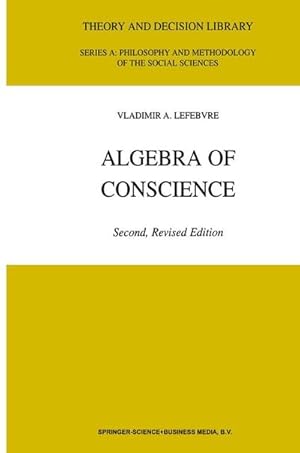
Algebra of Conscience
Sprache: Englisch
Verlag: Springer Netherlands, Springer Netherlands, 2001
ISBN 10: 0792371216 ISBN 13: 9780792371212
Anbieter: AHA-BUCH GmbH, Einbeck, Deutschland
Verkäuferbewertung 5 von 5 Sternen
Buch. Zustand: Neu. Druck auf Anfrage Neuware - Printed after ordering - Conscience is an essential human attribute. Nevertheless, in the construction of formal models of the subject it is customarily left outside the framework of theoretical analysis. The Algebra of Conscience, whose first edition appeared in 1982, was the first specialized work modeling the phenomenon of conscience. The method used in this book made it possible to connect moral experience with decision-making procedures on the level of mathematical models. The application of such models allows us to propose the hypothesis of two fundamentally different ethical systems determining the normative patterns of human behavior in situations of conflict. Under the first ethical system the subject's self-esteem is raised if the subject seeks to resolve the conflict; in the second it is raised by seeking to dramatize the conflict. The new edition of The Algebra of Conscience is significantly expanded. The second part of the book, devoted to moral choice, is completely new. Based on the theory presented in the first part, it constructs the model of a subject capable of making an intentional choice. A special variable corresponds to the subject's intention. This development allows us to include within the model freedom of will and freedom of choice, and also to generalize classical 2×2 game theory to the case where outcomes, in addition to having utility measures, are either `positive' or `negative.' In its concluding chapters the book constructs a dynamic model of the intentional subject faced with a choice between two alternatives, neither of which is morally acceptable for the subject. It is shown that in this case the probabilities of choice of the alternatives may change chaotically. From this it follows that one cannot predict which alternative will be chosen or even the probabilities with which they will be chosen. Audience: The book is addressed to a broad readership having elementaryknowledge of mathematical logic and the theory of probability. It can be used in college courses studying the modelling of moral choice. The book's material can also be used in the design of artificial intelligence systems.
-

Algebra of Conscience (Theory and Decision Library a:)
Anbieter: Revaluation Books, Exeter, Vereinigtes Königreich
Verkäuferbewertung 5 von 5 Sternen
EUR 331,72
EUR 14,42 Versand
Versand von Vereinigtes Königreich nach USAAnzahl: 2 verfügbar
In den WarenkorbPaperback. Zustand: Brand New. 2nd edition. 372 pages. 9.25x6.25x0.84 inches. In Stock.
-

MISSEL QUOTIDIEN DES ENFANTS
Verlag: DES FILLES DE L EGLISE- SOCIETE LITURGIQUE- APOSTOLAT LITURGIQUE, 1928
Couverture rigide. Zustand: bon. R200050772: 1928. In-16. Relié. Etat d'usage, Coins frottés, Dos satisfaisant, Intérieur frais. 655+ 28 pages- de dimension: 9x14.5cm environ- nombreuses lettrines- nombreuses illustrations en monochrome dans et hors texte- contreplats illustrés en couleurs- 2 pages désolidarisées- manque sur les contreplats, abîmés au niveau de la reliure- frontispice en monochrome- petites annotations sur la page de garde et la page de nomination de l'ancien propriétaire. . . . Classification Dewey : 264-Le culte.
-

MISSEL QUOTIDIEN POUR ENFANTS
Verlag: APOSTOLAT LITURGIQUE - SOCIETE LITURGIQUE, 1947
Couverture rigide. Zustand: bon. RO20174996: 1947. In-18. Cartonné. Etat d'usage, Coins frottés, Dos satisfaisant, Intérieur frais. 663 + 28 pages - nombreuses gravures en couleurs dans et hors texte - page 75 à 86 desolidarisées - 4 signets conservés - tranches rouges - contre-plats illustrés. . . . Classification Dewey : 264-Le culte.
-

MISSEL QUOTIDIEN DES ENFANTS
Verlag: SOCIETE LITURGIQUE, 1928
Couverture rigide. Zustand: bon. R240124559: 1928. In-16. Relié plein cuir. Etat d'usage, Coins frottés, Dos frotté, Intérieur acceptable. 633 + 28 pages augmentées de 300 gravures bicolore - tranches dorées - dos à 5 nerfs - titre doré sur le dos - annotation au stylo sur la page de garde. . . . Classification Dewey : 220-Bible.
-
Memento Práctico. Sociedades mercantiles. 1995 - 1996
Anbieter: Librería La Candela, Murcia, MU, Spanien
Verkäuferbewertung 5 von 5 Sternen
.- Madrid. 1995. EDERSA - Francis Lefebvre. 4º menor. 1234 pgs- 1 h. Plástico editorial. Muy buen estado. Derecho, . . . Derecho / Derecho Mercantil.
-

Memento Práctico. Sociedades mercantiles. 2010
Anbieter: Librería La Candela, Murcia, MU, Spanien
Verkäuferbewertung 5 von 5 Sternen
.- Madrid. 2009. Francis Lefebvre. 4º menor. 1916 pgs. Plástico editorial. Muy buen estado. Derecho, . . . Derecho.


