Gesamtpreis (1 Artikel Artikel):
Versandziel:

landseer edwin thomas (9 Ergebnisse)
Direkt zu den wichtigsten Suchergebnissen
Suchfilter
Produktart
- Alle Product Types
- Bücher (7)
- Magazine & Zeitschriften (Keine weiteren Ergebnisse entsprechen dieser Verfeinerung)
- Comics (Keine weiteren Ergebnisse entsprechen dieser Verfeinerung)
- Noten (Keine weiteren Ergebnisse entsprechen dieser Verfeinerung)
- Kunst, Grafik & Poster (1)
- Fotografien (Keine weiteren Ergebnisse entsprechen dieser Verfeinerung)
- Karten (Keine weiteren Ergebnisse entsprechen dieser Verfeinerung)
- Manuskripte & Papierantiquitäten (1)
Zustand Mehr dazu
- Neu (1)
- Wie Neu, Sehr Gut oder Gut Bis Sehr Gut (Keine weiteren Ergebnisse entsprechen dieser Verfeinerung)
- Gut oder Befriedigend (4)
- Ausreichend oder Schlecht (Keine weiteren Ergebnisse entsprechen dieser Verfeinerung)
- Wie beschrieben (4)
Einband
Weitere Eigenschaften
- Erstausgabe (3)
- Signiert (1)
- Schutzumschlag (Keine weiteren Ergebnisse entsprechen dieser Verfeinerung)
- Angebotsfoto (6)
Sprache (2)
Preis
- Beliebiger Preis
- Weniger als EUR 20 (Keine weiteren Ergebnisse entsprechen dieser Verfeinerung)
- EUR 20 bis EUR 40
- Mehr als EUR 40
Gratisversand
Land des Verkäufers
Verkäuferbewertung
-

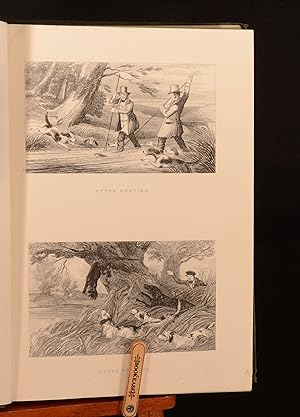
Engravings of Lions, Tigers, Panthers, Leopards, Dogs, &c.
Anbieter: Majestic Books, Hounslow, Vereinigtes Königreich
Verkäuferbewertung 4 von 5 Sternen

EUR 24,08
EUR 7,43 Versand
Versand von Vereinigtes Königreich nach USAAnzahl: 4 verfügbar
In den WarenkorbZustand: New.
-
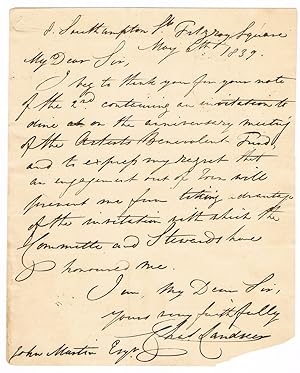
AUTOGRAPH LETTER SIGNED BY ARTIST CHARLES LANDSEER, to John Martin, secretary of the Artists' Benevolent Fund.
Verlag: Southampton, May, 1839., 1839
Anbieter: Blue Mountain Books & Manuscripts, Ltd., Cadyville, NY, USA
Verkäuferbewertung 5 von 5 Sternen

Signiert
Zustand: Good. - sc 67 words penned on 8-7/8 inch high by 7-1/4 inch wide paper with an armorial device embossed at the top left corner. In his brief letter addressed to John Martin, a bookseller of the period and secretary of the Artists' Benevolent Fund, Charles Landseer apologizes that he will not be able to attend the anniversary meeting. Signed "Chas. Landseer". Once folded with a tear near the top right, the letter has been mounted from the verso to heavier stock. A piece torn from the bottom right corner of both the letter and its mount does not affect the text. Good. Thomas Landseer's brother, the painter Charles Landseer (1799-1879) trained under his father John and subsequently Benjamin Robert Haydon before attending London's Royal Academy. He accompanied Sir Charles Stuart de Rothesay on his voyage to Portugal and Brazil while sharpening his drawing skills. These drawings were then exhibited at the British Institution in 1828 and he sent his first painting to the Royal Academy in that same year. In addition to historical subjects, Charles Landseer painted portraits, genre scenes and animal studies.John Martin (1791-1855) was a bookseller and the secretary to the Artists' Benevolent Fund from 1833-45.
-

[ Sir Edwin Landseer, artist. ] Autograph Letter Signed ('E Landseer'), accepting a dinner invitation from the Scottish artist Thomas Faed and his wife.
Verlag: On his St John's Wood Road letterhead. 8 February, 1868
Anbieter: Richard M. Ford Ltd, London, Vereinigtes Königreich
Verkäuferbewertung 5 von 5 Sternen
Manuskript / Papierantiquität
EUR 65,97
EUR 5,15 Versand
Versand von Vereinigtes Königreich nach USAAnzahl: 1 verfügbar
In den Warenkorb2pp., 12mo. On a bifolium, the blank second leaf of which is laid down on a leaf removed from an album. In good condition, on lightly aged paper. He apologises for 'seeming indfferent' to the 'kind invitation - For the last 3 days I have been very unwell[.] I am now well enough to say yes - with the hope of being still better by the 25th. of Feby'.
-
Rural Life Described and Illustrated In The Management Of Horses, Dogs, Cattle, Sheep, Pigs, Poultry etc
Verlag: The London Printing Co [1870], London, 1870
Anbieter: Barter Books Ltd, Alnwick, NORTH, Vereinigtes Königreich
Verbandsmitglied: IOBA
Verkäuferbewertung 5 von 5 Sternen
Erstausgabe
EUR 106,37
EUR 9,15 Versand
Versand von Vereinigtes Königreich nach USAAnzahl: 1 verfügbar
In den WarenkorbZustand: Good. First Edition. G : in Good condition without dust jacket. Covers rubbed with scuffing to leather. Inner hinges cracked. Ink inscription to fep. Scattered light foxing. 270mm x 190mm (11" x 7"). 1016pp. c. 100 steel engravings. Heavy book extra shipping needed for overseas. Two divisions complete in one volume. Brown hardback half-leather cover.
-
Rural Life, Described and Illustrated in the Management of Horses, Dogs, Cattle, Sheep, Pigs, Poultry, &c.
Verlag: London Printing and Publishing Company Limited, London, 1870
Anbieter: Rooke Books PBFA, Bath, Vereinigtes Königreich
Verbandsmitglied: PBFA
Verkäuferbewertung 5 von 5 Sternen
EUR 530,08
EUR 17,14 Versand
Versand von Vereinigtes Königreich nach USAAnzahl: 1 verfügbar
In den WarenkorbCloth. Zustand: Very Good. Sir Edwin Landseer; Thomas Landseer (illustrator). A lavishly illustrated work on the management of various farm animals in rural England, written by John Sherer, illustrated by Edwin and Thomas Landseer. Illustrations include three folding plates. Complete in five volumes. This work is a comprehensive and informative guide to the keeping and management of horses, dogs, cattle, sheep, pigs, poultry, and other animals that are commonly kept on a farm. Volume I with nine plates. Volume II with eleven plates. Volumes III with twelve plates. Volume IV with twelve plates. Volume V with eighteen plates, three of which are folding. Illustrated throughout by Edwin Landseer, and engraved by Thomas Landseer. Edwin is best known for his paintings of animals, as well as for his impressive lion sculptures in Trafalgar Square. His work was popular in Victorian Britain, and was the most highly regarded animal painter of his time. His brother, Thomas, often worked with him by engraving his paintings, which meant that their work could be widely used as illustrations in books. Thomas studied painting under Charles and William Bewick, beginning to practice etching when he was fourteen. Written by John Sherer. Undated, dated from Copac from copies held at Edinburgh University, and London School of Economics. Collated, complete. In the original publisher's cloth binding. Externally, generally smart. Tidemarking and discolouration to the boards. A little bumping to the head and tail of the spines and to the extremities. The odd spot to the fore edge. Front hinge of Volume V is starting but firm. Internally, firmly bound. Pages are bright and clean with only the occasional handling mark. Very Good. book.
-
Rural Life Described and Illustrated in the Management of Horses, Dogs, Cattle, Sheep, Pigs, Poultry, &c. With authentic information on all that relates to modern farming, gardening, shooting, angling, etc., etc.; And a complete System of Modern Veterinary Practice. In Two Volumes.
Verlag: London, The London Printing and Publishing Co., (n.d.) ca. 1870, 1870
Anbieter: PROCTOR / THE ANTIQUE MAP & BOOKSHOP, DORCHESTER, Vereinigtes Königreich
Verbandsmitglied: PBFA
Verkäuferbewertung 5 von 5 Sternen
EUR 97,77
EUR 22,87 Versand
Versand von Vereinigtes Königreich nach USAAnzahl: 1 verfügbar
In den Warenkorb2 volumes. Hardback, Tall 8vo. Approx 11 x 7.5 inches. Halfbound in maroon calf leather bindings with pebbled textured cloth to boards, raised banding and gilt decorations to spines with gilt lettering. Marbled endpapers and page edges. In very good condition. Spines faded, mottled fading to cloth on boards. Rubbing to leather on corners. and End-corners of spines. Some minor foxing to title page in vol.2. Some occasional minor spots to pages and plates, engraved plates all tissue guarded. Else pages clean and tight. 2 vols: 396 - 1016 pp. Illustrated by the best artists of the time, 66 plates with over 100 steel-engravings ( of famous horses as well as of veterinary diagrams, some plates are of riding or hunting, shooting, also of farm machinery, e.g. ?Garrett & Sons: Double-Cylinder Steam Ploughing Engine and Tackle? and ?Improved Stone Mill for Grinding Wheat?, and ?Garrett & Sons Patent Combined Threshing & Dressing Machine?). Engraved title page in vol.1. A fascinating book about the health and disease of farm animals. There are substantial sections on dogs, shooting, cattle, sheep, pigs, modern farming and implements, gardening, angling, and a large veterinary section. The first 364 pages deal with The Horse - its history, its veterinary care, its racing and working role.
-
Rat-Catching.
Verlag: Hurst Robinson & Co., London, 1823
Anbieter: Alexandre Antique Prints, Maps & Books, Toronto, ON, Kanada
Verkäuferbewertung 5 von 5 Sternen
Kunst / Grafik / Poster
Zustand: Very Good. Image Size : 285x388 (mm), 11.22x15.28 (Inches), Platemark Size : 344x485 (mm), 13.54x19.09 (Inches), Paper Size : 363x496 (mm), 14.29x19.53 (Inches), Hand Colored, Engraving.
-
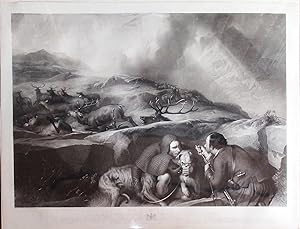
The Drive: Shooting deer on the pass; scene in the Black Mount, Glen-Urchy Forest.
Verlag: London, c. 1850., 1850
Anbieter: Arader Galleries - AraderNYC, New York, NY, USA
Verkäuferbewertung 5 von 5 Sternen
Erstausgabe
Single sheet, (32 ¾ x 43 inches). Fine engraving showing a hunting scene (separation at plate mark, repaired, affecting the imprint). First edition. Sir Edwin Landseer once wrote, "Who does not glory in the death of a fine stag?" In 1847 the Marquis of Bredalbane commissioned Landseer to create a large painting he entitled "A Drive of Deer - Glen Orchay." Landseer sent the painting to the Royal Academy, and Breadalbane presented it to Prince Albert (the engraving is dedicated to the Prince Consort as well). It was then engraved by Thomas Landseer, Sir Edwin's brother, and at the time was the largest plate ever executed from any work by that artist. Glen Orchay, also written as Glenorchy, is located in Argylshire, and visible in both the painting and the engraving are a range of hills which are part of the Southern Grampians. "Landseer had close links with the sphere of zoological art through his friendship with [Joseph] Wolf and through the activities of his own brothers, Charles and Thomas Landseer, both of whom were occasionally employed as illustrators of popular books on natural history. However, his paintings had a scale, dramatic power and imaginative exaltation that set them apart from such works. They were history paintings, but of a completely original kind, in the sense that they invested the lives of animals themselves with tragic grandeur. That this could be done so convincingly is itself evidence of great changes in attitudes to nature in the nineteenth century: the profound philosophical implications of the discoveries in geology, paleontology and evolutionary theory which I have outlined placed animals at the forefront of consciousness. As a writer in the London Quarterly Review put it in 1874, Landseer painted 'the poetry of animal life, running so curiously parallel to the poetry of human life' (Diana Donald, Picturing Animals in Britain, 1750-1850, p. 94). "One of his pictures, 'The Drive' (as here), which was exhibited in 1847 and acquired by Prince Albert, showed a herd of deer funneled through a narrow mountain pass and presenting an easy target for the concealed guns. As the Art-Union's reviewer noted, what it showed was not stalking but ambush: a practice which Landseer himself described in a letter as 'base atrocious or contemptible assassination.' The artist who in 1844 had represented the spearing of an otter with a bravado and flamboyance that defied remonstration now showed himself increasingly ill at ease with the sporting myth" (Donald, p. 303).
-
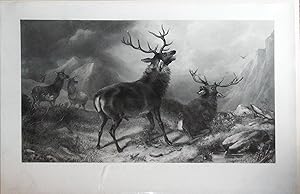
Victor of the Glen.
Verlag: London: L. Brall, 1868., 1868
Anbieter: Arader Galleries - AraderNYC, New York, NY, USA
Verkäuferbewertung 5 von 5 Sternen
Erstausgabe
Single sheet, (27 x 42 inches). Fine engraving showing stags (small indentation on lower margin). ?First edition. Sir Edwin Landseer rose to fame in the 1840s and 1850s, largely due to the publication of prints based on his paintings of deer. This particular scene shows a confrontation between two stags in the Scottish Highlands, the victor braying to the sky, and the other yielding on the ground, as three does look on from afar. "Landseer had close links with the sphere of zoological art through his friendship with [Joseph] Wolf and through the activities of his own brothers, Charles and Thomas Landseer, both of whom were occasionally employed as illustrators of popular books on natural history. However, his paintings had a scale, dramatic power and imaginative exaltation that set them apart from such works. They were history paintings, but of a completely original kind, in the sense that they invested the lives of animals themselves with tragic grandeur. That this could be done so convincingly is itself evidence of great changes in attitudes to nature in the nineteenth century: the profound philosophical implications of the discoveries in geology, paleontology and evolutionary theory which I have outlined placed animals at the forefront of consciousness. As a writer in the London Quarterly Review put it in 1874, Landseer painted 'the poetry of animal life, running so curiously parallel to the poetry of human life' (Diana Donald, Picturing Animals in Britain, 1750-1850, p. 94).