

Gesamtpreis (1 Artikel Artikel):
Versandziel:

kosuge tsune (11 Ergebnisse)
Direkt zu den wichtigsten Suchergebnissen
Suchfilter
Produktart
- Alle Product Types
- Bücher (11)
- Magazine & Zeitschriften (Keine weiteren Ergebnisse entsprechen dieser Verfeinerung)
- Comics (Keine weiteren Ergebnisse entsprechen dieser Verfeinerung)
- Noten (Keine weiteren Ergebnisse entsprechen dieser Verfeinerung)
- Kunst, Grafik & Poster (Keine weiteren Ergebnisse entsprechen dieser Verfeinerung)
- Fotografien (Keine weiteren Ergebnisse entsprechen dieser Verfeinerung)
- Karten (Keine weiteren Ergebnisse entsprechen dieser Verfeinerung)
- Manuskripte & Papierantiquitäten (Keine weiteren Ergebnisse entsprechen dieser Verfeinerung)
Zustand Mehr dazu
- Neu (4)
- Wie Neu, Sehr Gut oder Gut Bis Sehr Gut (2)
- Gut oder Befriedigend (5)
- Ausreichend oder Schlecht (Keine weiteren Ergebnisse entsprechen dieser Verfeinerung)
- Wie beschrieben (Keine weiteren Ergebnisse entsprechen dieser Verfeinerung)
Einband
Weitere Eigenschaften
- Erstausgabe (2)
- Signiert (Keine weiteren Ergebnisse entsprechen dieser Verfeinerung)
- Schutzumschlag (3)
- Angebotsfoto (5)
Sprache (2)
Gratisversand
- Kostenloser Versand nach USA (Keine weiteren Ergebnisse entsprechen dieser Verfeinerung)
Land des Verkäufers
Verkäuferbewertung
-

Plant-Microbe Interactions: Molecular and Genetic Perspectives
Anbieter: Phatpocket Limited, Waltham Abbey, HERTS, Vereinigtes Königreich
Verkäuferbewertung 5 von 5 Sternen

EUR 4,23
EUR 12,26 Versand
Versand von Vereinigtes Königreich nach USAAnzahl: 1 verfügbar
In den WarenkorbZustand: Good. Your purchase helps support Sri Lankan Children's Charity 'The Rainbow Centre'. Ex-library, so some stamps and wear, but in good overall condition. Our donations to The Rainbow Centre have helped provide an education and a safe haven to hundreds of children who live in appalling conditions.
-
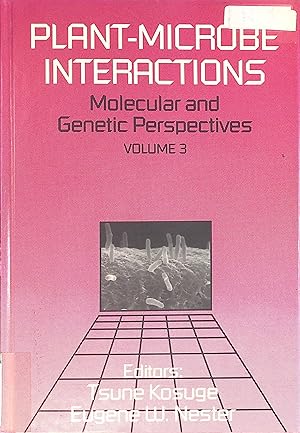
Plant-Microbe Interactions Molecular and Genetic Perspectives, vol. 3
Anbieter: books4less (Versandantiquariat Petra Gros GmbH & Co. KG), Welling, Deutschland
Verkäuferbewertung 5 von 5 Sternen
gebundene Ausgabe. Zustand: Gut. 511 Seiten; Der Erhaltungszustand des hier angebotenen Werks ist trotz seiner Bibliotheksnutzung sehr sauber. Es befindet sich neben dem Rückenschild lediglich ein Bibliotheksstempel im Buch; ordnungsgemäß entwidmet. Leichte altersbedingte Anbräunung des Papiers. In ENGLISCHER Sprache. Sprache: Englisch Gewicht in Gramm: 855.
-

Plant - Microbe Interactions Molecular and Genetic Perspectives
Sprache: Englisch
Verlag: MacMillan Publishing Co., New York, New York, 1987
ISBN 10: 0029479908 ISBN 13: 9780029479902
Anbieter: Catnap Books, Cobleskill, NY, USA
Verkäuferbewertung 5 von 5 Sternen
Erstausgabe
Hardcover. Zustand: Very Good. Zustand des Schutzumschlags: Good+. First Edition. Black cloth covers with white lettering on spine. The covers are in very good condition, with just a bit of bumping and wear to spine edges, The contents are very tight and clean. All-in-all, a nice copy. ; The book is divided into five sections: Overview, Nitrogen Fixation, Establishment of Microbes In Plants, Viruses and Plant Response to Stress. There are fourteen articles written by many of the (at that time) authorities in this field. ; Illustrated with charts and in-text drawings; 8vo 8" - 9" tall; xii, 448pp pages.
-
Hardcover. Zustand: Bon. Ancien livre de bibliothèque. Petite(s) trace(s) de pliure sur la couverture. Salissures sur la tranche. Tampon ou marque sur la face intérieure de la couverture. Couverture différente. Edition 1989. Tome 3. Ammareal reverse jusqu'à 15% du prix net de cet ENGLISH DESCRIPTION Book Condition: Used, Good. Former library book. Slightly creased cover. Stains on the edge. Stamp or mark on the inside cover page. Different cover. Edition 1989. Volume 3. Ammareal gives back up to 15% of this item's net price to charity organizations.
-
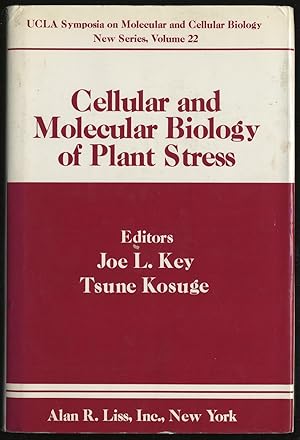
CELLULAR AND MOLECULAR BIOLOGY OF PLANT STRESS
Verlag: ALAN R. LISS, INC, New York, 1985
Anbieter: Between the Covers-Rare Books, Inc. ABAA, Gloucester City, NJ, USA
Verbandsmitglied: ABAA ESA ILAB IOBA
Verkäuferbewertung 5 von 5 Sternen
Erstausgabe
Hardcover. Zustand: Very Good. Zustand des Schutzumschlags: Very Good. First edition. Very good with a bookplate on the front pastedown, in a very good dustwrapper.
-
Genetic Engineering of Plants: An Agricultural Perspective (Basic Life Sciences, Vol. 26).
Sprache: Englisch
Verlag: New York (USA), Plenum Press., 1983
ISBN 10: 0306413531 ISBN 13: 9780306413537
Anbieter: Antiquariat Thomas Haker GmbH & Co. KG, Berlin, Deutschland
Verbandsmitglied: GIAQ
Verkäuferbewertung 5 von 5 Sternen
SonderangebotEUR 32,64
EUR 30,00 Versand
Versand von Deutschland nach USAAnzahl: 1 verfügbar
In den WarenkorbHardcover with dust jacket. Zustand: Gut. 499 p., with figures an photos (partly colored), 25 cm, Good condition. Dustjacket slightly worn. Sprache: Englisch Gewicht in Gramm: 1180.
-

Genetic Engineering of Plants: An Agricultural Perspective (Basic Life Sciences, 26)
Anbieter: Ria Christie Collections, Uxbridge, Vereinigtes Königreich
Verkäuferbewertung 5 von 5 Sternen
EUR 114,97
EUR 13,80 Versand
Versand von Vereinigtes Königreich nach USAAnzahl: Mehr als 20 verfügbar
In den WarenkorbZustand: New. In.
-

EUR 92,27
EUR 48,99 Versand
Versand von Deutschland nach USAAnzahl: Mehr als 20 verfügbar
In den WarenkorbZustand: New.
-
Zustand: Sehr gut. Zustand: Sehr gut | Seiten: 516 | Sprache: Englisch | Produktart: Bücher | William C. Taylor Department of Genetics University of California Berkeley, California 94720 It is evident by now that there is a great deal of interest in exploiting the new technologies to genetically engineer new forms of plants. A purpose of this meeting is to assess the possibilities. The papers that follow are concerned with the analysis of single genes or small gene families. We will read about genes found within the nucleus, plastids, and bacteria which are responsible for agri culturally important traits. Given that these genes can be isolated by recombinant DNA techniques, there are two possible strategies for plant engineering. One involves isolating a gene from a cultivated plant, changing it in a specific way and then inserting it back into the same plant where it produces an altered gene product. An example might be changing the amino acid composition of a seed pro tein so as to make the seed a more efficient food source. A second strategy is to isolate a gene from one species and transfer it to another species where it produces a desirable feature. An example might be the transfer of a gene which encodes a more efficient pho tosynthetic enzyme from a wild relative into a cultivated species. There are three technical hurdles which must be overcome for either strategy to work. The gene of interest must be physically isolated.
-
Taschenbuch. Zustand: Neu. Genetic Engineering of Plants | An Agricultural Perspective | Tsune Kosuge (u. a.) | Taschenbuch | xi | Englisch | 2012 | Springer | EAN 9781468445466 | Verantwortliche Person für die EU: Springer Verlag GmbH, Tiergartenstr. 17, 69121 Heidelberg, juergen[dot]hartmann[at]springer[dot]com | Anbieter: preigu.
-

Genetic Engineering of Plants : An Agricultural Perspective
Sprache: Englisch
Verlag: Springer US, Springer New York, 2012
ISBN 10: 1468445464 ISBN 13: 9781468445466
Anbieter: AHA-BUCH GmbH, Einbeck, Deutschland
Verkäuferbewertung 5 von 5 Sternen
Taschenbuch. Zustand: Neu. Druck auf Anfrage Neuware - Printed after ordering - William C. Taylor Department of Genetics University of California Berkeley, California 94720 It is evident by now that there is a great deal of interest in exploiting the new technologies to genetically engineer new forms of plants. A purpose of this meeting is to assess the possibilities. The papers that follow are concerned with the analysis of single genes or small gene families. We will read about genes found within the nucleus, plastids, and bacteria which are responsible for agri culturally important traits. Given that these genes can be isolated by recombinant DNA techniques, there are two possible strategies for plant engineering. One involves isolating a gene from a cultivated plant, changing it in a specific way and then inserting it back into the same plant where it produces an altered gene product. An example might be changing the amino acid composition of a seed pro tein so as to make the seed a more efficient food source. A second strategy is to isolate a gene from one species and transfer it to another species where it produces a desirable feature. An example might be the transfer of a gene which encodes a more efficient pho tosynthetic enzyme from a wild relative into a cultivated species. There are three technical hurdles which must be overcome for either strategy to work. The gene of interest must be physically isolated.


