
Gesamtpreis (1 Artikel Artikel):
Versandziel:

kleene s c (18 Ergebnisse)
Direkt zu den wichtigsten Suchergebnissen
Suchfilter
Produktart
- Alle Product Types
- Bücher (15)
- Magazine & Zeitschriften (3)
- Comics (Keine weiteren Ergebnisse entsprechen dieser Verfeinerung)
- Noten (Keine weiteren Ergebnisse entsprechen dieser Verfeinerung)
- Kunst, Grafik & Poster (Keine weiteren Ergebnisse entsprechen dieser Verfeinerung)
- Fotografien (Keine weiteren Ergebnisse entsprechen dieser Verfeinerung)
- Karten (Keine weiteren Ergebnisse entsprechen dieser Verfeinerung)
- Manuskripte & Papierantiquitäten (Keine weiteren Ergebnisse entsprechen dieser Verfeinerung)
Zustand Mehr dazu
- Neu (2)
- Wie Neu, Sehr Gut oder Gut Bis Sehr Gut (2)
- Gut oder Befriedigend (9)
- Ausreichend oder Schlecht (Keine weiteren Ergebnisse entsprechen dieser Verfeinerung)
- Wie beschrieben (5)
Einband
Weitere Eigenschaften
- Erstausgabe (7)
- Signiert (Keine weiteren Ergebnisse entsprechen dieser Verfeinerung)
- Schutzumschlag (Keine weiteren Ergebnisse entsprechen dieser Verfeinerung)
- Angebotsfoto (3)
Sprache (2)
Gratisversand
Land des Verkäufers
Verkäuferbewertung
-
Mathematical Logic. essays dedicated to Dexter Kozen on the occasion of his 60th birthday.
Anbieter: ANTIQUARIAT Franke BRUDDENBOOKS, Lübeck, Deutschland
Verkäuferbewertung 5 von 5 Sternen

Gebundene Ausgabe, Gr.8°. Zustand: Gut. 398 S. Das Buch ist in gutem, sauberen Zustand. Einband minimal berieben / fleckig. Ecken und Kanten leicht bestossen. Sonst sauberes und wohlerhaltenes Exemplar. ISBN: 9780471490333 Wir senden umgehend mit beiliegender MwSt.Rechnung. Sprache: Englisch Gewicht in Gramm: 635.
-

Logic, Methodology and Philosophy of Science Proceedings of the 1960 International Conference
Verlag: Stanford University Press
Anbieter: ThriftBooks-Dallas, Dallas, TX, USA
Verkäuferbewertung 5 von 5 Sternen
Hardcover. Zustand: Very Good. No Jacket. Former library book; May have limited writing in cover pages. Pages are unmarked. ~ ThriftBooks: Read More, Spend Less.
-
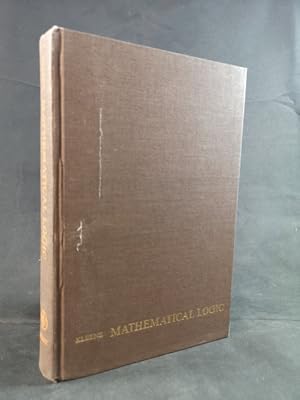
Mathematical Logic
Verlag: John Wiley and Sons, 1968
Anbieter: Anybook.com, Lincoln, Vereinigtes Königreich
Verkäuferbewertung 5 von 5 Sternen
EUR 27,02
EUR 15,34 shipping
Ships from Vereinigtes Königreich to USAAnzahl: 1 verfügbar
In den WarenkorbZustand: Good. This is an ex-library book and may have the usual library/used-book markings inside.This book has hardback covers. In good all round condition. No dust jacket. Please note the Image in this listing is a stock photo and may not match the covers of the actual item,750grams, ISBN:
-

Introduction to Metamathematics (Bibliotheca Mathematica)
Anbieter: Kisharon Langdon New Chapters, HARROW, Vereinigtes Königreich
Verkäuferbewertung 5 von 5 Sternen
EUR 73,11
EUR 11,44 shipping
Ships from Vereinigtes Königreich to USAAnzahl: 1 verfügbar
In den WarenkorbNO DUST JACKET. Sold by the UK charity Kisharon Langdon; offering opportunities and support for people within the autism and learning disability community.
-

Collected Works (Kurt Godel Collected Works)
Anbieter: Redux Books, Grand Rapids, MI, USA
Verkäuferbewertung 5 von 5 Sternen
Hardcover. Zustand: Very Good. Very Good+ Hardcover with DJ. Pages are clean and unmarked. Covers like new. Binding is tight, hinges strong. Dust jacket very good. Light shelving foxing spots/dust-dulling on book top page edge. APPEARS BARELY USED.; 100% Satisfaction Guaranteed! Ships same or next business day!
-
Collected Works
Verlag: Oxford University Press, Incorporated, 1989
ISBN 10: 0195039726 ISBN 13: 9780195039726
Sprache: Englisch
Anbieter: Better World Books, Mishawaka, IN, USA
Verkäuferbewertung 5 von 5 Sternen
Zustand: Good. Former library book; may include library markings. Used book that is in clean, average condition without any missing pages.
-
Introduction to Metamathematics
Anbieter: Majestic Books, Hounslow, Vereinigtes Königreich
Verkäuferbewertung 4 von 5 Sternen

EUR 115,81
EUR 7,44 shipping
Ships from Vereinigtes Königreich to USAAnzahl: 3 verfügbar
In den WarenkorbZustand: New. pp. 564 14:B&W 6 x 9 in or 229 x 152 mm Case Laminate on White w/Gloss Lam.
-
The Journal Of Symbolic Logic. Volume 4 Number 1. March 1939 [With Rozsa Peter's Review Of Gerhard Gentzeen's "Neue Fassung Des Widerspruchsfreiheitsbeweises Fur Die Reine Zahlentheorie"]
Verlag: Association for Symbolic Logic, Menasha / Ann Arbor, 1939
Sprache: Englisch
Anbieter: Arroyo Seco Books, Pasadena, Member IOBA, Pasadena, CA, USA
Verbandsmitglied: IOBA
Verkäuferbewertung 5 von 5 Sternen
Magazin / Zeitschrift Erstausgabe
Grey Wrappers. Zustand: Near Fine. First Edition. Volume 4 No 1, 40 Pp. Scarce In This, The Original Publication State Of Gray Printed Wrappers. Near Fine. Contains Rozsa's Review (In German) Of Gerhard Gentzeen's "Neue Fassung Des Widerspruchsfreiheitsbeweises Fur Die Reine Zahlentheorie". Rózsa Péter, Born Rózsa Politzer, (1905 - 1977) Was A Hungarian Mathematician And Logician. She Is Best Known As The "Founding Mother Of Recursion Theory". Initially, Péter Began Her Graduate Research On Number Theory. Upon Discovering That Her Results Had Already Been Proven By The Work Of Robert Carmichael And L. E. Dickson, She Abandoned Mathematics To Focus On Poetry. However, She Was Convinced To Return To Mathematics By Her Friend László Kalmár, Who Suggested She Research The Work Of Kurt Gödel On The Theory Of Incompleteness.[3] She Prepared Her Own, Different Proofs To Gödel's Work. Péter Presented The Results Of Her Paper On Recursive Theory, "Rekursive Funktionen," To The International Congress Of Mathematicians In Zurich, Switzerland In 1932. For Her Research, She Received Her Phd Summa Cum Laude In 1935. In 1936, She Presented A Paper Entitled "Über Rekursive Funktionen Der Zweiten Stufe" To The International Congress Of Mathematicians In Oslo.[3] These Papers Helped To Found The Modern Field Of Recursive Function Theory As A Separate Area Of Mathematical Research. In 1937, She Was Appointed As Contributing Editor Of The Journal Of Symbolic Logic. After The Passage Of The Jewish Laws Of 1939 In Hungary, Péter Was Forbidden To Teach Because Of Her Jewish Origin And Was Briefly Confined To A Ghetto In Budapest. During World War Ii, She Wrote Her Book Playing With Infinity: Mathematical Explorations And Excursions, A Work For Lay Readers On The Topics Of Number Theory And Logic. In 1952, She Was The First Hungarian Woman To Be Made An Academic Doctor Of Mathematics. After The College Closed In 1955, She Taught At Eötvös Loránd University Until Her Retirement In 1975. She Was A Popular Professor, Known As "Aunt Rózsa" To Her Students. In 1951, She Published Her Key Work, Recursive Functions (Rekursive Funtionen). She Continued To Publish Important Papers On Recursive Theory Throughout Her Life. Beginning In The Mid-1950S, Péter Applied Recursive Function Theory To Computers. Her Final Book, Published In 1976, Was Recursive Functions In Computer Theory. Originally Published In Hungarian, It Was The Second Hungarian Mathematical Book To Be Published In The Soviet Union Because Its Subject Matter Was Considered Indispensable To The Theory Of Computers. It Was Translated Into English In 1981.Péter Was Awarded The Kossuth Prize In 1951. She Received The Manó Beke Prize By The János Bolyai Mathematical Society In 1953, The Silver State Prize In 1970, And The Gold State Prize In 1973. In 1973, She Became The First Woman To Be Elected To The Hungarian Academy Of Sciences.
-
Introduction to Metamathematics
Verlag: ELSEVIER SCIENCE TECHNOLOGY, 1980
ISBN 10: 0720421039 ISBN 13: 9780720421033
Sprache: Englisch
Anbieter: Buchpark, Maidenhead, Berkshire, Vereinigtes Königreich
Verkäuferbewertung 5 von 5 Sternen
EUR 91,40
EUR 74,41 shipping
Ships from Vereinigtes Königreich to USAAnzahl: 1 verfügbar
In den WarenkorbZustand: Very Good. Condition: Very Good, Pages: 560, Size: 23.6x15.6x4.
-

INTRO TO METAMATHEMATICS
Verlag: Elsevier Science & Technology|North Holland, 1980
ISBN 10: 0720421039 ISBN 13: 9780720421033
Sprache: Englisch
EUR 154,55
EUR 48,99 shipping
Ships from Deutschland to USAAnzahl: Mehr als 20 verfügbar
In den WarenkorbZustand: New. Stephen Cole Kleene was one of the greatest logicians of the twentieth century and this book is the influential textbook he wrote to teach the subject to the next generation. It was first published in 1952, some twenty years after the publication of Gade.
-
The Journal Of Symbolic Logic. Volume 3 Number 2. June 1938 [With Rozsa Peter's Review Of Alan Turing's "Computability And L-Deiniability)
Verlag: Association for Symbolic Logic, Menasha / Ann Arbor, 1938
Sprache: Englisch
Anbieter: Arroyo Seco Books, Pasadena, Member IOBA, Pasadena, CA, USA
Verbandsmitglied: IOBA
Verkäuferbewertung 5 von 5 Sternen
Magazin / Zeitschrift Erstausgabe
Grey Wrappers. Zustand: Near Fine. First Edition. Volume 3 No 3, 96 Pp. Scarce In This, The Original Publication State Of Gray Printed Wrappers. Near Fine. Contains Rozsa's Review (In German) Of Turing's 1937 Article In This Same Journal. Rózsa Péter, Born Rózsa Politzer, (1905 - 1977) Was A Hungarian Mathematician And Logician. She Is Best Known As The "Founding Mother Of Recursion Theory". Initially, Péter Began Her Graduate Research On Number Theory. Upon Discovering That Her Results Had Already Been Proven By The Work Of Robert Carmichael And L. E. Dickson, She Abandoned Mathematics To Focus On Poetry. However, She Was Convinced To Return To Mathematics By Her Friend László Kalmár, Who Suggested She Research The Work Of Kurt Gödel On The Theory Of Incompleteness. She Prepared Her Own, Different Proofs To Gödel's Work. Péter Presented The Results Of Her Paper On Recursive Theory, "Rekursive Funktionen," To The International Congress Of Mathematicians In Zurich, Switzerland In 1932. For Her Research, She Received Her Phd Summa Cum Laude In 1935. In 1936, She Presented A Paper Entitled "Über Rekursive Funktionen Der Zweiten Stufe" To The International Congress Of Mathematicians In Oslo. These Papers Helped To Found The Modern Field Of Recursive Function Theory As A Separate Area Of Mathematical Research. In 1937, She Was Appointed As Contributing Editor Of The Journal Of Symbolic Logic. After The Passage Of The Jewish Laws Of 1939 In Hungary, Péter Was Forbidden To Teach Because Of Her Jewish Origin And Was Briefly Confined To A Ghetto In Budapest. During World War Ii, She Wrote Her Book Playing With Infinity: Mathematical Explorations And Excursions, A Work For Lay Readers On The Topics Of Number Theory And Logic. In 1952, She Was The First Hungarian Woman To Be Made An Academic Doctor Of Mathematics. After The College Closed In 1955, She Taught At Eötvös Loránd University Until Her Retirement In 1975. She Was A Popular Professor, Known As "Aunt Rózsa" To Her Students. In 1951, She Published Her Key Work, Recursive Functions (Rekursive Funtionen). She Continued To Publish Important Papers On Recursive Theory Throughout Her Life. Beginning In The Mid-1950S, Péter Applied Recursive Function Theory To Computers. Her Final Book, Published In 1976, Was Recursive Functions In Computer Theory. Originally Published In Hungarian, It Was The Second Hungarian Mathematical Book To Be Published In The Soviet Union Because Its Subject Matter Was Considered Indispensable To The Theory Of Computers. It Was Translated Into English In 1981. Péter Was Awarded The Kossuth Prize In 1951. She Received The Manó Beke Prize By The János Bolyai Mathematical Society In 1953, The Silver State Prize In 1970, And The Gold State Prize In 1973. In 1973, She Became The First Woman To Be Elected To The Hungarian Academy Of Sciences.
-
The Journal Of Symbolic Logic. March 1938 To 1955 (An Incomplete Run Of 38 Individual Issues In Original Wrappers)
Verlag: Association For Symbolic Logic 1938 1939 1940 1941 1942 1943 1944 1945 1946 1947 1948, 1949 1950 1951, 1952 1953 1954 1955, 1938
Sprache: Englisch
Anbieter: Arroyo Seco Books, Pasadena, Member IOBA, Pasadena, CA, USA
Verbandsmitglied: IOBA
Verkäuferbewertung 5 von 5 Sternen
Magazin / Zeitschrift Erstausgabe
Grey-blue Wrappers. Zustand: Very Good. First Edition. 53 Separate Numbers, 1938-1955, In Original Wrappers, As Issued. Not Ex-Library, Never Bound. Scarce In Original Condition Like This, As Almost All Surviving Issues Were Those Bound For Libraries. Condition Varies From Very Good To Fine. Vol 3 1938 Nos. 1, 3 And 4; Vol. 4 1939 No. 4; Vol 5 1940 Nos 1, 3, 4; Vol 6 1941 Nos. 1, 2, 4; Vol. 7 1942 No. 2; Vol 8 No. 1, 2, And 4; Vol 9 1944 Nos. 2, 3, 4; Vol. 10 1945 Nos 1, 2, 3, 4; Vol 11 1946 Nos. 1,2,3,4; Vol 12, 1947, Nos 1, 2, 3, 4; Vol. 13, 1948, Nos. 1, 3, 4; Vol. 14 1949 No. 2, 4; Vol 15 No. 1, 2, 3, 4; Vol 16 1951, Nos 1, 2, 3, 4; Vol 17, 1952 Nos. 1, 2, 3, 4; Volume 18, 1953, Nos 1,2, 4; Vol 19 1954 Nos 1, 2, 4; Volume 20, 1955, No. 4. " . The Extant Gains Registered By The Modern Symbolic Treatment Of Logic Have Become Such An Essential Factorin Making Pronouncements Regarding The History Of Logic That We Are Constrained To Say That An Essential Knowledge Of Symbolic Logic Have Become An Indispensable Condition For Any And All Fruitful Study Of The History Of Logic" [Heinrich Scholz,"Concise History Of Logic"). As It Is Impossible To Show That The Cause And Effect Of Any Physical Event Can Be Isolated Sufficiently To Make The Effects Of Forces Susceptible To A Complete Logical Analysis, The Connection Of Physical Science And Logic Remains Tangential And Tenuous. The Impossibility Of Exactly Physically Limiting Definition Of Sources And Effects Of Forces In Social Science Make Law, Economics And Politics Ridiculous, And The Rest Of Social Science Merely Entertaining. The Scientific Use Of Logic Is Limited To It's Use In Occam's Razor, The Endless Process Of Successive Removal Of Improper Statements, Relationships, And Associations In Statements About The Physical World, And The Refinement Of Unscientific Arguments In The Imaginary World To Make Them More Acceptable To Contemporary Sensibilities.
-
LOGIQUE MATHEMATIQUE
Anbieter: Librairie Philosophique J. Vrin, Paris, Frankreich
Verkäuferbewertung 4 von 5 Sternen
MATHÉMATIQUESKLEENE (S. C.).Logique mathématique.Trad. de J. Largeault.P., A. Colin, 1971, gr. in-8°, cart. édit., lég. défr., qq. annot. au crayon. 700 gr.
-

Two Papers on the Predicate Calculus (Permutability of Inferences in Gentzen's Calculi LK and LJ / Finite Axiomatizability of Theories in the Predicate Calculus Using Additional Predicate Symbols).
Verlag: American Mathematical Society, Providence, 1967
Anbieter: Der Buchfreund, Wien, Österreich
Verkäuferbewertung 4 von 5 Sternen
Original-Broschüre. Zustand: Sehr gut. 4 Original-Broschüre 2nd printing with revisions en Mathematics (Memoirs of the American Mathematical Society. N°; 10); 68 pp.
-
On the interpretation of intuitionistic number theory. - [FIRST FORMAL TREATMENTS OF LOGIC FOR COMPUTABILITY]
Anbieter: Herman H. J. Lynge & Søn ILAB-ABF, Copenhagen, Dänemark
Verkäuferbewertung 4 von 5 Sternen
Erstausgabe
(No place), The Association for Symbolic Logic, 1944 & 1945. Lev8vo. Bound in red half cloth with gilt lettering to spine. In "Journal of Symbolic Logic", Volume 9 & 10 bound together. Barcode label pasted on to back board. Small library stamp to lower part of 6 pages. A very fine copy. [Kleene:] Pp. 109-124. [Entire volume: IV, 107, (1), IV, 160 pp.]. First printing of Kleene's important paper constituting one of the very first formal treatments of logic for computability in which he proved that intuitionistic first-order number theory also has the related existence property through an interpretation of intuitionistic number theory in terms of Turing machine computations.
-
[QUINE:] Completeness of the Propositional Calculus (+) On the Theory of Types (+) [KLEENE:] On Notation for Ordinal Numbers.
Anbieter: Herman H. J. Lynge & Søn ILAB-ABF, Copenhagen, Dänemark
Verkäuferbewertung 4 von 5 Sternen
Erstausgabe
(Wisconsin), The Association for Symbolic Logic, 1937. Lex8vo. Original printed wrappers, no backstrip. In "The Journal of Symbolic Logic, Volume 3, 1938." Entire issue offered. Internally very fine and clean. [Quine:] Pp. 37-40" Pp. 125-39. [Entire issue: IV, 212 pp.]. First printing of these papers which include Kleene's milestone paper in which Kleene's O (Ordial numbers), a recursive function, is introduced. In set theory and computability theory, Kleene's is a canonical subset of the natural numbers when regarded as ordinal notations."In the seventeenth century, Leibniz envisaged a universal language that would allow one to reduce mathematical proofs to simple computations. Then, during the nineteenth century, llgicians such as Charles Babbage, Boole, Frege and Peano tried to formalize mathematical reasoning by an "algebraization" of logic. Finally, [.] Gödel, Church and Stephen Kleene introduced the notion of recursive functions. (The Princeston Companion to Mathematics. P. 111).
-
On Notation for Ordinal Numbers.
Anbieter: Herman H. J. Lynge & Søn ILAB-ABF, Copenhagen, Dänemark
Verkäuferbewertung 4 von 5 Sternen
Erstausgabe
Wisconsin, The Association for Symbolic Logic, 1938-39. Lev8vo. Entire volume one of "Journal of Symbolic Logic" (i.e. number 1-4), March 1938, June 1938, October 1938, January 1939. Bound in blue half cloth with gilt lettering to spine. Crossed-out library paper-label to lower part of spine and top left corner of front board. Two library stamps (in Chinese) to verso of title page. Internally a very fine and clean copy of the entire volume. [Kleene:] Pp. 150-55. [Entire volume: IV, 212 pp.]. First printing Kleene's milestone paper in which Kleene's O (Ordial numbers), a recursive function, is introduced. In set theory and computability theory, Kleene's is a canonical subset of the natural numbers when regarded as ordinal notations."In the seventeenth century, Leibniz envisaged a universal language that would allow one to reduce mathematical proofs to simple computations. Then, during the nineteenth century, llgicians such as Charles Babbage, Boole, Frege and Peano tried to formalize mathematical reasoning by an "algebraization" of logic. Finally, [.] Gödel, Church and Stephen Kleene introduced the notion of recursive functions. (The Princeston Companion to Mathematics. P. 111).The volume also contains the following papers of interest:1. Quine, W. V. Completeness of the propositional calculus. Pp. 37-402. Quine, W. V. On the theory of types. Pp. 125-39.3. Church, Alonzo. Additions and corrections to A bibliography of symbolic logic. Pp. 178-92.
-
On Notation for Ordinal Numbers.
Anbieter: Herman H. J. Lynge & Søn ILAB-ABF, Copenhagen, Dänemark
Verkäuferbewertung 4 von 5 Sternen
Erstausgabe
Wisconsin, The Association for Symbolic Logic, 1938-39. Lev8vo. Bound in red half cloth with gilt lettering to spine. In "Journal of Symbolic Logic", Volume 3 & 4 bound together. Barcode label pasted on to back board. Small library stamp to lower part of 6 pages. A very fine copy. [Kleene:] Pp. 150-55. [Entire volume: 4, 212, (4), 194, (2) pp.]. First printing Kleene's milestone paper in which Kleene's O (Ordial numbers), a recursive function, is introduced. In set theory and computability theory, Kleene's is a canonical subset of the natural numbers when regarded as ordinal notations."In the seventeenth century, Leibniz envisaged a universal language that would allow one to reduce mathematical proofs to simple computations. Then, during the nineteenth century, llgicians such as Charles Babbage, Boole, Frege and Peano tried to formalize mathematical reasoning by an "algebraization" of logic. Finally, [.] Gödel, Church and Stephen Kleene introduced the notion of recursive functions. (The Princeston Companion to Mathematics. P. 111).The volume also contains the following papers of interest:1. Quine, W. V. Completeness of the propositional calculus. Pp. 37-402. Quine, W. V. On the theory of types. Pp. 125-39.3. Church, Alonzo. Additions and corrections to A bibliography of symbolic logic. Pp. 178-92.


