

Gesamtpreis (1 Artikel Artikel):
Versandziel:

kangro pool (5 Ergebnisse)
Direkt zu den wichtigsten Suchergebnissen
Suchfilter
Produktart
- Alle Product Types
- Bücher (5)
- Magazine & Zeitschriften (Keine weiteren Ergebnisse entsprechen dieser Verfeinerung)
- Comics (Keine weiteren Ergebnisse entsprechen dieser Verfeinerung)
- Noten (Keine weiteren Ergebnisse entsprechen dieser Verfeinerung)
- Kunst, Grafik & Poster (Keine weiteren Ergebnisse entsprechen dieser Verfeinerung)
- Fotografien (Keine weiteren Ergebnisse entsprechen dieser Verfeinerung)
- Karten (Keine weiteren Ergebnisse entsprechen dieser Verfeinerung)
- Manuskripte & Papierantiquitäten (Keine weiteren Ergebnisse entsprechen dieser Verfeinerung)
Zustand Mehr dazu
- Neu (Keine weiteren Ergebnisse entsprechen dieser Verfeinerung)
- Wie Neu, Sehr Gut oder Gut Bis Sehr Gut (3)
- Gut oder Befriedigend (2)
- Ausreichend oder Schlecht (Keine weiteren Ergebnisse entsprechen dieser Verfeinerung)
- Wie beschrieben (Keine weiteren Ergebnisse entsprechen dieser Verfeinerung)
Einband
Weitere Eigenschaften
Sprache (2)
Preis
- Beliebiger Preis
- Weniger als EUR 20 (Keine weiteren Ergebnisse entsprechen dieser Verfeinerung)
- EUR 20 bis EUR 45 (Keine weiteren Ergebnisse entsprechen dieser Verfeinerung)
- Mehr als EUR 45
Gratisversand
- Kostenloser Versand nach USA (Keine weiteren Ergebnisse entsprechen dieser Verfeinerung)
Land des Verkäufers
Verkäuferbewertung
-
![Bild des Verkäufers für Kunst ja moraal (Art and Morality) [Essay] zum Verkauf von Sounds of Forest](https://pictures.abebooks.com/inventory/md/md22585065554.jpg)
Kunst ja moraal (Art and Morality) [Essay]
Verlag: Varrak, Tallinn, 1921
Anbieter: Sounds of Forest, Tallinn, Estland
Verkäuferbewertung 4 von 5 Sternen

Erstausgabe
Soft cover. Zustand: Near Fine. 1st Edition. Estonian language. Octavo 16 x 24 cm. Weight 155 gr. Wrappers, 66 pp. The book is in Near Fine condition, without any visible defects, losses, remarks and stains. Slightly frayed right edge of front cover and left edge of back cover, paper yellowing to the cover edges, owner's signature to the bottom edge of the front cover and to the centre of the title page. Great Expressionist woodcut on the cover created by outstanding Estonian artist Voldemar Kangro-Pool (1889-1943), who was brother of Rasmus Kangro-Pool. Early works were characterized as Art Nouveau and Futurism. Also he is known for his Expressionist and Jugendstil erotic drawings in Indian ink and Symbolist wood engravings. The second half of the 1920s witnesses the obvious calming down. He was already sufficiently well-known artist and his earlier restless futuristic themes are being replaced with peaceful, thoughtful manner of close-to-nature landscapes. Essay author Rasmus Theodor Kangro-Pool (1890-1963) was an Estonian literary-, theatre- and art critic. He published literary fiction and cultural history reviews, art- and literary critical articles. His cultural problems analyzing writings are characterized by versatile spectrum of themes and publicist, often polemic style of formulation. "Art and Morals" is one of Kangro-Pool's best known works. Inspired by creation of literary group Siuru, he wrote essay about art and morals relations. Poetry of Siuru members seemed to be very frank, some verses were extraordinary erotic for the public of that time. Marie Under, Henrik Visnapuu and others destroyed moral values. Current essay was the first quite detailed review published on Estonian language, considering relations of art creation and human morality. Included numerous examples from the world culture. At the end of the writing autror concluded that each art creation must be considered, assuming how it seems as independent system, but not according its necessity to meet non-art standards.
-

Kristjan Raud, exh. cat. Eesti nsv kunst, Estonia, 1961
Verlag: Unknown, 1961
Anbieter: The Private Library, London, Vereinigtes Königreich
Verkäuferbewertung 5 von 5 Sternen

EUR 213,48
EUR 34,74 Versand
Versand von Vereinigtes Königreich nach USAAnzahl: 1 verfügbar
In den WarenkorbHardcover. Zustand: Very Good. From the Library of John Russell Taylor.
-
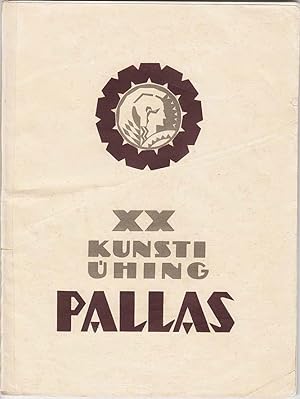
Kunstiühing Pallas : 1918-1938 : Kunstiühingu Pallase väljaanne 2 (Art Society Pallas : 1918-1938 : Art Society Pallas Publication No. 2)
Verlag: Noor-Eesti, Tartu, 1938
Anbieter: Sounds of Forest, Tallinn, Estland
Verkäuferbewertung 4 von 5 Sternen
Erstausgabe
Soft cover. Zustand: Near Fine. 1st Edition. Estonian language. Enlarged magazine format. Octavo 20 x 28 cm. Weight 200 gr. Wrappers, 37 [4] pp, [31] pp. illustration tables on coated paper. The book is in Near Fine condition without any visible defects, losses, remarks and stains. Creases across cover corners, two minor pieces of front cover right corners are broken off, some light rubbing on the back cover, broken off spine pieces are repaired; internally occasional fingerprints and frayed edges of one sheet with some minor tears. Edition financial support by Kujutava Kunsti Sihtkapital (Cultural Endowment of Estonia). Album was edited for 20th anniversary celebration of the Art Society Pallas and includes foreword by the Board and seven articles: about society beginning and goals; its development; fragments of Estonian art life; present society targets and values; Pallas significance in Estonian modern graphic art; overview of events held by society in the recent past; style problems in moderni architecture. Also attached exhibitions list organized by Pallas and list of exhibitions Pallas participated in during period 1934-1938. Album is richly illustrated with 31 full-page artwork reproductions by Nikolai Triik, Jaan Grüünberg, Eduard Wiiralt, Aleksander Bergman, Arkadio Laigo, Hando Mugasto, Kristjan Raud and many others prominent Estonian artists of the time, also it is decorated with 12 amazing graphical vignettes in the text by Hando Mugasto. Album's modernist cover design created by Arkadio Laigo. Mugasto and Laigo were the grand examples of the young Pallas students, who became notable wood engravers. The most significant pre-WWII organisation in Estonia to deal with figurative art was the Art Society Pallas established in 1918. Pallas united artists and literati, whose intellectual background was linked to the diverse European cultural experiences. Of the founders of the art society, Konrad Mägi, Ado Vabbe, Aleksander Tassa, Friedebert Tuglas and others had spent time in France, the Netherlands, Belgium, Italy, Spain, Finland, Sweden and elsewhere in Europe during the first years of the 20th century. In 1919 Art Society Pallas established the school with the same name. From autumn 1924 the art school Pallas worked as a higher educational institution. The curriculum of the Higher Art School Pallas was based on Western European art experience, influences of expressionism and constructivism are visible. Individualities emerge very clearly. Almost all great names of their time taught at Pallas: painters Konrad Mägi, Ado Vabbe, Nikolai Triik, graphic artists Eduard Wiiralt, Jaan Vahtra, Peet Aren, Ernst Kollom and Agu Peerna, sculptor Anton Starkopf, art historian Voldemar Vaga etc.
-
Eduard Viiralt [Monograph]
Verlag: Kultuurkoondis, Tallinn (Cultural Association, Tallinn), 1938
Anbieter: Sounds of Forest, Tallinn, Estland
Verkäuferbewertung 4 von 5 Sternen
Erstausgabe
Soft cover. Zustand: Fine. Zustand des Schutzumschlags: Near Fine. 1st Edition. Estonian language, summary in French. Enlarged octavo format 19 x 26 cm. Weight 250 gr. Wrappers, 63 pp., [5] illustration plates. Artwork reproductions printed on coated fine paper. The book is in Fine condition without any visible defects, losses, remarks and stains. Bottom edge of the cover shows minor fraying, very small soft creases across corners of front cover; internally minor foxing to the bottom edge of several pages. Frayed dust jacket spine ends are restored (pasted with paper strips from the inside), front cover of dust jacket shows some soiling to the bottom and left edges. In 1938 Estonian art-, literary- and theatre critic Rasmus Kangro-Pool put together the first monograph about Eduard Wiiralt (1898 1954), which is dedicated to the analysis of artist's life and work. Book is decorated throughout with amazing Wiiralt's vignettes, numerous reproductions in the text, 8 illustrations on the plates and 15 full-paged artworks reproductions printed on coated fine paper. In art history, Wiiralt is considered as the most remarkable master of Estonian graphic art in the first half of 20th century. Wiiralt received his art education at the beginning of the 20th century in Estonia (Arts and Crafts School in Tallinn and Pallas Art School in Tartu). Soon after graduating Tartu Art School he received a scholarship for studies in Paris and left Estonia in 1925. The Paris city and its night-life inspired young Wiiralt greatly and gave him the range of the themes different types of people, the scum of society, nature which he saw in expressionistic way. In 1930s Wiiralt began to acquire recognition both at home and abroad. His works were displayed at international shows of graphics. His one-man shows were arranged in Paris, Strasbourg, Amsterdam and Johannesburg. His display at the exhibition of the Creative Artists Association in Vienna in 1937 brought him a gold medal. At the end of 1930s Wiiralt made a study trip to Morocco. During this time he created a number of graphic sheets on Berber and Arabic topic. In his work Wiiralt used different methods including linocuts, copper engravings, deep-print techniques, technique of lithography. His art was thematically variegated and included abstract compositions, portraits, animals, landscapes, and compositions of natural phenomena, but focused primarily on the human form. The most well-known of artist's works include Inferno , Cabaret , Heads of Negroes , Sleeping Tiger and Head of a Camel .
-
Eduard Viiralt
Sprache: Russisch
Verlag: Kultuurkoondis, Tallin, 1938
Anbieter: Garden City Books, Herts, Vereinigtes Königreich
Verkäuferbewertung 5 von 5 Sternen
Signiert
EUR 232,56
EUR 23,16 Versand
Versand von Vereinigtes Königreich nach USAAnzahl: 1 verfügbar
In den WarenkorbSoft cover. Zustand: Very Good. Limited Edition. a very rare limited edition biography and summary of major works by Estonian Graphic artist Viiralt, of which this is copy number 187 signed by the author Kangro-Pool . 63 pages in total , of which 20 are plates of his work. previous owners inscriptions dated 1939 otherwise clean interior and all pages tight in binding. Covers are detached with one or 2 small marks to front cover. Signed by Author(s).


![Bild des Verkäufers für Eduard Viiralt [Monograph] zum Verkauf von Sounds of Forest](https://pictures.abebooks.com/inventory/md/md22592649605.jpg)
