

Gesamtpreis (1 Artikel Artikel):
Versandziel:

junger alexander (20 Ergebnisse)
Direkt zu den wichtigsten Suchergebnissen
Suchfilter
Produktart
- Alle Product Types
- Bücher (13)
- Magazine & Zeitschriften (Keine weiteren Ergebnisse entsprechen dieser Verfeinerung)
- Comics (Keine weiteren Ergebnisse entsprechen dieser Verfeinerung)
- Noten (Keine weiteren Ergebnisse entsprechen dieser Verfeinerung)
- Kunst, Grafik & Poster (7)
- Fotografien (Keine weiteren Ergebnisse entsprechen dieser Verfeinerung)
- Karten (Keine weiteren Ergebnisse entsprechen dieser Verfeinerung)
- Manuskripte & Papierantiquitäten (Keine weiteren Ergebnisse entsprechen dieser Verfeinerung)
Zustand Mehr dazu
- Neu (1)
- Wie Neu, Sehr Gut oder Gut Bis Sehr Gut (3)
- Gut oder Befriedigend (3)
- Ausreichend oder Schlecht (Keine weiteren Ergebnisse entsprechen dieser Verfeinerung)
- Wie beschrieben (13)
Einband
Weitere Eigenschaften
- Erstausgabe (4)
- Signiert (5)
- Schutzumschlag (Keine weiteren Ergebnisse entsprechen dieser Verfeinerung)
- Angebotsfoto (16)
Sprache (3)
Gratisversand
- Kostenloser Versand nach USA (Keine weiteren Ergebnisse entsprechen dieser Verfeinerung)
Land des Verkäufers
Verkäuferbewertung
-

Kleidung und Umwelt in Afrika: Eine anthropologische Studie, zugleich ein Beitrag zur Frage nach den Grundprinzipien der Tracht;
Sprache: Deutsch
Verlag: R. Voigtländer, 1926
Anbieter: books4less (Versandantiquariat Petra Gros GmbH & Co. KG), Welling, Deutschland
Verkäuferbewertung 5 von 5 Sternen

Softcover-Großformat; Zustand: Gut. 165 Seiten, 9 Karten, 10 Tafeln; Das hier angebotene Heft stammt aus einer teilaufgelösten wissenschaftlichen Bibliothek und trägt die entsprechenden Kennzeichnungen (Rückenschild, Instituts-Stempel.); Rücken geklebt, leichte altersbedingte Anbräunung des Papiers; ansonsten ordentlicher Erhaltungszustand. Sprache: Deutsch Gewicht in Gramm: 520.
-

Briefwechsel (1934-1953). Herausgegeben von Ingeborg Villinger u. Alexander Jaser.
Anbieter: Antiquariat + Verlag Klaus Breinlich, Frankfurt am Main, Deutschland
Verbandsmitglied: BOEV
Verkäuferbewertung 5 von 5 Sternen
8vo. 240 S. Originaler Verlagspappband. (Signatur auf Vorsatz, sonst sehr guter Zustand). (NP 69,95 EUR).
-

Kleidung und Umwelt in Afrika. Eine anthropogeographische Studie, zugleich ein Beitrag zur Frage nach den Grundprinzipien der Tracht.
Anbieter: Antiquariaat A. Kok & Zn. B.V., Amsterdam, Niederlande
Verkäuferbewertung 5 von 5 Sternen
Lpz., 1926. 165 pp. 9 maps, 10 plts & 2 text-ills. Softcover. (Inst. f. Völkerkunde, 8).
-

Kleidung und Umwelt in Afrika. Eine anthropogeographische Studie, zugleich ein Beitrag zur Frage nach den Grundprinzipien der Tracht. (Institut für Völkerkunde. Erste Reihe: Ethnographie und Ethnologie Achter Band)
Verlag: R. Voigtländer s Verlag, Leipzig, 1926
Anbieter: Nicoline Thieme, Leipzig, Deutschland
Verbandsmitglied: GIAQ
Verkäuferbewertung 4 von 5 Sternen

Erstausgabe
Zustand: Gut. 1. Aufl.;. 4° 165 Seiten, 9 Karten, 10 Tafeln und 2 Textabbildungen; Orig.-Broschur; 530g; [Deutsch]; Einband gering randgebräunt 1. Auflage; [lgr=T] _ xXx_. BUCH.
-

Geheime Feste Naturbetrachtungen
Anbieter: primatexxt Buchversand, München, Deutschland
Verkäuferbewertung 5 von 5 Sternen
gebundene Ausgabe. Zustand: Sehr gut. 280 Seiten Leichte äußere Mängel - Buch ist als Mängelexemplar gekennzeichnet - Buch ansonsten in sehr gutem und ungelesenem Zustand - Jeder Lieferung liegt eine ordentliche Rechnung mit ausgewiesener MwSt. bei Sprache: Deutsch Gewicht in Gramm: 480.
-
Briefwechsel Gretha Jünger und Carl Schmitt : (1934 - 1953)
Anbieter: Antiquariat Zeitenstrom, Chemnitz, Deutschland
Verkäuferbewertung 5 von 5 Sternen
Erstausgabe
240 S. Verlagsfrischer, tadelloser Zustand. Sprache: Deutsch Gewicht in Gramm: 500.
-

Kleidung und Umwelt in Afrika. Eine anthropogeographische Studie, zugleich ein Beitrag zur Frage nach dem Grundprinzipien der Tracht.
Verlag: Leipzig, R. Voigtländer Verlag 1926;, 1926
Anbieter: Antiquariat Hilbert Kadgien, Marktredwitz, Deutschland
Verkäuferbewertung 5 von 5 Sternen
EA; ca 29x20 cm; VIII, 165 (3) Seiten mit 9 Karten, 10 Tafeln und 2 Textabbildungen; Originalkartonbroschur mit Deckeltitel (Einband am Buchrücken etwas gebräunt, Name auf Reihentitelblattrückseite; sonst guter Zustand) Reihe: Staatliche Forschungsinstitut in Leipzig, Institut für Völkerkunde, Erste Reihe: Enthnographie und Ethnologie, Achter Band. Kein Versand nach Frankreich!
-

Briefwechsel 1934-1953: Hrsg. V. Ingeborg Villinger U. Alexander Jaser
Anbieter: Revaluation Books, Exeter, Vereinigtes Königreich
Verkäuferbewertung 5 von 5 Sternen
EUR 93,59
EUR 14,50 Versand
Versand von Vereinigtes Königreich nach USAAnzahl: 2 verfügbar
In den WarenkorbHardcover. Zustand: Brand New. 246 pages. German language. 9.61x6.14x0.79 inches. In Stock.
-
Kleidung und Umwelt in Afrika. Eine anthropogeographische Studie, zugleich ein Beitrag zur Frage nach den Grundprinzipien der Tracht.
Anbieter: Antiquariaat A. Kok & Zn. B.V., Amsterdam, Niederlande
Verkäuferbewertung 5 von 5 Sternen
Lpz., 1926. 165 pp. 9 maps, 10 plts & 2 text-ills. Rebound in cloth.
-

Jünger Debatte 1. Ernst Jünger und das Judentum. Herausgegeben in Verbindung mit der Ernst und Friedrich Georg Jünger Gesellschaft e.V.
Anbieter: Antiquariat carpe diem, Monika Geyer, Bocholt, Deutschland
Verkäuferbewertung 5 von 5 Sternen
Gr. 8°, 255 Seiten. mit wenigen Abbildungen. Orig.Karton. Mit Fußnoten, Verzeichnis der Schriften Jüngers in Übersetzungen und Kurzbiographien der Autoren. Beiliegender Zeitungsausschnitt über den im Buch z.T. veröffentlichten Briefwechsel zwischen Ernst Jünger und Joseph Wulf (jüdischer Historiker und Shoah-Überlebender). . - Gering bestoßen.
-

Geheime Feste : Naturbetrachtungen / Ernst Jünger ; herausgegeben, eingeleitet und kommentiert von Alexander Pschera
Sprache: Deutsch
Verlag: Stuttgart : Klett-Cotta, [2020]., 2020
ISBN 10: 360896472X ISBN 13: 9783608964721
Anbieter: Licus Media, Utting a. Ammersee, Deutschland
Verkäuferbewertung 4 von 5 Sternen
Erstausgabe
Gebundene Ausgabe. Zustand: Sehr gut. [1. Auflage]. 279 Seiten : Illustrationen ; 21 cm, 462 g Ungelesenes Remittendenexemplar mit Mängelkennzeichnung am Fußschnitt, kann leichte Lagerungsspuren aufweisen. 9783608964721 Werktäglicher Versand. Jede Lieferung m. ordentl. Rechnung und ausgew. MwSt. Der Versand erfolgt als Büchersendung / Einschreiben mit der Deutschen Post bzw. als Päckchen / Paket mit DHL. Die Lieferzeit ist abhängig von der Versandart und beträgt innerhalb Deutschlands 3-5 Tage, in der EU 5 - 12 Tage. KEIN Versand an Packstationen. Körperschaften und juristische Personen werden auf Wunsch per offener Rechnung beliefert. ***ATTENTION U.S. CUSTOMERS: Due to the new tariffs, we are unable to ship packages to the USA at this time. Thank you for understanding.*** Sprache: Deutsch Gewicht in Gramm: 462.
-

"Behemot" / Vorzeichnung für das Cover der Satire-Zeitschrift "Behemot" (Oktober 1925, Nr. 40); das Magazin erschien in Leningrad (Sankt Petersburg) zwischen 1924 und 1928. / Polizist mit Bluthund / Hund dog / Karikatur caricature / Russland Russia
Sprache: Deutsch
Verlag: Oktober 1925., 1925
Anbieter: Antiquariat Steffen Völkel GmbH, Seubersdorf, Deutschland
Verkäuferbewertung 5 von 5 Sternen
Kunst / Grafik / Poster
Original aquarellierte Tuschezeichnung von 1925. -- Blatt-Maße: ca. 34 x 26 cm. -- im Rand leicht fleckig, sonst gut erhalten. || Original drawing from 1925. -- slightly stained on the margin, otherwise in good condition. || "Behemot" was a Soviet weekly satirical magazine, published as a supplement to the "Krasnaya Gazeta". It was published from October 1924 as a continuation of the satirical magazine «Krasnyy voron» ("Red Raven"), until August 1928, when it merged with the humorous newspaper "Pushka". Between 1924 and 1926, this publication was printed on 16 pages, with one-color illustrations. From 1927 it was printed on 12 pages, with various colorful illustrations. -- The editors have worked towards expanding communication with the workers' activists. The task was set to create a magazine of real worker satire. In this way, the appearance of the magazine differed significantly from Red Raven: both externally and in terms of content. The main objects of satire were fools, bureaucrats of all stripes, bunglers, nepmen, priests, kulaks, moonshiners, swindlers, hooligans and other negative characters of Soviet reality. || Alexander Alexandrovich Jünger (aka Yunger), born in 1883, in St. Petersburg, comes from a Russified German family. His father was associated with the Richter trading company, and he had two brothers, Vladimir and Nikolai. He pursued his secondary education in Petrishul, concurrently becoming a student at the drawing school of the Society for the Encouragement of the Arts while in high school. Graduating from both institutions in 1902, he later attended the Institute of Civil Engineers, earning a gold medal upon graduation in 1914. Subsequently, Jünger augmented his education at the Academy of Arts, joining the studio of the renowned architect L. N. Benois. Due to financial constraints, he worked as an architect, staying in Benois's workshop until 1917. Evacuated to Ekaterinodar during the 1918 upheavals, he later became a teacher at the Kuban Polytechnic Institute in Krasnodar. Junger continued his architectural pursuits in the south, contributing to the development of the cities of Krasnodar and Novorossiysk. Upon returning to Leningrad in 1925, Jünger engaged in industrial structure design. He participated in numerous architectural competitions across different cities, winning prizes for 11 projects. In the late 1920s, he began teaching at the Leningrad Institute of Municipal Construction Engineers, eventually becoming a professor in 1930. In 1934, Junger assumed leadership of workshop No. 7 at the Lenproekt institute, concurrently writing articles and collaborating with the Union of Architects. His workshop focused on school projects, leading to the construction of several schools in Leningrad. Notable projects under his guidance included the hospital complex named after Mechnikov and buildings for various institutes. The outbreak of the Great Patriotic War interrupted Junger's active career. Surviving the initial siege winter, he was arrested on March 2, 1942, based on a false accusation. Although initially sentenced to death, clemency was granted, substituting the punishment with 10 years in the camps. Alexander Alexandrovich Jünger passed away on August 13, 1948. Jünger's diverse career included work as an artist, lecturer, and professor, contributing significantly to various magazines and artistic endeavors. He worked as an artist/illustrator for the magazines Sprut, Satyricon, New Satyricon (19051918), for the publishing house Modern Lubok (1917), in the group ROSTA Windows (1919), for the magazines Behemoth, Pushka ", "The Inspector General", "The Laugher" (1920s). He also participated in the creation of the first Soviet theater for children in Krasnodar (early 1920s); was engaged in the design of buildings in Voronezh, Krasnodar, Leningrad, Murmansk, Novorossiysk and other Russian cities. He was a lecturer at the Kuban Polytechnic Institute in Krasnodar (19181925). Main collections of his work are.
-
Die Häufigkeit der verschiedenen Formen der weiblichen Genitalkarzinome, ihre symptomlose Latenzzeit, Behandlungsverschleppung und Überlebenszeit
Sprache: Deutsch
Verlag: München, 1963
Anbieter: Wimbauer Buchversand, Hagen, NRW, Deutschland
Verkäuferbewertung 5 von 5 Sternen
Broschur. Zustand: Sehr gut. 45 S. mit Abb. ; 8 Extrem seltene Dissertation des Sohnes von Ernst Jünger (Das einzige Exemplar, das mir in über 25 Jahren Jüngersammeln je vor Augen kam!).- Kanten gering berieben / bestossen, papierbedingte Seitenbräunung.- Alexander Jünger hatte zeitlebens ein schwieriges Verhältnis zu seinem Vater. Er erschoss sich vor einem Bild Ernst Jüngers. /// Standort Wimregal HOM-03473 Sprache: Deutsch Gewicht in Gramm: 65.
-
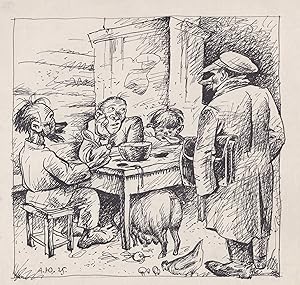
Vorzeichnung für die Satire-Zeitschrift "Behemot" (Nr. 47, 1925); das Magazin erschien in Leningrad (Sankt Petersburg) zwischen 1924 und 1928. / Bauernfamilie beim Essen / Karikatur caricature / Russland Russia
Sprache: Deutsch
Erscheinungsdatum: 1925
Anbieter: Antiquariat Steffen Völkel GmbH, Seubersdorf, Deutschland
Verkäuferbewertung 5 von 5 Sternen
Kunst / Grafik / Poster Signiert
Original Tuschezeichnung von 1925. -- Blatt-Maße: ca. 22 x 24 cm. -- gut erhalten. || Original ink drawing from 1925. -- in good condition. || "Behemot" was a Soviet weekly satirical magazine, published as a supplement to the "Krasnaya Gazeta". It was published from October 1924 as a continuation of the satirical magazine «Krasnyy voron» ("Red Raven"), until August 1928, when it merged with the humorous newspaper "Pushka". Between 1924and 1926, this publication was printed on 16 pages, with one-color illustrations. From 1927 it was printed on 12 pages, with various colorful illustrations. -- The editors have worked towards expanding communication with the workers' activists. The task was set to create a magazine of real worker satire. In this way, the appearance of the magazine differed significantly from Red Raven: both externally and in terms of content. The main objects of satire were fools, bureaucrats of all stripes, bunglers, nepmen, priests, kulaks, moonshiners, swindlers, hooligans and other negative characters of Soviet reality. || Alexander Alexandrovich Jünger (aka Yunger), born in 1883, in St. Petersburg, comes from a Russified German family. His father was associated with the Richter trading company, and he had two brothers, Vladimir and Nikolai. He pursued his secondary education in Petrishul, concurrently becoming a student at the drawing school of the Society for the Encouragement of the Arts while in high school. Graduating from both institutions in 1902, he later attended the Institute of Civil Engineers, earning a gold medal upon graduation in 1914. Subsequently, Jünger augmented his education at the Academy of Arts, joining the studio of the renowned architect L. N. Benois. Due to financial constraints, he worked as an architect, staying in Benois's workshop until 1917. Evacuated to Ekaterinodar during the 1918 upheavals, he later became a teacher at the Kuban Polytechnic Institute in Krasnodar. Junger continued his architectural pursuits in the south, contributing to the development of the cities of Krasnodar and Novorossiysk. Upon returning to Leningrad in 1925, Jünger engaged in industrial structure design. He participated in numerous architectural competitions across different cities, winning prizes for 11 projects. In the late 1920s, he began teaching at the Leningrad Institute of Municipal Construction Engineers, eventually becoming a professor in 1930. In 1934, Junger assumed leadership of workshop No. 7 at the Lenproekt institute, concurrently writing articles and collaborating with the Union of Architects. His workshop focused on school projects, leading to the construction of several schools in Leningrad. Notable projects under his guidance included the hospital complex named after Mechnikov and buildings for various institutes. The outbreak of the Great Patriotic War interrupted Junger's active career. Surviving the initial siege winter, he was arrested on March 2, 1942, based on a false accusation. Although initially sentenced to death, clemency was granted, substituting the punishment with 10 years in the camps. Alexander Alexandrovich Jünger passed away on August 13, 1948. Jünger's diverse career included work as an artist, lecturer, and professor, contributing significantly to various magazines and artistic endeavors. He worked as an artist/illustrator for the magazines Sprut, Satyricon, New Satyricon (19051918), for the publishing house Modern Lubok (1917), in the group ROSTA Windows (1919), for the magazines Behemoth, Pushka ", "The Inspector General", "The Laugher" (1920s). He also participated in the creation of the first Soviet theater for children in Krasnodar (early 1920s); was engaged in the design of buildings in Voronezh, Krasnodar, Leningrad, Murmansk, Novorossiysk and other Russian cities. He was a lecturer at the Kuban Polytechnic Institute in Krasnodar (19181925). Main collections of his work are at ROSIZO (Moscow), State Museum "Peterhof", Russian State Museum - both in St. Petersburg. // Wir, das Antiquariat Steffen Völkel, kaufen und verkaufen alte Bücher, Handschriften, Zeichnungen, Autographen, Grafiken und Fotografien. Wir sind stets am Ankauf von kompletten Bibliotheken, Sammlungen und Nachlässen interessiert. Sprache: Deutsch Gewicht in Gramm: 15.
-
O trabalhador : domínio e figura. Ernst Jünger. Introd., trad. e notas de Alexandre Franco de Sá. Pref. de Nuno Rogeiro / Biblioteca de ciênias humanas
Anbieter: Wimbauer Buchversand, Hagen, NRW, Deutschland
Verkäuferbewertung 5 von 5 Sternen
Erstausgabe
Breitklappenbroschur. Zustand: Gut. 1. ed. 271 S. ; 23 cm Selten! derzeit weltweit einziges angebotenes Exemplar.- Kanten etwas berieben / bestossen, Stempel des Verlegers oder Herausgebers "Oferta do Editor", Bleistift-Besitzeintrag /// Standort Wimregal HFT-10159 ISBN 9728310781 pt Gewicht in Gramm: 478.
-
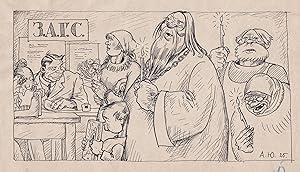
Vorzeichnung für die Satire-Zeitschrift "Behemot" (1925); das Magazin erschien in Leningrad (Sankt Petersburg) zwischen 1924 und 1928. / Hochzeitsgäste wedding guests / Karikatur caricature / Russland Russia
Sprache: Deutsch
Erscheinungsdatum: 1925
Anbieter: Antiquariat Steffen Völkel GmbH, Seubersdorf, Deutschland
Verkäuferbewertung 5 von 5 Sternen
Kunst / Grafik / Poster Signiert
Original Tuschezeichnung von 1925. -- Blatt-Maße: ca. 21 x 27 cm. -- gut erhalten. || Original ink drawing from 1925. -- in good condition. || "Behemot" was a Soviet weekly satirical magazine, published as a supplement to the "Krasnaya Gazeta". It was published from October 1924 as a continuation of the satirical magazine «Krasnyy voron» ("Red Raven"), until August 1928, when it merged with the humorous newspaper "Pushka". Between 1924and 1926, this publication was printed on 16 pages, with one-color illustrations. From 1927 it was printed on 12 pages, with various colorful illustrations. -- The editors have worked towards expanding communication with the workers' activists. The task was set to create a magazine of real worker satire. In this way, the appearance of the magazine differed significantly from Red Raven: both externally and in terms of content. The main objects of satire were fools, bureaucrats of all stripes, bunglers, nepmen, priests, kulaks, moonshiners, swindlers, hooligans and other negative characters of Soviet reality. || Alexander Alexandrovich Jünger (aka Yunger), born in 1883, in St. Petersburg, comes from a Russified German family. His father was associated with the Richter trading company, and he had two brothers, Vladimir and Nikolai. He pursued his secondary education in Petrishul, concurrently becoming a student at the drawing school of the Society for the Encouragement of the Arts while in high school. Graduating from both institutions in 1902, he later attended the Institute of Civil Engineers, earning a gold medal upon graduation in 1914. Subsequently, Jünger augmented his education at the Academy of Arts, joining the studio of the renowned architect L. N. Benois. Due to financial constraints, he worked as an architect, staying in Benois's workshop until 1917. Evacuated to Ekaterinodar during the 1918 upheavals, he later became a teacher at the Kuban Polytechnic Institute in Krasnodar. Junger continued his architectural pursuits in the south, contributing to the development of the cities of Krasnodar and Novorossiysk. Upon returning to Leningrad in 1925, Jünger engaged in industrial structure design. He participated in numerous architectural competitions across different cities, winning prizes for 11 projects. In the late 1920s, he began teaching at the Leningrad Institute of Municipal Construction Engineers, eventually becoming a professor in 1930. In 1934, Junger assumed leadership of workshop No. 7 at the Lenproekt institute, concurrently writing articles and collaborating with the Union of Architects. His workshop focused on school projects, leading to the construction of several schools in Leningrad. Notable projects under his guidance included the hospital complex named after Mechnikov and buildings for various institutes. The outbreak of the Great Patriotic War interrupted Junger's active career. Surviving the initial siege winter, he was arrested on March 2, 1942, based on a false accusation. Although initially sentenced to death, clemency was granted, substituting the punishment with 10 years in the camps. Alexander Alexandrovich Jünger passed away on August 13, 1948. Jünger's diverse career included work as an artist, lecturer, and professor, contributing significantly to various magazines and artistic endeavors. He worked as an artist/illustrator for the magazines Sprut, Satyricon, New Satyricon (19051918), for the publishing house Modern Lubok (1917), in the group ROSTA Windows (1919), for the magazines Behemoth, Pushka ", "The Inspector General", "The Laugher" (1920s). He also participated in the creation of the first Soviet theater for children in Krasnodar (early 1920s); was engaged in the design of buildings in Voronezh, Krasnodar, Leningrad, Murmansk, Novorossiysk and other Russian cities. He was a lecturer at the Kuban Polytechnic Institute in Krasnodar (19181925). Main collections of his work are at ROSIZO (Moscow), State Museum "Peterhof", Russian State Museum - both in St. Pet.
-
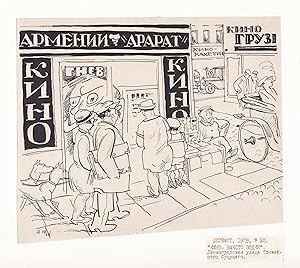
Vorzeichnung für die Satire-Zeitschrift "Behemot" (Nr. 32, 1928); das Magazin erschien in Leningrad (Sankt Petersburg) zwischen 1924 und 1928. / Kino in Leningrad Cinema / Karikatur caricature / Russland Russia
Sprache: Deutsch
Erscheinungsdatum: 1928
Anbieter: Antiquariat Steffen Völkel GmbH, Seubersdorf, Deutschland
Verkäuferbewertung 5 von 5 Sternen
Kunst / Grafik / Poster Signiert
Original Tuschezeichnung von 1928. Im Papier-Passepartout aufmontiert. -- Maße: ca. 22 x 31 cm. -- gut erhalten. || Original ink drawing from 1928. Laid down in a paper passepartout. -- in good condition. || "Behemot" was a Soviet weekly satirical magazine, published as a supplement to the "Krasnaya Gazeta". It was published from October 1924 as a continuation of the satirical magazine «Krasnyy voron» ("Red Raven"), until August 1928, when it merged with the humorous newspaper "Pushka". Between 1924and 1926, this publication was printed on 16 pages, with one-color illustrations. From 1927 it was printed on 12 pages, with various colorful illustrations. -- The editors have worked towards expanding communication with the workers' activists. The task was set to create a magazine of real worker satire. In this way, the appearance of the magazine differed significantly from Red Raven: both externally and in terms of content. The main objects of satire were fools, bureaucrats of all stripes, bunglers, nepmen, priests, kulaks, moonshiners, swindlers, hooligans and other negative characters of Soviet reality. || Alexander Alexandrovich Jünger (aka Yunger), born in 1883, in St. Petersburg, comes from a Russified German family. His father was associated with the Richter trading company, and he had two brothers, Vladimir and Nikolai. He pursued his secondary education in Petrishul, concurrently becoming a student at the drawing school of the Society for the Encouragement of the Arts while in high school. Graduating from both institutions in 1902, he later attended the Institute of Civil Engineers, earning a gold medal upon graduation in 1914. Subsequently, Jünger augmented his education at the Academy of Arts, joining the studio of the renowned architect L. N. Benois. Due to financial constraints, he worked as an architect, staying in Benois's workshop until 1917. Evacuated to Ekaterinodar during the 1918 upheavals, he later became a teacher at the Kuban Polytechnic Institute in Krasnodar. Junger continued his architectural pursuits in the south, contributing to the development of the cities of Krasnodar and Novorossiysk. Upon returning to Leningrad in 1925, Jünger engaged in industrial structure design. He participated in numerous architectural competitions across different cities, winning prizes for 11 projects. In the late 1920s, he began teaching at the Leningrad Institute of Municipal Construction Engineers, eventually becoming a professor in 1930. In 1934, Junger assumed leadership of workshop No. 7 at the Lenproekt institute, concurrently writing articles and collaborating with the Union of Architects. His workshop focused on school projects, leading to the construction of several schools in Leningrad. Notable projects under his guidance included the hospital complex named after Mechnikov and buildings for various institutes. The outbreak of the Great Patriotic War interrupted Junger's active career. Surviving the initial siege winter, he was arrested on March 2, 1942, based on a false accusation. Although initially sentenced to death, clemency was granted, substituting the punishment with 10 years in the camps. Alexander Alexandrovich Jünger passed away on August 13, 1948. Jünger's diverse career included work as an artist, lecturer, and professor, contributing significantly to various magazines and artistic endeavors. He worked as an artist/illustrator for the magazines Sprut, Satyricon, New Satyricon (19051918), for the publishing house Modern Lubok (1917), in the group ROSTA Windows (1919), for the magazines Behemoth, Pushka ", "The Inspector General", "The Laugher" (1920s). He also participated in the creation of the first Soviet theater for children in Krasnodar (early 1920s); was engaged in the design of buildings in Voronezh, Krasnodar, Leningrad, Murmansk, Novorossiysk and other Russian cities. He was a lecturer at the Kuban Polytechnic Institute in Krasnodar (19181925). Main collections of his work are at ROSIZO (Moscow).
-
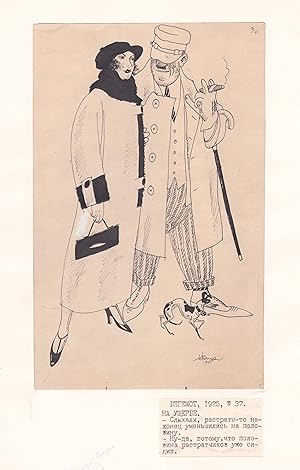
Vorzeichnung für die Satire-Zeitschrift "Behemot" (Nr. 37, 1925); das Magazin erschien in Leningrad (Sankt Petersburg) zwischen 1924 und 1928. / Industrielles Liebespaar mit Hund / Couple with dog / Art Deco / Karikatur caricature / Russland Russia
Sprache: Deutsch
Erscheinungsdatum: 1925
Anbieter: Antiquariat Steffen Völkel GmbH, Seubersdorf, Deutschland
Verkäuferbewertung 5 von 5 Sternen
Kunst / Grafik / Poster Signiert
Original Tuschezeichnung von 1925. Im Papier-Passepartout aufmontiert. -- Maße: ca. 27 x 21 cm. -- gut erhalten. || Original ink drawing from 1925. Laid down in a paper passepartout. -- in good condition. || "Behemot" was a Soviet weekly satirical magazine, published as a supplement to the "Krasnaya Gazeta". It was published from October 1924 as a continuation of the satirical magazine «Krasnyy voron» ("Red Raven"), until August 1928, when it merged with the humorous newspaper "Pushka". Between 1924and 1926, this publication was printed on 16 pages, with one-color illustrations. From 1927 it was printed on 12 pages, with various colorful illustrations. -- The editors have worked towards expanding communication with the workers' activists. The task was set to create a magazine of real worker satire. In this way, the appearance of the magazine differed significantly from Red Raven: both externally and in terms of content. The main objects of satire were fools, bureaucrats of all stripes, bunglers, nepmen, priests, kulaks, moonshiners, swindlers, hooligans and other negative characters of Soviet reality. || Alexander Alexandrovich Jünger (aka Yunger), born in 1883, in St. Petersburg, comes from a Russified German family. His father was associated with the Richter trading company, and he had two brothers, Vladimir and Nikolai. He pursued his secondary education in Petrishul, concurrently becoming a student at the drawing school of the Society for the Encouragement of the Arts while in high school. Graduating from both institutions in 1902, he later attended the Institute of Civil Engineers, earning a gold medal upon graduation in 1914. Subsequently, Jünger augmented his education at the Academy of Arts, joining the studio of the renowned architect L. N. Benois. Due to financial constraints, he worked as an architect, staying in Benois's workshop until 1917. Evacuated to Ekaterinodar during the 1918 upheavals, he later became a teacher at the Kuban Polytechnic Institute in Krasnodar. Junger continued his architectural pursuits in the south, contributing to the development of the cities of Krasnodar and Novorossiysk. Upon returning to Leningrad in 1925, Jünger engaged in industrial structure design. He participated in numerous architectural competitions across different cities, winning prizes for 11 projects. In the late 1920s, he began teaching at the Leningrad Institute of Municipal Construction Engineers, eventually becoming a professor in 1930. In 1934, Junger assumed leadership of workshop No. 7 at the Lenproekt institute, concurrently writing articles and collaborating with the Union of Architects. His workshop focused on school projects, leading to the construction of several schools in Leningrad. Notable projects under his guidance included the hospital complex named after Mechnikov and buildings for various institutes. The outbreak of the Great Patriotic War interrupted Junger's active career. Surviving the initial siege winter, he was arrested on March 2, 1942, based on a false accusation. Although initially sentenced to death, clemency was granted, substituting the punishment with 10 years in the camps. Alexander Alexandrovich Jünger passed away on August 13, 1948. Jünger's diverse career included work as an artist, lecturer, and professor, contributing significantly to various magazines and artistic endeavors. He worked as an artist/illustrator for the magazines Sprut, Satyricon, New Satyricon (19051918), for the publishing house Modern Lubok (1917), in the group ROSTA Windows (1919), for the magazines Behemoth, Pushka ", "The Inspector General", "The Laugher" (1920s). He also participated in the creation of the first Soviet theater for children in Krasnodar (early 1920s); was engaged in the design of buildings in Voronezh, Krasnodar, Leningrad, Murmansk, Novorossiysk and other Russian cities. He was a lecturer at the Kuban Polytechnic Institute in Krasnodar (19181925). Main collections of his work are at ROSIZO (Moscow).
-
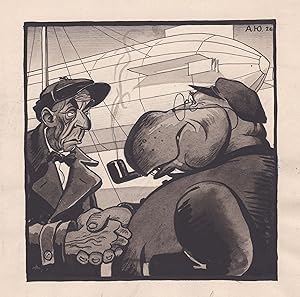
Vorzeichnung für das Cover der Satire-Zeitschrift "Behemot" (Nr. 16, 1926); das Magazin erschien in Leningrad (Sankt Petersburg) zwischen 1924 und 1928. / Zeppelin Hippo Nilpferd / Karikatur caricature / Russland Russia
Sprache: Deutsch
Erscheinungsdatum: 1926
Anbieter: Antiquariat Steffen Völkel GmbH, Seubersdorf, Deutschland
Verkäuferbewertung 5 von 5 Sternen
Kunst / Grafik / Poster Signiert
Original Tuschezeichnung von 1926. -- Blatt-Maße: ca. 30 x 25 cm. Bild: ca. 17 x 17 cm. -- im Außenrand teils leicht fleckig und mit kleinen Löchlein, sonst gut erhalten. || Original ink drawing from 1926. -- slightly stained and with small holes on the outer margin, otherwise in good condition. || "Behemot" was a Soviet weekly satirical magazine, published as a supplement to the "Krasnaya Gazeta". It was published from October 1924 as a continuation of the satirical magazine «Krasnyy voron» ("Red Raven"), until August 1928, when it merged with the humorous newspaper "Pushka". Between 1924and 1926, this publication was printed on 16 pages, with one-color illustrations. From 1927 it was printed on 12 pages, with various colorful illustrations. -- The editors have worked towards expanding communication with the workers' activists. The task was set to create a magazine of real worker satire. In this way, the appearance of the magazine differed significantly from Red Raven: both externally and in terms of content. The main objects of satire were fools, bureaucrats of all stripes, bunglers, nepmen, priests, kulaks, moonshiners, swindlers, hooligans and other negative characters of Soviet reality. ||Alexander Alexandrovich Jünger (aka Yunger), born in 1883, in St. Petersburg, comes from a Russified German family. His father was associated with the Richter trading company, and he had two brothers, Vladimir and Nikolai. He pursued his secondary education in Petrishul, concurrently becoming a student at the drawing school of the Society for the Encouragement of the Arts while in high school. Graduating from both institutions in 1902, he later attended the Institute of Civil Engineers, earning a gold medal upon graduation in 1914. Subsequently, Jünger augmented his education at the Academy of Arts, joining the studio of the renowned architect L. N. Benois. Due to financial constraints, he worked as an architect, staying in Benois's workshop until 1917. Evacuated to Ekaterinodar during the 1918 upheavals, he later became a teacher at the Kuban Polytechnic Institute in Krasnodar. Junger continued his architectural pursuits in the south, contributing to the development of the cities of Krasnodar and Novorossiysk. Upon returning to Leningrad in 1925, Jünger engaged in industrial structure design. He participated in numerous architectural competitions across different cities, winning prizes for 11 projects. In the late 1920s, he began teaching at the Leningrad Institute of Municipal Construction Engineers, eventually becoming a professor in 1930. In 1934, Junger assumed leadership of workshop No. 7 at the Lenproekt institute, concurrently writing articles and collaborating with the Union of Architects. His workshop focused on school projects, leading to the construction of several schools in Leningrad. Notable projects under his guidance included the hospital complex named after Mechnikov and buildings for various institutes. The outbreak of the Great Patriotic War interrupted Junger's active career. Surviving the initial siege winter, he was arrested on March 2, 1942, based on a false accusation. Although initially sentenced to death, clemency was granted, substituting the punishment with 10 years in the camps. Alexander Alexandrovich Jünger passed away on August 13, 1948. Jünger's diverse career included work as an artist, lecturer, and professor, contributing significantly to various magazines and artistic endeavors. He worked as an artist/illustrator for the magazines Sprut, Satyricon, New Satyricon (19051918), for the publishing house Modern Lubok (1917), in the group ROSTA Windows (1919), for the magazines Behemoth, Pushka ", "The Inspector General", "The Laugher" (1920s). He also participated in the creation of the first Soviet theater for children in Krasnodar (early 1920s); was engaged in the design of buildings in Voronezh, Krasnodar, Leningrad, Murmansk, Novorossiysk and other Russian cities. He was a lecturer at the Kuban Polytec.
-
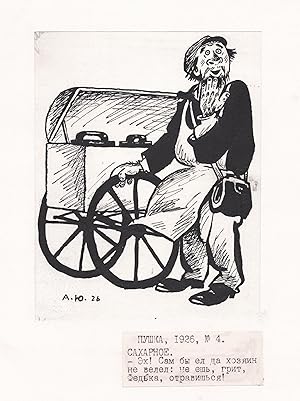
Vorzeichnung für die Satire-Zeitschrift "Pushka" (1926, Nr. 46) / Straßenverkäufer Zucker sugar street merchant vendor / Karikatur caricature / Russland Russia
Sprache: Deutsch
Erscheinungsdatum: 1926
Anbieter: Antiquariat Steffen Völkel GmbH, Seubersdorf, Deutschland
Verkäuferbewertung 5 von 5 Sternen
Kunst / Grafik / Poster
Original Tuschezeichnung von 1926. -- Blatt-Maße: ca. 17 x 17 cm. -- gut erhalten. || Original ink drawing from 1926. -- in good condition. || Alexander Alexandrovich Jünger (aka Yunger), born in 1883, in St. Petersburg, comes from a Russified German family. His father was associated with the Richter trading company, and he had two brothers, Vladimir and Nikolai. He pursued his secondary education in Petrishul, concurrently becoming a student at the drawing school of the Society for the Encouragement of the Arts while in high school. Graduating from both institutions in 1902, he later attended the Institute of Civil Engineers, earning a gold medal upon graduation in 1914. Subsequently, Jünger augmented his education at the Academy of Arts, joining the studio of the renowned architect L. N. Benois. Due to financial constraints, he worked as an architect, staying in Benois's workshop until 1917. Evacuated to Ekaterinodar during the 1918 upheavals, he later became a teacher at the Kuban Polytechnic Institute in Krasnodar. Junger continued his architectural pursuits in the south, contributing to the development of the cities of Krasnodar and Novorossiysk. Upon returning to Leningrad in 1925, Jünger engaged in industrial structure design. He participated in numerous architectural competitions across different cities, winning prizes for 11 projects. In the late 1920s, he began teaching at the Leningrad Institute of Municipal Construction Engineers, eventually becoming a professor in 1930. In 1934, Junger assumed leadership of workshop No. 7 at the Lenproekt institute, concurrently writing articles and collaborating with the Union of Architects. His workshop focused on school projects, leading to the construction of several schools in Leningrad. Notable projects under his guidance included the hospital complex named after Mechnikov and buildings for various institutes. The outbreak of the Great Patriotic War interrupted Junger's active career. Surviving the initial siege winter, he was arrested on March 2, 1942, based on a false accusation. Although initially sentenced to death, clemency was granted, substituting the punishment with 10 years in the camps. Alexander Alexandrovich Jünger passed away on August 13, 1948. Jünger's diverse career included work as an artist, lecturer, and professor, contributing significantly to various magazines and artistic endeavors. He worked as an artist/illustrator for the magazines Sprut, Satyricon, New Satyricon (19051918), for the publishing house Modern Lubok (1917), in the group ROSTA Windows (1919), for the magazines Behemoth, Pushka ", "The Inspector General", "The Laugher" (1920s). He also participated in the creation of the first Soviet theater for children in Krasnodar (early 1920s); was engaged in the design of buildings in Voronezh, Krasnodar, Leningrad, Murmansk, Novorossiysk and other Russian cities. He was a lecturer at the Kuban Polytechnic Institute in Krasnodar (19181925). Main collections of his work are at ROSIZO (Moscow), State Museum "Peterhof", Russian State Museum - both in St. Petersburg. // Wir, das Antiquariat Steffen Völkel, kaufen und verkaufen alte Bücher, Handschriften, Zeichnungen, Autographen, Grafiken und Fotografien. Wir sind stets am Ankauf von kompletten Bibliotheken, Sammlungen und Nachlässen interessiert. Sprache: Deutsch Gewicht in Gramm: 15.


