Gesamtpreis (1 Artikel Artikel):
Versandziel:

john stankovic (7 Ergebnisse)
Direkt zu den wichtigsten Suchergebnissen
Suchfilter
Produktart
- Alle Product Types
- Bücher (7)
- Magazine & Zeitschriften (Keine weiteren Ergebnisse entsprechen dieser Verfeinerung)
- Comics (Keine weiteren Ergebnisse entsprechen dieser Verfeinerung)
- Noten (Keine weiteren Ergebnisse entsprechen dieser Verfeinerung)
- Kunst, Grafik & Poster (Keine weiteren Ergebnisse entsprechen dieser Verfeinerung)
- Fotografien (Keine weiteren Ergebnisse entsprechen dieser Verfeinerung)
- Karten (Keine weiteren Ergebnisse entsprechen dieser Verfeinerung)
- Manuskripte & Papierantiquitäten (Keine weiteren Ergebnisse entsprechen dieser Verfeinerung)
Zustand Mehr dazu
- Neu (5)
- Wie Neu, Sehr Gut oder Gut Bis Sehr Gut (1)
- Gut oder Befriedigend (1)
- Ausreichend oder Schlecht (Keine weiteren Ergebnisse entsprechen dieser Verfeinerung)
- Wie beschrieben (Keine weiteren Ergebnisse entsprechen dieser Verfeinerung)
Einband
Weitere Eigenschaften
- Erstausgabe (Keine weiteren Ergebnisse entsprechen dieser Verfeinerung)
- Signiert (Keine weiteren Ergebnisse entsprechen dieser Verfeinerung)
- Schutzumschlag (Keine weiteren Ergebnisse entsprechen dieser Verfeinerung)
- Angebotsfoto (4)
Sprache (1)
Gratisversand
- Kostenloser Versand nach USA (Keine weiteren Ergebnisse entsprechen dieser Verfeinerung)
Land des Verkäufers
Verkäuferbewertung
-

Structured systems and their performance improvement through vertical migration (Computer science)
Anbieter: Zubal-Books, Since 1961, Cleveland, OH, USA
Verkäuferbewertung 5 von 5 Sternen

Zustand: Good. *Price HAS BEEN REDUCED by 10% until Monday, Jan. 26 (SALE ITEM)* 141 pp., hardcover, ex library, else text clean, tight and bright. - If you are reading this, this item is actually (physically) in our stock and ready for shipment once ordered. We are not bookjackers. Buyer is responsible for any additional duties, taxes, or fees required by recipient's country.
-
Sonderangebot
EUR 5,84
EUR 20,50 Versand
Versand von Frankreich nach USAAnzahl: 1 verfügbar
In den WarenkorbHardcover. Zustand: Bon. Ancien livre de bibliothèque. Légères traces d'usure sur la couverture. Edition 1998. Ammareal reverse jusqu'à 15% du prix net de cet article à des organisations caritatives. ENGLISH DESCRIPTION Book Condition: Used, Good. Former library book. Slight signs of wear on the cover. Edition 1998. Ammareal gives back up to 15% of this item's net price to charity organizations.
-

Deadline Scheduling for Real-Time Systems
Sprache: Englisch
Verlag: Springer US, Springer US Okt 1998, 1998
ISBN 10: 0792382692 ISBN 13: 9780792382690
Anbieter: buchversandmimpf2000, Emtmannsberg, BAYE, Deutschland
Verkäuferbewertung 5 von 5 Sternen
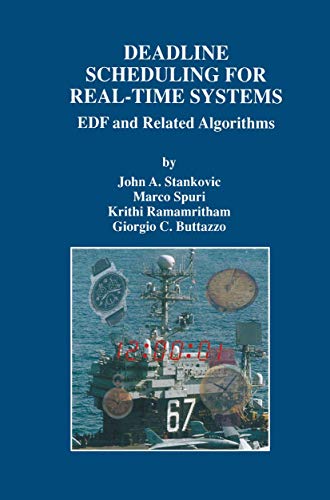
Buch. Zustand: Neu. Neuware -Many real-time systems rely on static scheduling algorithms. This includes cyclic scheduling, rate monotonic scheduling and fixed schedules created by off-line scheduling techniques such as dynamic programming, heuristic search, and simulated annealing. However, for many real-time systems, static scheduling algorithms are quite restrictive and inflexible. For example, highly automated agile manufacturing, command, control and communications, and distributed real-time multimedia applications all operate over long lifetimes and in highly non-deterministic environments. Dynamic real-time scheduling algorithms are more appropriate for these systems and are used in such systems. Many of these algorithms are based on earliest deadline first (EDF) policies. There exists a wealth of literature on EDF-based scheduling with many extensions to deal with sophisticated issues such as precedence constraints, resource requirements, system overload, multi-processors, and distributed systems.Deadline Scheduling for Real-Time Systems: EDF and Related Algorithms aims at collecting a significant body of knowledge on EDF scheduling for real-time systems, but it does not try to be all-inclusive (the literature is too extensive). The book primarily presents the algorithms and associated analysis, but guidelines, rules, and implementation considerations are also discussed, especially for the more complicated situations where mathematical analysis is difficult.In general, it is very difficult to codify and taxonomize scheduling knowledge because there are many performance metrics, task characteristics, and system configurations. Also, adding to the complexity is the fact that a variety of algorithms have been designed for different combinations of these considerations. In spite of the recent advances there are still gaps in the solution space and there is a need to integrate the available solutions. For example, a list of issues to consider includes: preemptive versus non-preemptive tasksuni-processors versus multi-processorsusing EDF at dispatch time versus EDF-based planningprecedence constraints among tasksresource constraintsperiodic versus aperiodic versus sporadic tasksscheduling during overloadfault tolerance requirements, andproviding guarantees and levels of guarantees (meeting quality of service requirements).Deadline Scheduling for Real-Time Systems: EDF and Related Algorithms should be of interest to researchers, real-time system designers, and instructors and students, either as a focussed course on deadline-based scheduling for real-time systems, or, more likely, as part of a more general course on real-time computing. The book serves as an invaluable reference in this fast-moving field.Springer Verlag GmbH, Tiergartenstr. 17, 69121 Heidelberg 294 pp. Englisch.
-

Deadline Scheduling for Real-Time Systems
Sprache: Englisch
Verlag: Springer US, Springer New York Mär 2013, 2013
ISBN 10: 1461375304 ISBN 13: 9781461375302
Anbieter: buchversandmimpf2000, Emtmannsberg, BAYE, Deutschland
Verkäuferbewertung 5 von 5 Sternen
Taschenbuch. Zustand: Neu. Neuware -Many real-time systems rely on static scheduling algorithms. This includes cyclic scheduling, rate monotonic scheduling and fixed schedules created by off-line scheduling techniques such as dynamic programming, heuristic search, and simulated annealing. However, for many real-time systems, static scheduling algorithms are quite restrictive and inflexible. For example, highly automated agile manufacturing, command, control and communications, and distributed real-time multimedia applications all operate over long lifetimes and in highly non-deterministic environments. Dynamic real-time scheduling algorithms are more appropriate for these systems and are used in such systems. Many of these algorithms are based on earliest deadline first (EDF) policies. There exists a wealth of literature on EDF-based scheduling with many extensions to deal with sophisticated issues such as precedence constraints, resource requirements, system overload, multi-processors, and distributed systems.Deadline Scheduling for Real-Time Systems: EDF and Related Algorithms aims at collecting a significant body of knowledge on EDF scheduling for real-time systems, but it does not try to be all-inclusive (the literature is too extensive). The book primarily presents the algorithms and associated analysis, but guidelines, rules, and implementation considerations are also discussed, especially for the more complicated situations where mathematical analysis is difficult.In general, it is very difficult to codify and taxonomize scheduling knowledge because there are many performance metrics, task characteristics, and system configurations. Also, adding to the complexity is the fact that a variety of algorithms have been designed for different combinations of these considerations. In spite of the recent advances there are still gaps in the solution space and there is a need to integrate the available solutions. For example, a list of issues to consider includes: preemptive versus non-preemptive tasksuni-processors versus multi-processorsusing EDF at dispatch time versus EDF-based planningprecedence constraints among tasksresource constraintsperiodic versus aperiodic versus sporadic tasksscheduling during overloadfault tolerance requirements, andproviding guarantees and levels of guarantees (meeting quality of service requirements).Deadline Scheduling for Real-Time Systems: EDF and Related Algorithms should be of interest to researchers, real-time system designers, and instructors and students, either as a focussed course on deadline-based scheduling for real-time systems, or, more likely, as part of a more general course on real-time computing. The book serves as an invaluable reference in this fast-moving field.Springer Verlag GmbH, Tiergartenstr. 17, 69121 Heidelberg 292 pp. Englisch.
-

Deadline Scheduling for Real-Time Systems : EDF and Related Algorithms
Anbieter: AHA-BUCH GmbH, Einbeck, Deutschland
Verkäuferbewertung 5 von 5 Sternen
Taschenbuch. Zustand: Neu. Druck auf Anfrage Neuware - Printed after ordering - Many real-time systems rely on static scheduling algorithms. This includes cyclic scheduling, rate monotonic scheduling and fixed schedules created by off-line scheduling techniques such as dynamic programming, heuristic search, and simulated annealing. However, for many real-time systems, static scheduling algorithms are quite restrictive and inflexible. For example, highly automated agile manufacturing, command, control and communications, and distributed real-time multimedia applications all operate over long lifetimes and in highly non-deterministic environments. Dynamic real-time scheduling algorithms are more appropriate for these systems and are used in such systems. Many of these algorithms are based on earliest deadline first (EDF) policies. There exists a wealth of literature on EDF-based scheduling with many extensions to deal with sophisticated issues such as precedence constraints, resource requirements, system overload, multi-processors, and distributed systems. Deadline Scheduling for Real-Time Systems: EDF and Related Algorithms aims at collecting a significant body of knowledge on EDF scheduling for real-time systems, but it does not try to be all-inclusive (the literature is too extensive). The book primarily presents the algorithms and associated analysis, but guidelines, rules, and implementation considerations are also discussed, especially for the more complicated situations where mathematical analysis is difficult. In general, it is very difficult to codify and taxonomize scheduling knowledge because there are many performance metrics, task characteristics, and system configurations. Also, adding to the complexity is the fact that a variety of algorithms have been designed for different combinations of these considerations. In spite of the recent advances there are still gaps in the solution space and there is a need to integrate the available solutions. For example, a list of issues to consider includes: preemptive versus non-preemptive tasks, uni-processors versus multi-processors, using EDF at dispatch time versus EDF-based planning, precedence constraints among tasks, resource constraints, periodic versus aperiodic versus sporadic tasks, scheduling during overload, fault tolerance requirements, and providing guarantees and levels of guarantees (meeting quality of service requirements). Deadline Scheduling for Real-Time Systems: EDF and Related Algorithms should be of interest to researchers, real-time system designers, and instructors and students, either as a focussed course on deadline-based scheduling for real-time systems, or, more likely, as part of a more general course on real-time computing. The book serves as an invaluable reference in this fast-moving field.
-

Deadline Scheduling for Real-Time Systems : EDF and Related Algorithms
Anbieter: AHA-BUCH GmbH, Einbeck, Deutschland
Verkäuferbewertung 5 von 5 Sternen
Buch. Zustand: Neu. Druck auf Anfrage Neuware - Printed after ordering - Many real-time systems rely on static scheduling algorithms. This includes cyclic scheduling, rate monotonic scheduling and fixed schedules created by off-line scheduling techniques such as dynamic programming, heuristic search, and simulated annealing. However, for many real-time systems, static scheduling algorithms are quite restrictive and inflexible. For example, highly automated agile manufacturing, command, control and communications, and distributed real-time multimedia applications all operate over long lifetimes and in highly non-deterministic environments. Dynamic real-time scheduling algorithms are more appropriate for these systems and are used in such systems. Many of these algorithms are based on earliest deadline first (EDF) policies. There exists a wealth of literature on EDF-based scheduling with many extensions to deal with sophisticated issues such as precedence constraints, resource requirements, system overload, multi-processors, and distributed systems. Deadline Scheduling for Real-Time Systems: EDF and Related Algorithms aims at collecting a significant body of knowledge on EDF scheduling for real-time systems, but it does not try to be all-inclusive (the literature is too extensive). The book primarily presents the algorithms and associated analysis, but guidelines, rules, and implementation considerations are also discussed, especially for the more complicated situations where mathematical analysis is difficult. In general, it is very difficult to codify and taxonomize scheduling knowledge because there are many performance metrics, task characteristics, and system configurations. Also, adding to the complexity is the fact that a variety of algorithms have been designed for different combinations of these considerations. In spite of the recent advances there are still gaps in the solution space and there is a need to integrate the available solutions. For example, a list of issues to consider includes: preemptive versus non-preemptive tasks, uni-processors versus multi-processors, using EDF at dispatch time versus EDF-based planning, precedence constraints among tasks, resource constraints, periodic versus aperiodic versus sporadic tasks, scheduling during overload, fault tolerance requirements, and providing guarantees and levels of guarantees (meeting quality of service requirements). Deadline Scheduling for Real-Time Systems: EDF and Related Algorithms should be of interest to researchers, real-time system designers, and instructors and students, either as a focussed course on deadline-based scheduling for real-time systems, or, more likely, as part of a more general course on real-time computing. The book serves as an invaluable reference in this fast-moving field.
-

Deadline Scheduling for Real-Time Systems: EDF and Related Algorithms (The Springer International Series in Engineering and Computer Science)
Anbieter: Revaluation Books, Exeter, Vereinigtes Königreich
Verkäuferbewertung 5 von 5 Sternen
EUR 231,41
EUR 11,54 Versand
Versand von Vereinigtes Königreich nach USAAnzahl: 2 verfügbar
In den WarenkorbPaperback. Zustand: Brand New. 289 pages. 9.25x6.10x0.66 inches. In Stock.