

Gesamtpreis (1 Artikel Artikel):
Versandziel:

irwin john frederick (5 Ergebnisse)
Direkt zu den wichtigsten Suchergebnissen
Suchfilter
Produktart
- Alle Product Types
- Bücher (5)
- Magazine & Zeitschriften (Keine weiteren Ergebnisse entsprechen dieser Verfeinerung)
- Comics (Keine weiteren Ergebnisse entsprechen dieser Verfeinerung)
- Noten (Keine weiteren Ergebnisse entsprechen dieser Verfeinerung)
- Kunst, Grafik & Poster (Keine weiteren Ergebnisse entsprechen dieser Verfeinerung)
- Fotografien (Keine weiteren Ergebnisse entsprechen dieser Verfeinerung)
- Karten (Keine weiteren Ergebnisse entsprechen dieser Verfeinerung)
- Manuskripte & Papierantiquitäten (Keine weiteren Ergebnisse entsprechen dieser Verfeinerung)
Zustand Mehr dazu
- Neu (Keine weiteren Ergebnisse entsprechen dieser Verfeinerung)
- Wie Neu, Sehr Gut oder Gut Bis Sehr Gut (Keine weiteren Ergebnisse entsprechen dieser Verfeinerung)
- Gut oder Befriedigend (2)
- Ausreichend oder Schlecht (Keine weiteren Ergebnisse entsprechen dieser Verfeinerung)
- Wie beschrieben (3)
Einband
Weitere Eigenschaften
- Erstausgabe (3)
- Signiert (Keine weiteren Ergebnisse entsprechen dieser Verfeinerung)
- Schutzumschlag (Keine weiteren Ergebnisse entsprechen dieser Verfeinerung)
- Angebotsfoto (5)
Sprache (1)
Preis
- Beliebiger Preis
- Weniger als EUR 20 (Keine weiteren Ergebnisse entsprechen dieser Verfeinerung)
- EUR 20 bis EUR 45
- Mehr als EUR 45
Gratisversand
- Kostenloser Versand nach USA (Keine weiteren Ergebnisse entsprechen dieser Verfeinerung)
Land des Verkäufers
Verkäuferbewertung
-

Nonsenseorship: Sundry Observations Concerning Prohibitions, Inhibitions and Illegalities
Verlag: Putnam's, New York, 1922
Anbieter: Between the Covers-Rare Books, Inc. ABAA, Gloucester City, NJ, USA
Verbandsmitglied: ABAA ESA ILAB IOBA
Verkäuferbewertung 5 von 5 Sternen

Erstausgabe
Hardcover. Zustand: Very Good. First edition. Octavo. 181pp. Gilt-stamped blue cloth. Decorative owner bookplate (William H. Johnson) and contemporary owner gift inscription on front endpapers, old bookstore label on rear fly, spine toned and cloth modestly worn, else very good. Literary spoof of the bluenoses of the era with contributions by Dorothy Parker, Ben Hecht, Heywood Broun, Alexander Woollcott and several others. Amusing illustrations of the contributors at battle with the forces of prudery by Ralph Barton.
-
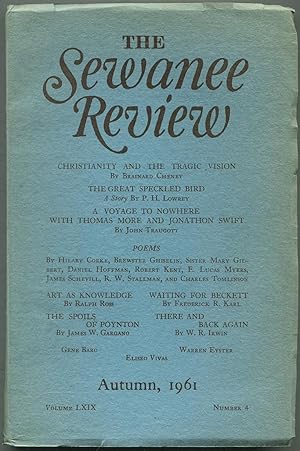
The Sewanee Review Volume LXIX, Number 4, October-December, 1961
Verlag: University of the South, Sewanee, TN, 1961
Anbieter: Between the Covers-Rare Books, Inc. ABAA, Gloucester City, NJ, USA
Verbandsmitglied: ABAA ESA ILAB IOBA
Verkäuferbewertung 5 von 5 Sternen
Erstausgabe
Softcover. Zustand: Very Good. First edition. Blue wrappers. Octavo. 515-712pp., iv. Yapped edges bumped and nicked, spine lightly cocked and sunned, very good. "A Voyage to Nowhere with Thomas More and Jonathon Swift" by John Traugott. Essays, poetry, fiction, art and letter contributions by Brainard Cheney, John Traugott, W.R. Irwin, Ralph Ross, Daniel G. Hoffman, Brewster Ghiselin, E. Lucas Myers, Hilary Corke, Charles Tomlinson, Sister Mary Gilbert, P.H. Lowrey, Robert Kent, James Schevill, R.W. Stallman, James W. Gargano, Frederick R. Karl, Eliseo Vivas, Warren Eyster, Gene Baro, Bernard Grebanier, and Charles Harrison.
-
![Bild des Verkäufers für Journal [LAICA Journal], No. 37, Volume 4 (September - October 1983) zum Verkauf von Specific Object / David Platzker](https://pictures.abebooks.com/inventory/md/md32017006509.jpg)
Journal [LAICA Journal], No. 37, Volume 4 (September - October 1983)
Verlag: Los Angeles Institute of Contemporary Art Los Angeles, CA, 1983
Anbieter: Specific Object / David Platzker, New York, NY, USA
Verkäuferbewertung 5 von 5 Sternen
72 pp.; 27.5 x 21.3 cm.; staple bound; black-and-white; edition size unknown; unsigned and unnumbered; offset-printed; September/October 1983 issue of Journal. Edited by Cindy Berry. Contents include:"Guy de Cointet, In Memorium," by unattributed artists; "History Repeats Itself, Part II," by unattributed artists; "Why I Go to the Movies Alone," by Richard Prince; "Representational Drawing Today," Phyllis Plous; "After the Revolution, Cuba in Photographs," by Emily Hicks; "Big Folks," by Suzanne Muchnic; "Is It Curtains for the T.V. Window?," by Beverly O'Neill; "The Rocket Ship Tree," by John Beach; "Gordon Wagner: Magician and Mythmaker," by Judith Hoffberg "Vortex," by unattributed artists. Cover: William Brice. Reference : "Artists' Magazines : An Alternative Space for Art" by Gwen Allen. Cambridge / London, MA / United Kingdom : The MIT Press, 2011, pp. 271. Very Good / Fine. Very light bumping of top and bottom edges of publication. Additional very light edgewear. Contents clean and unmarked.
-
![Bild des Verkäufers für Art and Technology : A Report on the Art and Technology Program of the Los Angeles County Museum of Art, 1967 - 1971 [Paperback Edition] zum Verkauf von Specific Object / David Platzker](https://pictures.abebooks.com/inventory/md/md31986443565.jpg)
Art and Technology : A Report on the Art and Technology Program of the Los Angeles County Museum of Art, 1967 - 1971 [Paperback Edition]
Verlag: Los Angeles County Museum of Art Los Angeles, CA, 1971
Anbieter: Specific Object / David Platzker, New York, NY, USA
Verkäuferbewertung 5 von 5 Sternen
387 pp.; 28.5 x 22.5 cm.; glue bound; black-and-white; edition size unknown; unsigned and unnumbered; offset-printed Exhibition catalogue and documentation of preparation for exhibition held in 1971. Large-scale book documenting the thrills and chills of when artists and scientists [or corporations] joined together by the Los Angeles County Museum of Art attempted to produce collaborative works. Amazingly self-critical of the failures [and limited success] of the program. Full documentation of each of the invited artists in narrative, blow-by-blow detail. Includes sections on Stephen Antonakos, Avigdor Arikha, Michael Asher, John Baldessari, Iain Baxter, Larry Bell, Max Bill, Ronald Bladen, George Brecht, James Byars, Greg Card, Anthony Caro, John Chamberlain, Christo, Ron Cooper, François Dallegret, Channa Davis, Ron Davis, Walter de Maria, Mark di Suvero, Jean Dubuffet, Jean Dupuy, frederick Eversley, Oyvind Fahlstrom, Dan Flavin, Sam Francis, Hans Haacke, Newton Harrison, Erich Hartmann, Robert Irwin, Donald Judd, Aleksandra Kasuba, Ellsworth Kelly, Philip King, R.B. Kitaj, Piotr Kowalski, Rockne Krebs, Wesley Duke Lee, Les Levine, Roy Lichtenstein, Len Lye, Jackson MacLow, Robert Mallary, Charles Mattox, John McCracken, Glenn McKay, Boyd Mefferd, Michael Moore, Robert Morris, Bruce Nauman, Claes Oldenburg, Jules Olitski, Eduardo Paolozzi, Otto Piene, Pulsa, Jeff Raskin, Robert Rauschenberg, Jess Reichek, Vjencenslav Richter, James Rosenquist, James Seawright, Richard Serra, Tony Smith, Robert Smithson, Karlheinz Stockhausen, Takis, Gerhard Trommer, James Turrell, Victor Vasarely, Stephan Von Huene, Peter Voulkos, Andy Warhol, Robert Watts, Martial Westburg, Robert Whitman, and William T. Wiley. Black-and-white illustrations throughout. Fair / Good. 1.6 cm. tear to top edge of recto. Significant rubbing of cover edges. 18 cm. scratch to recto. 7.5 cm., 17.6 cm., 6.5 cm., 7 cm., and 2.5 cm. creases to verso. Light soiling of text block edge. Contents clean and unmarked. Due to large size and weight additional shipping charges will be required for international orders.
-

Views in Southern Afghanistan.
Verlag: London: Vincent Brooks, Day & Son, Lith., c.1880, 1880
Anbieter: Peter Harrington. ABA/ ILAB., London, Vereinigtes Königreich
Verbandsmitglied: ABA ILAB PBFA
Verkäuferbewertung 5 von 5 Sternen
Erstausgabe
EUR 8.944,54
EUR 25,47 Versand
Versand von Vereinigtes Königreich nach USAAnzahl: 1 verfügbar
In den WarenkorbFirst and sole edition of this rare suite of plates, a fine visual record of the Second Anglo-Afghan War (1878-81), an episode in the Great Game between Britain and Russia, almost certainly printed privately for Lieutenant Irwin. An online search of institutional libraries reveals just 3 locations (British Library, Duke, and Minnesota), with only 2 copies on auction records (2004 and 1957). John Frederick Irwin passed out of RMC Sandhurst in 1866 and then served with the 59th (2nd Nottinghamshire) Regiment: ensign January 1868; lieutenant October 1871. "Captain Irwin served with the 59th Regiment in the Afghan war of 1878-80 with the Candahar Column under Sir Donald Stewart, during 1878 as Orderly Officer to Brigadier General Hughes. Took part in the advance on Khelat- i-Ghilzie and Ghuznee and in the subsequent operations in the Logar Valley; was present in the engagements at Shahjui, Ahmed Kheyl, and Urzoo near Ghuznee (mentioned in despatches, Medal with Clasp)" (Hart's Army List 1885). In 1881, under the Childers Reforms, the 59th was amalgamated with the 30th (Cambridgeshire) Foot to form the East Lancashire Regiment; while serving with this newly-formed unit, Irwin was promoted captain in September 1881, and appointed paymaster to the 2nd Battalion. The National Army Museum holds a sketchbook by Irwin, along with the original drawings for the present work; two other collections of original watercolours have passed through the auction rooms. Irwin also supplied sketches made during the war to the illustrated weekly The Graphic. During the 18th century drawing masters had been established at the military training centres at Woolwich, Chatham, High Wycombe, and Addiscombe, with the aim of instructing officer cadets in drawing and watercolour. Sandhurst, too, which Irwin attended, had such a setup, as noted in a guide of 1849: "There is a Master for Landscape drawing, and the Cadets are taught to draw from nature; there are two Military Drawing Masters, who instruct the students in the art of delineating ground with the brush and with the pen. This power, combined with the knowledge obtained under the Surveying Master, renders the élèves of this institution valuable assistants on the Quarter-Master-General's Staff". It is possible that Irwin's sketches may have been worked up by the lithographers Vincent Brooks, Day & Son, London's leading firm, a practice begun for officer-artists by Day & Son during the Crimean War. A contemporary review in The Athenaeum (12 February 1881) noted that Irwin's choice of views "are good subjects, all of which have been treated in the manner to be expected when the slight sketches of an amateur are reproduced in the offices of a London lithographer". Views in Southern Afghanistan would have been a vanity project intended for distribution among a small coterie of friends and family; and something of an engaging anachronism given that the camera had established its worth in a military context as early as the Second Anglo-Sikh War (1848-9) and the pioneering work of John McCosh. The plates comprise: Kelat-i-Ghilzai Fort Kelat-i-Ghilzai (inside main gate) City and Cantonments, Candahar Cantonment, Candahar The Bolan Pass Arghandab Valley (looking south) The Gwajur Pass Rather than stirring battle scenes, Irwin depicts placid yet mournful landscapes, capturing something of the harsh mountainous terrain of the region that made campaigning so particularly gruelling. Unsurprisingly, five of the eight plates depict two strategically important locations: the fort at Kalat-i-Ghilzai (2) and Kandahar (3); the first on the Kabul-Kandahar road, the second "at the meeting-place of two main strategic routes - from Herat to Kabul and from Herat to the Bolan Pass" (Robson, pp. 20-1). The Bolan Pass itself is described by Captain H. L. Nevill in his excellent Campaigns on the North-West Frontier (1912) as "a formidable obstacle". Irwin makes this his most animated scene, with British troops moving barefoot through a stream, a soldier pausing on a spit of sand to light his pipe, the newly-installed telegraph line visible on the left. By contrast, the forbidding Gwajur (Gwaja) pass is a desolate landscape depicted in sombre greys, a dead camel - a common sight during the war - lying by the river while vultures circle overhead. Bobins 257; not in Abbey or Tooley; Complete Guide to the Junior and Senior Departments of the Royal Military College, Sandhurst, 1849; Brian Robson, The Road to Kabul: The Second Afghan War 1878-1881, 2003. Folio. 8 coloured lithographs loose in portfolio, as issued. Original royal blue sand-grain cloth portfolio, title gilt to front cover, brown silk ties renewed. Cloth recoloured, front cover a little cockled and mildly stained, lining paper of spine relaid, plates mildly toned: a very good copy.
