

Gesamtpreis (1 Artikel Artikel):
Versandziel:

heap jane (7 Ergebnisse)
Direkt zu den wichtigsten Suchergebnissen
Suchfilter
Produktart
- Alle Product Types
- Bücher (7)
- Magazine & Zeitschriften (Keine weiteren Ergebnisse entsprechen dieser Verfeinerung)
- Comics (Keine weiteren Ergebnisse entsprechen dieser Verfeinerung)
- Noten (Keine weiteren Ergebnisse entsprechen dieser Verfeinerung)
- Kunst, Grafik & Poster (Keine weiteren Ergebnisse entsprechen dieser Verfeinerung)
- Fotografien (Keine weiteren Ergebnisse entsprechen dieser Verfeinerung)
- Karten (Keine weiteren Ergebnisse entsprechen dieser Verfeinerung)
- Manuskripte & Papierantiquitäten (Keine weiteren Ergebnisse entsprechen dieser Verfeinerung)
Zustand Mehr dazu
- Neu (Keine weiteren Ergebnisse entsprechen dieser Verfeinerung)
- Wie Neu, Sehr Gut oder Gut Bis Sehr Gut (1)
- Gut oder Befriedigend (Keine weiteren Ergebnisse entsprechen dieser Verfeinerung)
- Ausreichend oder Schlecht (Keine weiteren Ergebnisse entsprechen dieser Verfeinerung)
- Wie beschrieben (6)
Einband
Weitere Eigenschaften
- Erstausgabe (5)
- Signiert (Keine weiteren Ergebnisse entsprechen dieser Verfeinerung)
- Schutzumschlag (5)
- Angebotsfoto (7)
Sprache (1)
Preis
- Beliebiger Preis
- Weniger als EUR 20 (Keine weiteren Ergebnisse entsprechen dieser Verfeinerung)
- EUR 20 bis EUR 40
- Mehr als EUR 40
Gratisversand
Land des Verkäufers
Verkäuferbewertung
-

JANE HEAP / NOTES
Verlag: Two Rivers Press, Aurora, 2022
Anbieter: By The Way Books, Richmond, TX, USA
Verkäuferbewertung 4 von 5 Sternen

Second printing of second edition. 95 pages. Jane Heap told her pupils that when she "met the teaching in the person of G. I. Gurdjieff she turned her back on her old life, locked her studio on Long Island and painted no more." From that time in 1924 until her death in 1964, she sought to understand and apply to her own life the Gurdjieff teaching, while fulfilling significant functions in transmitting the ideas to others. After several years of work and preparation, Gurdjieff sent her to assist A.R. Orage in establishing work groups in London, and in editing Beelzebub's Tales to His Grandson.Jane Heap left no lectures, no books, only the notes she wrote down for talks to her groups on the ideas of Gurdjieff. Her legacy was an oral, living one, passed through her pupils, who marveled at her exceptionally brilliant mind and remarkable gift for exact formulation, stirring one's feeling as well as thought. As Mrs. A. L. Staveley, her pupil for some 20 years, said, "she was an artist in words as well as materials of all kinds. The precision with which an idea was presented, the fact that it appeared as a picture rather than as verbal thought, was a little shock and entered a pupil as an unforgettable impression." Peter Brook, also a pupil of Jane's, has described her as "gentle, ferocious, and compassionate," with the ability to link "the tiniest details of everyday life to the laws and forces that condition all humanity." She was known to possess a "wonderful sense of humor, a needle sharp wit, and a penchant for weighty, succinct sayings."Sometime after her death, Jane's extensive notes, all hand written, were meticulously typed by her surviving pupils in London, and a copy was sent to Mrs. Staveley at Two Rivers Farm. Selections from the notes were made in the early 1980's simultaneously in London by pupils there, and here at Two Rivers by Mrs. Staveley. The London selection was published by Two Rivers Press as The Notes of Jane Heap, and remains in print. The notes selected and edited here at Two Rivers, including a selection of "Jane Heap sayings," were first published in 1983, under the title Jane Heap / Notes, in a limited edition of 100 handset letter press copies, for private distribution. This second edition is an exact facsimile reproduction of the first edition, now published for public distribution. New cloth bound in dust jacket.
-

THE NOTES OF JANE HEAP
Verlag: Two Rivers Press, Aurora, 1994
Anbieter: By The Way Books, Richmond, TX, USA
Verkäuferbewertung 5 von 5 Sternen

Erstausgabe
First edition. 158 pages with marking ribbon. Hardbound in very good condition in a near very good dust jacket; Wear to jacket edges.
-

THE NOTES OF JANE HEAP
Verlag: Two Rivers Press, Aurora, 1994
Anbieter: By The Way Books, Richmond, TX, USA
Verkäuferbewertung 5 von 5 Sternen
Erstausgabe
First edition. From the colection of J. Walter Driscoll with original recepit laid in; 158 pages with marking ribbon. Hardbound in very good condition in a very good dust jacket.
-

JANE HEAP / NOTES
Verlag: Two Rivers Press, Aurora, 2002
Anbieter: By The Way Books, Richmond, TX, USA
Verkäuferbewertung 5 von 5 Sternen
Second edition. Walter Driscoll's copy with his sales receipt laid in; 95 pages. Jane Heap told her pupils that when she "met the teaching in the person of G. I. Gurdjieff she turned her back on her old life, locked her studio on Long Island and painted no more." From that time in 1924 until her death in 1964, she sought to understand and apply to her own life the Gurdjieff teaching, while fulfilling significant functions in transmitting the ideas to others. After several years of work and preparation, Gurdjieff sent her to assist A.R. Orage in establishing work groups in London, and in editing Beelzebub's Tales to His Grandson.Jane Heap left no lectures, no books, only the notes she wrote down for talks to her groups on the ideas of Gurdjieff. Her legacy was an oral, living one, passed through her pupils, who marveled at her exceptionally brilliant mind and remarkable gift for exact formulation, stirring one's feeling as well as thought. As Mrs. A. L. Staveley, her pupil for some 20 years, said, "she was an artist in words as well as materials of all kinds. The precision with which an idea was presented, the fact that it appeared as a picture rather than as verbal thought, was a little shock and entered a pupil as an unforgettable impression." Peter Brook, also a pupil of Jane's, has described her as "gentle, ferocious, and compassionate," with the ability to link "the tiniest details of everyday life to the laws and forces that condition all humanity." She was known to possess a "wonderful sense of humor, a needle sharp wit, and a penchant for weighty, succinct sayings."Sometime after her death, Jane's extensive notes, all hand written, were meticulously typed by her surviving pupils in London, and a copy was sent to Mrs. Staveley at Two Rivers Farm. Selections from the notes were made in the early 1980's simultaneously in London by pupils there, and here at Two Rivers by Mrs. Staveley. The London selection was published by Two Rivers Press as The Notes of Jane Heap, and remains in print. The notes selected and edited here at Two Rivers, including a selection of "Jane Heap sayings," were first published in 1983, under the title Jane Heap / Notes, in a limited edition of 100 handset letter press copies, for private distribution. This second edition is an exact facsimile reproduction of the first edition, now published for public distribution. Fine condition in a very good dust jacket.
-
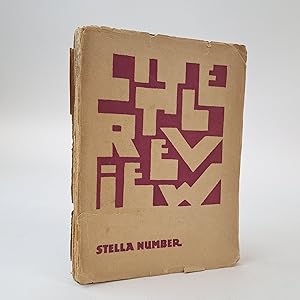
THE LITTLE REVIEW, QUARTERLY JOURNAL OF ART AND LETTERS; AUTUMN 1922
Verlag: Shakespeare and Company, Paris, 1922
Anbieter: Second Story Books, ABAA, Rockville, MD, USA
Verkäuferbewertung 4 von 5 Sternen
Erstausgabe
Hardcover. First Edition. Octavo, 62 plus 17 illustrated plates. In Fair condition. Gray and purple paper wrappers; both covers detached, complete loss of material to spine. Text block remains intact. Light age toning and heavy chipping along all edges of both covers. Age toning to text block. with moderate wear along the edges and dust soiling on the top edge. Light soiling along the fore edge of several pages and plates; page contents unaffected. Housed in a card-backed archival sleeve. Shelved in Room A. . The Autumn 1922 issue of the celebrated and influential avant-garde literary magazine The Little Review. Includes photography by Man Ray, a short piece by Gertrude Stein, and an essay by the editor Jane Heap (referred to in the magazine as "jh") reflecting on the The Little Review's past serialization of James Joyce's novel Ulysses, the subsequent obscenity trial, and the shift in public opinion after the full novel's release earlier that year. . 1403480. Special Collections.
-
THE NOTES OF JANE HEAP
Verlag: Two Rivers Press, Aurora, 1983
Anbieter: By The Way Books, Richmond, TX, USA
Verkäuferbewertung 5 von 5 Sternen
Erstausgabe
First US edition. Limited first printing of 100 copies wih marbled end papers; 158 pages. Hardbound in very good condition in a very good dust jacket; Modest wear to head of jacket spine; Some pages' fore-edge roughly cut due to binding/trimming issue.
-
THE LITTLE REVIEW [Vol. VIII, No. 1]
Verlag: Margaret Anderson, New York, 1921
Anbieter: Type Punch Matrix, Silver Spring, MD, USA
Verkäuferbewertung 5 von 5 Sternen
Erstausgabe
Zustand: Near fine. First edition. Brancusi tribute issue of the celebrated Modernist journal, published in protest after the persecution and prosecution of the editors for their publication of ULYSSES. Founded in 1914, THE LITTLE REVIEW soon gained a reputation for its experimental approach to art, literature, and politics alike. After enduring arrest and trial in 1920-1 for daring to print installments of Joyce's ULYSSES, Anderson and Heap decamped to Paris and continued to publish THE LITTLE REVIEW through the end of the decade. This issue's bold announcement: "As PROTEST against the suppression of the Little Review containing various instalments of the "ULYSSES" of JAMES JOYCE, the following artists and writers of international reputation are collaborating in the autumn number of THE LITTLE REVIEW: BRANCUSI, JEAN COCTEAU, JEAN HUGO, GUY CHARLES CROS, PAUL MORAND, FRANCIS PICABIA, EZRA POUND." Contains a full-page advertisement and order form for Sylvia Beach's own famous and then-forthcoming publication of ULYSSES. Additional contributors include Iwan Goll, Mina Loy, Kenneth Burke, Clement Pansaers, and Mary Butts. Special mention must also be made of Elsa von Freytag-Loringhoven's "Criticism of William Carlos William's 'Kora in Hell'"; context is supplied by Margaret Anderson's autobiography, which records the Baroness's "tragic spring" of unrequited love for the poet. Williams unwittingly lent false hope to Loringhoven by offering a basket of peaches in tribute to her own poems: "He brought me peaches and now he won't look at me. Not just peachesthey were ripe peaches. Are American men really so naïve as that?" 9.5'' x 7.5''. Modern quarter-bound marbled papers. Original wrappers bound in. 112 pages. Touches of shelfwear. Faint toning to pages. Else bright and clean.


![Bild des Verkäufers für THE LITTLE REVIEW [Vol. VIII, No. 1] zum Verkauf von Type Punch Matrix](https://pictures.abebooks.com/inventory/md/md32343650260.jpg)