
Haydn mackey (4 Ergebnisse)
 Weitere Bilder
Sprache: Englisch
Verlag: The Verona Society, London, 1930
- Hardcover
- Erstausgabe
Anbieter: Tarrington Books, Tarrington, HEF, Vereinigtes KönigreichTarrington Books
Verkäufer/-in kontaktierenVerkäufer/-in mit 5 SternenZustand: Gebraucht - Gut
EUR 25,39
EUR 21,13 VersandVersand von Vereinigtes Königreich nach USAAnzahl: 1 verfügbar
Zustand: Very Good. 1st Edition. Limited edition of 1000 copies. Beige buckram binding, top page edge gilt, other edges untrimmed. Browning and slight rubbing to spine. Foxing to page edges, clean text throughout. Overall condition is Very Good. Size: 6 x 9 inches (15 x 23.5 cm). Hardback. Printed pages: xxvi, 161.
 Weitere Bilder
Verlag: The Verona Society, London, 1930
- Hardcover
Anbieter: Rooke Books PBFA, Bath, Vereinigtes KönigreichRooke Books PBFA
Verkäufer/-in kontaktierenVerkäufer/-in mit 5 SternenVerbandsmitglied: PBFA
Zustand: Gebraucht - Gut
EUR 78,59
EUR 23,46 VersandVersand von Vereinigtes Königreich nach USAAnzahl: 1 verfügbar
Cloth. Zustand: Very Good. An illustrated re-print of the adventurous and enthralling novel The Unfortunate Traveller. This is a reprinted copy of Thomas Nash's novel The Unfortunate Traveller: Or the Life of Jack Wilton first published in 1594. The text has been taken from the earliest edition of The Unfortunate Traveller in th…e British Museum. Only one thousand copies of this edition have been printed and the illustrations are from blocks designed and cut by Haydn Mackey of which there are multiple throughout the text.Thomas Nash was an Elizabethan playwright, poet, satirist and pamphleteer most known for his novel The Unfortunate Traveller which is a picaresque novel that depicts Jack Wilton, a roguish but appealing hero, as he adventures through the European continent. In the publisher's original cloth binding. Externally, smart. There is some bumping to the spine. A previous owner's inscription is to the front free endpaper. Internally, firmly bound with generally bright and clean pages and the odd scattered spot throughout. Very Good. Haydn Mackey (illustrator). book.

Verlag: c, 1931
- Softcover
Anbieter: CHILTON BOOKS, SUDBURY, Vereinigtes KönigreichCHILTON BOOKS
Verkäufer/-in kontaktierenVerkäufer/-in mit 3 SternenVerbandsmitglied: PBFA
Zustand: Gebraucht
EUR 96,72
EUR 46,95 VersandVersand von Vereinigtes Königreich nach USAAnzahl: 1 verfügbar
Linocut in black and grey with additional hand colouring. 147mm x 105mm . Laid-down to verso of front board of a book. G+ ** Haydn Reynolds Mackey was a British painter and illustrator. Born in King's Lynn, Norfolk in 1883 the artist began his artistic education at the Slade School of Art in London. Mackey served as an Official…War Artist during the First World War, and was stationed with the Royal Army Medical Corps on the Western Front. The artist received great acclaim for his depiction of life during the war, his immediacy to the suffering and hardship of active soldiers imbued his work with raw emotional truth. Mackey's representation of life on the front line included scenes of domestic duties that were rarely seen. Following the War, Mackey came to be well regarded as a more commercial artist. His innovative approach to printmaking established the artist as a particularly fine illustrator. Mackey developed his own method of colour printing, whereby the artist would produce single impression linocuts printed on fine transparent sheets which were then hand painted in bold colours using oil paints. The artist used this method regularly in his work for the Mandrake Press, through which he illustrated several literary publications. The artist was also well regarded as a more traditional painter, and exhibited often in Paris, France where he was awarded a multitude of prizes at international fairs. From the 1930s onwards, Mackey taught at the Walthamstow School of Art for a significant period. The artist died in 1979. His work remains in a number of eminent collections, including those of the Imperial War Museum and the Royal Academy. The bold coloured linocuts of printmaker and book illustrator Haydn Reynolds Mackey represent an innovative departure from recognised methods of colour printmaking. Although they appear, at first sight, to be multiple colour printed linocuts on heavy wove oatmeal paper, this is not the case. They are, in fact, single impression linocuts printed in black ink on fine tracing-style tissue paper which Haydn Mackey then hand-painted and presented in a manner unique to his work. Having printed his linocut in black ink, H.R.Mackey would hand colour each proof with thick opaque oil paint on the reverse of the fine transparent printed sheet. He would then apply this hand coloured proof on to a heavy oatmeal backing paper, paint surface downward. Once the printed sheet was perfectly adhered to the backing, he would trim the edges so that both sheets appear as one. The resulting effect is for the strong oil colours to show through the transparent paper of the proof print, giving the appearance of a perfectly registered multiple colour printing of the finest and most even nature. Haydn Reynolds Mackey's prints are consistently rare, having never been published in formal editions. It is likely that the time and difficulty involved in producing each final colour print precluded the production of these prints on a commercial scale. Mackey's works of this nature remain some of the most striking linocuts produced in England at this time, outside the Grosvenor School." Source: Campbell Fine Arts and others.
 Weitere Bilder
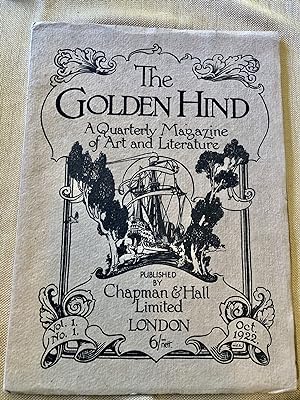
Verlag: Chapman & Hall Limited, London, 1922
- Softcover
- Erstausgabe
Anbieter: Crossroads Books, Reno, NV, USACrossroads Books
Verkäufer/-in kontaktierenVerkäufer/-in mit 5 SternenVerbandsmitglied: IOBA
Zustand: Gebraucht - Gut bis sehr gut
EUR 274,57
EUR 4,43 VersandVersand innerhalb von USAAnzahl: 1 verfügbar
Zustand: near fine. First Edition. Published October 1922. table of contents: Wagner Reconsidered: by Louis N. Parker, Port De France: Tunis Poem by Cecil French, A Third Rate Poet: By Ford Madox Hueffer, Cantares Populares: Bu Havelock Ellis, Dragon-Flies: Poem by E. L. Grant Watson, Consummation: Poem by G. M. Hort, The Earl o…f Oxford as Shakespeare: By J. Thomas Looney, Trinacria: Poem by Clifford Bax, Stripes: By Ethel Mayne, The Past: Poem by Richard Church, Praise: Poem by Peter Renny, Vagabond Death: Poem by Arthur Thrush, Reviews: By H. f. Rubinstein, Clifford Bax, R. O. Morris, E. Powys Mathers, Crossley Davies. Softcover, large folio, binding very good, pages clean, 48 pages, erratum slip for advertisement pg 2 on pg 3. Austin O. Spare, V. Voigt Alastair, John Austen, Laurence Bradshaw, E. A. Cox, Cecil French, Robert Gibbings, Winifred How, H. Hamp, A. Garth Jones, Morin-Jean, Jean Lebedeff, Stewart Marshall, Haydn Mackey, John Nash, Glyn W. Philpot, Ludovic Rodo, (illustrator).


