
Harpke (8 Ergebnisse)

Tagfalter-Monitoring Deutschland. Jahresbericht 2009 - Neuigkeiten 2010
Kühn, E., Harpke, A., Musche, M., Feldmann, R. & Hirneisen, N.
Anbieter: ConchBooks, Harxheim, DeutschlandConchBooks
Verkäufer/-in kontaktierenVerkäufer/-in mit 4 SternenZustand: Gebraucht
EUR 5,75
EUR 24,00 VersandVersand von Deutschland nach USAAnzahl: 1 verfügbar
43 pp., num. figs, stapled 8.
 Weitere Bilder
Tagfalter-Monitoring Deutschland - Jahresbericht 2021
Kühn, E., Musche, M., Harpke, A., Feldmann, R., Wiemers, M., Hirneisen, N. & Settele, J. [eds]
- Softcover
Anbieter: ConchBooks, Harxheim, DeutschlandConchBooks
Verkäufer/-in kontaktierenVerkäufer/-in mit 4 SternenZustand: Gebraucht
EUR 21,85
EUR 24,00 VersandVersand von Deutschland nach USAAnzahl: 1 verfügbar
Kühn, E., Musche, M., Harpke, A., Feldmann, R., Wiemers, M., Hirneisen, N. & Settele, J.: Tagfalter-Monitoring Deutschland: Jahresauswertung 2021. Rieger, E.: Tagfalter-Monitoring im Kaltbachtal bei Steinigtwolmsdorf / Oberlausitzer Bergland SN - 4952-01. Widder, C.: Extremsituation für Schmetterlinge in der Markgräfler Trockena…ue im Sommer 2022. Junga, W.: Transekt BY-6433-03, 18 Jahre Entwicklung und 7 Jahre Begehung voller Spannung und Freude. Ziegeler, J.: In Memoriam - der Schwarze Apollo (Parnassius mnemosyne) im Harz. Müller, M., Bader, N., Schulz, C. & Creutzburg, F.: VIA Natura 2000 - Vernetzung für Iselten in der Agrarlandschaft zwischen Natura 2000-Gebieten in Thüringen. Sofia. Pensoft. 55 pp. num. figs & tabs, br. 4.

Verbreitungsatlas der Tagfalter und Widderchen Deutschlands
Reinhardt, Rolf; Harpke, Alexander; Caspari, Steffen; Dolek, Matthias; Kühn, Elisabeth; Musche, Martin; Trusch, Robert; Wiemers, Martin; Settele, Josef
- Hardcover
Anbieter: Majestic Books, Hounslow, Vereinigtes KönigreichMajestic Books
Verkäufer/-in kontaktierenVerkäufer/-in mit 4 SternenZustand: Neu
EUR 62,02
EUR 7,65 VersandVersand von Vereinigtes Königreich nach USAAnzahl: 1 verfügbar
Zustand: New.
- Hardcover
Anbieter: Revaluation Books, Exeter, Vereinigtes KönigreichRevaluation Books
Verkäufer/-in kontaktierenVerkäufer/-in mit 5 SternenZustand: Neu
EUR 53,60
EUR 17,66 VersandVersand von Vereinigtes Königreich nach USAAnzahl: 2 verfügbar
Hardcover. Zustand: Brand New. German language. 9.61x7.09x1.34 inches. In Stock.

Verlag: MEB, Halle, 2011
- Hardcover
- Erstausgabe
Anbieter: PEMBERLEY NATURAL HISTORY BOOKS BA, ABA, Iver, Vereinigtes KönigreichPEMBERLEY NATURAL HISTORY BOOKS BA, ABA
Verkäufer/-in kontaktierenVerkäufer/-in mit 5 SternenZustand: Gebraucht - Wie neu
EUR 78,84
EUR 25,91 VersandVersand von Vereinigtes Königreich nach USAAnzahl: 1 verfügbar
Zustand: As New. 576, col distribution maps. 240x160mm. HB. Fine - as new. Updated second edition. The number of data records has almost trebled since publiction of the first edition in 2002 - the current edition is based on 650,000+ data records. Contains colour distribution maps (one per page) for all 441 European butterfly sp…ecies. A major contribution towards the advancement of our knowledge of European butterflies. [9783938249703].

- Hardcover
Anbieter: moluna, Greven, Deutschlandmoluna
Verkäufer/-in kontaktierenVerkäufer/-in mit 5 SternenZustand: Neu
EUR 49,95
EUR 48,99 VersandVersand von Deutschland nach USAAnzahl: 3 verfügbar
Zustand: New. AUTOR: Reinhardt, RolfRolf Reinhardt ist Biologe. Er befasst sich mit der faunistischen Bearbeitung von Tagfaltern sowie dem Phaenomen der Insektenwanderungen und ist Bearbeiter Roter Listen von Tagfaltern.AUTOR: Harpke, AlexanderDr. Al.
 Weitere Bilder
Verbreitungsatlas der Tagfalter und Widderchen Deutschlands
Reinhardt, R., Harpke, A., Caspari, S., Dolek, M., Kühn, E., Musche, M., Trusch, R., Wiemers, M. & Settele, J.
- Hardcover
Anbieter: ConchBooks, Harxheim, DeutschlandConchBooks
Verkäufer/-in kontaktierenVerkäufer/-in mit 4 SternenZustand: Gebraucht
EUR 53,68
EUR 24,00 VersandVersand von Deutschland nach USAAnzahl: 1 verfügbar
Wer Schmetterlinge schützen will, muss wissen, wo sie vorkommen. Die Fundmeldungen aus bestehenden Monitoringprogrammen lagen bislang jedoch nur regional vor. Erstmals führt der Atlas die Verbreitungsdaten aller 184 heimischen Tagfalter- und der 24 Widderchenarten zu einem schlüssigen Bild ihrer Gesamtverbreitung zusammen und li…efert so ein wirkungsvolles Instrument zu ihrem Schutz. Eine Einleitung beschreibt die Lebensweisen der Schmetterlinge und ihren Wert für Ökosysteme und Naturschutz und gibt Einblicke in das Monitoring. Ausführliche Porträts und lebendige Bilder stellen die Arten samt Schutz- und Gefährdungsstatus vor und zeigen ihre Verbreitung in meist ganzseitigen Karten. Stuttgart. Ulmer. 430 pp., 568 color figs, 218 distribution maps, hardcover gr. 8 [17.3 x 24 cm].
 Weitere Bilder
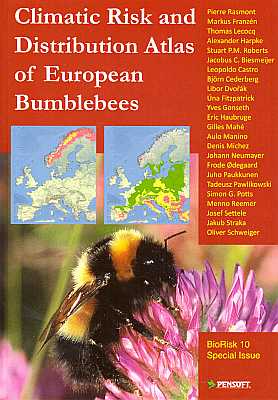
Climatic Risk and Distribution Atlas of European Bumblebees
Rasmont, P., Franzén, M., Lecocq, T., Harpke, A., Roberts, S. P. M., Biesmeijer, J. C., Castro, L., Cederberg, B., Dvo?ák, L., Fitzpatrick, U., Gonseth, Y., Haubruge, E., Mahé, G., Manino, A., Michez, D., Neumayer, J., Ødegaard, F., Paukkunen, J., Pawlikowski, T., Potts, S. G., Reemer, M., Settele, J., Straka, J. & Schweiger, O.
- Hardcover
Anbieter: ConchBooks, Harxheim, DeutschlandConchBooks
Verkäufer/-in kontaktierenVerkäufer/-in mit 4 SternenZustand: Gebraucht
EUR 66,70
EUR 24,00 VersandVersand von Deutschland nach USAAnzahl: 1 verfügbar
Bumblebees represent one of the most important groups of pollinators. In addition to their ecological and economic relevance, they are also a highly charismatic group which can help to increase the interest of people in realizing, enjoying and conserving natural systems. However, like most animals, bumblebees are sensitive to cl…imate. In Climatic Risk and Distribution Atlas of European Bumblebees, maps depicting potential risks of climate change for bumblebees are shown together with informative summary statistics, ecological background information and a picture of each European species. Thanks to the EU FP7 project STEP, the authors gathered over one million bumblebee records from all over Europe. Based on these data, they modelled the current climatic niche for almost all European species (56 species) and projected future climatically suitable conditions using three climate change scenarios for the years 2050 and 2100. While under a moderate change scenario only 3 species are projected to be at the verge of extinction by 2100, 14 species are at high risk under an intermediate change scenario. Under a most severe change scenario as many as 25 species are projected to lose almost all of their climatically suitable area, while a total of 53 species (77% of the 69 European species) would lose the main part of their suitable area. Climatic risks for bumblebees can be extremely high, depending on the future development of human society, and the corresponding effects on the climate. Strong mitigation strategies are needed to preserve this important species group and to ensure the sustainable provision of pollination services, to which they considerably contribute. Sofia, Moscow. Pensoft. 236 pp., color photos, color & b/w illustrations, color distribution maps, color tables, hardcover gr. 8 [16.7 x 23.7 cm].


