
Gubcevsky (2 Ergebnisse)
 Weitere Bilder
Verlag: Stuttgart: Verlag Julius Hoffmann, 1933 1933
- Softcover
- Erstausgabe
- Signiert
- Zeitschrift
Anbieter: °ART...on paper - 20th Century Art Books, Lugano, , Schweiz°ART...on paper - 20th Century Art Books
Verkäufer/-in kontaktierenVerkäufer/-in mit 5 SternenZustand: Gebraucht - Gut
EUR 305,80
EUR 25,00 VersandVersand von Schweiz nach USAAnzahl: 1 verfügbar
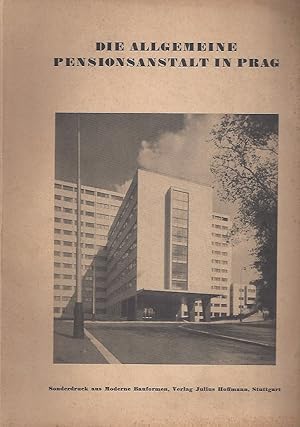
Soft cover. Zustand: Very Good. 1st Edition. 4° - 20pp - B/w Photo-reproductions (De Sandalo). General Pension Institute (Veobecný penzijní ústav) (1932) by the Architects Josef Havlicek (1899-1961). Czechoslovak avant-garde architect who vigorously promoted the ideas of CIAM and Le Corbusier. With Karel Honzík (19001966) Czech…modernist architect. Inscribed and signed by Havlicek and Honzik. First edition text in German language. Original wrappers. In very good condition. Inscribed by Author(s).
Verlag: Antonin Gubcevsky, Praha 1930
Anbieter: Földvári Books, Budapest, , UngarnFöldvári Books
Verkäufer/-in kontaktierenVerkäufer/-in mit 5 SternenZustand: Gebraucht
EUR 550,00
EUR 19,50 VersandVersand von Ungarn nach USAAnzahl: 1 verfügbar
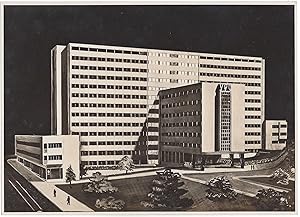
Original, black and white photograph. Original, black and white photograph. 232 × 167 mm. Czech avant-garde architects, Josef Havlicek and Karel Honzik's visual for their iconic modernist work, the building of the General Pension Institute in Prague. Josef Havlicek (18991961) and Karel Honzik (19001966) were representatives of f…unctionalist and purist architecture and were both founding members of Devetsil, the association of the Czech avant-garde artists. They designed the building of the General Pension Institute, following Le Corbusier's modernist architectural principles. ? The structure of the monumental, twelve storey building was made of reinforced concrete which allowed free design of the ground plan. It featured horizontal windows in the entire length of its facade, roof gardens, and was equipped with state-of-the-art technologies, including American air conditioning. Besides the workspaces, the complex also included meeting rooms, restaurants, cafes, shops and employees' apartments. As it was the highest building in Prague at the time of its construction it was often referred to as the first skyscraper of the city. . With the stamps of the architects, and the photographer, Gubcevsky on the verso. In fine condition.

