
French philosopher writer (27 Ergebnisse)

La nouvelle Heloise, ou lettres de deux amans, habitans d'une petite ville au pied des Alpes. Precedees de voyage a Ermenonville, de M. le Tourneur. Tome second, Tome troisieme, Tome quatrieme. [The New Heloise, or letters from two lovers, the inhabitants of a small town at the foot of the Alps] Volume 2, 3 and 4 [Three Volumes]
Rousseau, J. J. [Jean-Jacques Rousseau (28 June 1712 - 2 July 1778) was a Genevan philosopher, writer, and composer of the 18th century. His political philosophy influenced the French Revolution as well as the overall development of modern political, sociological, and educational thought].
Verlag: Published by Francois Lacombe, Libr Lausanne . Three Volumes. 51792., 1792
- Hardcover
Anbieter: Little Stour Books PBFA Member, Canterbury, Vereinigtes KönigreichLittle Stour Books PBFA Member
Verkäufer/-in kontaktierenVerkäufer/-in mit 5 SternenVerbandsmitglied: PBFA
Zustand: Gebraucht
EUR 60,14
EUR 35,03 VersandVersand von Vereinigtes Königreich nach USAAnzahl: 1 verfügbar
Uniform matching hard back binding in contemporary aqua green cloth covers, faded gilt title and author lettering to the spines. 12mo 6'' x 4''. Contents: volume II 431; volume III 387; volume IV 346. Volume I is missing, armorial bookplate inside each front end paper belonging to George Blackshaw, rubbing to the covers, hinges…still sound, text block with light foxing to the end leaves. Member of the P.B.F.A. FRANCE [Literature & History).

JULIEN BENDA (1867-1956) Professor Dr., französischer Philosoph und Schriftsteller / french philosopher and writer
JULIEN BENDA (1867-1956) Professor Dr., französischer Philosoph und Schriftsteller / french philosopher and writer
- Signiert
Anbieter: Herbst-Auktionen, Detmold, DeutschlandHerbst-Auktionen
Verkäufer/-in kontaktierenVerkäufer/-in mit 3 SternenZustand: Gebraucht
EUR 48,00
EUR 8,50 VersandVersand von Deutschland nach USAAnzahl: 1 verfügbar
Eigenhändiger Brief (Kartenbrief, 1/2 S. kl. 8 to) in violetter Tinte mit Ort, Datum, Unterschrift signiert - an Cher ami, Andre Bequnier in Le Vesinet betreffend Bouquet de Glycere Sncy, Vendredi 26.
 Weitere Bilder
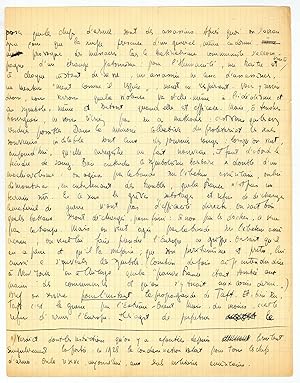
"Les communistes et la paix". Autograph manuscript (fragment).
Sartre, Jean-Paul, French philosopher and writer (1905-1980).
Verlag: No place, [1952]., 1952
- Softcover
- Manuskript
Anbieter: Antiquariat INLIBRIS Gilhofer Nfg. GmbH, Vienna, A, ÖsterreichAntiquariat INLIBRIS Gilhofer Nfg. GmbH
Verkäufer/-in kontaktierenVerkäufer/-in mit 5 SternenZustand: Gebraucht
EUR 4.500,00
EUR 30,00 VersandVersand von Österreich nach USAAnzahl: 1 verfügbar
4to. French manuscript on paper. (2) pp. on 2 ff. Interesting early manuscript of chapter I/2 of his series of articles entitled "Les communistes et la paix" that was first published in Sartre's journal "Les Temps modernes" (July 1952 - April 1954) and later in its entirety and thoroughly revised as part of the collection Situat…ions VI (1964). The original title of the chapter, "Moscou veut la guerre", sets the cynical tone of the text that was first conceived in reaction to the deadly suppression of the Paris protests against General Ridgway on 28 May 1952 and the subsequent wrongful arrest of the French communist leader Jacques Duclos. Sartre accuses Western, particularly U.S. politicians of hypocrisy as, in the name of peace, they employ the violent and belligerent means that theye ascribe to the Soviet Union, polemically asking, in a deleted section: "Do you not also pretend to desire peace? I look for your olive twigs and I see atomic bombs, I look for your doves and I see rocket planes. You say that you show your force so as not to have to make use of it. But to show force is already violence: let your tanks defile, cover the African sky with your bombers [.]". - With "Les communistes et la paix" Sartre publicly affirmed his support of the French Communist Party, despite its loyalty to Stalin, which would cause his rupture with Maurice Merleau-Ponty. In 1956, appalled by the Soviet invasion of Hungary, Sartre definitely broke with the party. Unsurprisingly, the corresponding pages in the 1964 publication Situations VI (96-97) are very different from the manuscript and the article. - Some browning and bent corners.
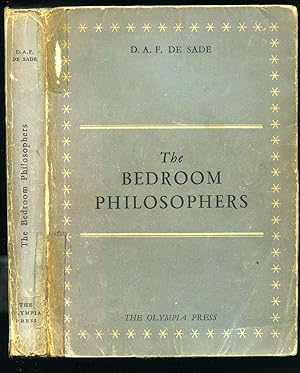
The Bedroom Philosophers | Being an English rendering of La Philosphie dans le Boudoir, done by Pieralessandro Casavini (Austryn Wainhouse).
Sade, Marquis De (D. A. F. De Sade) Donatien Alphonse François, Marquis de Sade (2 June 1740 - 2 December 1814), was a French nobleman, revolutionary politician, philosopher, and writer, famous for his libertine sexuality. The words sadism and sadist are derived from his name. [Translator Austryn Wainhouse].
Verlag: Published by The Olympia Press, 2 bis, rue des Ciseaux, Paris First thus Edition May . 1953., 1953
- Erstausgabe
Anbieter: Little Stour Books PBFA Member, Canterbury, Vereinigtes KönigreichLittle Stour Books PBFA Member
Verkäufer/-in kontaktierenVerkäufer/-in mit 5 SternenVerbandsmitglied: PBFA
Zustand: Gebraucht
EUR 102,23
EUR 35,03 VersandVersand von Vereinigtes Königreich nach USAAnzahl: 1 verfügbar
First thus edition in publisher's original decorated French Card wrap covers [soft back] over stiff card covers. 8vo. 7¼'' x 5''. First edition of this new translation by Austryn Wainhouse, masquerading as 'Pieralessandro Casavini.' One of the earliest Olympia imprints. First issue without price to bottom rear panel (Only printe…d in France) and the tail of the 'R' in 'Bedroom' extend below the text on the title page. Contains 216 printed pages of English text. Soiling to the covers, old tape shadow marks to the spine ends, ink name inside. Member of the P.B.F.A. FRANCE [Literature & History).
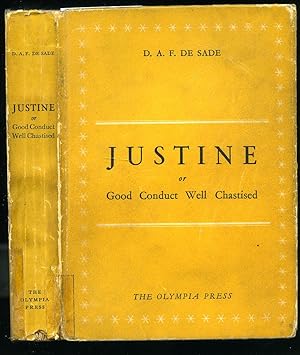
Justine or Good Conduct Well Chastised | Being an English Rendering of Justine ou les Malheurs de la Vertu done by Pieralessandro Casavini.
Sade, Marquis De (D. A. F. De Sade) Donatien Alphonse François, Marquis de Sade (2 June 1740 - 2 December 1814), was a French nobleman, revolutionary politician, philosopher, and writer, famous for his libertine sexuality. The words sadism and sadist are derived from his name.
Verlag: Published by The Olympia Press, 2 bis, rue des Ciseaux, Paris May . 1953., 1953
- Erstausgabe
Anbieter: Little Stour Books PBFA Member, Canterbury, Vereinigtes KönigreichLittle Stour Books PBFA Member
Verkäufer/-in kontaktierenVerkäufer/-in mit 5 SternenVerbandsmitglied: PBFA
Zustand: Gebraucht
EUR 102,23
EUR 35,03 VersandVersand von Vereinigtes Königreich nach USAAnzahl: 1 verfügbar
First thus edition in publisher's original decorated French card wrap covers [soft back] over stiff card covers. 8vo. 7¼'' x 5''. First edition of this new translation by Austryn Wainhouse, masquerading as 'Pieralessandro Casavini.' One of the earliest Olympia imprints. 'Printed in France / Price: 1.750 Francs' at the bottom of…the rear cover, printed May 1953 (first printing). Contains 330 printed pages of English text. Soiling to the covers, old tape shadow marks to the spine ends, ink name inside. Member of the P.B.F.A. FRANCE [Literature & History).
 Weitere Bilder
Verlag: Ferney, 8. I. 1776., 1776
- Manuskript
Anbieter: Antiquariat INLIBRIS Gilhofer Nfg. GmbH, Vienna, A, ÖsterreichAntiquariat INLIBRIS Gilhofer Nfg. GmbH
Verkäufer/-in kontaktierenVerkäufer/-in mit 5 SternenZustand: Gebraucht
EUR 28.000,00
EUR 30,00 VersandVersand von Österreich nach USAAnzahl: 1 verfügbar
4to (160 x 196 mm). 1 p. on bifolium. Unpublished in the printed correspondence, in this late letter Voltaire addresses his "cher confrère" Audibert of the Académie de Marseille, casting a local administrative change as a victory for liberty: the Pays de Gex, he writes with relish, has "devenu aussi franc que Marseille", the age…nts of the Ferme having been "délogés"; he signs with the spare authority of his final years, "V". - The declaration is immediately grounded in the material life of Ferney. Voltaire notes that Marseille has already begun to send the goods that make a winter tolerable - "huile, vins de liqueur, sucre, caffé, épiceries" - a brisk inventory that turns fiscal policy into lived experience. He then mobilises the Academy's social capital for commerce, commending to Audibert "un de nos grands négociant de Ferney" who has come to "prendre des arrangements" and who will, Voltaire hopes, benefit from his "bons offices". The letter closes in Voltaire's characteristic register of wit and fatigue, opposing the Jura's cold to the Mediterranean climate ("Ferney n'est agréable que l'été"), recalling Audibert's earlier visit as a "belle fantaisie", and signing off as "Le vieux malade de ferney". - Written when Voltaire's château functioned as both intellectual embassy and economic experiment, the note neatly shows how Enlightenment sociability - provincial academies, personal patronage, and mercantile networks - could be pressed into the service of freer circulation and local privilege. - Address on verso with seal hole, without loss of text. Otherwise well preserved. - Not in Besterman.
 Weitere Bilder
Autograph manuscript with extract from and commentary on the Political Testament of Cardinal Richelieu.
Rousseau, Jean-Jacques, French-Swiss philosopher and writer (1712-1778).
Verlag: No place, [1745-1751]., 1751
- Erstausgabe
- Manuskript
Anbieter: Antiquariat INLIBRIS Gilhofer Nfg. GmbH, Vienna, A, ÖsterreichAntiquariat INLIBRIS Gilhofer Nfg. GmbH
Verkäufer/-in kontaktierenVerkäufer/-in mit 5 SternenZustand: Gebraucht
EUR 12.500,00
EUR 30,00 VersandVersand von Österreich nach USAAnzahl: 1 verfügbar
4to (195 x 240 mm). 5 pp on 3 ff. Reflections on women's power from one of the most important thinkers of the Enlightenment, at the time working for one of France's great forerunners of feminism. Between 1745 and 1751 Rousseau was employed by Louise Dupin as a secretary and tutor to her son, and this extract and commentary seems… to have been copied on her behest, likely in connection with her work "Des femmes. Observation du préjugé commun sur la différence des sexes". - In this extract, Richelieu discusses the quarrel between Louis XIII and his mother, Marie de Médici, at first Richelieu's patron and later bitter enemy. Rousseau adds a barbed commentary on Richelieu's duplicity and dishonesty, accusing him of concealing how much power the queen actually had, and in fact entrusted him with, which he used to betray her: "Tout le monde sait, malgré ce qui est allégué ici, et les protestations du desir de l'union du Roy et de la Reine, la Reine avoit conservé beaucoup d'autorité avec laquelle elle avoit même favorisé le Cardinal [.] On trouve dans touttes les histoires les diverses disgraces que la Reine essuya, et les calamités qui accompagnérent la fin de sa vie. Il n'y a point d'honnétes gens qui puissent se les rappeler sans les imputer au Cardinal et sans lui en savoir mauvais gré". - The transcript is drawn from a 1688 edition of the "Testament Politique du Cardinal de Richelieu" (possibly the second, as the pagination cited is different from that of the first and third editions, which both appeared in the same year). In the first edition, it covers from the end of p. 7 ("Je promis [.]") to the top of p. 9 ("[.] en cet ouvrage"), followed by Rousseau's commentary ("Tout le monde sait [.]"). - A testimony to the collaboration of two of the greatest male and female thinkers of the Enlightenment. - Light edgewear consistent with age. A handsome and well-legible document.
 Weitere Bilder
Verlag: [Paris, January 1759]., 1759
- Manuskript
Anbieter: Antiquariat INLIBRIS Gilhofer Nfg. GmbH, Vienna, A, ÖsterreichAntiquariat INLIBRIS Gilhofer Nfg. GmbH
Verkäufer/-in kontaktierenVerkäufer/-in mit 5 SternenZustand: Gebraucht
EUR 35.000,00
EUR 30,00 VersandVersand von Österreich nach USAAnzahl: 1 verfügbar
8vo. 1 page on bifolium. With autograph address on verso. Remains of a red seal. To the printer of the Encyclopédie, André François Lebreton, written at a time when the first signs of censorship regarding Diderot and d'Alembert's great work were becoming evident. Diderot echoes rumours of legal proceedings that threaten the publ…ication of the Encyclopédie, discussing a recent dinner at which Germain-Louis Chauvelin, the Marquis de Grosbois (1685-1762), Secretary of State for Foreign Affairs under Louis XV, mentioned that the Encyclopédie was to be treated in Parliament the coming Friday: "Je dinais aujourd'hui chez M. Le Baron d'Holbach [i. e. Paul Henri Thiry, Baron d'Holbach, 1723-89]. Après diner, monsieur, il est venu une croix de St Louis de ses amis et des miens. Cette croix de St Louis venait de diner chez M. d'Argental où l'abbé Chauvelin s'était trouvé, et cet abbé Chauvelin avait dit que vendredi matin on agiterait au Parlement l'affaire de l'Encyclopédie, sur le rapport de M. Joly de Fleury. Avez-vous quelque connaissance de cela? J'en avais déjà entendu murmurer quelque chose. Je vous préviens afin que si vous avez des démarches à faire, vous ne les négligiez pas. J'aurai l'honneur de passer chez vous ce soir. On m'a dit que votre Rhumatisme allait mieux [.]". - At the end of the year 1758, after the publication of the seventh volume, d'Alembert decided to resign as co-director of the Encyclopédie and to stop contributing to it. From then on, the Encyclopédie, whose first volume had appeared in 1751, was in the hands of Diderot. A few months later, the publication of Helvétius's anti-religious work, "De l'Esprit", brought lightning down on the Encyclopédie. Parliament and the attorney general, Joseph-Omer Joly de Fleury, denounced Helvétius's book, the Encyclopédistes, and Diderot himself, who was suspected of heresy and of being involved with Helvétius's work. In January 1759, "De l'Esprit" was condemned by the French Parliament as well as by Pope Clement XIII to be torn and burned in public. Diderot, preparing to publish the eighth volume of the Encyclopédie, was accused by Joly de Fleury of plotting against religion and the state. On March 4th, the seven published volumes were banned, and further publication was forbidden.
 Weitere Bilder
Verlag: No place, 11 April [1781]., 1781
- Manuskript
Anbieter: Antiquariat INLIBRIS Gilhofer Nfg. GmbH, Vienna, A, ÖsterreichAntiquariat INLIBRIS Gilhofer Nfg. GmbH
Verkäufer/-in kontaktierenVerkäufer/-in mit 5 SternenZustand: Gebraucht
EUR 18.000,00
EUR 30,00 VersandVersand von Österreich nach USAAnzahl: 1 verfügbar
8vo. 1 page on bifolium. With autograph address verso. To the French artist Saint-Aubin, suspecting he has forgotten their agreement that Saint-Aubin present him with a Venus and a plate of antique gems in exchange for receiving a copy of his first printed work. He suggests Saint-Aubin hand over the Venus, well wrapped, to the b…earer of the present letter, unless he values his own work more highly than Diderot's and suspects he has struck a bad deal: "M. de Saint-Aubin a oublié qu'il y a entre lui et moi un traité. Je dois lui envoyer le premier ouvrage qu'on imprimera de moi. Lui doit m'accorder en échange une Vénus Anadyomène et sa seconde petite planche des pierres antiques. Si cet oubli vient de ce qu'il estime plus son ouvrage que le mien et de ce qu'il croit avoir fait un mauvais marché, il a raison Si ce n'est pas cela, il remettra la Vénus au proteur, bien enveloppée de manière que sa main sale et grossière ne puisse la gâter [.]". - With a handwritten pencil note by Saint-Aubin: "1781 / I sent him a Venus before the letter in February 1782" (transl.). - Tourneux, Diderot et Catherine II, 419f.
 Weitere Bilder
Autograph letter signed.
Sartre, Jean Paul, French writer and philosopher and Nobel laureate (1905-1980).
Verlag: Athens, 5 August 1937, 1937
- Manuskript
Anbieter: Kotte Autographs GmbH, Roßhaupten, DeutschlandKotte Autographs GmbH
Verkäufer/-in kontaktierenVerkäufer/-in mit 5 SternenZustand: Gebraucht
EUR 6.500,00
EUR 20,00 VersandVersand von Deutschland nach USAAnzahl: 1 verfügbar
8vo. 21 pp. With autograph envelope. Pencil. To the French theatre actress Wanda Kosakiewicz (19171989). Sartre complains at great length about not having found any letters from her at his arrival in Athens. He hopes that nothing has changed between them: "Ma chère petite Sphère, De quel nom vais je vous appeler? Je suis rentré…ce matin à Athènes vers les 5 heures du matin, je suis allé à la poste dès qu'elle a ouvert et je n'ai pas trouvé la moindre lettre de vous. [] Qu'est-ce que cela veut dire? Y a-t-il quelque chose de changé entre nous? [] A présent vous avez rompu un lien. Naturellement je continuerai à vous écrire, je ne marchande pas mes lettres. Mais je n'aurai plus le même plaisir à le faire [] Si vous n'êtes pas la dernière des dernières vous répondrez par avion au reçu de cette lettre. Je ne vous demande pas quarante pages (je pense que j'ai été assez gaulois pour vus demander de m'écrire un petit peu tous les jours et ça me fait rire) []". After that, he tells her about his trip to Greece, especially about the antique and the modern architecture: "A partir de Mykonos nous avons plus eu aucun rapport avec la Grèce antique. A peine avons nous vu [] deux colonnes à la pointe d'un cap à Naxos [] Mykonos était notre premier contact avec les curieuses petites villes des cyclades, où les maisons sont des petits cubes blanchis à la chaux [] C'était un peu amusant de voir la transformation en constructions modernes et confortables des bâtisses antiques de Mykonos. A vous qui demandez toujours «quelle sorte de gens habitent ces maisons» je crois pouvoir dire que c'étaient surtout des petits et moyens bourgeois et puis, plus haut et sur les côtes des gens plus pauvres. C'est là que c'était le plus plaisant []". - Kosakiewicz was one of Jean-Paul Sartre's love interests and Olga Kosakiewicz's sister. Sartre wrote that she was one of the reasons that his friendship with Albert Camus went sour.
 Weitere Bilder
Autograph musical manuscript signed (with his initials, "E.59 JJR. cop").
Rousseau, Jean-Jacques, French philosopher and writer (1712-1778).
Verlag: No place, 1. VI. 1777., 1777
- Manuskript
Anbieter: Antiquariat INLIBRIS Gilhofer Nfg. GmbH, Vienna, A, ÖsterreichAntiquariat INLIBRIS Gilhofer Nfg. GmbH
Verkäufer/-in kontaktierenVerkäufer/-in mit 5 SternenZustand: Gebraucht
EUR 18.000,00
EUR 30,00 VersandVersand von Österreich nach USAAnzahl: 1 verfügbar
Oblong folio. Title-page and 19 pp. of score. Sewn. A musical manuscript entitled "Che faro Senza Euridice, Aria del Sigr. Ferdinando Bertoni", each page comprising ten staves traced by hand in a pale ink. The musical notes for the aria are attractively penned in a darker ink for two parts violin ("Violini"), two parts oboe ("Ob…oe"), two parts horn ("Corni"), two parts viola ("Viole") and the voice part ("Orfeo") with lyrics penned in Rousseau's hand, the indications of movement ("Andantino", "Presto", "Andno" etc.), as well as the indications of intensity and nuance, all penned in red ink. Each measure is divided in the middle by a very light vertical pencil line. With four blank pages of staves at the conclusion, the whole tied with a small pale blue ribbon. An elegant manuscript which still retains Rousseau's light pencil annotation ("19 p. a 8S - 7L12") at the head of the title-page, indicating the price charged for this copy. - Ferdinando Bertoni (1725-1813) was an Italian composer and organist who composed 70 operas, all of which fell into oblivion with the exception of "Orfeo", which was first performed in Venice in 1776. The work was based on the same libretto for the work of Christoph Willibald Gluck entitled "Orfeo ed Euridice". The aria Rousseau copied is the most famous one of the opera; in the third act, Orfeo mourns the loss of Euridice ("Che faro senza Euridice"). - In his autobiographical work "Confessions", Volume VIII, Rousseau recounted how, in 1751, he ceased working for Dupin de Francueil and started working as a professional music copyist in order to provide a consistent and reliable source of income. In September 1770 he resumed his work as a music copyist and practiced it until 1777, charging ten sols per page. Rousseau's work as a music copyist has been described as remarkable for its beauty and reliability. - Some very light, minor staining and foxing throughout, a few small pinholes to the title-page, and one page with a small area of paper loss to the lower right corner, only very minimally affecting the manuscript.

Typed letter signed. In French.
Camus, Albert, French writer, philosopher and Nobel laureate (1913-1960).
Verlag: Paris, 2 Sept. [1955]., 1955
- Manuskript
Anbieter: Antiquariat INLIBRIS Gilhofer Nfg. GmbH, Vienna, A, ÖsterreichAntiquariat INLIBRIS Gilhofer Nfg. GmbH
Verkäufer/-in kontaktierenVerkäufer/-in mit 5 SternenZustand: Gebraucht
EUR 2.500,00
EUR 30,00 VersandVersand von Österreich nach USAAnzahl: 1 verfügbar
8vo. 1 p. To the German-American romanist Konrad Ferdinand Bieber (1916-2006), thanking him for an article that Camus will "send to [his] editor" as they are starting a "revision of the translation", in all likelihood of the 1954 English edition of "The Rebel". Camus also expresses his regret that he failed to meet Bieber in Par…is during the summer because he "quits Paris more and more often to be able to work" and asks him to announce his next visit in advance so they can arrange a meeting. In a short postscript, Camus informs Bieber that his preface to Bieber's book "has led to a brief polemic" that he will send him in order to give him an idea "of the pleasures of being a French writer". - Although Camus does not name any of the texts referenced in the letter, they are easily identified. In May 1955, Bieber published his article "The Translator - Friend or foe?" on the mixed reception of Camus's "The Rebel" in Anthony Bower's translation. Bieber's book "L'Allemagne vue par les écrivains de la Résistance française" with a preface by Camus was published in Geneva and Lille in 1954. - On stationery of Camus's publisher "Librairie Gallimard". The year "55" marked in ballpoint, probably by the recipient. Well preserved. - Cf. K. F. Bieber, "The Translator - Friend or Foe?", The French Review 28.6 (1955), pp. 493-497.
Verlag: No place or date.
- Manuskript
Anbieter: Antiquariat INLIBRIS Gilhofer Nfg. GmbH, Vienna, A, ÖsterreichAntiquariat INLIBRIS Gilhofer Nfg. GmbH
Verkäufer/-in kontaktierenVerkäufer/-in mit 5 SternenZustand: Gebraucht
EUR 18.500,00
EUR 30,00 VersandVersand von Österreich nach USAAnzahl: 1 verfügbar
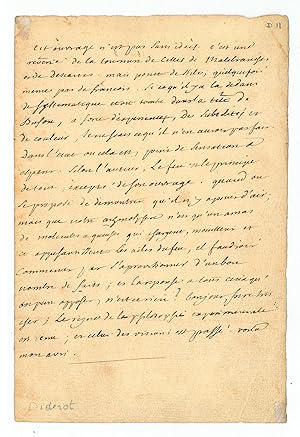
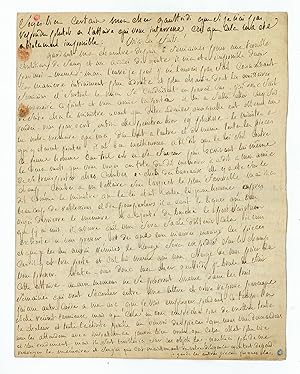
8vo. 1 page. To a friend, criticizing a philosophical work similar to those of Nicolas Malebranche and René Descartes, but lacking in style and even in correct French, wherein the author claims fire to be the main principle of everything, and the atmosphere to be nothing more than a mass of aqueous molecules which charge, moiste…n, and minimize the power of fire, without giving the proper scientific facts confirming his theory, concluding with the observation that the age of experimental philosophy has come to supersede that of visions: "Cet ouvrage n'est pas sans idées. C'est une réverie de la tournure de celles de Malebranche et de Descartes, mais point de stile, quelquefoi même pas de Français. Si ce qu'il y a là dedans de systematique etait tombé dans la tête de Bufon, à force d'expressions, De Subtilités et de couleur, je ne sais ce qu'il n'en aurait pas fait. Dans l'état où cela est, point de sensation d'espérer. Selon l'auteur, Le feu est le principe de tout, excepté de son ouvrage. Quand on se propose de demonstrer qu'il n'y a point d'air, mais que notre athmosphère n'est qu'un amas de molecules aqueuses qui chargent, mouillent et [.] appesantissent Les ailes du feu, il faudrait commencer par l'aprovisionner d'un bon nombre de faits, et la reponse à tous ceux qu'on peut apposer, n'est ce rien? [.] Le reigne de la philosophie experimentale est venu, et celui des visions est passé [.]". - With pencil attribution at the lower edge. Number 24 stamped on verso. Traces of former mounting; slightly brownstained. - Roth/Varloot, Correspondence XVI, 980.
 Weitere Bilder
Verlag: [Paris], 20 Pluviôse [20 Feb. 1796]., 1796
- Manuskript
Anbieter: Antiquariat INLIBRIS Gilhofer Nfg. GmbH, Vienna, A, ÖsterreichAntiquariat INLIBRIS Gilhofer Nfg. GmbH
Verkäufer/-in kontaktierenVerkäufer/-in mit 5 SternenZustand: Gebraucht
EUR 12.500,00
EUR 30,00 VersandVersand von Österreich nach USAAnzahl: 1 verfügbar
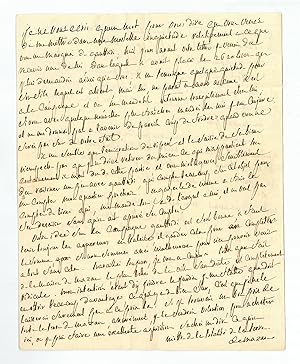
8vo. 3½ pp. on bifolium. Amicable letter to his estate administrator Gaspard-François-Xavier Gaufridy about his spending six weeks in bed with a high fever before having his "emissaire", his mistress Marie-Constance Quesnet, deliver a memoir to the minister and his "chef des bureaux" concerning the military draft of Gaufridy's s…on François. The minister indicated the possibility of a leave of absence, provided that Gaufridy deliver several documents, which de Sade encourages him to do as soon as possible: "Gardant ma chambre depuis 6 semaines pour une terrible ébulition de sang et un accès de goute, il m'a été impossible d'agir par moi-meme, mais l'eusse je pu je ne l'aurais pas fait connaisant la manière infiniment plus adroite et plus chaude dont les emissaires feminins, et surtout le mien se conduisent en pareil cas. J'ai donc fait le memoire ci joint, et mon amie l'a porté [.] chez le ministre [.] il a dit à mon amie de se transporter chez [.] le chef des bureaux [.] mais il a dit comme le ministre que la loi était contre le jeune homme [.] il vous exhorte à vous presser, et dès que vous m'auvez envoiyé les pièces et que je les lui aurai remises le congé sera expédié sur le champ [.] Hatez-vous donc mon cher Gauffridi, je brute de finir cette affaire [.]". - De Sade confirms the receipt of three parcels containing jam, candles, and oil, and gives a sketch of a curious phenomenon he observed within one oil barrel, in which the oil appears to have solidified and compressed itself into two thirds of the container's space. Further, he complains about the various kinds of jam, wishing to have kiwi, less sour flavours and fewer red jams, which his doctor forbids him to consume: "Je viens de recevoir trois ballots contenant [.] huit pots de confitures de differentes sortes [.] neuf livres de bougies, deux boites de confitures seches et deux barils d'huile [.] il est arrivé quelque chose d'assez singulier au baril d'huile à manger, la figure ci joint[e] va vous le demonstrer [.] Toute l'huile parfaitement figée s'est comprimée dans la partie b et toute cette partie b est absolument pleine [.] quant à la partie a elle est entièrement vuide [!] et c'est coupé à pan droit comme si on l'eut fait avec un couteau [.] Les confitures sont excellentes mais pourquoi point de chinois que j'aime a la folie, et pourquoi tant d'acide et de confitures rouges qui me sont positivement defendues par mon medecin [.]". - In conclusion he mentions financial affairs, including the selling of the Château de Mazan, the costs of the estate having incurred him debts of one million, and the Château de La Coste, looted during the Revolution, as well as his need of 6,000 livres to pay a loan: "Le troisième objet est la vente du château de Mazan. Vous ne voulez pas absolument entendre qu'imaginant que vous alliez vendre cet objet sur le champ j'ai toujours acheté et que me voilà maintenant chargé d'une dette d'un million [.] tirez moi donc de le mauvais par tout de suite [.]". - Small traces of red wax.
 Weitere Bilder
Verlag: [Paris], 5. X. 1793., 1793
- Manuskript
Anbieter: Antiquariat INLIBRIS Gilhofer Nfg. GmbH, Vienna, A, ÖsterreichAntiquariat INLIBRIS Gilhofer Nfg. GmbH
Verkäufer/-in kontaktierenVerkäufer/-in mit 5 SternenZustand: Gebraucht
EUR 8.500,00
EUR 30,00 VersandVersand von Österreich nach USAAnzahl: 1 verfügbar
8vo. 2 pp. on bifolium. With autograph address on verso. To Jean-Baptiste Quinquin in Avignon, who had caused him worries about obtaining a loan of 2,620 livres from his estate administrator Gaspard-François-Xavier Gaufridy, letting him know he just received the funds, certain that the emigration of his landlord Riper, as well a…s the seizing of the property, will not prevent him from retrieving what is rightfully his, and mentioning a bank account in Lyon: "Je ne vous ecris qu'un mot pour vous dire que vous venez de me mettre dans une mortelle inquiétude relativement à ce que vous me marqués de Gauffridi [.] je venois de recevoir une de lui, dans laquelle il avait placé les 2620 livres que je lui demandois ainsi qu'à vous [.] Il me semble que l'émigration de Ripert et la saisie de ses biens n'empeche pas que je ne doive retirer du mien ce qui m'appartient très certainement. Il m'est du de cette partie, et vous m'obligerés sensiblement d'en raisoner un peu avec Gauffridi qui compte beaucoup sur cet objet pour me compter mon quartier prochain. Engagés le de même à finir les comptes de Lions qui, me mande-t-on, a de l'argent à moi [.]". - About his plans to sell his property in Mazan in order to buy a house in Paris, mentioning a ridiculously low offer for the Mazan house, and concluding with a request to ask his aunt Henriette-Victoire de Sade, marquise de Villeneuve, for a loan of 40,000 francs: "L'offre qu'on fait de la maison de Mazan, la plus belle de la ville sans doute, est complètement ridicule [.] Ce qu'il y a de bien sur, c'est que je ne le laisserai surement pas à ce prix là. Si je trouvais un bon prix de toute la terre de Mazan, assurément, je le vendrois volontiers, pour acheter ici, où je puis faire une excellente acquisition [.] Je vous recommande vivement aussi mes intérêts près de ma tante, assurément il ne tient qu'a elle de me prêter la somme de quarante mille francs dont j'ai besoin [.]". - A brief autograph note by Quinquin on verso, summarizing the letter.
 Weitere Bilder
Autograph letter signed and typed letter signed.
Camus, Albert, French writer, philosopher and Nobel laureate (1913-1960).
Verlag: Paris and no place, 7 December 1956 and no date., 1956
- Manuskript
Anbieter: Antiquariat INLIBRIS Gilhofer Nfg. GmbH, Vienna, A, ÖsterreichAntiquariat INLIBRIS Gilhofer Nfg. GmbH
Verkäufer/-in kontaktierenVerkäufer/-in mit 5 SternenZustand: Gebraucht
EUR 4.500,00
EUR 30,00 VersandVersand von Österreich nach USAAnzahl: 1 verfügbar
(Oblong) 8vo. Together (1+1=) 2 pp. Both letters to the writer Georges Adam. - The handwritten letter concerns a work of Adam's (either "L'Épée dans les reins" [1947] or "Le Sang de César" [1956], both published by Gallimard) that Camus has read: "J'ai aimé votre livre, comme vous avez la gentillesse de le souhaiter, et je l'ai…aimé en manuscrit puisque je suis un de ceux qui l'ont fait prendre par Gallimard [.]" (no place or date). In the typed letter, Camus thanks Adam for participating in an event, probably in connection with the Hungarian Revolution. On 3 November a Hungarian delegation had been invited to attend negotiations on Soviet withdrawal at the Soviet Military Command at Tököl, near Budapest. Around midnight that evening, General Ivan Serov, Chief of the Soviet Security Police, ordered the arrest of the Hungarian delegation, and the following day the Soviet army attacked Budapest: "Si dure que soit l'idée de la solitude où nous avons laissé mourir les combattants hongrois, le regroupement qui s'est fait en Europe donne cependant une sorte de sens à leur combat désespéré. Il faut simplement aider la nation hongroise à vivre libre sans avoir à consentir de nouveaux et sanglants sacrifices [.]" (Paris, 7 Dec. 1956). Before writing this letter Camus had already expressed his concerns twice, first by responding to Imre Nagy's radio appeal to writers around the world on the day of the invasion, and a second time during a speech on 23 November. - Typed letter on stationery with printed letterhead of the "Librairie Gallimard".
 Weitere Bilder
Autograph letter signed.
Sartre, Jean-Paul, French writer and philosopher and Nobel laureate (1905-1980).
Verlag: n.p., 31.7.1937, 1937
- Manuskript
Anbieter: Kotte Autographs GmbH, Roßhaupten, DeutschlandKotte Autographs GmbH
Verkäufer/-in kontaktierenVerkäufer/-in mit 5 SternenZustand: Gebraucht
EUR 14.500,00
EUR 20,00 VersandVersand von Deutschland nach USAAnzahl: 1 verfügbar
8vo. 47 pp. With envelope. An incredibly long letter to the French theatre actress Wanda Kosakiewicz, in part (translated): "I left Athens yesterday for ten days of course there was nothing of you at the post office. If I do not find at least three letters on my return I will bait youI'm all hell on a piece of rock four kilomete…rs long, without a tree, without a grass, it's called DelosI only wish, lazy little sphere, that you imagine very well that it is one o'clock in the afternoon and that I write to you by a sun of melted lead, while the Beaver sleeps, rolled up in blankets on the steps of the hotelI stayed yesterday at the moonlit walk on the Acropolisthe ruins of Athens look like dilapidated monuments as a result of the negligence of the government and it is much more pleasant, we want to say every time: another superb monument that these bastards have left collapse by laziness. It does not stand on the bottom of the city, it's Athens. I suddenly felt that there was something broken in Greece forever." Four of the pages are on letterhead from a Greek hotel. In overall fine condition. Accompanied by the original mailing envelope.

Autograph manuscript Idéologie et mystification".
Sartre, Jean-Paul , French writer and philosopher and Nobel laureate (1905-1980).
Verlag: no place, no date.
- Manuskript
Anbieter: Kotte Autographs GmbH, Roßhaupten, DeutschlandKotte Autographs GmbH
Verkäufer/-in kontaktierenVerkäufer/-in mit 5 SternenZustand: Gebraucht
EUR 9.500,00
EUR 20,00 VersandVersand von Deutschland nach USAAnzahl: 1 verfügbar
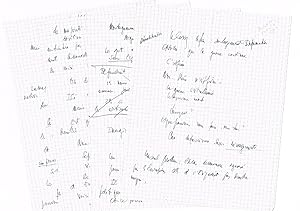
4to. 10 pp. A philosophical text with various headings, including (translated): "Ideology and Mystification," "Initiation-Baptism," and "Action and Idea." In part (translated): "So there is a kind of new society, a kind of neutral tension, of meeting in the scattering which is the union of social death and everyday life. And the…re is the elevation to a new potential. But what does it give him? All. Life. Meaning: he sees differentlyIn short, he is the otherThe other is sacred object. Social life is unhappy consciousness. Problem: how to make a metamorphosis effective. How to be for myself the Other that I am in oneself. Hegel and the tearing. Initiation: belongs to a new look. The sun: as a look. View and light: bound. Light is the view of the other. To live and to see is to participate in the vision of the other. Initiation: one wants to tear me away from a natural life that is dead and that I am in daily familiarity. That is to say, in the daily monotony of consciousness which is precisely what I want to get rid of, since it is the very symbolThe ideology as framework for the individual." Further on, Sartre evokes Marx, the societies of production, capitalist sociology and the sociology of the proletariat: "Thus the sociologyestablishes meanings in history against possible nonsense and makes absolute synthetic relations of comprehension." The last page is about human relations: "There are totalitarian essences which are nothing other than the relation of libertiesfor example: the gift. But these essences are limited by the limits that liberties impose (for example, on the possession of objects). So can we discover them only little by little and do we realize them only long after discovering them." In fine condition. Accompanied by an export certificate from the French Ministry of Culture.
 Weitere Bilder
Autograph manuscript.
Sartre, Jean-Paul, French writer and philosopher and Nobel laureate (1905-1980).
Verlag: n. p. n. d.
- Manuskript
Anbieter: Kotte Autographs GmbH, Roßhaupten, DeutschlandKotte Autographs GmbH
Verkäufer/-in kontaktierenVerkäufer/-in mit 5 SternenZustand: Gebraucht
EUR 12.500,00
EUR 20,00 VersandVersand von Deutschland nach USAAnzahl: 1 verfügbar
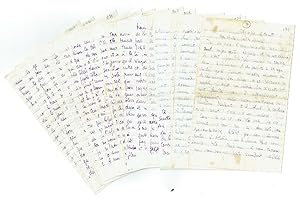
4to. 11 pp. His thoughts about Algerien. Imaginons la chose. Assemblée parlementaire. Un gouvt est pris dans une majorité pour appliquer une politique [] Est-ce possible? oui à condition de changer de majorité. Et si l'on n'en veut pas changer? Si l'on dit qu'on ne tiendra pas compte des votes de ceux qui soutiennent la nouvelle… politique [] Il y a eu des plébiscites. Naturellement. Nous en reparlerons. Mais le plébiscite après le coup d'état, c'est l'ordre que je vous propose ou le chaos [] Nous allons voter. Mais le but est clair: impressionner l'armée. Si le pays tout entier est d'accord []".
 Weitere Bilder
Autograph letter signed.
Sartre, Jean-Paul, French writer and philosopher and Nobel laureate (1905-1980).
Verlag: n.p., 12.8.1937, 1937
- Manuskript
Anbieter: Kotte Autographs GmbH, Roßhaupten, DeutschlandKotte Autographs GmbH
Verkäufer/-in kontaktierenVerkäufer/-in mit 5 SternenZustand: Gebraucht
EUR 12.500,00
EUR 20,00 VersandVersand von Deutschland nach USAAnzahl: 1 verfügbar
8vo. 52 pp. Long letter to the French theatre actress Wanda Kosakiewicz (19171989). - Kosakiewicz was one of Jean-Paul Sartre's love interests and Olga Kosakiewicz's sister. Sartre wrote that she was one of the reasons that his friendship with Albert Camus went sour.
 Weitere Bilder
Verlag: n.p., 8.9.1937, 1937
- Manuskript
Anbieter: Kotte Autographs GmbH, Roßhaupten, DeutschlandKotte Autographs GmbH
Verkäufer/-in kontaktierenVerkäufer/-in mit 5 SternenZustand: Gebraucht
EUR 6.500,00
EUR 20,00 VersandVersand von Deutschland nach USAAnzahl: 1 verfügbar
8vo. 15 pp. With envelope. Long letter to the French theatre actress Wanda Kosakiewicz (19171989). - Kosakiewicz was one of Jean-Paul Sartre's love interests and Olga Kosakiewicz's sister. Sartre wrote that she was one of the reasons that his friendship with Albert Camus went sour.
 Weitere Bilder
Autograph letter signed.
Sartre, Jean-Paul, French writer and philosopher and Nobel laureate (1905-1980).
Verlag: Thessaloniki, 28.8.1937, 1937
- Manuskript
Anbieter: Kotte Autographs GmbH, Roßhaupten, DeutschlandKotte Autographs GmbH
Verkäufer/-in kontaktierenVerkäufer/-in mit 5 SternenZustand: Gebraucht
EUR 14.500,00
EUR 20,00 VersandVersand von Deutschland nach USAAnzahl: 1 verfügbar
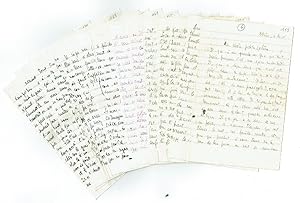
8vo. 59 pp. With envelope. Long letter to the French theatre actress Wanda Kosakiewicz (19171989). - Kosakiewicz was one of Jean-Paul Sartre's love interests and Olga Kosakiewicz's sister. Sartre wrote that she was one of the reasons that his friendship with Albert Camus went sour.
 Weitere Bilder
Autograph letter signed.
Sartre, Jean-Paul, French writer and philosopher and Nobel laureate (1905-1980).
Verlag: n.p., 6.8.1937, 1937
- Manuskript
Anbieter: Kotte Autographs GmbH, Roßhaupten, DeutschlandKotte Autographs GmbH
Verkäufer/-in kontaktierenVerkäufer/-in mit 5 SternenZustand: Gebraucht
EUR 13.500,00
EUR 20,00 VersandVersand von Deutschland nach USAAnzahl: 1 verfügbar
8vo. 60 pp. Long letter to the French theatre actress Wanda Kosakiewicz (19171989). - Kosakiewicz was one of Jean-Paul Sartre's love interests and Olga Kosakiewicz's sister. Sartre wrote that she was one of the reasons that his friendship with Albert Camus went sour.
 Weitere Bilder
Autograph letter signed.
Sartre, Jean-Paul, French writer and philosopher and Nobel laureate (1905-1980).
Verlag: Andritsaena, 16.8.1937, 1937
- Manuskript
Anbieter: Kotte Autographs GmbH, Roßhaupten, DeutschlandKotte Autographs GmbH
Verkäufer/-in kontaktierenVerkäufer/-in mit 5 SternenZustand: Gebraucht
EUR 14.500,00
EUR 20,00 VersandVersand von Deutschland nach USAAnzahl: 1 verfügbar
4to. 34 pp. Long letter to the French theatre actress Wanda Kosakiewicz (19171989). - Kosakiewicz was one of Jean-Paul Sartre's love interests and Olga Kosakiewicz's sister. Sartre wrote that she was one of the reasons that his friendship with Albert Camus went sour.
 Weitere Bilder
Autograph letter signed.
Sartre, Jean-Paul, French writer and philosopher and Nobel laureate (1905-1980).
Verlag: n.p., 26.8.1937, 1937
- Manuskript
Anbieter: Kotte Autographs GmbH, Roßhaupten, DeutschlandKotte Autographs GmbH
Verkäufer/-in kontaktierenVerkäufer/-in mit 5 SternenZustand: Gebraucht
EUR 12.500,00
EUR 20,00 VersandVersand von Deutschland nach USAAnzahl: 1 verfügbar
4to. 22 pp. Long letter to the French theatre actress Wanda Kosakiewicz (19171989). - Kosakiewicz was one of Jean-Paul Sartre's love interests and Olga Kosakiewicz's sister. Sartre wrote that she was one of the reasons that his friendship with Albert Camus went sour.
 Weitere Bilder
Autograph letter signed.
Sartre, Jean-Paul, French writer and philosopher and Nobel laureate (1905-1980).
Verlag: Marseille, 20 July 1937, 1937
- Manuskript
Anbieter: Kotte Autographs GmbH, Roßhaupten, DeutschlandKotte Autographs GmbH
Verkäufer/-in kontaktierenVerkäufer/-in mit 5 SternenZustand: Gebraucht
EUR 8.500,00
EUR 20,00 VersandVersand von Deutschland nach USAAnzahl: 1 verfügbar
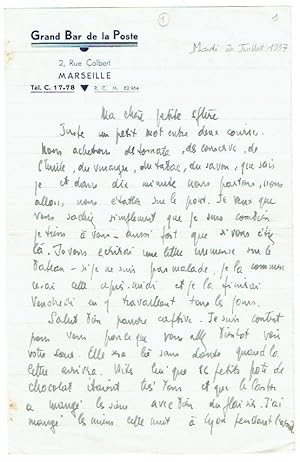
8vo. 1 1/2 pp. Hotel letterhead. To the French theatre actress Wanda Kosakiewicz (19171989), during a shopping trip where Jean-Paul Sartre was buying provisions. He assures Wanda of his affection, promises her a much longer letter, and asks her to thank her sister for the chocolate:"Just a quick note between two errands. We are…buying tomatoes, canned goods, oil, vinegar, tobacco, soapwho knows what elseand in ten minutes, we are leaving. We are going to settle on the bridge. I just want you to know that I am fully aware of how much I care about youas much as if you were here. I will write you a long letter on the boatif I am not seasick, I will start it this afternoon and finish it by Friday, working on it every day.Farewell, my poor captive. I am happy for you because you will soon see your sister. She will probably be there when this letter arrives. Tell her that the little chocolate jars were excellent and that Castor (Simone de Beauvoir) ate hers with great pleasure. I ate mine last night in Lyon [].Do not send your letters by air. It seems they get lost. By boat, they take eight days. Write to me often. Sending you my regards."Kosakiewicz was one of Jean-Paul Sartre's love interests and the sister of Olga Kosakiewicz. Sartre later wrote that she was one of the reasons his friendship with Albert Camus deteriorated.

Autograph letter signed.
Boyer, Marquis d'Argens, Jean-Baptiste de, French writer and philosopher (1703-1771).
Verlag: N. p. o. d.
- Signiert
- Manuskript
Anbieter: Kotte Autographs GmbH, Roßhaupten, DeutschlandKotte Autographs GmbH
Verkäufer/-in kontaktierenVerkäufer/-in mit 5 SternenZustand: Gebraucht
EUR 2.000,00
EUR 20,00 VersandVersand von Deutschland nach USAAnzahl: 1 verfügbar
1 p. 4to. Mon cher Monsieur, j'étais sur le point de me porter à merveille lorsque mon chirurgien s'avise de me donner une médecine qui depuis six jours m'a remis sur le grabat. Je conte (sic) avec l'aide d'un médecin qui répare le mal du chirurgien être en état de sortit dans quatre ou cinq jours. Ma première visite sera chez v…ous, et nous règlerons la partie dont vous me parlez, qui me flate intimement ; en attendant je vous prie d'agréer mes respects à son excellence : et de me croire avec une respectueuse considération, votre très humble et très obeissant serviteur, [signé] le marquis d'argens.


