

Gesamtpreis (1 Artikel Artikel):
Versandziel:

finlay jones robert (4 Ergebnisse)
Direkt zu den wichtigsten Suchergebnissen
Suchfilter
Produktart
- Alle Product Types
- Bücher (4)
- Magazine & Zeitschriften (Keine weiteren Ergebnisse entsprechen dieser Verfeinerung)
- Comics (Keine weiteren Ergebnisse entsprechen dieser Verfeinerung)
- Noten (Keine weiteren Ergebnisse entsprechen dieser Verfeinerung)
- Kunst, Grafik & Poster (Keine weiteren Ergebnisse entsprechen dieser Verfeinerung)
- Fotografien (Keine weiteren Ergebnisse entsprechen dieser Verfeinerung)
- Karten (Keine weiteren Ergebnisse entsprechen dieser Verfeinerung)
- Manuskripte & Papierantiquitäten (Keine weiteren Ergebnisse entsprechen dieser Verfeinerung)
Zustand Mehr dazu
- Neu (Keine weiteren Ergebnisse entsprechen dieser Verfeinerung)
- Wie Neu, Sehr Gut oder Gut Bis Sehr Gut (2)
- Gut oder Befriedigend (Keine weiteren Ergebnisse entsprechen dieser Verfeinerung)
- Ausreichend oder Schlecht (Keine weiteren Ergebnisse entsprechen dieser Verfeinerung)
- Wie beschrieben (2)
Einband
- alle Einbände
- Hardcover (Keine weiteren Ergebnisse entsprechen dieser Verfeinerung)
- Softcover (4)
Weitere Eigenschaften
- Erstausgabe (2)
- Signiert (Keine weiteren Ergebnisse entsprechen dieser Verfeinerung)
- Schutzumschlag (Keine weiteren Ergebnisse entsprechen dieser Verfeinerung)
- Angebotsfoto (3)
Sprache (2)
Gratisversand
- Kostenloser Versand nach USA (Keine weiteren Ergebnisse entsprechen dieser Verfeinerung)
Land des Verkäufers
Verkäuferbewertung
-

Great Science Fiction Magazine #1 (1965) [Great Science Fiction from Amazing Stories]
Verlag: Ultimate Publishing, 1965
Anbieter: Books From California, Simi Valley, CA, USA
Verkäuferbewertung 4 von 5 Sternen

paperback. Zustand: Fine.
-

Model, The : Selected Writings of Kenneth Seaforth McKenzie
Sprache: Englisch
Verlag: University of Western Australia Press, 2000
ISBN 10: 1876268344 ISBN 13: 9781876268343
Anbieter: Elizabeth's Bookshops, Fremantle, WA, Australien
Verkäuferbewertung 4 von 5 Sternen
Erstausgabe
Softcover. Zustand: Fine. WEST AUSTRALIANA LITERARY Kenneth (Seaforth) Mackenzie was an Australian poet and novelist. In August 1944 he witnessed the Japanese break-out at the Cowra prisoner of war camp, which became the subject of his third novel, Dead Men Rising.Kenneth Ivo Brownley Langwell (Seaforth) Mackenzie (1913-1955), poet and novelist, was born on 25 September 1913 in South Perth, son of Australian-born parents Hugh Mackenzie, farmer, and his wife Marguerite Christina, nà e Pryde-Paterson. After his parents were divorced in 1919, Kenneth was raised by his mother and maternal grandfather. Educated at South Perth and Pinjarra state schools, and (as a boarder) at Guildford Grammar School, he took no interest in sport and studied only when he felt inclined. At 16 he ran away from school and refused to return. Finding Muresk Agricultural College even more uncongenial than boarding school, he entered the University of Western Australia in 1932 to read law. He gained a reputation for spasmodic brilliance and eccentricity, and left before the end of his first year.Following occasional employment as a journalist on theÂWest Australian, Mackenzie travelled to Melbourne in 1933. In the height of the Depression he took a job as a scullery-assistant and survived on the charity of his father's sisters. He moved to Sydney in the following year. There he reviewed books, films and drama for theÂSydney Morning Herald, wrote forÂFox Movietone NewsÂand contributed toÂSmith's Weekly, through which he metÂKenneth Slessor. ImpressingÂNorman Lindsay, he was admitted to his Bohemian circle: wherever Mackenzie was, 'wild comedy and wild adventures tended to break out'. He was strong, muscular and blonde, and immensely attractive to certain women. On 24 December 1934 at the registrar general's office, Sydney, he married Kathleen Bartlett, nà e Loveday; born in England, she was a 25-year-old widow who had taken a job as a pastry-cook.His first novel,ÂThe Young Desire It, was published (1937) under the pseudonym 'Seaforth' Mackenzie by Jonathan Cape in London; sensitive, vital and erotic, it was to win the Australian Literary Society's prize in 1939. A sense of moral ambiguity and impending chaos, evident in Mackenzie's second novel,ÂChosen PeopleÂ(London, 1938), began to invade his own life as he became addicted to alcohol. The outbreak of World War II destroyed what vague plans he had to make a name as a writer in England. Mobilized in the Australian Military Forces, he began full-time duty on 8 April 1943, but was rejected for active service because of poor eyesight. Mackenzie was posted to the 22nd Garrison Battalion at Cowra prisoner-of-war camp. In August 1944 he witnessed the Japanese break-out, the subject of his third novel,ÂDead Men RisingÂ(New York, 1951). Two collections of his poetry were published in his lifetime,ÂOur EarthÂ(Sydney, 1937) andÂThe Moonlit DoorwayÂ(Sydney, 1944). Medically unfit, he was discharged from the army on 11 June 1945. His drinking habits (claret with breakfast) and lack of qualifications meant that he was virtually unemployable. ix, 237 p. : ports. ; 21 cm. #010923 Includes bibliographical references: p. 233-35. First Edition Mackenzie, Kenneth, 1913-1955 Australian prose literature Australian poetry Elizabeth's Bookshops have been one of Australia's premier independent book dealers since 1973. Elizabeth's family-owned business operates four branches in Perth CBD, Fremantle (WA), and Newtown (NSW). All orders are dispatched within 24 hours from our Fremantle Warehouse. All items can be viewed at Elizabeth's Bookshop Warehouse, 23 Queen Victoria Street\, Fremantle WA.
-
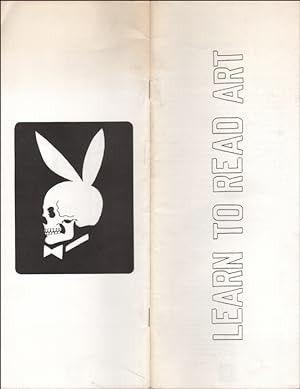
Learn to Read Art
Verlag: Art Metropole / Printed Matter Bookstore at Dia Toronto / New York, Canada / NY, 1991
Anbieter: Specific Object / David Platzker, New York, NY, USA
Verkäuferbewertung 5 von 5 Sternen

[44] pp.; 27.5 x 10.5 cm.; staple bound; black-and-white; edition size unknown; unsigned and unnumbered; offset-printed; Exhibition catalogue published in conjunction with joint presentation by Art Metropole and Printed Matter at Art Basel, Basel, Switerzland, June 12 - 17, 1991. Cover artwork by Richard Prince and Lawrence Weiner. Curated by AA Bronson, John Goodwin. Artists include Carl Andre, David Antin, Eleanor Antin, Ida Applebroog, John Armleder, Art & Language, John Baldessari, Robert Barry, Lothar Baumgarten, Iain Baxter, Ingrid Baxter, Joseph Beuys, Barbara Bloom, Mel Bochner, Alighiero E. Boetti, Christian Boltanski, George Brecht, Marcel Broodthaers, Stanley Brouwn, David Buchan, Chris Burden, Daniel Buren, Michael Buthe, James Lee Byars, Genevieve Cadieux, Guiseppe Chiari, Christo, Francesco Clemente, Robert Cumming, Jan Dibbets, Marcel Duchamp, Hans-Peter Feldmann, File, Robert Filliou, Ian Hamilton Finlay, Fluxus, Robert Fones, Katharina Fritsch, Hamish Fulton, General Idea, Gilbert & George, Dan Graham, Rodney Graham, Jenny Holzer, Douglas Huebler, Image Bank, International Situationist, Joe Jones, Allan Kaprow, Anselm Kiefer, Martin Kippenberger, Michael Kirby, Yves Klein, Bengt af Klintberg, Joseph Kosuth, Barbara Kruger, Louise Lawler, Sol LeWitt, George Maciunas, Allan MacKay, Jackson Mac Low, Liz Magor, Christian Marclay, Lise Melhorn-Boe, Mario Merz, Robert Morris, Multiples Inc., Ian Murray, Maurizio Nannucci, Bruce Nauman, Hermann Nitsch, Claes Oldenburg, Yoko Ono, Dennis Oppenheim, Meret Oppenheim, Nam June Paik, Robert Rauschenberg, Steve Reich, Dieter Rot [Dieter Roth], Jerome Rothenberg, Edward Ruscha, Carolee Schneemann, Becky Singleton, Robert Smithson, SMS [Shit Must Stop], Michael Snow, Valerie Solanis, Jesus Raphael Soto, Jana Sterbak, Rosemarie Trockel, Ben Vautier, Bernar Venet, Andy Warhol, Robert Watts, Krzysztof Wodiczko, Wolf Vostell, La Monte Young and Zaj. "An Exhibition of Artists' Books and Multiples from the Permanent Collection of Art Metropole. LEARN TO READ ART is an exhibition of 287 published works by artists from the postwar period to the present. Although the contemporary artist's book emerged early in the twentieth century, it was not until the sixties that it came into its own as a medium ideally suited to the needs of Fluxus and Conceptual artists of the period thus our exhibition picks up this thread of history in the postwar years and follows it into that period of intense evolution which was the sixties and early seventies." ?- AA Bronson, General Idea, from introduction. Reference : No. 54 in "The Book on Books on Artists' Books" by Arnaud Desjardin. London, England : The Everyday Press, 2011, pp. 35. Very Good. Yellowing of recto edges with 6 cm. of yellowing across top of verso. Dust soiling to covers with light wear to corners including a 2 cm. dog-ear to top left of verso. Contents clean and unmarked.
-
Form Magazine (Complete Set 1-10)
Verlag: Form Magazine 1966-1969, Cambridge, 1966
Anbieter: William Allen Word & Image, London, Vereinigtes Königreich
Verkäuferbewertung 5 von 5 Sternen
Erstausgabe
EUR 1.424,55
EUR 24,78 Versand
Versand von Vereinigtes Königreich nach USAAnzahl: 1 verfügbar
In den WarenkorbPaperback. Zustand: Very Good + / Near Fine. 1st Edition. FORM MAGAZINE. Complete set: Issues 1-10. (Summer) 1966- (October )1969.The most significant British magazine of the 60s concentrating on pure abstraction and through this art theory, architecture, avant-garde magazines et al. Interest in FORM itself has grown in recent years: while studying for his Ph.D. the Portuguese architect Joaquim Moreno made a particular study of the magazine, contending that it is essentially a magazine about little magazines of the avant-garde. Moreno was part of the research group that produced 'Clip Stamp Fold' (M + M books, Princeton, 2011), which features interviews with Bann and Steadman. Issues often include a Great Little Magazines section. Each issue is about 9.5 inches square, illustrated, with 32pp (apart from one issue with 36pp). Number 1: Contents includes Film as Pure form by Theo Van Doesburg (first translation of 1929 essay), The Activity of Structuralism by Roland Barthes, Experimental Aesthetics by Carlyn Cumming, essay on Fernand Leger, Great Little Magazines No.1 : Secession with work by William Carlos Williams, Hans Arp Yvor Winters / Number 2: Contents includes Le Parc and The Group Problem by Frank Popper; A Little Night Music by Charles Tomlinson; Articles by Gillo Dorfles; Poem by Charles Tomlinson; William Carlos Williams on Emanuel Romano. Great Little Magazines No.2: Blues with work by Gertrude Stein, Sidney Hunt, Parker Tyler, Kenneth Rexroth, Charles Henri Ford./ Number 3: Contents includes Poems by Ian Hamilton Finlay, Ernst Jandl, Paul de Vree, Kenneth Robinson. Articles on and by Charles Biederman and 'The Electrical -Mechanical Spectacle' by El Lissitzky. Great Little Magazines No 3: 'G' with work by Kurt Schwitters, Theo van Doesburg, Mies van der Rohe, Miklos Bandi./ Number 4: Contents includes: Brighton Concrete Poetry Exhibition , notes, map & full review (exhibition organised by Form's editors), Black Mountain College, Albers 'Graphic Tectonics', 'What is Kentetism' ? Two essays by Charles Biederman, Poems by Anselm Hollo. Review of Mecano magazine in Great Little Magazines No.4 (therefore discussion of Van Doesburg) - which includes translation of Van Doesburg text. / Number 5: Contains Hans Jaffes - De Stijl and Architecture, features on Bernard Lassus and Raul Hausmann, and in the Black Mountain Series John A. Rice, George Zabriskie and designs for college buildings by Walter Gropius and Marcel Breuer. Great Little Magazines No.5 'RAY' with work by Sidney Hunt, I. K. Bonset ( Theo Van Doesburg) and Kurt Schwitters./ Number 6: The contents include essays on Russian unofficial art, and on the work of Laszlo Moholy Nagy; John Evarts and Jean Charlot writing on Black Mountain; and poems by David Chaloner. Great Little Magazines No.6 'De Stijl' (Part 1). / Number 7: March / 1968. Contents include Kinetic Art in Czechoslovakia, Cinema and Semiology, by Peter Wollen, new American Photography, Abraham Moles on Vasarely. Airfields by Simon Cutts. Great Little Magazines No.6 'De Stijl' (author index part 2). / Number 8: The contents include Russian Exhibitions 1904 to 1922, Xanti Schawinskys - Spectodrama, and a feature on Pierre Albert-Birot with Barbara Wrights translations from - Grabinoulor. Great Little Magazines No.7 'SIC' with work by Apollinaire, Tristan Tzara, Pierre Albert-Birot. / Number 9: Contents includes articles by Hans Richter, Joost Baljeu, H. H. Stuckenschmidt. 'Notes on Theatre at Black Mountain College (1948-1952)' by Mark Hedden. 'Theo van Doesburg is of Today' by Maurice Agis and Peter Jones. Great Little Magazines section No 8: 'Kulchur' with work by Robert Indiana./ Number 10: The Aesthetic of Ian Hamilton Finlay by Simon Cutts. Art in Crisis by Charles Biederman, Structuralism & Literary Criticism by Gerard Genette. Great Little Magazines : LEF by Richard Sherwood & articles from LEF by Brik, Arvatov, Mayokovsky. Together with printed letter from the editor, Philip Steadman, sent to contributors when the magazine finished & flier for Form subscriptions. Condition: Some light toning and halding to covers. Overall very good+/near fine.


