

Gesamtpreis (1 Artikel Artikel):
Versandziel:

falus andras (7 Ergebnisse)
Direkt zu den wichtigsten Suchergebnissen
Suchfilter
Produktart
- Alle Product Types
- Bücher (7)
- Magazine & Zeitschriften (Keine weiteren Ergebnisse entsprechen dieser Verfeinerung)
- Comics (Keine weiteren Ergebnisse entsprechen dieser Verfeinerung)
- Noten (Keine weiteren Ergebnisse entsprechen dieser Verfeinerung)
- Kunst, Grafik & Poster (Keine weiteren Ergebnisse entsprechen dieser Verfeinerung)
- Fotografien (Keine weiteren Ergebnisse entsprechen dieser Verfeinerung)
- Karten (Keine weiteren Ergebnisse entsprechen dieser Verfeinerung)
- Manuskripte & Papierantiquitäten (Keine weiteren Ergebnisse entsprechen dieser Verfeinerung)
Zustand Mehr dazu
- Neu (6)
- Wie Neu, Sehr Gut oder Gut Bis Sehr Gut (1)
- Gut oder Befriedigend (Keine weiteren Ergebnisse entsprechen dieser Verfeinerung)
- Ausreichend oder Schlecht (Keine weiteren Ergebnisse entsprechen dieser Verfeinerung)
- Wie beschrieben (Keine weiteren Ergebnisse entsprechen dieser Verfeinerung)
Einband
Weitere Eigenschaften
- Erstausgabe (Keine weiteren Ergebnisse entsprechen dieser Verfeinerung)
- Signiert (Keine weiteren Ergebnisse entsprechen dieser Verfeinerung)
- Schutzumschlag (Keine weiteren Ergebnisse entsprechen dieser Verfeinerung)
- Angebotsfoto (4)
Sprache (1)
Preis
- Beliebiger Preis
- Weniger als EUR 20 (Keine weiteren Ergebnisse entsprechen dieser Verfeinerung)
- EUR 20 bis EUR 45 (Keine weiteren Ergebnisse entsprechen dieser Verfeinerung)
- Mehr als EUR 45
Gratisversand
Land des Verkäufers
Verkäuferbewertung
-

Clinical Applications of Immunomics
Buch 2 von 4: Immunomics Reviews:Anbieter: Majestic Books, Hounslow, Vereinigtes Königreich
Verkäuferbewertung 4 von 5 Sternen

EUR 51,51
EUR 7,46 Versand
Versand von Vereinigtes Königreich nach USAAnzahl: 4 verfügbar
In den WarenkorbZustand: New. pp. xvi + 274.
-
Clinical Applications Of Immunomics (Hb)
Buch 2 von 4: Immunomics Reviews:Anbieter: Romtrade Corp., STERLING HEIGHTS, MI, USA
Verkäuferbewertung 5 von 5 Sternen

Zustand: New. This is a Brand-new US Edition. This Item may be shipped from US or any other country as we have multiple locations worldwide.
-
Zustand: Sehr gut. Zustand: Sehr gut | Seiten: 300 | Sprache: Englisch | Produktart: Bücher | Innate immunity is one the most evolutionally conserved systems, designed to protect the organism from viruses and bacterial infections, stress and many other types of attacks from the outside world. During the past decade, the capacity of molecular biology and information technology to produce and analyse data have grown exponentially, rapidly reforming many aspects of immunology research in the post-genomics era. As a result, scientific understanding of signalling networks governing the innate immunity response in human tissues and other organisms has evolved beyond recognition, compared to even just a decade ago. Many strategies have been designed over the years to identify novel proteins, which have a crucial role in innate immunity responses by regulating particular signalling pathways. These projects had many advantages, including the definition of novel drug targets, as exemplified by the recent success of anti-TNF therapy, as well as leading to a better, system-wide understanding of the molecular control of innate immunity. In the past few years, a new concept, Immunomics, has been adopted to define an emerging, multidisciplinary field of research (Schonbach, 2003). Although rapid progress has been made to identify the proteins playing pivotal roles in the innate immunity¿related signalling pathways (for example, TIR signalling pathways), the catalogue of proteins with a key regulatory function identified and studied is far from completed. Novel proteins need to be char- terised to gain a more comprehensive picture of how signalling networks are regulated.
-
Taschenbuch. Zustand: Neu. Clinical Applications of Immunomics | Andras Falus | Taschenbuch | xvi | Englisch | 2014 | Springer US | EAN 9781493900541 | Verantwortliche Person für die EU: Springer Verlag GmbH, Tiergartenstr. 17, 69121 Heidelberg, juergen[dot]hartmann[at]springer[dot]com | Anbieter: preigu.
-

Clinical Applications of Immunomics
Buch 2 von 4: Immunomics Reviews:Sprache: Englisch
Verlag: Springer New York, Springer US Okt 2008, 2008
ISBN 10: 0387792074 ISBN 13: 9780387792071
Anbieter: buchversandmimpf2000, Emtmannsberg, BAYE, Deutschland
Verkäuferbewertung 5 von 5 Sternen
Buch. Zustand: Neu. Neuware -Innate immunity is one the most evolutionally conserved systems, designed to protect the organism from viruses and bacterial infections, stress and many other types of attacks from the outside world. During the past decade, the capacity of molecular biology and information technology to produce and analyse data have grown exponentially, rapidly reforming many aspects of immunology research in the post-genomics era. As a result, scientific understanding of signalling networks governing the innate immunity response in human tissues and other organisms has evolved beyond recognition, compared to even just a decade ago. Many strategies have been designed over the years to identify novel proteins, which have a crucial role in innate immunity responses by regulating particular signalling pathways. These projects had many advantages, including the definition of novel drug targets, as exemplified by the recent success of anti-TNF therapy, as well as leading to a better, system-wide understanding of the molecular control of innate immunity. In the past few years, a new concept, Immunomics, has been adopted to define an emerging, multidisciplinary field of research (Schonbach, 2003). Although rapid progress has been made to identify the proteins playing pivotal roles in the innate immunity¿related signalling pathways (for example, TIR signalling pathways), the catalogue of proteins with a key regulatory function identified and studied is far from completed. Novel proteins need to be char- terised to gain a more comprehensive picture of how signalling networks are regulated.Springer Verlag GmbH, Tiergartenstr. 17, 69121 Heidelberg 300 pp. Englisch.
-
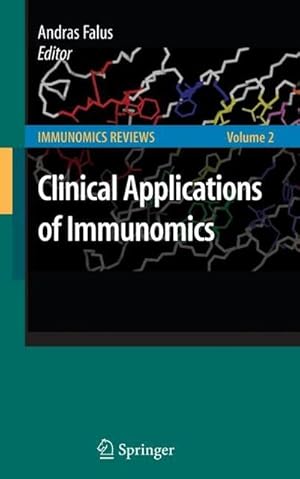
Clinical Applications of Immunomics
Buch 2 von 4: Immunomics Reviews:Sprache: Englisch
Verlag: Springer New York, Copernicus, 2008
ISBN 10: 0387792074 ISBN 13: 9780387792071
Anbieter: AHA-BUCH GmbH, Einbeck, Deutschland
Verkäuferbewertung 5 von 5 Sternen
Buch. Zustand: Neu. Druck auf Anfrage Neuware - Printed after ordering - Innate immunity is one the most evolutionally conserved systems, designed to protect the organism from viruses and bacterial infections, stress and many other types of attacks from the outside world. During the past decade, the capacity of molecular biology and information technology to produce and analyse data have grown exponentially, rapidly reforming many aspects of immunology research in the post-genomics era. As a result, scientific understanding of signalling networks governing the innate immunity response in human tissues and other organisms has evolved beyond recognition, compared to even just a decade ago. Many strategies have been designed over the years to identify novel proteins, which have a crucial role in innate immunity responses by regulating particular signalling pathways. These projects had many advantages, including the definition of novel drug targets, as exemplified by the recent success of anti-TNF therapy, as well as leading to a better, system-wide understanding of the molecular control of innate immunity. In the past few years, a new concept, Immunomics, has been adopted to define an emerging, multidisciplinary field of research (Schonbach, 2003). Although rapid progress has been made to identify the proteins playing pivotal roles in the innate immunity-related signalling pathways (for example, TIR signalling pathways), the catalogue of proteins with a key regulatory function identified and studied is far from completed. Novel proteins need to be char- terised to gain a more comprehensive picture of how signalling networks are regulated.
-

Clinical Applications of Immunomics
Buch 2 von 4: Immunomics Reviews:Sprache: Englisch
Verlag: Springer New York, Springer New York, 2014
ISBN 10: 1493900544 ISBN 13: 9781493900541
Anbieter: AHA-BUCH GmbH, Einbeck, Deutschland
Verkäuferbewertung 5 von 5 Sternen
Taschenbuch. Zustand: Neu. Druck auf Anfrage Neuware - Printed after ordering - Innate immunity is one the most evolutionally conserved systems, designed to protect the organism from viruses and bacterial infections, stress and many other types of attacks from the outside world. During the past decade, the capacity of molecular biology and information technology to produce and analyse data have grown exponentially, rapidly reforming many aspects of immunology research in the post-genomics era. As a result, scientific understanding of signalling networks governing the innate immunity response in human tissues and other organisms has evolved beyond recognition, compared to even just a decade ago. Many strategies have been designed over the years to identify novel proteins, which have a crucial role in innate immunity responses by regulating particular signalling pathways. These projects had many advantages, including the definition of novel drug targets, as exemplified by the recent success of anti-TNF therapy, as well as leading to a better, system-wide understanding of the molecular control of innate immunity. In the past few years, a new concept, Immunomics, has been adopted to define an emerging, multidisciplinary field of research (Schonbach, 2003). Although rapid progress has been made to identify the proteins playing pivotal roles in the innate immunity-related signalling pathways (for example, TIR signalling pathways), the catalogue of proteins with a key regulatory function identified and studied is far from completed. Novel proteins need to be char- terised to gain a more comprehensive picture of how signalling networks are regulated.


