Gesamtpreis (1 Artikel Artikel):
Versandziel:

emanuel schelstrate (5 Ergebnisse)
Direkt zu den wichtigsten Suchergebnissen
Suchfilter
Produktart
- Alle Product Types
- Bücher (5)
- Magazine & Zeitschriften (Keine weiteren Ergebnisse entsprechen dieser Verfeinerung)
- Comics (Keine weiteren Ergebnisse entsprechen dieser Verfeinerung)
- Noten (Keine weiteren Ergebnisse entsprechen dieser Verfeinerung)
- Kunst, Grafik & Poster (Keine weiteren Ergebnisse entsprechen dieser Verfeinerung)
- Fotografien (Keine weiteren Ergebnisse entsprechen dieser Verfeinerung)
- Karten (Keine weiteren Ergebnisse entsprechen dieser Verfeinerung)
- Manuskripte & Papierantiquitäten (Keine weiteren Ergebnisse entsprechen dieser Verfeinerung)
Zustand Mehr dazu
- Neu (Keine weiteren Ergebnisse entsprechen dieser Verfeinerung)
- Wie Neu, Sehr Gut oder Gut Bis Sehr Gut (Keine weiteren Ergebnisse entsprechen dieser Verfeinerung)
- Gut oder Befriedigend (1)
- Ausreichend oder Schlecht (Keine weiteren Ergebnisse entsprechen dieser Verfeinerung)
- Wie beschrieben (4)
Einband
- alle Einbände
- Hardcover (3)
- Softcover (Keine weiteren Ergebnisse entsprechen dieser Verfeinerung)
Weitere Eigenschaften
- Erstausgabe (Keine weiteren Ergebnisse entsprechen dieser Verfeinerung)
- Signiert (Keine weiteren Ergebnisse entsprechen dieser Verfeinerung)
- Schutzumschlag (1)
- Angebotsfoto (3)
Sprache (2)
Preis
- Beliebiger Preis
- Weniger als EUR 20 (Keine weiteren Ergebnisse entsprechen dieser Verfeinerung)
- EUR 20 bis EUR 45 (Keine weiteren Ergebnisse entsprechen dieser Verfeinerung)
- Mehr als EUR 45
Gratisversand
- Kostenloser Versand nach USA (Keine weiteren Ergebnisse entsprechen dieser Verfeinerung)
Land des Verkäufers
Verkäuferbewertung
-
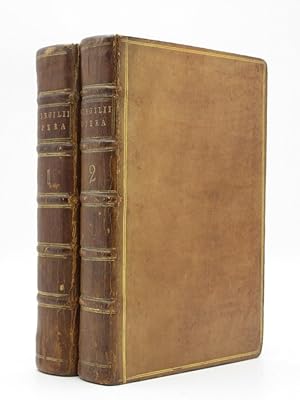
Publii Virgilii Maronis: Bucolica, Georgica, et Aeneis: (Complete 2 Volume Set)
Sprache: Englisch
Verlag: J. & P. Knapton, Gul. Sandby, London, 1750
Anbieter: Tarrington Books, Tarrington, HEF, Vereinigtes Königreich
Verkäuferbewertung 5 von 5 Sternen

EUR 357,78
EUR 20,84 Versand
Versand von Vereinigtes Königreich nach USAAnzahl: 1 verfügbar
In den WarenkorbZustand: Very Good. 1st Edition Thus. Complete two volume set. Full calf leather bindings. Spines with five raised bands and morocco title labels. Double gilt filet border to all boards. Cracking to joints of Volume I and slightly to Volume II but both books remain very securely bound. Very clean text throughout. Title pages printed in red and black. Profusely illustrated to both volumes, including numerous illustrations of Roman coins. A very nice example of a sought after edition. ESTC: T139415. Overall condition is Very Good. Size: 4 x 6.25 inches (10.5 x 15.5 cm). Hardback. Printed pages: Small 8vo. [54], 223; 266.
-
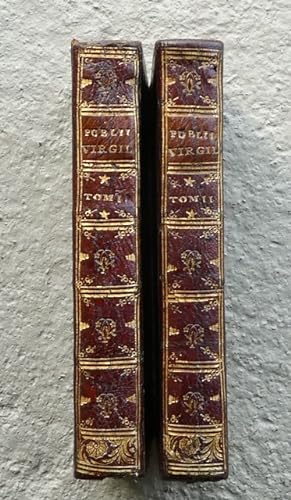
Publii Virgilii Maronis Bucolica, Georgica, et Aeneis, illustrata, ornata, et accuratissime impressa. Tom. I/II.
Verlag: [London] : Londini, Impensis J. et P. Knapton, in Vico Ludgate, et Gul. Sandby, in Vico Fletano / Typis Jacobi Bettenham 1750 -, 1750
Anbieter: Franz Kühne Antiquariat und Kunsthandel, Affoltern am Albis, Schweiz
Verkäuferbewertung 5 von 5 Sternen
2 Bände (cpl.). Kl.-8° (16 x 10.2 x 2.5, resp. 2.7 cm). 28 Bll., 223 SS. u. 1 Bl., 266 SS. Schriftsatz in 6-Punkt Antiqua, Druck a. Bütten. Beide Titel in Rot u. Schwarz, ident. Portr.-Titelvignetten (Vergil), vol. I mit gest. Front. (=Tafel 1), gest. Dedikation (=Taf. 2) u. 1 Textkupfer, total 58 röm. num. Tafeln in Kupferstich (cpl.). Ldr. d.Zt. (etwas bestossen, Kapitale mit kleinen Ausbrüchen, Gelenke etwas rissig, Rücken craqueliert) mit mont. Rückenschildchen, vergold. Deckel- und Stehkantenfileten, Rücken- u. Innenkantendekor, alls. Goldschnitt (etwas oxidiert). Vorsätze mit buntem Kammeisenmuster (unterschiedlich berieben). Fl.Bll. etwas (stock-) fleckig, Seiten gleichmässig gebräunt, vereinzelt min. stockfleckig. Alters-, Dislokations- u. etwas Gebrauchsspuren, ident. hs. Besitzeretiketten a. Vorsatzspiegeln. Gesamthaft weitgehend sauberes, sehr ordentliches Exemplar. - - Digitalis. in BVB/BSB u. Google Books - Graesse nennt primär die Oktavausgabe und merkt an "Cette édition se trouve plus souvent de format pet. in-8° [.], avec les mêmes figures. Le texte est très correct; il a été donné sur les mss. de Medici et du Vatican, les vignettes sont des copies de monnaies, pierres gravées etc." - Cohen erwähnt ebenfalls die grössere Ausgabe, zählt die Illustrationen: 1 fleuron qui est placé sur chaque titre, 58 figures de médailles, par Bonneau et Wilson, gravés par Grignion, Muller et J.S.M., und meint dann etwas maliziös: "Cet ouvrage, illustré d'une manière fort intéressante, contient malheureusement parmi les médailles des pièces imaginés par le savant antiquaire [Hubertus od. Hubrecht d.J.] Goltzius, qui a laissé dans le numismatique une réputation d'auteur aussi dangereux que le marquis des Sade dans la litérature." (!; sp. 1017; Henry Cohen musste es wissen: er war selbst ein renommierter Numismatiker - allerdings musste Goltzius im 16. Jh. seine Nachforschungen unter wesentlich schwierigeren Bedingungen anstellen als der über 300 Jahre später tätige Cohen) -- INHALT : I: P. Virgilii Maronis historia descripta per consules a Carolo Ruaeo S.J. [i.e. Charles de la Rue; DB&S 7, sp. 290]; Vorrede von E. Schelstrate; Anmerkungen (Tabularum Explicatio); I.1 Bucolica 1-10 (10 Eclogae od. Elogen; pp. 1-32), I.2 Georgica Lib. I-IV (pp. 33-112), I.3 Aeneidos Lib. I-IV (pp. 113-223) / II.1 Aeneidos Lib. V-XII (Aeneis, tot. 12 Bücher; pp. 1-246) - Mit Lectiones Variantes (pp. 247-266) -- Zu Vergils Werk vgl. A. Baumgartner S.J., Gesch. d. Weltliteratur, 3, 1900, pp. 415-437; zu P. de la Rues Vergil-Biographie s. G. E. Müller, Historisch-critische Einleitung zu nöthiger Kenntniß [.] der alten lateinischen Schriftsteller, I, 1747: "Diese Art, die Lebensgeschichte der Scribenten zu schreiben, ist, wegen der Zeitrechnung schätzbar; im Lesen aber etwas holpricht" (etc.; p. 216) - "Die Bucolica, d.h. die [.] zehn Elogen, [.] lehnen sich an Theokrits Idyllen. [.] Am selbständigsten und eigenartigsten tritt Vergil mit seinem reinen und erhabenen Idealismus aus der alltäglichen Hirtenwelt Theokrits in der berühmten vierten Eloge heraus, ohne die ländliche Sphäre indes ganz zu verlassen. Es drängte seine Seele empor zu etwas Höherem und Besserem. Non omnes arbusta iuvant humilesque myricae. [.] Wie er das Bauernleben der Lombardei aus eigener Anschauung kannte, streifte er fröhlich in Campanien und Calabrien herum und studierte das ländliche Treiben in Neapel, Pästum und Tarrent. Was er da schaute und empfand, rief nicht nur wieder die schönsten literarischen Erinnerungen wach, es umgab dieselben mit neuem lebendigem Zauber und regte ihn selbst zu neuem, eigenem Schaffen an. In solcher Weise sind die Georgica entstanden, Vergils selbständiges Werk, kein frostiges, pedantisches Lehrbuch, sondern ein wirkliches Gedicht [.]. Es stammt aus einem Herzen, das rein und lauter, für das Höchste und Edelste schlug [.]. [.] Die Aeneis. Wohl zumeist Octavians Triumph selbst [.], endlich Ermutigung von seiten des Maecenas und anderer Freunde reiften in ihm den Plan, Hand an ein großes Nationalwerk zu legen und soweit möglich der Homer der Römer zu werden. [.] Die Sagenwelt Homers war jedem gebildeten Römer bekannt und längst mit den einheimischen Sagen verbunden worden. Es fehlte nur der Dichter, welcher dieser Aneignung und Eroberung der Sage eine würdige künstlerische Gestalt gab. [.] Diese Aufgabe hat Vergil meisterhaft gelöst, mit aller Selbständigkeit und poetischen Schöpfungskraft, welche dieselbe ihrer Natur nach ermöglichte." (etc.; Baumgartner, p. 417 f., 420 f., 423 u. 425). -- Provenienz (Etiketten): Mr. De Luigny fils (nicht eruierbar). - Sprache: la.
-
Acta Constantiensis concilij ad expositionem decretorum eius sessionum quartae et quintae facientia nunc primum ex codicibus M. SS. in lucem eruta ac dissertatione illustrata per D. Emanuelem A Schelstrate S. T. D. Bibliothcae Vaticanae Praefectum.
Verlag: Apud Joannem Baptistam Verdussen,, Antverpiae (Anvers),, 1683
Anbieter: Librairie Ancienne Richard (SLAM-ILAB), NANTES, Frankreich
Verbandsmitglied: ILAB
Verkäuferbewertung 4 von 5 Sternen

232 x 180 mm, (4) ff., 76 pp., (2) ff. Reliure de l'époque en veau mouchetée, dos à nerfs orné de fleurons dorés, roulettes dorées aux coupes, tranches mouchetées, premier feuillet de garde absent, galeries et trous de vers dans la marge, des feuillets brunis, coiffe sup. absente, second plat taché, épidermures aux mors, manque de cuir aux coins.
-

Collection of 2 theological dissertations: [1] De Disciplina Arcani contra disputationem Ernesti Tentzlii Dissertatio Apologetica per D. Emanuelem A Schelstrate .[2] Dissertatio de Auctoritate Patriarchali et Metropolitica adversus .Edvardus Stillingfleet Decanus Londinensis in libro de Originibus Brittanicis.
Anbieter: Antiquariaat Wim de Goeij, Kalmthout, ANTW, Belgien
Verbandsmitglied: ILAB
Verkäuferbewertung 5 von 5 Sternen
Roma, Typis Sac. Congragat. de Propagandâ Fide. [1] , 1685 , in-4°, 21,5 cm, (18)nn pp + 160 pp + (8)nn pp (last blank). [2] 1687, (10)nn pp + xxiv pp + 114 pp + (4) nn pp (index). Bound in contemporary full calf, raised gilt spine, fine crisp copy with only minor damage to the binding extremities. E. Schelstrate (Antwerp 1649 - Rome 1692) was the head librarian of the Vatican Library, he was highly esteemed by Pope Innocentius XI for whom he wrote the ''Oratio in Funere''. He gained a reputation as one of the first scholars to study church history in a modern scientific way. In the first [1] treatise the author refutes the German protestant Ernest Tentzel's ideas about Transsubstantiation (the change of bread and wine into the body and blood of Christ in the Eucharist.) In the [2] treatise he opposes Edward Stillingfleet for his ideas on the the origine of the British Church ( '' Origines Brittanicae - Or the Antiquities of the British Churches'', published by E. Stillingfleet in 1685). Schelstrate's dissertation opens with a beatifully printed laudatory letter to king James II ''King of Britain, triumphant and victorius defender of the Faith ( in Latin). Illustrated with a fine engraved vignet and a finely engraved initial.
-
De Disciplina Arcani contra disputationem Ernesti Tentzlii Dissertatio Apologetica per D. Emanuelem A Schelstrate S.T.D. Bibliothecae Vaticanae Praefectum, Ecclesiae Antverpiensis canonicum.
Anbieter: Antiquariaat Wim de Goeij, Kalmthout, ANTW, Belgien
Verbandsmitglied: ILAB
Verkäuferbewertung 5 von 5 Sternen
11. Roma, Typis Sac. Congragat. de Propagandâ Fide, 1685, in-4°, 21,5 cm, (18)nn pp + 160 pp + (8)nn pp (last blank), bound in contemporary full vellum, inkstain on first (blank) fly leaf, printed ex-libris on first paste-down, nice engraved 18th century ex-libris tipped in at verso title page. Fine copy. E. Schelstrate (Antwerp 1649 - Rome 1692) was a librarian to the Vatican Library, he was highly esteemed by Pope Innocentius XI for whom he wrote the ''Oratio in Funere''. He gained a reputation as one of the first scholars to study church history in a modern scientific way. In this treatise the author refutes the German protestant Ernest Tentzel's ideas about Transsubstantiation (the change of bread and wine into the body and blood of Christ in the Eucharist.).