

Gesamtpreis (1 Artikel Artikel):
Versandziel:

e h jons (13 Ergebnisse)
Direkt zu den wichtigsten Suchergebnissen
Suchfilter
Produktart
- Alle Product Types
- Bücher (13)
- Magazine & Zeitschriften (Keine weiteren Ergebnisse entsprechen dieser Verfeinerung)
- Comics (Keine weiteren Ergebnisse entsprechen dieser Verfeinerung)
- Noten (Keine weiteren Ergebnisse entsprechen dieser Verfeinerung)
- Kunst, Grafik & Poster (Keine weiteren Ergebnisse entsprechen dieser Verfeinerung)
- Fotografien (Keine weiteren Ergebnisse entsprechen dieser Verfeinerung)
- Karten (Keine weiteren Ergebnisse entsprechen dieser Verfeinerung)
- Manuskripte & Papierantiquitäten (Keine weiteren Ergebnisse entsprechen dieser Verfeinerung)
Zustand Mehr dazu
- Neu (6)
- Wie Neu, Sehr Gut oder Gut Bis Sehr Gut (Keine weiteren Ergebnisse entsprechen dieser Verfeinerung)
- Gut oder Befriedigend (Keine weiteren Ergebnisse entsprechen dieser Verfeinerung)
- Ausreichend oder Schlecht (Keine weiteren Ergebnisse entsprechen dieser Verfeinerung)
- Wie beschrieben (7)
Einband
- alle Einbände
- Hardcover (Keine weiteren Ergebnisse entsprechen dieser Verfeinerung)
- Softcover (12)
Weitere Eigenschaften
- Erstausgabe (3)
- Signiert (Keine weiteren Ergebnisse entsprechen dieser Verfeinerung)
- Schutzumschlag (Keine weiteren Ergebnisse entsprechen dieser Verfeinerung)
- Angebotsfoto (4)
Sprache (2)
Gratisversand
Land des Verkäufers
Verkäuferbewertung
-

Sam's Secret Notebook No: 1 - Keepers of the Secret
Sprache: Englisch
Verlag: Pegasus Elliot Mackenzie Publishers, 2024
ISBN 10: 1800165498 ISBN 13: 9781800165496
Anbieter: PBShop.store US, Wood Dale, IL, USA
Verkäuferbewertung 5 von 5 Sternen

PAP. Zustand: New. New Book. Shipped from UK. Established seller since 2000.
-
Sam's Secret Notebook No: 1 - Keepers of the Secret
Sprache: Englisch
Verlag: Pegasus Elliot Mackenzie Publishers, 2024
ISBN 10: 1800165498 ISBN 13: 9781800165496
Anbieter: PBShop.store UK, Fairford, GLOS, Vereinigtes Königreich
Verkäuferbewertung 5 von 5 Sternen
EUR 12,43
EUR 3,79 Versand
Versand von Vereinigtes Königreich nach USAAnzahl: 3 verfügbar
In den WarenkorbPAP. Zustand: New. New Book. Shipped from UK. Established seller since 2000.
-
Sam's Secret Notebook No: 1 - Keepers of the Secret
Anbieter: Revaluation Books, Exeter, Vereinigtes Königreich
Verkäuferbewertung 5 von 5 Sternen
EUR 9,80
EUR 14,41 Versand
Versand von Vereinigtes Königreich nach USAAnzahl: 2 verfügbar
In den WarenkorbZustand: Brand New. 172 pages. 7.72x5.12x0.94 inches. In Stock.
-
Sam's Secret Notebook No: 1 - Keepers of the Secret
Anbieter: Kennys Bookstore, Olney, MD, USA
Verkäuferbewertung 5 von 5 Sternen
Zustand: New.
-

Sam's Secret Notebook No: 1 - Keepers of the Secret
Sprache: Englisch
Verlag: Pegasus Elliot Mackenzie Publishers Mai 2024, 2024
ISBN 10: 1800165498 ISBN 13: 9781800165496
Anbieter: AHA-BUCH GmbH, Einbeck, Deutschland
Verkäuferbewertung 5 von 5 Sternen
Taschenbuch. Zustand: Neu. Neuware.
-
SAMS SECRET NOTEBOOK NO 1 KEEPERS OF THE
Sprache: Englisch
ISBN 10: 1800165498 ISBN 13: 9781800165496
Anbieter: Speedyhen, Hertfordshire, Vereinigtes Königreich
Verkäuferbewertung 5 von 5 Sternen
EUR 10,54
EUR 47,28 Versand
Versand von Vereinigtes Königreich nach USAAnzahl: 3 verfügbar
In den WarenkorbZustand: NEW.
-
Zustand: Hervorragend. Zustand: Hervorragend | Sprache: Englisch | Produktart: Bücher | Keine Beschreibung verfügbar.
-

J. J. Berzelius Lehrbuch der Chemie.In vollständigem Auszuge, mit Zusätzen und Nachträgen aller neueren Entdeckungen und Erfindungen zu Vorlesungen und zum Selbststudium für Aerzte, Apotheker, Fabrikanten, Kameralisten, Landwirthe, Gewerbtreibende. Bearbeitet von Professor H. F. Eisenbach und Professor E. A. Hering. In drei Bänden. Erster Band.
Verlag: J. B. Metzler, Stuttgart,, 1832
Anbieter: Bouquinerie du Varis, Russy, FR, Schweiz
Verkäuferbewertung 5 von 5 Sternen
Basil-Halbledereinband. 210x130mm, XII- 656Seiten, mit einer Steintafel, Marmorierteinband. Handschriftlicher Rückenetikett. Besitzername. Sehr guter Zustand. En cas de problème de commande, veuillez nous contacter via notre page d'accueil / If there is a problem with the order, please contact us via our homepage.
-

Versuch einer lateinischen Nomenclatur für die Chemie, nach electrisch-chemischen Ansichten. (Im Auszuge, frei bearbeitet, und mit Vorschlägen für die deutsche Nomenclatur begleitet, von Gilbert).
Anbieter: Herman H. J. Lynge & Søn ILAB-ABF, Copenhagen, Dänemark
Verkäuferbewertung 4 von 5 Sternen

Erstausgabe
Leipzig, Johann Ambrosius Barth, 1812. Without wrappers. In: "Annalen der Physik und der Physikalischen Chemie. Hrsg. Ludwig Wilhelm Gilbert", Bd. 12 (= Bd. 42 der Reihe), Neuntes Stück. Titlepage to vol. 12. Pp. 1-116 a. 1 engraved plate. (The entire issue offered). Berzelius' paper: pp. 37-89. First German edition of this classic paper in chemistry in which Berzelius presented his system of nomenclature to the scientific world. The paper was first preseted in French "Essay sur la nomenclature chimique" in Journal de Physique the year before (1811)."Of his contributions, moreover, to the development of the atomic theory and the advancement of chemical science, not the least valuable was the introduction of a chemical symbolism which, with slight modifivcations, is in use at the present day. By giving his symbols a quantitative meaning - the symbol of an element representing one atomic proportion by weight - it was possible "to show briefly and clearly the number of elementary atoms in each compound and, after the determination of their relative weights, present the results of each analysis in a si8mple and easely retained manner.". This symbolism was speedily adopted on the Continent but, en England, only after some considerable time."(Findley "A Hundred Year of Chemistry", p. 14). - Holmberg, Bibliografi öfver Berzelius, 1812:7).
-
Experiments on the Nature of Azote, of Hydrogen, and of Ammonia, and upon the Degrees of Oxidation of which Azote is susceptible.
Anbieter: Herman H. J. Lynge & Søn ILAB-ABF, Copenhagen, Dänemark
Verkäuferbewertung 4 von 5 Sternen
Erstausgabe
London, Robert Baldwin, 1813. 8vo. Contemp. hcalf. Marbled boards. Spine lacks and boards loose. In: "Annals of Philosophy" or Magazine of Chemistry, Mineralogy, Mechanics. By Thomas Thomson". Vol. II. - VIII,480 pp. a. 7 plates. (Entire volume offered). Berzelius' paper: pp. 276-284, 357-368. Some browning and brownspots to plates. First printing of this milestone papers in the history of chemistry, where Berzelius introduced his famous chemical symbolism (the offered paper is the first on the subject - Leicester & Klickstein calls it the "Preliminary note) whereby an element is generally represented by the first letter of its Latin name, or, in the event of elements having the same first letter, by the first two letters. Even though his atomic symbols were introduced in 1813 (see the note on p. 359), it was quite a few years before Berzelius's symbols were adopted by the chemistry community. But once accepted, they became the new international language of chemistry. Berzelius "contributed more to the development of the atomic theory and to the setting up of accurate values of the atomic weights than did any other worker of the time. Of his contributions, moreover, to the development of the atomic theory and the advancement of chemical science, not the least valuable was the introduction of a chemical symbolism which, with slight modification, is in use at the present day. By giving his symbols a quantitative meaning - the symbol of an element representing one atomic proportion by weight - it was possible "to show briefly and clearly the number of elementary atoms in each compound and, after the determination of their relative weights, present the results of each analysis in a simple and easely retained manner". This symbolism was speedily adopted on the Continent but, in England, only after some considerable time."(Findlay "A Hundred Years of Chemistry", p. 14.).Parkinson "Breakthroughs", 1813 C. - Leicester & Klickstein "A Source Book in Chemistry", p. 258 ff. - Holmberg 1813:28 a.
-
Experiments on the Nature of Azote, of Hydrogen, and of Ammonia, and upon the Degrees of Oxidation of which Azote is susceptible. (+) Essay on the Cause of Chemical Proportions, and on some Circumstances relating to them: together with a short and eas.
Anbieter: Herman H. J. Lynge & Søn ILAB-ABF, Copenhagen, Dänemark
Verkäuferbewertung 4 von 5 Sternen
Erstausgabe
London, Robert Baldwin, 1813 a. 1814. 8vo. 2 contemp. hcalf. Marbled boards. Spines lacks and boards detached. In: "Annals of Philosophy" or Magazine of Chemistry, Mineralogy, Mechanics. By Thomas Thomson". Vol. II and Vol. III. Entire volumes offered. Berzelius' papers: pp. 276-284, 357-368 (the first paper in vol. II), pp. 443-454 (vol. II) a. pp. 51-62, 93-106, 244-257 a. 353-364. (vol. III). Internally fine and clean. First printing of these milestone papers in the history of chemistry, where Berzelius introduced his famous chemical symbolism whereby an element is generally represented by the first letter of its Latin name, or, in the event of elements having the same first letter, by the first two letters. Even though his atomic symbols were introduced in 1813 (see the note on p. 359 in the first paper), it was quite a few years before Berzelius's symbols were adopted by the chemistry community. But once accepted, they became the new international language of chemistry.Berzelius "contributed more to the development of the atomic theory and to the setting up of accurate values of the atomic weights than did any other worker of the time. Of his contributions, moreover, to the development of the atomic theory and the advancement of chemical science, not the least valuable was the introduction of a chemical symbolism which, with slight modification, is in use at the present day. By giving his symbols a quantitative meaning - the symbol of an element representing one atomic proportion by weight - it was possible "to show briefly and clearly the number of elementary atoms in each compound and, after the determination of their relative weights, present the results of each analysis in a simple and easely retained manner". This symbolism was speedily adopted on the Continent but, in England, only after some considerable time."(Findlay "A Hundred Years of Chemistry", p. 14.).Parkinson "Breakthroughs", 1813 C. - Leicester & Klickstein "A Source Book in Chemistry", p. 258 ff. - Holmberg 1813:28 a. The volume contains other notable papers THOMAS THOMSON "On the Discovery of the Atomic Theory", pp. 329-338. and JOHN DALTON "Remarks on the Essay of Dr. Berzelius on the Cause of Chemical Proportions", pp. 174-180 (Vol. III).
-
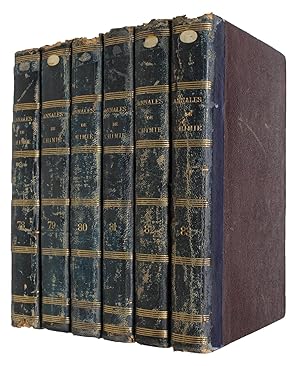
Essais sur les proportions déterminées dans lesquelles se trouvent réunis les élémens de la nature inorganiques. (+) Suite des experiences sur les proportions déterminées, d'après lesquelles les élémens de la nature inorganique s'unissent. (In all.
Anbieter: Herman H. J. Lynge & Søn ILAB-ABF, Copenhagen, Dänemark
Verkäuferbewertung 4 von 5 Sternen
Paris, Chez J. Klostermann fils, 1811-12. Bound in 6 contemp. hcalf. Gilt spines, slightly rubbed. Wear to top of spines. In: "Annales de Chimie, ou Recueil de Mémoires concernant la Chemie" Tome 78, 79, 80, 81, 82 and 83. (Entire volumes offered). The 14 parts: (Tome 78:) pp. 5-37, 105-132, 217-242. - (Tome 79:) pp. 113-142, 233-264. - (Tome 80:) pp. 5-37, 225-258. - (Tome 81:) pp. 5-36, 278-303. - (Tome 82:) pp. 5-33, 113-125, 225-72. (Tome 83:) pp. 5-35 a. pp. 117-127. With in all 3 engraved plates. Some scattered brownspots. The papers represents one of the first announcements of Berzelius' discovery of the fixed chemical proportions, determining the weights and valencies of the various constituent elements in inorganic compounds. The papers were published at the same time in Swedish, German (both here in Annalen and in Schweiger's Journal), and in French. By running many hundreds of analysis of chemical compounds he gave so many examples of the law of definite proportions that the world of chemistry could no longer doubt its validity, and in so doing he gave experimental evidence to the atomic theory. He hereby laid a solid fundation for the further development of chemistry. A reprint is found in Ostwald's Klassiker der exakten Wissenschaften, No. 35.According to Söderbaum (Jac. Berzelius, 2, p.12) "It was a giant work, one of the most importent in the history of chemistry, which was here presented. One is even more impressed when one remembers that it was a pioneer undertaking in every sense of the term. Analytic and synthetic methods existed before Berzelius' time, to be sure, but there were no precise methods of the sort which he required. They all had to be elaborated at the cost of time and labour."(J. Erik Jorpes "Jac. Berzelius", p.45)."In general Berzelius's efforts were directed toward the consolidation and extension of the atomic theory. He improved chemical analysis and determined the composition of a large number of compounds, thus verifying the laws of constant and multiple proportions and furnishing the most accurate equivalent weights then available. By ingenious methods he arrived at the correct atomic composition of most common substances, and thus was enabled to draw up (in 1826) a table of atomic weights very nearly identical with the modern one."(Leicester & Klicktein "A Source Book in Chemistry", p. 258).Parkinson "Breakthroughs", 1810-20 C.
-
Versuch, die bestimmten und einfachen Verhältnisse anzufinden, nach welchen die Bestandtheile der unorganischen Natur mit einander verbunden sind. Erste Hälfte. (+) Zweite Hälfte. (+) Erste Fortsetzung des Versuchs, die bestimmten.(+) Zweite Fortse.
Anbieter: Herman H. J. Lynge & Søn ILAB-ABF, Copenhagen, Dänemark
Verkäuferbewertung 4 von 5 Sternen
Halle, Rengerschen Buchhandlung, 1811, 1811, 1812. Without wrappers as published in "Annalen der Physik. Herausgegeben von Ludwig Wilhelm Gilbert", Bd. 37, Drittes u. Viertes Stück + Bd. 38, Sechtes Stück + Bd. 40, Zweites u. Drittes Stück. The entire issues offered (5 issues). With titlepage to vol. 37, 38 a. 40. Pp. 233-480 a. 3 engraved plates., pp. 121-236 a. 2 engraved plates., pp. 117-348 a. 1 engraved plate. Berzelius's papers: pp. 249-337 a. 415-472.- Pp. 161-226. - Pp. 162-208 a. 235-330. The papers represents one of the first announcements of Berzelius' discovery of the fixed chemical proportions, determining the weights and valencies of the various constituent elements in inorganic compounds. The papers were published at the same time in German (both here in Annalen and in Schweiger's Journal), and in French. By running many hundreds of analysis of chemical compounds he gave so many examples of the law of definite proportions that the world of chemistry could no longer doubt its validity, and in so doing he gave experimental evidence to the atomic theory. He hereby laid a solid fundation for the further development of chemistry.According to Söderbaum (Jac. Berzelius, 2, p.12) "It was a giant work, one of the most importent in the history of chemistry, which was here presented. One is even more impressed when one remembers that it was a pioneer undertaking in every sense of the term. Analytic and synthetic methods existed before Berzelius' time, to be sure, but there were no precise methods of the sort which he required. They all had to be elaborated at the cost of time and labour."(J. Erik Jorpes "Jac. Berzelius", p.45)."In general Berzelius's efforts were directed toward the consolidation and extension of the atomic theory. He improved chemical analysis and determined the composition of a large number of compounds, thus verifying the laws of constant and multiple proportions and furnishing the most accurate equivalent weights then available. By ingenious methods he arrived at the correct atomic composition of most common substances, and thus was enabled to draw up (in 1826) a table of atomic weights very nearly identical with the modern one."(Leicester & Klicktein "A Source Book in Chemistry", p. 258).Parkinson "Breakthroughs", 1810-20 C.


